This Was Tomorrow

Tomorrowland is an annual electronic music festival held in the small, picturesque Belgian town of Boom. Since 2005 it has grown into one of the world’s largest and most noteworthy festivals. From its early years, ID&T who produced the festival, focused  on experience and community over profit and renown. The particular attention to detail and incredible line-up of artists led to world record ticket sale times, with sell out occurring within seconds every year.

https://www.youtube.com/watch?v=6dVFy4d61gU

In the summer of 2011, Tomorrowland took an unprecedented step and uploaded what they titled “Aftermovie[s]” for every festival up to that point. These, at first short, videos posted to YouTube and Vimeo were meant to give attendees a sort of virtual yearbook. The first video “2005 Aftermovie” was a little over 3 minutes long. It was not until 2012’s edition of the Aftermovie that the videos received viral attention. The “Book of Life” themed 2012 edition of the festival produced an “Aftermovie” that received over 140 million views. Riding the massive EDM bubble that had begun to peak in the US, the rise of YouTube as a foremost competitor in the sector of mainstream content production and a generation that valued experience over anything else, Tomorrowland producers understood the value and importance of what they had created. 

Tomorrowland 2012 Aftermovie 

The “Aftermovie” became as much a celebration of the year’s festival as it became a viral marketing tool and celebration of the evolution of electronic music and rave culture. By 2017, it had amassed over a billion views across its Youtube channel. 

2017’s “Amicorum Spectaculum” was a Tomorrowland like no other. The largest stage to date, the most impressive and expansive line-up in Tomorrowland history, the most tickets sold, and the most countries represented by its participants since the festival’s inception.

The 2017 Official Aftermovie was a paragon of seamless interplay between visual and aural experience. The almost half hour long video not only shows off the incredible production value of the event itself, but presents a narrative that explores themes of unity, multiculturalism and acceptance that the festival has preached since 2005.
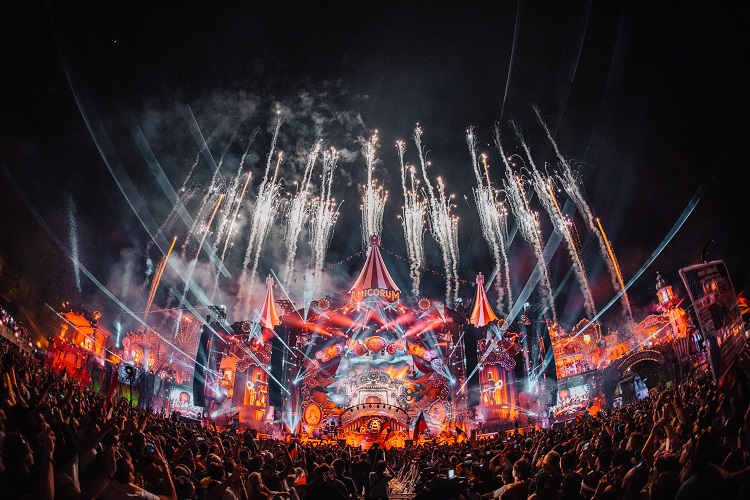
The video opens with a panoramic view of the festival grounds, themed airplanes and an incredible montage of flags from all over the world that festival goers proudly display. These opening scenes are accompanied by atmospheric tracks from Steve Angello’s fittingly titled Genesis EP. The track used in this first scene, Rejoice, is a massive departure from the EDM ( specific genre of pop electronic dance music popularized in the early 2010s) sound that put electronic music on the map in foreign markets. Steve Angello as an artist maps this evolution of electronic dance music, he was at the forefront of the EDM push in the 2010s as a member of the iconic trio Swedish House Mafia. This track explores more underground sounds than those he rose to prominence with, its synthesis of grunge rock and sampling of gospel and religious vocals are indicative of the return of electronic music to its experimental and exploratory roots. An incredibly fitting tune for the opening scene of the worlds foremost electronic music festival.
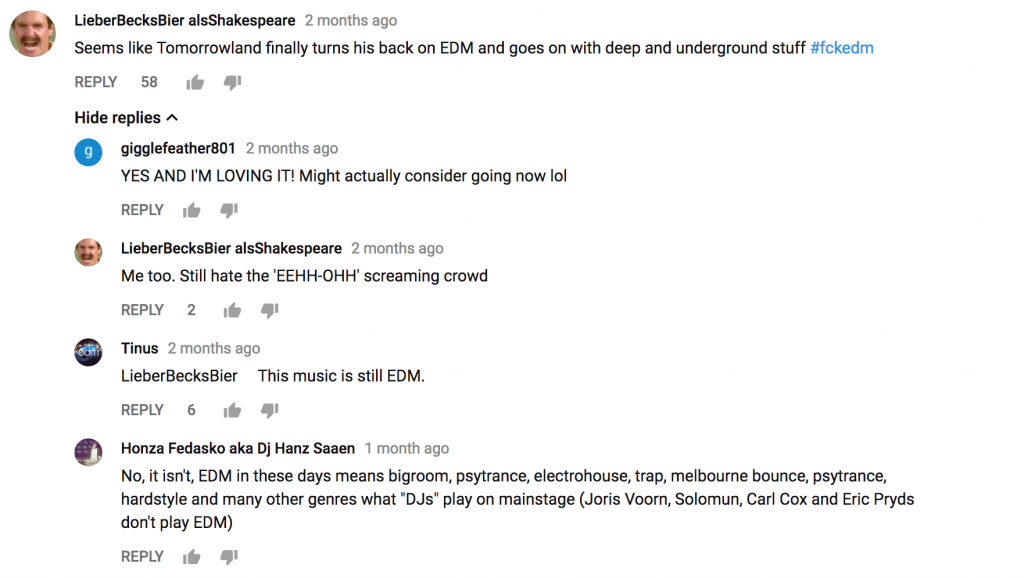
User LieberBecksBier alsShakespeare comments on this return to electronic dance music’s roots. He mentions Tomorrowland “turning its back” from EDM, a term coined in a huge multinational marketing push, meant to make the music more accessible to younger audiences. The term EDM stuck around longer than intended and became a blanket term for the incredibly diverse and imaginative sound world of electronic music. This “blanket effect” led to a long period of homogenization of mainstream dance music, which had a devastating effect on the creativity and individuality of underground artists. The popularity of Skrillex and Swedish House Mafia specifically made  the american perversion of dub-step and a very specific progressive house sound respectively, the overwhelming and sole mainstream sound for many years. Tomorrowland in this video, strategically chooses tracks and artists that embody the return to the creativity and sounds of the pre-EDM rave.

The next few minutes of the video explore the move-in process. A building trance track (Filterheadz’s Kaleidoscope) accompanies time-lapse clips of people walking into the festival’s temporary campgrounds. Interspersed between the clips are  people’s thoughts on attending the festival, representing a variety of shapes, sizes, colors and nationalities. As the music builds, the excitement and speed of the clips build as well, climaxing in the first experience of a hard “four on the floor” beat track, and a first full frame shot of the iconic Tomorrowland mainstage. The frames seem to change in time with every idiosyncrasy of the track, and as the “welcome to the jungle” vocals start to creep in, all of the festival’s 16 stages are presented in a whirlwind of quickly shifting frames. Just as quickly the music stills and nighttime falls.

This is when the incredible cinematography and production of the video and event truly come to life. The House of House, a track by the festivals main headliners Dimitri Vegas and Like Mike builds as the lights and lasers of the festival begin to come alive. The anticipation of the eventual “drop” is heightened by quickly changing frames, odd vantage points, peeks of pyrotechnic displays, as soon as the main portion of the song begins, the camera focuses on the incredible fireworks, lasers and enthusiastic dance from people and artists alike. The music, audience, Djs and stage all move to the same beat, and form a cohesive experience.

A similar cycle of low tempo ambient to high tempo house tracks accompanying a transitioning from day to night is employed in the next part of the video. Smiles, flying hands, bouncing heads are featured from all kinds of festival goers. This concludes with words by the godfather of modern electronic dance music, Armin Van Buuren .
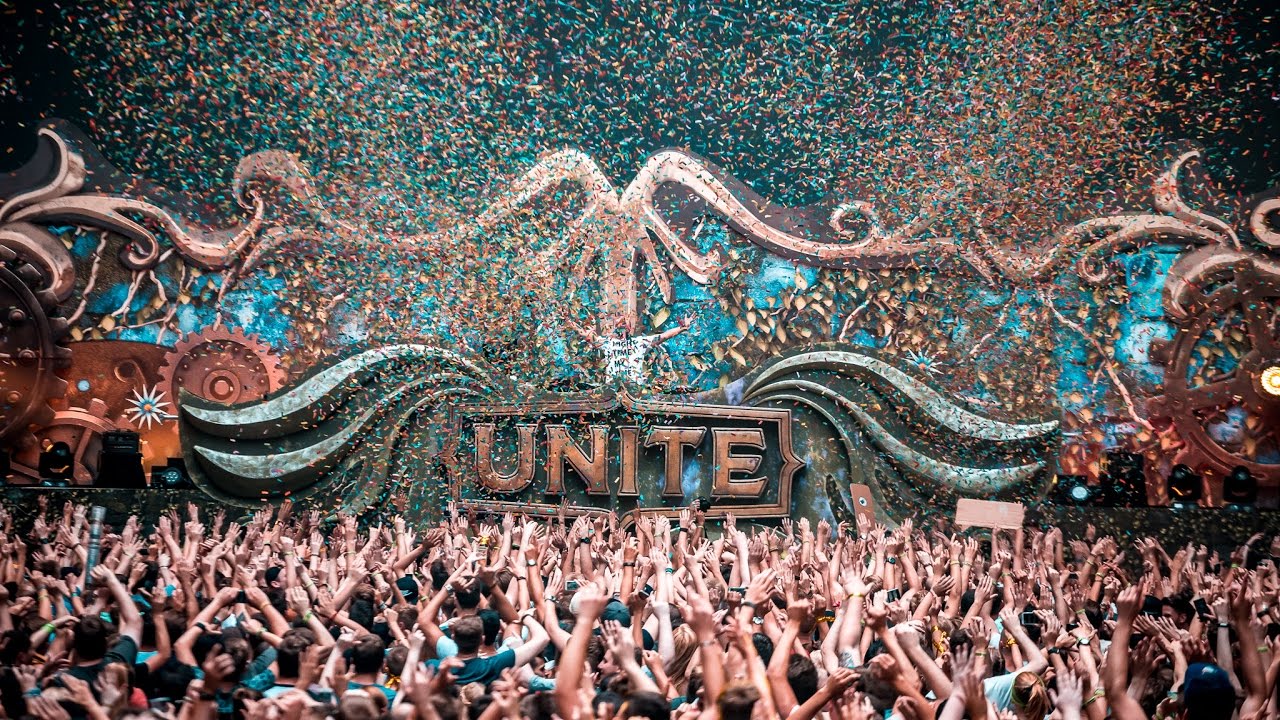
On the  mainstage with the word “UNITE” proudly displayed at its base, he brings attention to the 7 satellite shows providing live stream coverage around the world; Germany, Dubai, Lebanon, Malta, Spain, South Korea, Israel.  This scene is accompanied by Martin Garix’s track Pizza, not only does the incorporation of string instruments make the moment incredibly nostalgic, but it speaks to the future of the genre. A 21 year old wunderkind, Garrix represents a controversial but promising future of globalization and multiculturalism embodied in electronic dance music’s next generation of fans.

“It’s an amazing feeling to know that while you’re getting goosebumps at the MainStage in Belgium, literally millions of people around the world are watching my performance, even organizing home parties and having an amazing time as well.” -Armin Van Buuren

This globalization of the art form, and incredible role technology continues to play on the dissemination and consumption of the music is further explored in user vadeske’s comment:

The festival’s online presence has allowed it to reach homes across the world, in a way that could never have been imagined in its inception. The idea of unity earns a new meaning when social media and live stream engagement for  Tomorrowland’s 2017 edition garnered over 1.2 billion views by more than 200 million unique fans.

 “Not only has the growth of the event itself been amazing but also the content that they produce, like the live registration and after-movie. It just gets better and better each year. I think it’s great that people at home can watch the live stream and experience the festival as if they were there themselves.” -David Guetta

The video ends with an incredibly moving snippet of  London Grammar’s Hell to the Liars Remixed by Kölsch. Along with text thanking performer, artist and visitor alike for the creation of the experience, the music creates a nostalgic and incredibly emotional atmosphere. This track takes an indie-pop Nottingham native band’s song, translates it into trance style sounds, and ultimately fades to a string orchestration, very reminiscent of late romantic music, faded and echoey vocals and incredibly faint acid house sounds are barely perceptible. One would we be hard pressed to find a track that more perfectly embodies the state of transformation electronic music is experiencing so beautifully curated by Tomorrowland.

In its final scene the video urges viewers to take the beauty of the experience and use the impulse to “spread [their] message to the world…” Live today, love tomorrow, unite forever. These egalitarian, utopian and community oriented ideas may seem idealistic, but for three days every year, this video and festival argues that Tomorrowland proves living by these principles is achievable.

Progress and cohesion are central to driving this point home, and many comments below the video praise not only the cinematic and musical content, but the accurate representation of the ideals and atmosphere of the festival experience.
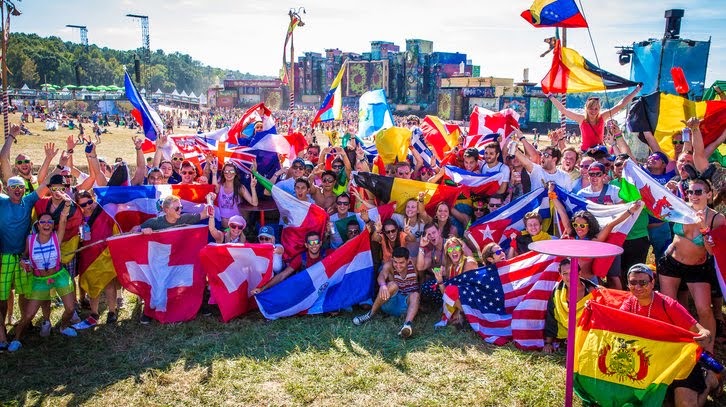
Tomorrowland 2017’s “Official After Movie” is a celebration of its performers, audience, artists, but more importantly explores the real-time evolution of electronic dance music and serves as a platform to further preach its ideas of unity, acceptance and multiculturalism.

Acid House and the Iron Lady

The Second Summer of Love is a name attributed to the period between 1988 and 1989 where the rise of MDMA and acid house resulted in an explosion in youth culture, and complete resistance to the rise of oppressive conservative politics .

In the autumn of 1989 a very interesting letter came across the desk of a third term Lady Margaret Thatcher. MP Archibald Gavin Hamilton forwarded a letter on behalf of his great uncle Gerald Coke who had become extremely disturbed by an all-night rave party hosted near the outside of his property.  Not only did Coke share a misinformed fear of confrontation but also described his fear of “bloodshed.”

Coke could not be any farther from the reality of this rave, one of 223 known acid house parties during the Second Summer of Love. These underground, mostly illegal parties were marked by the prevalent use of MDMA, also known by the more descriptive name of ecstasy. The feelings of empathy, euphoria and love caused by ecstasy were marked features of these gatherings, and resulted in incredibly low instances of violence.

The ecstasy and music came together. It was all part of the package… That may sound a little sad, but there’s no way acid house would have taken off the way it did without ecstasy.


-Nicky Holloway, DJ

Government research into these parties led to the shocking discovery of “very little alcohol use” and the prevalence of discarded “ecstasy wrappers;” whatever that means… What the government feared more so than public health, was the gathering of young people, of all races and backgrounds, in a defiance of conservative attitudes and politics of the time.

“Because a few people had the power to assemble thousands of young people with a phone call, the government thought there was a political angle to it when there wasn’t.”
Andrew Weatherall , English DJ, producer, and remixer.

Thatchers brand of conservatism was akin to the U.S.’s Reaganism.  An era marked by the triumph of imperialism, offensive against the working class, increased international military aggression, rise in poverty and the exponential growth of ruling class wealth.  Military invasions of Latin America, the fight against Irish Liberation movements and an overall interest in the elite over British workers are just some of the calling cards which have been attributed to Thatcher.

Prime Minister Thatcher became notorious for her no-frills political style and willingness to oppress individual rights of expression in order to protect the  ruling class. In 1988 she introduced a broadcasting  ban on left-wing political views in six countries. In 1982 Thatcher directly ordered the sinking of an Argentine ship, outside of fighting area, in a conflict to protect imperial interests in the area.

In 1981 Britain saw the rise of a social rebellion. Unequal social conditions and high levels of unemployment created pressure to address segregation and opportunity for the youth. Thatcher however rejected the idea that social conditions had any influence on the unrest.

“What absolute nonsense. … No one should condone violence. No one should condone the events. … They were criminal, criminal.”

Margaret Thatcher, in response to the resistance of the Black Caribbean population in Brixton subject to immense police brutality

Her politics and ruling style were considered so oppressive and lacking any interest in its people that her death in 2013 was celebrated by thousands throughout England.

Thatcherism was at its most powerful when Acid House jumped the pond from the underground music scene of Chicago, it first landed on the Island of Ibiza before five major English DJs brought it over to Britain. In celebration of Paul Oakenfold’s 24th birthday, Johnny Walker, Danny Rampling, Nicky Holloway and Oakenfold himself had massive revelation at the iconic Amnesia nightclub. They returned home with a drive to recreate the incredible experience. The sounds and culture of acid house quickly took over the underground music scene in England, much more so than it ever did in the U.S.

https://www.youtube.com/watch?v=JCUPc9zVfyo

Acid House had been playing in Haçienda nightclub in England since 1986 but it wasn’t until the introduction of MDMA in 1987 that the new style began to take. “It was like a tidal wave across the club from their alcove. Suddenly everyone was on ecstasy. I could stop a record and put my hands in the air, and the place would erupt.”Ecstasy also affected what people wore. “It’s quite endearing looking back now,” says DJ Dave Haslam.

When met with the stern and austere rule of Prime Minister Thatcher, the freedom, unity and escape that the rave provided became a de facto form of resistance and delegitimization of Thatcher’s influence and control over the youth of England.  Symbols like the yellow smiley face, whistles and baggy clothes now became synonymous with rave culture and Acid House, a clear resistance to the conservatism of the time.

Thatcher, much like Trump in recent months, utilized the arts and music to elevate the elitist concert experience above the expression and freedom of various disciplines. She utilized the works of Andrew Lloyd Weber, and placed them upon a pedestal as the clear forerunner in artistic and musical expression. Much like Trump, she was very misinformed when it came to the nature and underlying message of the works she chose to champion, In doing so, Thatcher strengthened the political message, legitimacy and social revolution of the New Romantics, Socca producers of South London and DJs throughout the country. 

The government met the social revolution with limited success. Unable to seize profits because the rave gatherings were mostly free, the government found its only solution in banning the music all together and Thatcher’s immediate successor did just that.

“Rave was more about unity … and, unlike other scenes, there weren’t really any faces from the scene for society to grab on to and scapegoat, which must have been frustrating for the government and media at the time. Because it was kind of this big, inclusive faceless mass, I also feel like the social pressures that got people seeking a release from rave did a lot of good things to make the racial divide less of a divide.”

Gavin Watson

By 1994 legislation had been passed banning music with “repetitive beats” and outdoor gatherings with more than 12 people where amplified music would be played. In a shocking, under the radar political statement, artists like Autechre released electronic music, which was labeled as having “no bars contain identical beats ” a music which could legally be played under this new law.

https://www.youtube.com/watch?v=fk0JxXFJMKw

Acid House became the anthem for a new generation of liberal, socially conscious individuals that continue to shape England to this day. The generation that found and elevated Rave culture into the realm of political resistance to this day finds itself across England, taking the ideas of empathy, love and freedom that defined the Summer of Love. Despite the efforts of an oppressive, conservatism government  House music and rave culture are still powerful drivers of culture throughout England and its realm of influence.


Roland TB-303 and the rise of Acid House and Techno

Very few electronic musical instruments have left such a lasting impression and influence as the Roland TB-303. This “synth” machine was released in  1982 and marketed as an accompaniment machine for guitarists.  It was quickly written off as a failure due to its unrealistic distortions and confusing interface. The release of this bass machine synthesizer was so poorly received that production was halted in 1942 after the production of a mere 10,000 units. Despite its low price of $400, many groups complained of its unnatural sound which could never duplicate the human intricacies of a bass player.

“The switches and control knobs have several functions, so operating the TB-303 may seem a little complicated. You may find difficulty using the TB-303 at first, because it is so different from a bass guitar or keyboard instrument. There, this manual includes a basic, intermediate, and advanced course to help you understand these operations step by step. However, each individual operation is quite simple, so take your time and master each step.”

-This quote is taken directly from the Roland TB-303’s 1982 user’s manual.

Interestingly enough, the confusion and uselessness it afforded to the guitarists for whom this machine was created led to its ready availability in pawn shops and second hand stores across the country. The cheap and interestingly designed machine caught the eye of many garage-based producers and mixers in impoverished areas across the country. No where was this machine’s impact as immense as in Chicago’s  House and Electronic underground.  A few producers, most notably Chicago based Dj Pierre took this machine’s idiosyncrasies and fashioned  an entirely new bass beat, in effect creating a  new genre of electronic music.

“‘Acid Tracks wasn’t pre-programmed man… DJ Pierre, he was over and he was just messing with this thing and he came up with that pattern, man…So we were listening to it, getting drunk, man. “Hey, this is kinda hot, man. This is a great mood man. Let’s put it out””

-producer Marshall Jefferson

The Roland TB 303 features a keyboard spanning an 8va range, and a total of 6 knobs which control various effects. The machine also left producers to choose wether to work with a saw waveform, a complete revolution and distortion of the traditional square waveform.  When innovators such as DJ Pierre began using these controls to distort and augment simple baselines, they realized the “slippery” and completely new sound world the Roland made accessible.

These “slippery” sounds can be  heard in one of the most revolutionary works in contemporary music in history, the Dj Pierre produced ‘Acid Tracks” This new sound confused audiences at first, but after a few months, this track gained massive support in the underground rave scene and many more Chicago based Djs began to champion the Roland TB-303 and its new soundscape. This new sound in traditional Chicago House was dubbed Acid House, taking its name from the pioneering Dj Pierre track. This popularity spread as far as Britain by way of Ibiza where Acid-House beats reached main-stream popularity, in part aided by the Rave culture of the 1980s and 1990s.

Acid House’s focus on subtle evolution of a beat, and otherworldly sounds quickly became synonymous with the club drug culture already in its peak by the mid 1980s. Drugs like MDMA (known as molly, ecstasy, XTC etc.) LSD, Ketamine and others, quickly became synonymous with the scenes in which Acid House was dominant as the shifts and insistence of its sound provided an excellent compliment to many of these illegal drug’s effects. This led Acid House, by way of the Roland TB-303’s quirky unrealistic sounds, to become the soundtrack for the cultural revolution and  decadent freedom of the era.

“Back in the 80s those early acid records spoke about alienation , they said square peg round hole , the surrounding records were almost gospel like messages of hard times and hope , quite churchy. Or euphoric weekend escape Anthems like Someday ‘Aint no Stopping us now’,they had R n B roots. Something like Phuture or Adonis hit the spot for me with insistent abstraction, it was outsider music with pure energy, it had cut from the line of history, it was a page turned, a clean page. These machines meant we all had the same accent ,previously a UK record and a US record, or a Belgian record or a Dutch record all had an accent musically speaking, Roland was an esperanto.”

-Graham Massy, producer

Acid House’s dominance in the world of electronic and mainstream music came to an end almost as quickly as it rose. By July of 1989 Acid-House had faded into the mid ground of electronic sounds, but this was not before it had influenced the next generation of music. Mainstream dance pop was not immune to the Roland’s new sound, most notably the Madonna track “Ray of Light. New genres like trance, techno, big beat,  and trip hop can all be directly traced back to experimentation with Acid House tracks.  It’s influence is still incredibly apparent today, with many almost exact physical clones on the market, and numerous software dupes. Little did anyone know that this initial market failure, and quirky little piece of confusing plastic would change the face of pop culture in such an extraordinary way.