Blogpost #3

BLACKSTAR


David Bowie’s “Blackstar” (video) was released on November 19th, 2015. It is a harrowing and visceral piece of audio-visual art. It is dense, dark and packed with allusion to earlier works, art, religion and the occult. Furthermore it is a swansong. Bowie died of liver cancer on January 10th, two days after the full album release1. Like all great music video’s it was engaging from the beginning. However , I can’t remember another video which has haunted me throughout the course of a week like this one has. I want see how Bowie created a video this thought provoking and disturbing.


First one must know about David Bowie’s early life and career before they can understand his last and most experimental album. Born David Jones in London, England in 1947, David had showed an early interest in music. He learned to play the saxophone at 13 and was influenced by his older brother’s record collection. In his teen years he did not enjoy much professional success and even spent time in a scottish buddhist monastery 2. It wasn’t until the release of Space Oddity in 1969 did he enjoy commercial success. After that the rest is more or less history. He continued and matured as an artist. He developed an alter ego on stage named Ziggy Stardust. He and the rest of his ilk signaled the end of the Woodstock era and most famously he was deeply involved with narcotics 2.

https://www.youtube.com/watch?v=D67kmFzSh_o


The music of Blackstar is experimental and utilises the sum total of David Bowies creative ability while not replicating or summarising his past works. It opens with an atmospheric trio of 2 flute and guitar. Then drums enter with a syncopated ECM beat, signaling a departure from Bowie cannon. The melody itself is comprised mostly of one repeated note, followed by a closing gesture on “ahh”. One may say that it is reminiscent of medieval chant. To further darken the atmosphere, Bowie dubbed the melody at the octave. This all continues in more or less the same way until 1:45 where we hear something uncommon to most contemporary popular music, a Saxophone. Bowie had recruited Donny McCaslin, a Jazz musician from NYC, and his band to play on his final album. The story goes that Maria Schneider (ESM alum and good friend of Bowie) had recommended McCaslin to Bowie. The usage of saxophone itself isn’t what is interesting, it’s the context in which it is used. In most rock and roll the saxophone solo is a brief interlude and is really not used to the further the song as a whole. On Blackstar McCaslin plays and embellishes the melody and improvises throughout the track. I think that Bowie wanted the living breathing feel of jazz and improvised music to be central to this piece.


Another musical feature which distinguishes this piece from the bulk of popular music is its form. It is comprised of a distinct A section marked by the chanting melody and syncopated drum beat. This is followed by an equally distinct B. The B section is reminiscent of a rock ballad  and features a lighter mood. It has a simple drum beat and even features a James Brown-esque saxophone line. The interesting part is how the B section slowly melts into the A1. First the harmonic minor-ish theme from the beginning is reintroduced. Its then repeated and passed around the ensemble until suddenly we are back at the beginning. To he honest the first few times I listened to this video I didn’t even notice the transition. I think that Bowie, intentionally or otherwise, was imitating classical form. First you introduce a theme, then you develop it and then finally you return to the theme


The Video itself is perhaps the most unsettling and controversial part of this artwork. It is also the most dense and allusion filled part so I must admit that there is no way I could cover the many references and themes in the video, so I will pick a few to expand upon. The first theme is death. This theme presents itself in subtle and overt ways. The overt ways are easy to tell, like the raggedy monster at the end which cuts down the men at the end, this is clearly the personification of death. Less overt manifestations appear in the lyrics such as “In the Villa of Ormen stands a solitary candle”. Here we see the candle be used as a metaphor, where we all have a candle burning in ourselves which will eventually cease to burn. These themes are uneasy.  Skriptin commented  


“i think i only disliked when it came out because it scared the living shit out of me o_0”.

But in a way that is the point. The song is about death and it’s his experience dying which inspired this song.


Another theme which presents itself is religion and the occult. Once again we have overt references such as the three men being crucified in a field and the women performing an occult ritual with Major Tom’s head. The more obscure reference lies in the lyric “In the center of it all”. This is derived from an occultist teaching by Aleister Crowley, with whom bowie was obsessed 3. Furthermore, the “Villa of Ormen” is an occult reference 5. Ormen in Norwegian means snake, a popular subject of the occult. Once again these themes of religion and especially of the occult conjure emotional reactions from many. The Youtuber “Hamza Khan” had the following reaction to this music video.


“(W)hat the fuck is this shit this is some devil worshipping ritual shit wtf who actually considers this to be music”


While this comment may be written off at trolling, I think this is a discomfort we all feel. Religion is often considered an untouchable topic in popular art. For example Madonna was ostracised for using catholic imagery in her “Like a Prayer” video 4. I think Bowie was contemplating his own beliefs, or at least his own morality.


Finally, I’d like to conclude with a comment from Tom Brearley-Smith’s comment.


“Fuck Rolling Stone magazine for putting Beyoncé’s Lemonade as #1 on its Best Albums of 2016 list instead of Blackstar.”


This comment was clearly made to be inflammatory but it does beg the question; What makes a music video good? Tom here is insinuating that Beyonce’s ‘’Lemonade” is not artistic or of equal merit and I must wholeheartedly disagree. Lemonade is a vignette of the experience of Women of Color in America. It is a masterpiece, it pushes boundaries and addresses cultural issues at the heart of American life. Lemonade deserved to win.  But something about Blackstar is different. It’s much more personal and it feels more like an expression of the artist’s consciousness. While Beyoncé is addressing systemic issues she and many people of color have experienced Bowie is addressing his own personal apocalypse, a rapture which is coming for every single one of us. It is this unfiltered impression of Bowies last years which stick poignantly with the viewer for days. And the subtle, uneasy realization of our own mortality is what impacts us.


  1. https://www.theguardian.com/music/2016/oct/04/donny-mccaslin-david-bowie-blackstar-interview
  2. https://www.biography.com/people/david-bowie-9222045
  3. https://www.theguardian.com/music/2016/jan/21/final-mysteries-david-bowie-blackstar-elvis-crowley-villa-of-ormen
  4. https://www.axs.com/5-artists-who-have-used-religious-imagery-in-their-videos-79496
  5. https://www.newyorker.com/culture/culture-desk/the-beautiful-meaninglessness-of-david-bowie
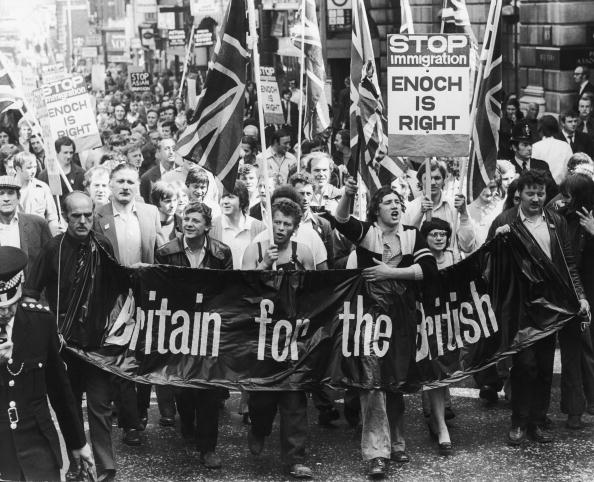
 

Rock Against Racism: Reaction to Far Right Politics and Eric Clapton in the United Kingdom

Rock Against Racism: Reaction to Far Right Politics and Eric Clapton in the       United Kingdom

A large crowd gathered at London’s East End Victoria Park on April 30th 19781. They came from all over Britain to join forces and support a cause which had become a embroiled in the central struggle of British politics. This struggle was a race struggle thinly veiled as a immigration debate. Political agents such as Enoch Powell and his National Front had, in the years prior, created an atmosphere of xenophobia, hate and White/English supremacy. But there was a reaction to this rhetoric. Rock Against Racism, founded by Red Saunders, was a movement which fought hatred with music. They turned music from a medium of entertainment to a form of political activism. When one looks in retrospect, one might claim that they were central to reclaiming Britain’s youth from the jaws of neo-fascism.

The far right had always been lurking in the back waters of British politics. As far back as the 1920s, fascists such as Oswald Mosley had wielded varying degrees of power and influence2. But ever since the end of WWII support for the far right had dwindled. This was likely due to the increasing radical anti-semitic policy proposals ended Mosley’s Career, the traumatic war against the Nazis and the existence of a centre right party, the conservative party, which contested all elections as one of the two main political parties.  However, starting in the late 1960’s there was an unsettling resurgence of Ultra-Nationalist rhetoric entering the mainstream political debate. The main reasons for the resurgence of far right parties such as the National Front was the great influx of immigrants coming from former colonies/ commonwealth realms3. The Troubles, the civil rights movement turned insurgency/ fight for liberation in Northern Ireland, was also a cause for their surge in popularity. They believed in Ulster as an integral part of the UK and advocated for extreme Loyalism in NI. The culmination of this racist populism was a speech given by Enoch Powell (National Front Leader) in 1968. The “River of Blood” speech, as it is now known, voiced Powell’s paranoid concerns that within the century the white british people will become an underclass to the commonwealth immigrants3. While this paranoia is totally unjustified, it resonated with the white working class and lead to a atmosphere of racial intolerance and hatred.

Now with the political context set, we can look at the inciting incident which lead to the formation of Rock Against Racism. On august 5th1976, at a concert in at the Birmingham Odeon,Eric Clapton made remarks which will forever overshadow anything he played that night. Just blocks away from where Powell made his “Rivers of Blood” speech, Clapton went on an alcohol fueled diatribe against the immigrant community and people of colour in general. Below is an slightly censored quote from that night.


The black w*gs and c**ns and Arabs and f***ing Jamaicans don’t belong here, we don’t want them here”


Clapton then followed up this remark with.


“This is England, this is a white country, we don’t want any black w**s and c**ns living here… Enoch for Prime Minister! Throw the wogs out! Keep Britain white!”4


Drunkenness does not turn someone into a racist, and even if it did it would not matter. Clapton never apologised for his statement that night. This lead to a reaction by a rock photographer and future organizer of Rock Against Racism, Red Saunders . Saunders’ response included a swift denunciation of Clapton, a accurate accusation of appropriating black music and a call to action to support his new found cause1. But why was it Clapton’s comment that prompted such a large response from popular culture and not Enochs Speech? Similarly why didn’t this response come when David Bowie made similar albeit stranger remark a few months earlier?  I think what Saunders understood about music was that it had a profound ability to mold the thoughts and outlooks of a generation. It was not so much that Claptons music was overtly racist, but that people felt a deep connection to him due to his immense expressive power. We identify with the artists of our time more so than the politicians of our time. So when Clapton demonstrates his racist attitude openly, it encourages others who feel similarly to overtly convey their attitudes. Furthermore when Clapton does not apologize he vindicates the racists attitudes held by some of these younger fans. This, I think, is what separated Bowie from Clapton, who has since apologized many times and was admittedly under the influence of a lot of narcotics (and Nietzsche?) at the time5.

Western music has been creating cults of personality for many centuries. Since Beethoven, the musician as a demigod has been an unfortunate feature of our musical culture6. However what happens when this elitist attitude transforms from a dog-whistle of white supremacy6 ,suggesting western classical music is superior music written by a superior race, to the bull-horn for fascist ideologies? Luckily in the UK the reaction is the organization of sane people standing up for those who are marginalized. By rejecting the propagators of  fascism and reclaiming the idiom of rock the British scene was able to save a generation from shifting two giant steps to the right and played a part in the fall of the National Front.


  1. https://www.theguardian.com/music/2008/apr/20/popandrock.race
  2. https://depts.washington.edu/chid/intersections_Autumn_2010/Bret_Rubin_The_Death_of_British_Fascism.pdf
  3. http://www.telegraph.co.uk/comment/3643826/Enoch-Powells-Rivers-of-Blood-speech.html
  4. http://thequietus.com/articles/20701-eric-clapton-racism-morrissey
  5. http://www.playboy.com/articles/playboy-interview-david-bowie
  6. https://www.nytimes.com/2017/07/30/arts/music/trump-classical-music.html?smid=tw-


History of the Saxophone

The History of the Saxophone


The saxophone is one of the most ubiquitous instruments in America and Europe today. From the jazz clubs to the concert hall to the band room, it seems as though the saxophone is and always has been a common fixture of the musical landscape in America. To the average american, the saxophone is much more familiar to their eyes and ears than say the oboe or viola. This certainly seemed to be the case for me growing up in New Jersey. In New Jersey most people have heard of Clarence Clemons of the East Street Band while almost no one has heard of Juilliard and Curtis educated Principal oboist of the Philadelphia Orchestra John Mack. This is despite the fact the John Mack is a New Jersey Native while The Big Man (Clemmons) is actually from Virginia. Yet, this has not always been the case. The saxophone is a relatively new addition to the woodwind family and did not find its way into american popular music until approximately 1915.


Most instruments in evolve over long periods of time from one more primitive version to a successively more refined version. One may point to C. H. Denner1 who modernized the Chalumeau in the 1740’s as an example of someone “inventing” an instrument. While he did radically improve the instrument by adding the second upper register and addressing intonation issues, he was still building upon centuries of previous designs and methods in order to create his clarinetto. In contrast, the saxophone was invented by Adolphe Sax in 1841 and officially patented in 19462. Sax was a born in Belgium in 1814 to master instrument maker Charles Joseph Sax. By the age of 16, Adolphe was an accomplished instrument maker in his own right3. He had made improvements on the clarinet and cornet and created high quality flutes and clarinets 3. He was also an accomplished musician and had studied at the Brussels conservatory. When Adolphe Sax was creating the saxophone, he was looking to create an instrument which would have the timbre of woodwind instrument but the power and volume of brass instrument. He originally intended for his creation to find its way into the orchestra. With elements from both brass and woodwind instrument families he envisioned it bridging the sonic gap between the two families. However this vision would never be realised.


The saxophone was largely rejected by most “serious” musicians and composers of the day with many regarding it as “unacceptable”. However, the Bb Tenor and Eb alto saxophones were officially adopted into the French military band and thus began the history of popular saxophone music. This is not to say the saxophone was totally out of the classical establishment. Sax himself was instructor of saxophone at the Paris Conservatory and romantic composers such as Jean-Baptiste Singelée5 wrote for the saxophone in the mid to late 1800’s. But most of the music played on the saxophone in the late 19th and early 20th century was military band music. However, around 1915 the saxophone was starting to show up in early recordings of jazz music6. In early jazz music the clarinet was the main woodwind instrument being utilized. However, with its superior projection and volume, the saxophone was a good replacement for the clarinet as jazz band began to play in loud dance halls. Given the saxophones gradual takeover of roles traditionally left to the clarinet, it isn’t surprising that the first jazz saxophone soloist was Sidney Bechet, originally a clarinetist. In the 1930’s the standard big bands grew to have five saxophones, two altos (Eb), two tenors (Bb) and a Baritone (Eb). As big band music matured, the role of the saxophonist as soloist did as well. These early luminaries include Johnny Hodges, Lester Young, Coleman Hawkins, Ben Webster and Don Byas just to name a few.  These early swing players really set the stage for the explosion of jazz saxophonists who revolutionised jazz and american music in the following decades. They inspired the likes of Charlie Parker, Dexter Gordon, John Coltrane, Ornette Coleman and many others who further explored the technical and expressive range of the saxophone.


The saxophone maybe be as important an instrument as the violin when it comes to western (particularly american) music. However, it had its beginnings in unusual circumstances and was nearly doomed to obscurity. Yet through chance and circumstance was propelled to the forefront of musical exploration in the 20th century.


  1. http://www.the-clarinets.net/english/clarinet-history.html
  2. https://www.thoughtco.com/history-of-the-saxophone-2456519
  3. http://www.madehow.com/Volume-6/Saxophone.html
  4. https://www.britannica.com/art/saxophone#ref138721
  5. http://www.dolmetsch.com/cdefss.htm
  6. http://teenjazz.com/the-development-of-the-saxophone/#sthash.HBgXPwhJ.dpbs