Beyoncé’s “XO” : A Multisensory Music Video

Beyoncé’s song “XO” is track number 10 on her 2013 self-titled album, “Beyoncé”. Beyoncé labeled this album her “visual album” , as every song also has a music video. “XO” quickly gained popularity after its release. The majority of fans loved the song, however others had a negative reaction.

The song begins with the voice of a NASA Public Affairs Officer moments after the space shuttle Challenger exploded in 1986. Some of Beyoncé’s fans deemed using this recording insensitive, especially those who had lost loved ones in the disaster. Beyoncé responded to this saying “The song ‘XO’ was recorded with the sincerest intention to help heal those who have lost loved ones and to remind us that unexpected things happen, so love and appreciate every minute you have with those who mean the most to you”.

The music video, set in Coney Island (Brooklyn, NYC), illustrates what Beyoncé intended with the message of this song. I will break up my analysis into a few pieces: text painting, camera footage, and the effect of the music within the pace of the video’s visual story.

The music video begins with flashing colorful lights, and the first lyrics we hear Beyoncé sing are “Your love is bright as ever/ Even in the Shadows”. Immediately viewers see the contrast of light and dark. There is a sense of temporality both in the video and the lyrics, as we start seeing different scenes of Beyoncé singing individually, Beyoncé with friends in the amusement park and arcade, and random people having fun in the park. The lyrics “We don’t have forever/ Baby daylight’s wasting” Is shown with some scenes of the video being filmed in daylight, and some at night. When Beyoncé sings, “In the darkest night hour/ I searched through the crowd, Beyoncé is surrounded by people. Sun sets in the video with the lyrics “We don’t have forever”. I could go on and on, but basically this video does a great job visually representing the literal meanings behind the lyrics. This makes the song not only more digestible, but it becomes an experience of multiple senses.

The camera shots in this video are also very effective in creating a powerful musical experience. We see the juxtaposition of more intimate and close up angles of Beyoncé alongside moving and sometimes out of focus shots of people in the park. The clip of Beyoncé and her friends on the roller coaster is also an interesting camera shot because we can almost experience the ride as if we were Beyoncé. The camera is also very focused on people smiling and loving each other, which again makes the experience more intimate both visually and musically.


The music and the video come together harmoniously. Scenes are pieces in rhythm to the music, and because most of the clips are moving, the video compliments how upbeat the song is. Beyoncé and her friends also make a dance move out of “XO” with their hands that goes along with the music.
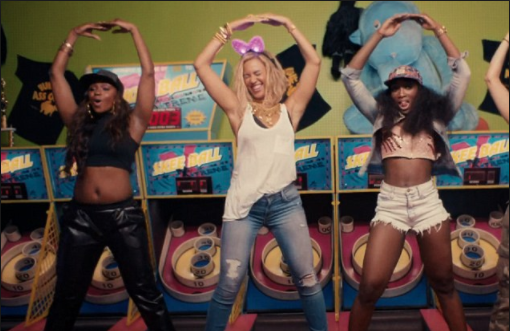
Overall this music video is very stimulating and makes listening to the song that much more meaningful. As I scrolled through the comments, I found three that sum up the general reaction to this music video.

These comments about being able to “feel” the music and the song taking them back to a certain place or atmospheric feeling are definitely influenced by the powerful experience of the video! Anyone who has been to an amusement park, have been out with friends late at night, or have even just had a great time with loved ones at any time can relate to this song and video, which is why it is such a powerful piece of art.

I hope watching this video inspires you to go check out some of Beyoncé’s other awesome music videos. Here are three that I was considering for this blog post and are just as cool and a testament to how music can be a multisensory experience with image, sound, and screen!

“Love on Top”

“Pretty Hurts”

“Halo”


“Back In the USSR”: Parody or Political Statement?

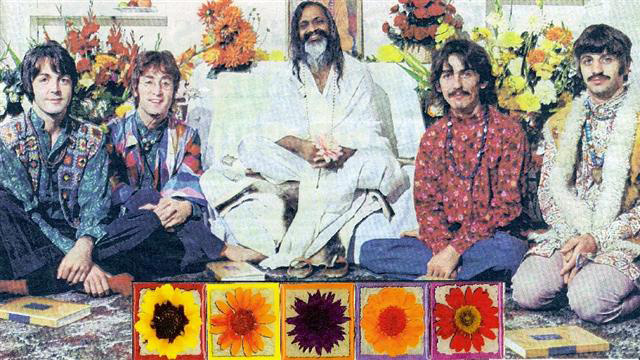
In early 1968 , The Beatles went on a meditation retreat in Rishikesh, India. They aimed to study Transcendental Meditation with their guru Maharishi, and eventually become teachers of this craft. Mike Love, from the Beach Boys, was also on this trip.

The Beatles with the Maharishi Mahesh Yogi

Love recalls  “sitting at the breakfast table and McCartney came down with his acoustic guitar and he was playing ‘Back In The U.S.S.R.’ and I told him that what you ought to do is talk about the girls all around Russia, The Ukraine and Georgia. [Paul] was plenty creative not to need any lyrical help from me but I gave him the idea for that little section”. McCartney did in fact take Love’s suggestion and wrote about admiring girls from Georgia, Ukraine, and Moscow, all locations represented in the USSR (Union of Soviet Socialist Republics).

Album Sleeve


A performance of “Back in the USSR” by the Beatles


“Back to the USSR” represents influence and power that music has in creating political controversy. When the song was released in 1968, America was at war with Vietnam. Because Russia supported the Viet Cong, conservative Americans immediately rejected this song, believing the Beatles were sympathizing with the enemy and promoting communism. The lyrics to this song fueled anger in Americans, especially the John Birch Society, who were particularly offended by the lines “You don’t know how lucky you are, boys”.

Additionally, this song caused controversy in Russia. Rock and roll was not respected at the time and the Beatles were not either. This said, Back in the USSR became wildly popular in Russia, and people sought to listen to the song even from tapes smuggled into the country. Elton John performed the song in Moscow a year after Americans had boycotted the 1980 Summer Olympics in Russia and wrote “they went ape s—. It was like playing ‘Philadelphia Freedom’ in Philadelphia”. The fact that there was such varied reactions to this song only made it more controversial.

Paul McCartney argues the claims of this song being politically charged by explaining this song as a parody of Chuck Berry’s hit “Back in the USA”.

McCartney says “I just liked the idea of Georgia girls…and talking about places like the Ukraine as if they were California, you know?…Its a jokey song, but it’s also become a bit of an anthem now…In my mind its just about a [Russian] spy who’s been in America for a long time and he’s become very American but when he gets back to the USSR he’s saying ‘Leave it ‘til tomorrow to unpack my case, Honey, disconnect the phone’”. It is interesting that McCartney had to defend himself for attempting to humanize young people on the other side of the world, and was also forced to defend the feeling of pride and comfort when a person returns home.

Performance of “Back In the USA” by Chuck Berry


In the article “Colin Kaepernick and the Radical Uses of the Star Spangled Banner”, Robin writes “Our national symbols are always more complicated than their original myths”. Kneeling at a football game to illuminate long-standing racism is viewed as a disrespectful and criminal act amongst conservatives. This can relate to Back in the USSR. Just as kneeling down during the Star Spangled Banner has become a controversial symbol of a larger national issue, Back in the USSR developed into a symbol of controversy during a time when a war was taking place . A parody song aiming to humanize non-American young people became a highly political debate.

This topic is very relevant to our class so far because we have focused so much on audience reception, the power of change and imitation, and how composers adapted to political ideals or brought to light political issues in their music. Politics and music will always be intertwined because politics inspires the cultural environment. As music is a pillar of culture, it is fair to say that these two will always have a powerful connection.

Carving out a Path for the Viola

When I first decided I wanted to play an instrument, I went to an instrument “try-out” day at my town’s local music store. I first tried out a flute, then a trumpet. Then I moved on to strings and picked up the violin. I remember that the sound of the bow against the strings was painful to my ears. A few minutes later, I walked over to my identical twin sister, who was smiling at what looked like a big violin. “Let me try!!!” I said, and I put the viola on my shoulder. I drew two bows on the D string, then two on the A string. Thinking, “OMG, I can already play Twinkle Twinkle Little Star”, I told my mom and sister that I wanted to play viola. My twin sister did too! As you can imagine we played a lot of viola duets over the next several years.

As a violist, I am used to the reputation this instrument has in the music world. In an orchestra, the viola plays a supportive role. Seldom receiving the melody, violists learn how to play harmony very well. When we received this blog post assignment, I knew I wanted to discuss the history of this instrument because there is a lot that goes untold (and unknown). Though, I am biased, I feel the viola’s importance should be projected. What other instrument sounds like caramel and chocolate when it’s played well?!

 Click to play

To emphasize this gif, here is a recording of one of my favorite pieces (and one that shows off that caramel sound of the viola). Just listen to the first 30 seconds- that’s all you’ll need.

Let us go back to sixteenth century Italy. The viola is a member of the violin family, but there is no clear answer to exactly when this instrument came to be. According to the Vienna Symphonic Library the role of the viola came defined when demands for instruments that would fill out a room with sound for Baroque Opera became necessary. String instruments were often made in different sizes with the same tuning, so when a need had to be met to split the registers and have another instrument played “da braccio”  or played on the arm, the viola was born.

Composers soon composed for sections to mimic the human voice (parts separated by bass, tenor, alto, and soprano registers). Naturally the viola falls into the alto category, and makers had to continually experiment to “find the optimal combination of tone, size, shape, and range to compliment the current trends in orchestra and court music” .

The viola is often misunderstood in terms of size because there is no standardized system for measurement. This makes the viola imperfect acoustically, because in order for the most amazing sound to be achieved, the body of the instrument would have to be huge (and therefore unplayable). Today there are many makers who experiment with string length and the size of the body to achieve the optimal effect. Usually, people with longer limbs and fingers play larger violas and vice versa.

A huge advance in the viola-making world came with the modern bow. Francois Tourte , a Frenchman, is often credited with many string instrument advances but the modern bow is especially important to violists. Because a viola responds less quickly because of the thicker strings, a modern bow allows for more tension between that hair and the strings. This means violists could actually project(!). Soon, the role of the viola became increasingly important in chamber music and the first solo pieces were composed for the instrument.

I encourage you to watch this TEDx talk specifically about the viola. This talk is great because there are frequent playing examples as well as great facts.

Today, there are many amazing solo violists who have created a beautiful new reputation for this instrument. Some of my favorites, including Kim Kashkashian, Nobuko Imai, Yuri Bashmet, etc. have inspired not only violists around the world, but also composers to write new and challenging works for this instrument. In the last decade new commissions and transcriptions have taken off, carving out a new path for this instrument. In this article by TimeOut New York, Steve Smith writes of new CD releases that deserve attention, honing in on many new contemporary works.

Past the viola jokes, I believe we gain a lot from understanding the technology of this instrument, and how it came to fruition. It is important to consider that instrument makers in the 16th century may have had some of the same musical concerns that instrument makers and composers have today, and that the means of creating music are constantly being improved upon.