Bartoli’s Mission: A Modern Woman and Baroque Music

Cecilia Bartoli’s album, Mission, released in 2012, profiles the works of Agostino Steffani, a long forgotten baroque composer. This recording features some world premiere recordings of baroque fireworks by a woman who has referred to herself as, “the Indiana Jones of classical,  in an interview with All Things Considered host, Robert Siegel. In collaboration with EuroArts, a film was produced to follow this music and the life of the composer. This film acts as an extended music video, following a light plot but focusing mostly on the music and especially the period of the music. The opening aria, “Pìu non v’ascondo” from the opera Tassilone employs vocal fireworks while being set in Versailles, promoting a staunch take on the status of baroque music.

The film, Mission, was co-produced by Idéale Audience & ARTE France. The film opens following a priest-composer, a parallel to Steffani. Ms. Bartoli uses this imagery of the priest-composer as well on her album cover where she portrays the image of a bald man of the cloth holding a cross.

The film is  set at the Palace of Versailles, a strange choice for a film of the works of a composer who was strongly based in Italy. Additionally, there are no overt connections between Steffani and France, much less Versailles; he died soon after the second phase of expansion. Setting Mission in Versailles does not demonstrate an element of the composer’s life, but rather portrays the elaborate nature of baroque chamber music. Just as the ornate, almost gaudy stylings of the Palace of Versailles, baroque music is equally ornate and come with a hefty price tag. Most chamber pieces were written by court composers; Steffani was the court composer in Düsseldorf, which is where Tassilone premiered. This also demonstrates the elite nature of baroque chamber music; it was written for the royal court. This feeling of an ornateness and social elite is evident within Mission through its setting and design elements, but also parallels Steffani’s life through the inclusion of the priest-composer.

“Pìu non v’ascondo” comes from Steffani’s opera,Tassilone, a court opera following the life of the Bavarian prince, Tassilo III who opposed the Emperor Charlemagne. The aria translates to “I no longer miss it” and features flighty melismas. The original score calls for 2 oboes, bassoon, trumpet, strings, and basso continuo. Bartoli’s recording adds some percussion in the form of a tambourine and a recorder that add an extra light-heartedness to the recording. Cecilia Bartoli’s recording and filming of this aria mimics the bouncy nature of the piece through the cinematography and demeanor of the musicians. Bartoli captures the essence of a baroque royal in both her appearance in a silken green gown and her demeanor with proud smile and joyous, hopeful movement. The instrumentalists, I Barocchisti, mimic this demeanor as well, though they are not wearing courtly attire. The joyful nature of the piece is further cemented by the camera angles which mimic the movement of the piece in an almost dizzying effect. Midway through the aria, the camera switches from a pan to a pivot point movement which is very disconcerting to watch full screen but also captures the excitement of the musicians and the grandeur of the setting at the same time. Additionally, NPR argues that the piece ends with a “vocal wink” which Ms. Bartoli physicalizes in the filming. The camera angles and setting further demonstrate the joy and grandeur of baroque music which drew Ms. Bartoli to the Steffani project initially.

Mission was covered extensively by NPR and other broadcasting outlets, lauding the virtuosity of Ms. Bartoli and the originality of the project. The film similarly received very positive comments on YouTube shown by Mirtika Schultz’s comment, “This woman makes my ears so happy. Glorious talents. She’s been a fave of mine for many years….she’s not so young anymore, but she still makes the air dance.” For Mirtika, Bartoli’s talents transcend the video and makes the environment move with the music. Sólveig Sigmarsdóttir agrees, writing, “Cecilia proofs [sic] it once again, that  she is magnificence and inspire her fans with joyful and gorgeous performance. Bellissimo :).” The only negative comment I found was from MandO Marc and applies to the uploading of the video rather than the video or Ms. Bartoli’s performance, brilliantly penning the comment, “Thanks for putting video ads throughout the video so I can’t listen to songs uninterrupted. Reminds me of this time I took a shit in a mailbox.” Cecilia Bartoli’s performance and production of Mission reflect the music and aesthetic of Steffani’s time period through the setting, wardrobe, and cinematography.
Britten’s War Requiem as a Critique of War

Commissioned for the 1962 reopening of Coventry Cathedral, which was destroyed during a World War II bombing raid, Benjamin Britten’s War Requiem offers a critique of war while still maintaining a mournful setting with a traditional Latin text. Britten, a conscientious objector, vehemently adhered to the principles of pacifism and his critique of war shines within this opus through the addition of Wilfred Owen’s poetry. Owen, a soldier, wrote scathing poems about his wartime experiences and his opinions on war. The combination of the traditional Latin text and Owen’s poetry along with Britten’s setting merge within the work to create comforting, mournful environments or these elements contrast drastically forming sharp oppositions, demonstrating the composer’s opposition to war. In addition to textual tension, the personnel and venue of the premiere further the anti-war statement particularly though the hiring of nationally diverse soloists. Britten’s War Requiem acts not only as a lamentation of the dead, but also speaks as a reflection of Britten’s pacifist beliefs shown through the text setting and the premiere.

The texts employed in War Requiem make an anti-war statement through the juxtaposition of the traditional Latin Mass of the Dead and nine poems by Wilfred Owen. Wilfred Owen is revered as one of the greatest war poets; he served in World War I, losing his life one week before armistice day. Throughout the work the texts create tension through opposition and this tension is particularly poignant in the third movement, The Offertorium, scored for boy’s choir, chorus, and tenor and baritone soloists, organ, chamber orchestra, and full orchestra. The movement begins with the boys choir singing Domine Jesu Christe, followed by the juxtaposition of Quam olim Abrahae and Owen’s “Parable of the Young Man and the Old.” The combination of these texts and ensembles demonstrate an anti-war belief through the usage of a boy’s choir, representing the men lost at battle. Wilfred Owen’s Parable of the Old Man and the Young sharply critiques war and the attitudes of national authorities on young people, particularly men. Within the poem, Owen refers to Abraham as Abram, defying Genesis 17:5, the bible verse in which God changes Abram to Abraham because He states “a father of many nations have I made thee.” Besides the name change, the beginning of the poem derives directly from the biblical text of Genesis 22, particularly the King James Version, until the angel telling Abraham to sacrifice the ram instead of Isaac. In Owen’s poem, the angel points out the ram caught in the thicket and refers to it as the “Ram of Pride.” No such reference exists within either version of the bible, and Abraham finds the ram on his accord in the parable, though he knows God provided it. In the poem, Abram rejects the slaying of pride and chooses to murder his own son instead. Instead of sacrificing pride, he opts to kill his offspring, presenting Owen’s views on the world powers’ decision to continue the war rather than end it. Owen offers Abram as a representation the world powers, unfit as the fathers of nations and choosing to kill the youth rather than sacrifice pride, represented by the ram. In contrast to this, the Latin text of the offertory of a Requiem, lauds Abraham as the father of all nations in Quam olim Abrahae and prays for the return of souls to the holy light. Towards the end of the movement, after the slaying of Isaac in the poem and “half the seed of Europe one by one,” the Latin text returns, praying for the sacrifices offered to be accepted for the salvation of the lives recalled during the mass. This creates a vicious cycle of slaughter in which none survive and none are saved, an argument in accordance with Britten’s pacifist views. The juxtaposition of the old Latin text and the newer poetry of Owen creates an irony of an inescapable vicious cycle to which, Britten argues, half of Europe’s young men fell victim during the two world wars.

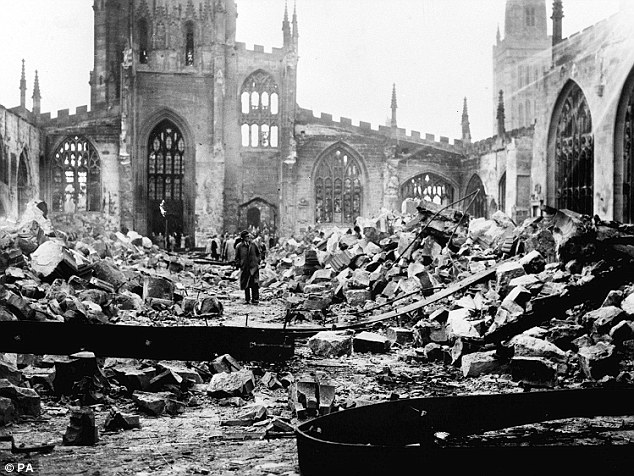
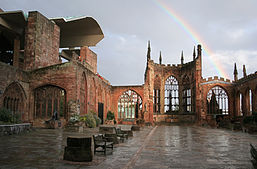
The premiere of the work was intended to further demonstrate Britten’s pacifist beliefs through venue and personnel. The piece was commissioned for the reopening of Coventry Cathedral, originally a fourteenth century structure

Coventry Cathedral after bombing; 1940.


Coventry Cathedral at reopening; 1962. It maintains the bones of the destroyed structure while rebuilding a new church.

in Coventry, England, that was destroyed during a World War II bombing and reopened in 1962. This venue is representative of the destruction caused by war and also faith struggles inflicted by war, as it is a church that was destroyed, making it an ideal venue for a work demonstrating the tragedy of war. In addition to venue, the work was originally written for British tenor, Peter Pears, German baritone, Dietrich Fisher-Dieskau, and Russian soprano, Galina Vishnevskaya. The nationalities of these soloists are representative of the great powers of the war, and having these nations, represented by the singers, unify to perform a work centering on war is inherently pacifist. Because there was such a strong hatred during the war, any art created by these nations together would be pacifist. However, Soviet authorities did not permit Ms. Vishnevskaya to attend the premiere, and English soprano, Heather Harper, stepped in only ten days before the event. The nationalities of the soloists and the venue of the premiere are representative of the composer’s pacifist beliefs as they demonstrate the reunification and rebuilding after war.


Benjamin Britten’s War Requiem offers a strong statement against war in a method that still honors the dead. The piece demonstrates the opposition and irony of war powers between the world powers and the young serving and also shows the reunification after war. This struggle between world powers and institutions demonstrated through the juxtaposition of old and new texts is still poignant today. Colin Kaepernick’s use of the Star Spangled Banner as a platform against institutional racism parallels Britten’s use of traditional Requiem mass text as a platform against war. Drawing upon familiar material to illustrate pain and discomfort, but also hope, furthers a goal or message. This message within Britten’s War Requiem was vehemently anti-war, demonstrated through the juxtaposition of traditional Latin text and Wilfred Owen’s poetry and the premiere of the work.


Additional Sources:

Britten, Benjamin. War Requiem. London: Boosey and Hawkes, n.d.

Mighty Impactful Data Interface: The History and Effects of the MIDI File

While I am not technically savvy as a person, I am generally savvy, so when my hard drive crashed with all of my arrangements for my various ensembles and projects on it, I was able to scrounge up the only files I had saved to cloud storage. Those files were, you guessed it, Standard MIDI files. Slightly too big for email, slightly incompatible for Google Drive, just right for Dropbox. Once I found those files, I was able to run them through a music notation software and regenerate the arrangements, narrowly avoiding a fearsome confrontation with my film music ensemble colleagues. But what went into this software that I, a stressed out music student, was able to so easily rebuild something that was thought to be lost with only a poorly tempered synthesizer file and a dream?

This answer begins in the 1980’s with the collaboration between Ikutaro Kakehashi, Tom Oberheim, and Dave Smith. Kakehashi was the serving president of Roland, an instrument and software company which has begun the development of an interface for electronic instruments, early models including SYNC and Digital Control Bus. Kakehashi dreamt of a standardization among synthesizer interface, allowing for direct communication between equipment produced by different manufacturers. He took this idea to Oberheim and Smith, the leaders of Oberheim Electronics and Sequential Circuits, respectively. The plan was to use a combination of  Kakehashi’s original DCB and SYNC interfaces as a foundation to build upon; DCB managed the pitch and SYNC managed tempo. The three men then opened communication with other major electronic musical equipment manufacturers, including Yamaha and Kawai, and thus, the Musical Instrument Digital Interface was born.

Standard (slightly outdated) complete MIDI studio set up

MIDI revolutionized the musical industry of the late 20th century. Though it was originally produced to allow musicians and producers to directly communicate with each other electronically, it quickly sparked the development of new equipment for the age of electronic music and personal computers. People with little to no experience in notation software could now create sequences of synthesizer and beats, and immediate playback allowed untrained musicians the ability to immediately hear their compositions, giving more room for experimentation.  MIDI is not often a stand-alone performance tool, but it is the standard production tool. In contrast with digital audio, MIDI is a set of commands recording pitch and duration rather than a recording or representation of sound.  The setup as a series of commands makes it ideal for sequencing, sampling, and music notation software. This is why I was able to regenerate my lost scores through its use; MIDI is a set of instructions to be used with other equipment.

Although Standard MIDI files still sound like a 1980’s synth, the most exciting thing about MIDI is its ability to run sequences and cues. This is the clearest development of the software through the years. As seen in the linked video, a beat can be sequenced to also run a melody given a cue. Additionally, without MIDI, lights and sound could not easily be synchronized in theatrical productions. At stadium concerts, performers, production, and effects teams remain synchronized through the usage of MIDI files within tracks. These files are the reason that Disney’s lights and fireworks go off perfectly in sync; MIDI Show Control provides the interface for lighting, pyrotechnics, and other effects, allowing for cues in the track to cue other events. More information on this software can be found at this poorly designed but informative website: http://www.richmondsounddesign.com/.

In our current age of advancement of audio engineering, it is amazing that a 1980’s interface has lasted as the foundation for electronic musical files and so much more. This system has provided the foundation for Logic Pro X, a software used in the development of scores and click tracks for film. MIDI also is the file used for ringtones, and is now used for recording and automation of faders in audio engineering. Despite its musical background, MIDI is now in use for many ubiquitous domestic events that require cues, such as automatic home lighting, thermostat regulation, and traffic lights.  Originally developed as a standard communication interface for musical instruments, the Musical Instrument Digital Interface has expanded to be a foundation of not only music production, but computer technology itself.

History of MIDI: https://www.midi.org/articles/midi-history-chapter-6-midi-is-born-1980-1983

MIDI Show Control Specification: http://www.richmondsounddesign.com/docs/midi-show-control-specification.pdf

Introduction to MIDI: http://www.doc.ic.ac.uk/~nd/surprise_97/journal/vol1/aps2/

Why Is MIDI Still Used? https://music.tutsplus.com/articles/8-reasons-midi-is-still-alive-and-kicking–audio-1811

How MIDI works: http://www.indiana.edu/~emusic/etext/MIDI/chapter3_MIDI2.shtml