The wonderfully bizarre world of Yiddish Metal

A few summers ago, I and some friends were browsing YouTube for music to listen to.  One of my friends came up with the brilliant idea of searching for “Yiddish Metal.”  Without even hearing the music, the name of genre alone suggests something highly out of the ordinary – which the video I will discuss delivers upon in droves.  Apparently, the genre of Yiddish Metal is not a highly competitive one, as only one band – Gevolt is actually involved in it.

For this Blog, I will be looking at the official lyrics video for Gevolt’s Kokhotshet (I highly recommend watching the whole thing – it’s quite a unique experience):

In this video, and in many of their other works, Gevolt creates a unique flavor by combining traditional Klezmer melodies and instruments with the sounds of modern metal music.  What makes this video stand out to me it the way in which the lyrics are presented (and the random butterflies).  Note how throughout the video, the font and styling of the text changes – which may or may not relate to the meaning of the text.  However, as I am not a speaker of Yiddish, I cannot know for certain.

Note as well that there appears to be some general plot-line to the images presented along with the texts – from the introductory fields (and butterflies):

To the rush of crowds in the city (still butterflies):

And finally, to what appears to be an alien invasion (no butterflies):

While again, I do not speak Yiddish, and my attempts to translate the lyrics using Google Translate yielded mostly gibberish (predictable), I did gather the feeling that none of these images related to the text in any meaningful way!

So, the already rather surreal blending of klezmer and metal is only amplified by the weirdness of the accompanying imagery.  The combination of trombone glissandi and sudden synthesized beeps, or klezmer violin with amplified electric guitar is definitely not a combination that is often heard anywhere else, which is a shame.  This mixture of styles and forms creates a genre which is yet to be explored to its fullest potential.  When there is only one ensemble creating a musical style, it is hard for that style to expand and grow at rates that other genres are.  I assume that the reason that Yiddish Metal has not been expanded to a larger audience is that the initial audience is small, as there are not many Yiddish speakers in Israel (Gevolt’s home country).  Though, in a positive turn of events, Gevolt did perform in the MIDI music festival in china a few years back.  [check out their live vids on YouTube – they are quite bizarre]

Upon turning to the comment section in search of a few laughs (after all, it is YouTube) and maybe some further insight into this video, I instantly found that as expected, most comments were fairly useless.  About half the comments were either comparing the band to Rammstein or trying to comprehend Yiddish (an infrequently spoken language these days).  Then, there were some others which held no interest either.  Of the comments which I found interesting, the first one, from a “Noam Perlman” matched somewhat my initial reaction upon listening to Gevolt the first time:

Though, without quite as colorful language 🙂

My eventual feelings about Gevolt are now most matched by “Bubba Chunk,” who remarks:

However, in terms of actual analysis, I found most useful the thoughts of “Matthew Simpson”, who writes:

“Matthew” is probably correct in associating Gevolt to what he terms the “Yiddish Renaissance.”  While I would not call it just that, it is indeed true that Yiddish as a spoken language is beginning to make somewhat of a comeback.  It is then not so surprising that it would return to the realm of music as well.


Sources:

https://www.economist.com/blogs/prospero/2017/02/pr-ven

http://www.gevolt.com/

https://www.musixmatch.com/lyrics/Gevolt/Khokhotshet

https://www.haaretz.com/israel-news/.premium-1.813370

http://www.jpost.com/Opinion/Op-Ed-Contributors/When-Zionism-feared-Yiddish-351939
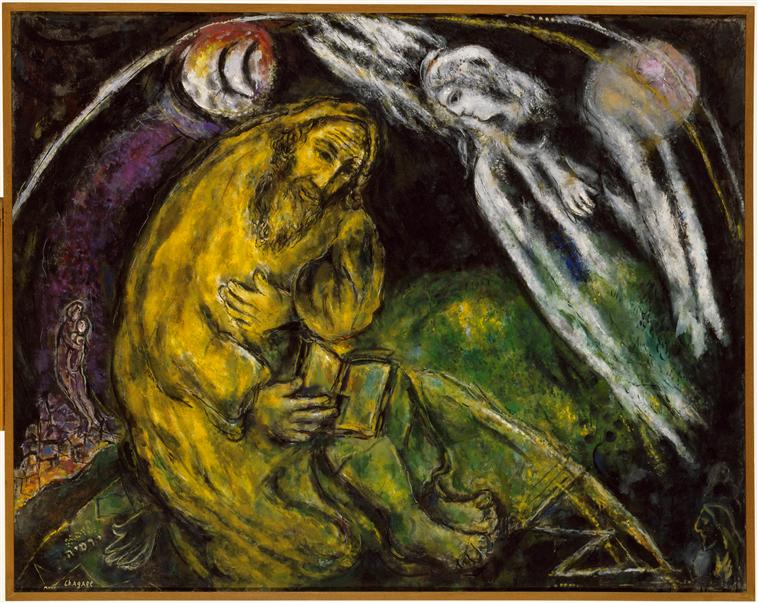
I Profeti

https://uploads4.wikiart.org/images/marc-chagall/prophet-jeremiah-1968.jpg

The year is 1931.  In the United States, the effects of the Great Depression are beginning to take a toll.  In Europe, unease reigns supreme.  The feeble peace brought by the treaty of Versailles still holds, but is beginning to crumble.  Antisemitism is once more on the rise.  As always when times are troubled, a scapegoat is found.  In the lead up to the horrors of World War II, Europe brings back the traditional bogeyman of the Jew.  While it is still years removed from the absolute evil of the Holocaust, Jewish life in Europe feels threatened.

In Italy, Mario Castelnuovo-Tedesco, a famed guitarist and composer of Jewish Heritage is approached by Jascha Heifetz with a request.  Heifetz wishes have a concerto composed for him, to be premiered by himself and Arturo Toscanini.  By 1931, Heifetz is already possessed of fame and glamour he will maintain for the rest of his life.  He has also been a naturalized US citizen for six years.  Castelnuovo-Tedesco accedes Heifetz’s request, and so Castelnuovo-Tedesco’s 2nd Violin Concerto, subtitled I Profeti, is born.  Into this work, Castelnuovo Tedesco channels all his pride in his Jewish Heritage, and all his fear and defiance towards the uncertain grim future.

I Profeti is divided into three movements, each named after a prophet from the Torah (Old Testament).  These movements are, in order:

  1. Grave e meditative Isaiah
  2. Espressivo e dolente Jeremiah
  3. Fiero e impetuoso (ma sostenuto e ben marcato il ritmo) Elijah

While the concerto is generally in minor mode, the final movement Elijah is a rather boisterous march in major.  This, combined with the fireworks in the solo violin may signal Castelnuovo-Tedesco’s optimistic outlook towards the future.  Another, darker interpretation, stems from the religious implications of Elijah’s return.  According to Jewish liturgical lore, Elijah is set to return at the end of the world, at the age of ultimate redemption.  [Side note – every Passover, Jewish Families set aside a cup of wine at Seder for Elijah, and leave a door open for him]  Thus, the celebratory finale may also be seen as a sign of Castelnuovo-Tedesco’s readiness for the end of days.

While the social implications of such a work of art are clear, the political implications may be more obscured.  Unfortunately, both in 1931 and now, Hate is political.  To stand up to it then becomes a poltical gesture in itself.  Castelnuovo-Tedesco was under no obligation to open himself up to further attacks by exposing his Jewishness in such a clear manner.  Yet, he chose to remain true to himself and his heritage.  Often, a work of art becomes more than the simple lines on canvas or sound waves in a concert hall – it becomes imbued with the politics and social standings of its creator.

While a work of art can reflect history, it can not change it.  Castelnuovo-Tedesco’s valiant effort to change his world through his art failed, as history shows.  Persecution of Jews in Italy only escalated.  By the late 1930’s, works by Jewish composers were no longer permitted on the stage or the airwaves.  Castelnuovo-Tedesco’s livelihood is at stake.  In 1939, months before the beginning of World War II, he flees to the United States, where he rejoins Heifetz in California, which has become a hub of the artistic Jewish Émigré community.  He remains there for the rest of his life through his death in 1968, and rebuilds his reputation, composing soundtracks for over two hundred Hollywood films, as well as numerous works for guitar.

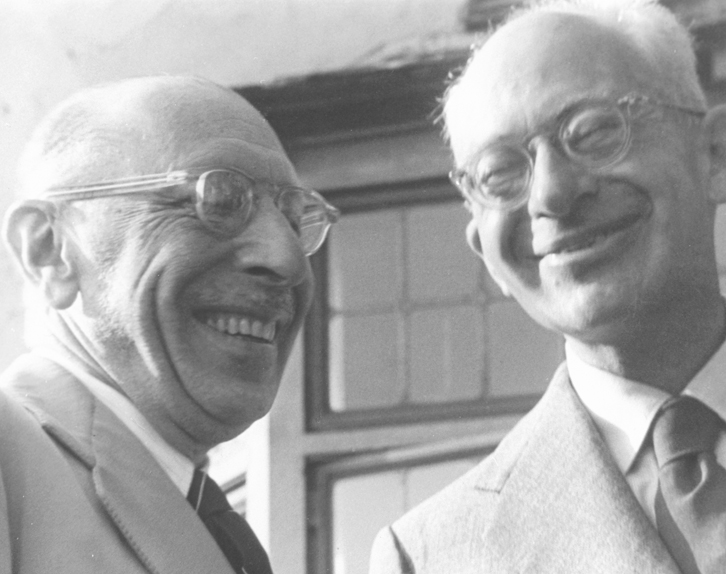
(Castelnuovo-Tedesco with Igor Stravinsky – http://www.milkenarchive.org/artists/view/mario-castelnuovo-tedesco/)

To me, I Profeti holds a special place in the pantheon of works for violin for the defiance that went into its composition.  Castelnuovo-Tedesco refused to be cowed into submission by the forces of hatred.  He chose to celebrate his Jewish Heritage rather than be terrified by the consequences of it.  I Profeti stands strong as a celebration of Jewish Culture and learning, and remains relevant today not just as a work of art, but as an act of political courage.


Sources:

Biography

http://www.milkenarchive.org/music/volumes/view/a-garden-eastward/work/violin-concerto-no-2/

http://www.chabad.org/library/article_cdo/aid/111833/jewish/The-Prophet-Elijah.htm

https://en.wikipedia.org/wiki/Mario_Castelnuovo-Tedesco

Europe in 1931

Elon, Amos. The Pity of It All: a Portrait of German Jews 1743-1933. Penguin, 2004.

Why F Holes?

One the most notable features of the modern bowed string instrument family is that of the so called “f holes” located centrally on either side of the instruments’ main bodies.  These in particular contrast with the single circular shaped sound hole located in the center of an acoustic guitar.  In the guitar’s case, the single circular hole has been a staple of the instrument’s design for centuries.  In the case of the violin and other bowed string instrument, the f hole is a product of years of development through trial and error.

Image source: http://digitalcommons.usu.edu/cgi/viewcontent.cgi?article=1741&context=gradreports

The earliest bowed string instruments actually had the same circular hole design as the guitar.  This probably occurred as some of the first instruments to be played with bows were simply lutes, whose main performance technique remained plucking.  However, as bowing took off as a genuine technique in its own right, the makers of such stringed instruments found that the circular sound holes did not produce the desired results.  And so, they began experimenting with other designs.

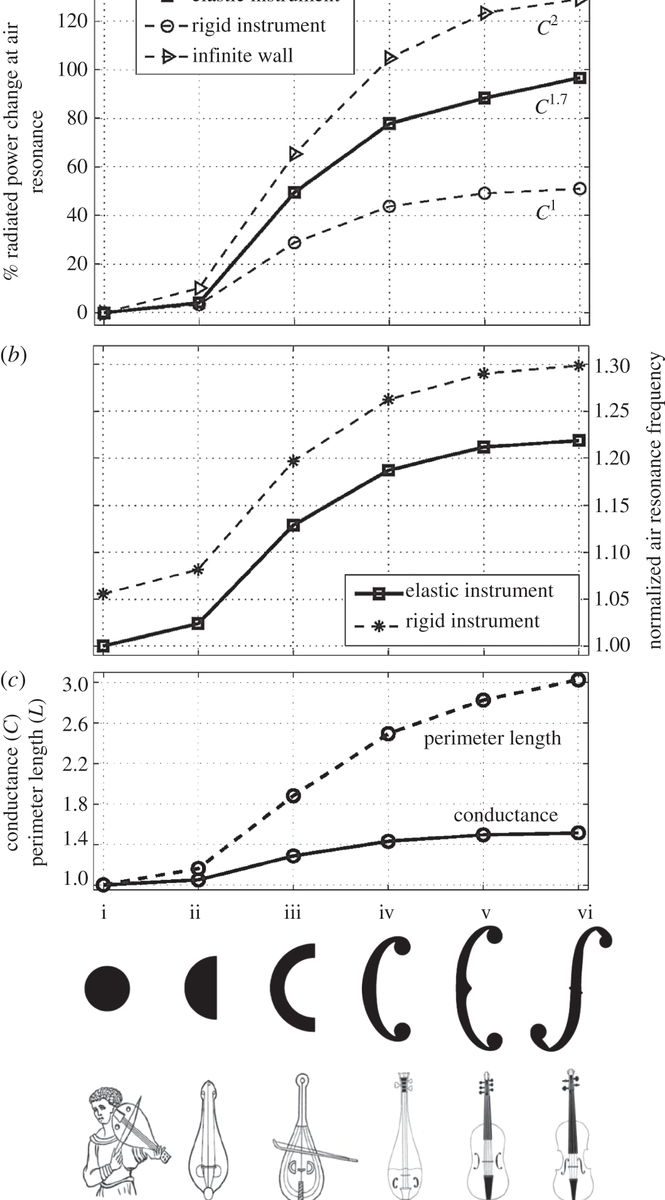
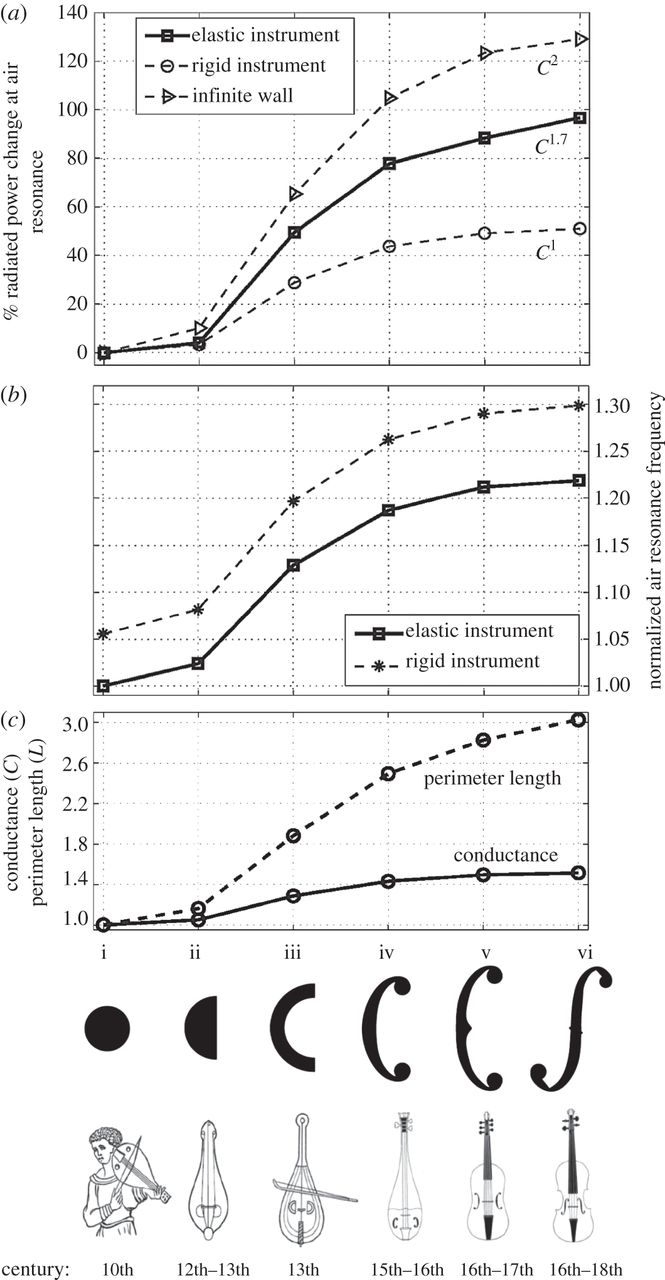
In the 10th and 11th centuries, the single circular hole was replaced by two separate circular holes on opposite sides of the instrument’s body, much as the modern f holes are located today.  This double design produced a greater acoustic clarity for bowed instruments than the single holes did, but it was still far from perfect.  And so, the experimenting continued.

By the 12th and 13th centuries, the circular holes were replaced with half moon shaped holes, followed quickly by C shaped holes.  These, combined with improvements in the technology of the bow itself contributed to a new era in the evolution of the bowed string instruments.  These C holes were so successful, that while they went through many phases of stylization through the centuries to come, they remained a staple through the early baroque.  In fact, many baroque string instruments retain the C shaped sound holes.  However, by the high baroque, influential luthiers – most notably Nicolo Amati – began creating instruments whose sound holes were shaped like an f.  This new design caught on rapidly, and remains in use today, with slight variations between different makers.  Guarnieri, for example, favored a longer and narrower design, while Stradivarius’s design was wider and shorter.

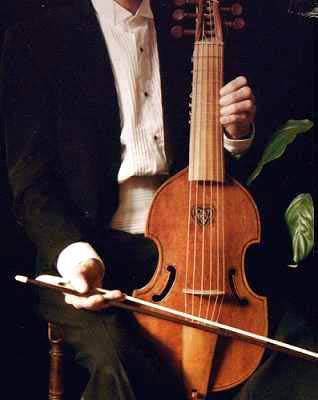
Viola Da Gamba with C shaped sound hole

Image Source: http://www.orpheon.org/OldSite/Seiten/education/ShapeUpEnglish.htm

The reason for the adoption of the f shape is not entirely clear.  However, a separate blog I found poses an interesting theory: namely, that the holes are not intended to be f – shaped.  Rather, the shape is intended as a stylized s, which in turn stood for “sound” in various languages.  Whether this theory is accurate is up to debate, but in either case, the f hole (or s hole), is now an integral part of the design of any modern bowed string instrument.  (side note, the f hole is also shaped like the symbol for integral: )

Interestingly enough, an MIT study from 2015 (in sources) has discovered that the f-hole is actually the ideal shape for sound production.  The vibrations from the f-holes carry longer and louder than that of any other shape on the bowed string instruments, as it is most suited to the sonic vibrations and air flow that bowing the strings produces.

Image source: http://rspa.royalsocietypublishing.org/content/471/2175/20140905#sec-4

It is a curious coincidence that this ideal shape was stumbled upon by what amounts to accident.  While I am certain that the early luthiers could empirically ascertain the superiority of the f-holes, they undoubtedly were unable to replicate the detailed acoustic physics calculations of the MIT researchers.

As a violinist, I am actually rather pleased with the concept of a chance occurrence driving the evolution of an important part of my instrument.  After all, so much of what goes into a good performance is created by chance – the atmosphere of the hall, the artist’s current mood, avoiding an unfortunate mistake – that having the creation of your instrument be coincidental is rather comforting.


Sources:

http://digitalcommons.usu.edu/cgi/viewcontent.cgi?article=1741&context=gradreports

https://newt.phys.unsw.edu.au/music/publications/mclennan/fholes.pdf

http://blog.feinviolins.com/2013/04/why-f-holes.html

https://www.thestrad.com/new-research-into-the-development-of-violin-f-holes-is-simplistic-at-best/4073.article

http://rspa.royalsocietypublishing.org/content/471/2175/20140905#sec-4

http://www.orpheon.org/OldSite/Seiten/education/ShapeUpEnglish.htm