Banking on Taboo

Content Warning: Blackface, explicit language and images


Die Antwoord is a South African rap-rave group that has garnered fame for their provocative, aggressive style and unique vocal sound. In 2012, their music video “Fatty Boom Boom” inspired controversy because of their use of blackface bodypaint and shocking content. The reception of the video, and of the group in general, has been bitterly divided.
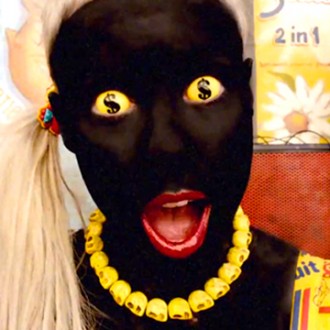
This article by Aisha Harris directly condemns Die Antwoord’s use of blackface in their music video and raises other concerns about their video. Since blackface minstrelsy is a cultural vestige of slavery in both America and South Africa, this video’s flippant use of blackface imagery is totally unjustified. On the other hand, Harris also mentions that minstrelsy has become a cultural symbol of progress for black people in South Africa after Apartheid. Annually there is a giant festival called “Tweede nuwe jaar” where a multitude of minstrel troupes celebrate together in a colorful display of costumes, body paint, and music.

An article on South African History Online says that: “as one of the longest surviving traditions it has become very evident that the minstrel festival is an important aspect of South Africa’s history and cultural heritage… It is therefore important to maintain the tradition, which has become so deeply entrenched within the popular culture of Cape Town.”

This almost seems like a cogent argument as to why it’s normal that Yo-landi Vi$$er donned a full-body outfit of black paint, until we remember that a group of black South Africans wearing pink and purple, etc, from head to toe and celebrating overcoming slavery and Apartheid is a lot different than a white person dressing in blackface in a music video.

What you-tuber Mayfinder might not realize is that “African” is not homogeneous. In contrast, Adam Haupt argues that Die Antwoord is doing nothing short of culturally appropriating black South African culture. In this article he says: “It is ironic that Jones, the crew’s founding member, is neither coloured nor white Afrikaans working class; rather, he is a well-resourced white, English-speaking South African.” To clarify, the Afrikaans language is associated with poor, uneducated people, while English is the more official and elite language in South Africa. So, we can conclude that their performing persona is not genuine and it is built off an existing culture that they will never be part of.

Okay, now that you’re primed on the racially exploitive elements of the video, let’s take a look and see what you think! Are these artists just being sensationalist and intentionally treading on open wounds? or is there a compelling artistic vision or critique that makes these images powerful and meaningful?

The first minute of the video actually strikes me as a commentary against the mainstream stereotypes and voyeuristic attitudes towards Africa. The tour guide’s monologue and the inclusion of docile safari animals presents an absurd image of an unrealistic place, which is perhaps part of their attack against Lady Gaga, who also embraces sensationalism.

The next three minutes is a fast-paced visual spectacle that enhances the intensity of the music with its quick camera cuts that change the size of the frame and its high energy dance moves. These scenes also rapidly move between color blocks – basically alternating between high contrast bright colors and white body paint to the “voo-doo room” (as they call it in an interview) that is all black and features semi-reflective costumes made of human hair.

Their diss of Gaga in this video – both with the prawn in her vagina and her tragic encounter with the king of the concrete jungle – seems to be a major media-grab. And it bolsters their position as “radically unique” and as a more niche and interesting music than most pop, which they continually drag through the mud in the lyrics of this song.

This video shows a different side of the creative process and explains how they got to the finished product.

While this video succeeds in making the members of Die Antwoord seem more human, engaged, and less sensationalist, I am still skeptical about whether or not this is a continued marketing ploy. Elements of satire in their videos make me question to what extent they are playing an artificial persona or wether their goal is just to embrace the child-like absurdity and freedom that their irregular dancing and graffiti suggests. Whatever cultural impact Die Antwoord’s complicated, racialized, sensational music videos have on the US and South Africa, they’re a hit and here to stay. 

Western Revised: Django Unchained

The American wild West on the cinema screen is an iconic and globally influential part of film and popular culture. The rugged cowboy heroism sweats the narrative of manifest destiny and makes every young boy yearn for a Red Ryder BB Gun. But the Western as a cinema genre is inherently intertwined with deeply problematic racial and gendered oppression and violence. Most Western films feature a principal conflict between a white, male hero facing off against a savage group of Native Americans or Mexican bandits. Watch this short clip detailing the consequences of perpetuating the cowboy myth on the Native American population:

This video makes clear that the western genre overtly relies on racial conflict and violence as the central plot device and the genre shamelessly villianizes Native American people for the purpose of glorifying white western conquest.

Since popular opinion on the subject of the genocide of Native American people has generally and slowly shifted to a position of “that was a bad thing” in the past thirty years, the western film enterprise needed to find  a new angle. This article in The Atlantic analyzes the trend of “revisionist” Westerns as American film directors grapple with the contradictions of our nation’s morally dubious history and the optimistic heroism of a cowboy character. Michael Agresta writes in this article:

“For a century plus, we have relied on Westerns to teach us our history and reflect our current politics and our place in the world. We can ill afford to lose that mirror now, especially just because we don’t like what we see staring back at us.”

Enter: Django. A hero that subverts this racialized genre. Quentin Tarantino’s film Django Unchained is about a freed slave who partners with a bounty hunter to kill wanted men, exact revenge, and rescue and free his wife. The artistic splendor of this film relies heavily on the ways Tarantino sets up a traditional Western scene or narrative and subverts it in ways that are political, shocking, comedic, or uncomfortable. The score to this film is one of they key ways the audience can engage with this historical commentary. One clear example of music defining the boundaries of the paradigm and the exception is in the trailer:

https://www.youtube.com/watch?v=eUdM9vrCbow

The first minute of the trailer features the Jonny Cash song “Ain’t No Grave” that fits our expectations about wild west Americana. The mood of the song is enhanced by the added sound effects of a hawk crying overhead, the wind whistling, and a horse whinnying. This use of sound in the score is consistent with Ennio Morricone’s writing for famous spaghetti Westerns. Listen to this clip for a reminder of a tune you’re probably familiar with:

https://www.youtube.com/watch?v=h1PfrmCGFnk

Ennio Morricone, in fact, wrote several original pieces for the score to Django Unchained, which is a detail that creates consistency with the aesthetic paradigms of the Western genre. This sense of consistency breaks about one minute into the trailer for Django, when a funky classic from James Brown, “The Payback” underscores the advertisement for Django’s complicated, free, and heroic character.

In this next clip we can hear the familiar trumpet fanfare of a heroic, Morricone style Western soundtrack. In this scene, the music establishes the connection to the genre traditions while the action subverts the historical narrative as Django whips a white slaver and his bounty hunter friend kills another in an evocative scene in a cotton field.

Content warning: the following clips from Django Unchained gratuitously use the word “n***er”.

https://www.youtube.com/watch?v=45V4fdoeMiE

In contrast with this use of familiar Western style music to ground the action in the context of the genre, the following clip uses distinctly different music by Rick Ross to underline the way Django is walking a complicated line between empowered and constrained. The next scene doesn’t necessarily portray Django as heroic, but rather as grappling with his position in society and the role he is occupying while in the company of white slave owners. The central conflict in this clip is over the social power of the word “n***er”. I think the use of the song “100 Black Coffins”, which Rick Ross wrote for this film, underscores this element of personal racialized conflict and reminds the audience that even though Django is the hero, he must constantly fight for his autonomy among white men.

https://www.youtube.com/watch?v=dFfDPc0JY38

This song by Rick Ross and a few other featured songs by John Legend and the aforementioned James Brown song conspicuously stick out in this film because they are a major anachronism in an otherwise fairly linear and stylistically consistent movie. Therefore, I credit the juxtaposition of familiar Western tropes with racially charged divergences from the genre as a key element that makes this film so successful at reclaiming the American narrative.

As the Atlantic article informed us, Westerns have long been a reflection of American politics and ideals. Django Unchained is an important film because it reflects a mainstream acknowledgement of the deeply flawed racial oppression in American history, culture, and media. And, while including a James Brown song in a movie where black men are eaten by dogs is really not a great victory for the equality of mankind, it is a small victory against the inherently racist whitewashed history and art culture of America.

Timber and Timbre: the Precedent for Change in Woodwind Playing

For experts and amateurs alike, the unique and personal tone colors from the back of the orchestra in the wind section can be among the most memorable and emotionally invigorating aspects of a concert performance. Composers use this palette in very engaging ways – from the lamenting sighs of the bassoon to effervescent bird song on the flute – or vice versa. But what came first – the sounds or the music? What I mean is: have composers always imagined the color palette we associate with wind instruments today? The simple answer is no, and our concept of these sounds keep changing.

The woodwind sound we know and love today began to take shape roughly in 1850 and was fairly well established by the turn of the century (although new and different models continued to be made available until about 1930). This is largely because of the contributions of an instrument maker named Theobald Boehm who led to the implementation of new key systems on oboe, clarinet, flute, and bassoon. His work effectively pushed manufacturers to make instruments that were more even in pitch in all twelve keys and provided easier technical facility by using more automatic key work. His work was one of many efforts to make orchestral instruments that could meet the needs of 19th and 20th century composers and audiences.

Some musicians specialize in the performance of historical woodwind instruments that were used before the widespread reconstruction of woodwind mechanisms. Consider this video published by the Orchestra of the Age of Enlightenment. Oboist Katharina Spreckelsen explains some of the unique characteristics of the baroque oboe and the way in which the material and keys on an instrument impact its sound. Of similar interest is this article by David Brown detailing some of the differences between wooden key-less flutes and Boehm-system metal flutes. 

Now consider in contrast this recording of living oboist Eugene Izotov performing the showpiece “La Favorita” by Antonio Pasculli. As Katharina Spreckelsen mentioned, the addition of keys and the use of a more dense wood in the modern oboe drastically changed the sound and it also made virtuosic showmanship on the oboe possible. Also consider the difference in the way the way the instrument sounds when it articulates – it is a very unique and somewhat jarring sound on the baroque oboe, but the sound of articulation does not stand out on the modern instrument. This allows the instrument to blend in with the string and brass sound of a modern orchestra.

So why does changing woodwind instrument technology matter? Because both the music written today, the people playing it, and the people listening to it have new ideas about what woodwinds can and should sound like. Check out this recording of Chris Fisher-Lochhead’s piece for bassoon called grandFather. The performer is Ben Roidl-Ward. This piece uses a great deal of extended technique, produces sounds that are complex harmonics, uses amplification, and even the sound of breath and shouting. This is a marked departure from the standard range of sounds we expect from a bassoon. We can also hear these characteristics in more subtle and standard ways when we hear “flutter tonguing” or “growling” or pitch bending on woodwind instruments in more mainstream repertoire. For further reading about extended techniques consider this article by Matthew Burtner in New Music Box: Making Noise: Extended Techniques after Experimentalism.

As a result of the new sonic demands, can we expect woodwind instruments to expand their ranges or perhaps have optional built-in amplification output technology? I think it is likely that with new aesthetics we will start making an even wider variety of woodwind instruments for different performance purposes and we will consider new conditions under which to play them.

We should also consider the material with which we make our instruments. Oboes and clarinets are both made from a wood called grenadilla, which is an extremely dense wood that only grows in Africa. As is illustrated in this article, the Mpingo tree from which it grows is endangered and, while supplies dwindle, it has been illegally logged which has serious environmental concerns. While this has long been the choice material among instrument makers, they are also already accustomed to building oboes and clarinets in other mediums like rosewood, rubber, resin, and plastic (although this implies other environmental issues such as reliance on fossil fuels). In fact, synthetically made instruments are in particularly high demand already among young musicians because they are a fraction of the cost of grenadilla instruments. And synthetically produced cork for woodwind instruments is available even at WalMart. 

Many people have strong opinions about the sanctity and sound quality of particular woodwind instruments. This leads to consumer brand loyalty and also material divides between different styles of playing. But economic and environmental factors will push us into new territory with the manufacturing of instruments. I think that the musical examples provided above prove that there is a historical, sound-based precedent for altering our instruments and that the next few decades will reveal new timbres made possible by different woodwinds.