Totino’s Pizza Rolls: A Postmodern Adventure Great Job!

Summarized in this article beautifully as a video in which “grown men … dance to shrill synth beats while eating Totino’s pizza rolls out of a tiny pink backpack,” comedy duo Tim Heidecker and Eric Wareheim’s commercial for Totino’s pizza rolls depicts an authentic and successful marriage between image, music, sound, and editing — a true multimedia experience. After all, as the comment below reminds us, this is a real commercial:

Totino’s actually paid Tim and Eric to create an advertisement featuring their product, and they’re not the first ones to do so (check out these pieces for Absolut and Old Spice). But what exactly is the fine line that separates this masterpiece from a Mountain Dew-fueled fever dream of a last minute assignment thrown together the night before a freshman English presentation?

There’s definitely… a lot to unpack here. Much of the ad’s effectiveness lies in incongruity theory, or the idea that part of what makes something funny is presenting the unexpected. In his Critique of Judgement, Immanuel Kant writes, “In everything that is to excite a lively laugh there must be something absurd.” 

Incongruity theory hard at work

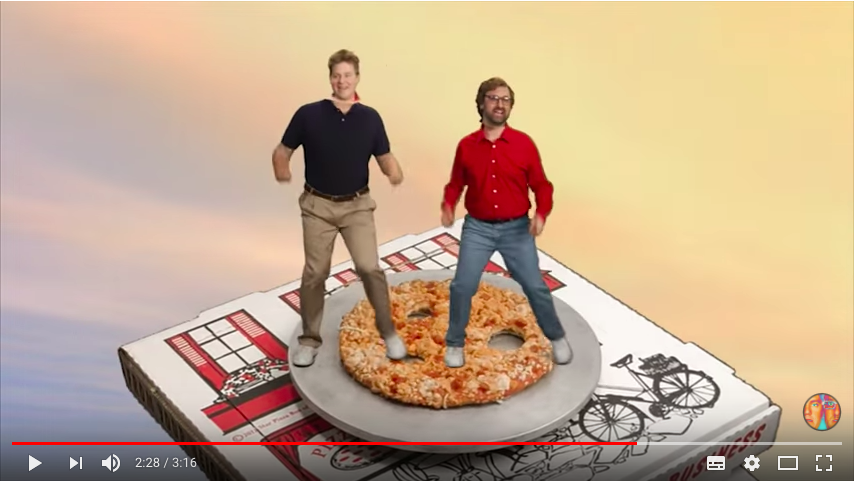
This definition of incongruity theory also touches on irony, which derives power from an awareness of what is expected and plays off of that expectation by subverting it. Much of Tim and Eric’s humor relies on this principle, often pushing past a primary boundary into the absurd. The juxtaposition of a tiny pink backpack on a grown man, for example, is ironic enough, but in the segment from 0:28-0:35 the team takes it further by cutting away from the scene and labeling this backpack as a “Feminine Pizza Bag.” In this cut scene, Tim and Eric are made tiny and the tiny pink backpack is made huge, with the duo standing on top of it. This takes the juxtaposition one degree further — using something that already lies outside a norm (shrinking a backpack and putting it on someone who you would not normally see wearing said backpack), pinpointing some aspect that makes it weird (it’s really small!), and then inverting that quality (let’s make it large and put Tim and Eric on the bag instead of putting the bag on Eric), then sequencing those two visuals back to back to back. This happens in a span of less than ten seconds, which is not a lot of time for your brain to consciously grab on to all of these intricacies, further playing into the absurdity of it all.

Tiny Tim Feat. Big Backpack

Repetition is another powerful tool throughout the video. From an auditory standpoint, the chorus “Totino’s, Totino’s, how did you know!” comes and goes throughout the video in various forms. It opens with the original iteration in the exposition, but later revisits Tim and Eric in a greenscreened kitchen just chanting “Totino’s” over and over. In fact, thanks to a transcript provided in the comments by user HannibalOrJustRex, we know that the word “Totino’s” comes up no less than 29 times. The majority of this repetition is concentrated near the end of the video, which devolves into an Einstein-on-the-Beach-esque chorus of “Totino’s,” “Whoo” (from Tim), and “Yeah” (from Eric), before a closing word from Hard Rock Joe and a final “Whoo/Yeah” from Tim and Eric, respectively. This progression from coherent nonsense distilled down to the most basic dialogue consisting solely of product name and cheers of enthusiasm falls under that same umbrella of absurdist incongruity theory, but does so in a way that still abstractly relates to the original topic at hand (Totino’s = Good). From an advertising standpoint, it also sends the subliminal message tying the product (Totino’s) to a positive reaction (Whoo/Yeah), which strengthens the overall effect of the work.

Visual repetition is an equally powerful element at play. The video opens and closes with snippets of Hard Rock Joe talking about his love of punk bass and pizza rolls over a green screen backdrop of a dimly lit brick room. Whenever we see Hard Rock Joe by himself throughout the video, it’s in this setting, and the three principal scenes in this setting are the very beginning, middle (1:35), and very end. Repetition abounds within a lot of these recurring green screen backgrounds — take the layered pizza one at 0:15 (which comes back at 0:25 and 1:15), or the cut and paste city assembled from a combination of pizza rolls, party pizza boxes, and standard run-of-the-mill pizzas at 0:27. The pizza with holes cut out of it here is actually derived from the pizza mask the unnamed woman wears in the exposition at 0:08, and resurfaces in the backdrop at 2:28 (as evidenced below).

Pizza Mask, Upper Right
Pizza Mask, Original
Pizza Mask Returns (also as a bonus, note the face swap of Tim’s head on Eric’s body and vice versa)

A similar repetition out of context can be found with the glasses Eric wears in the pizza chess scene — we saw a cut and paste version of those on Hard Rock Joe near the beginning (0:22). And there are plenty of scenes with duplicates of Tim or Eric — we have three Tims on screen at 1:32, five Tims at 1:59, and three Erics at 2:32, for instance. There’s also two separate scenes where each sings with mouths replacing their eyes — Tim at 1:35, and Eric at 2:29. 
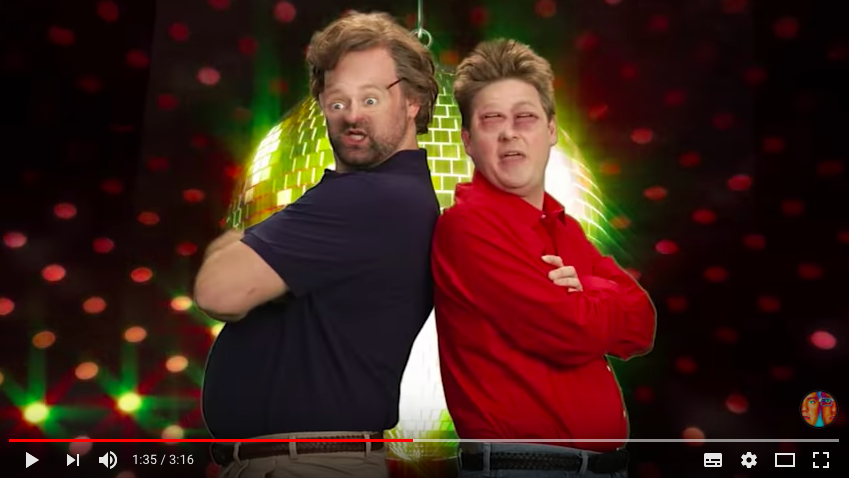
Tim on the right (sans eyes but with triple the mouths)

 This repetition of image and sound provides us with a sense of formal structure throughout, however abstract, whether it’s revisiting Hard Rock Joe in his punk bass dungeon, repeating a backdrop as with the layered pizzas, or repeating a word or phrase. This purposeful reuse of previous material, no matter how fleeting or subtle, provides a thread for our subconscious to follow, which is what allows us to view the whole thing as a (somewhat) coherent single entity as opposed to a string of random unrelated vignettes. Again, this is all presented in a very fast paced manner, not something we consciously pick up on but rather dependent on the fact that the human brain is hard-wired to detect pattern and repetition. 
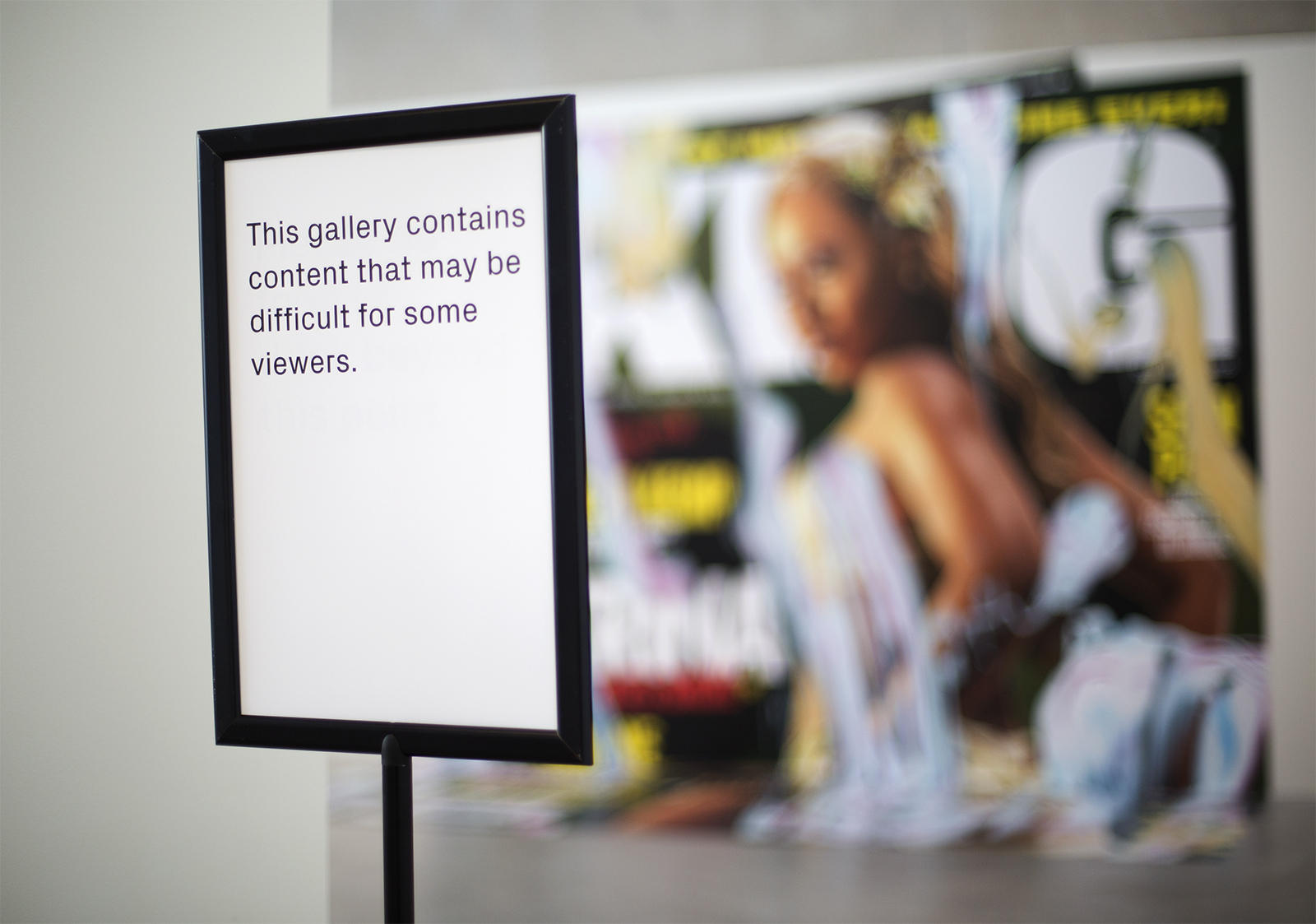
Art is hard sometimes

A lot of the time we hear responses to contemporary art (and by extension contemporary music) like, “My kid could do that — so unimpressive,” or “I can’t tell the difference between that and garbage,” or “What’s this doing in a gallery? That’s not art!” These reactions imply a few things. First, that the artist is not talented; consequentially, that a determining factor of “talent” lies in how easy it is for the viewer to “get” the meaning at first glance; and finally, an output fueled by anger at the museum or concert hall or whatever space said piece of art finds residence for allowing that piece of art to be put on display. To me, comments like this are a visceral negative response that allow the (often narrow-minded) viewer to maintain a sense of superiority, maintain power in an unfamiliar context, and maintain the same worldview they had before it was challenged by the idea that something different or hard to understand could have something powerful and relevant behind it. In the words of this Guardian article, that’s a big part of what makes Contemporary Art art: “As long as someone thinks modern art is rubbish, it is still provocative. It is still dangerous.”

A lot of the negative reactions to Tim and Eric’s work (the Totino’s advertisement being no exception) contain a similar veiled anger. One comment reads:

And to an extent, he does have a point, with regard to timing. I don’t think this kind of humor would have resonated as strongly 20 years ago, and it also seems to resonate better with younger audiences than older demographics. But the reason this dynamic duo finds success is because the “nonsense” they put out is so carefully not random. It toes the line between expectation and absurdity in a way that plays with your head but still leaves you with the impression that you’ve watched some abstraction of a single idea, as opposed to a disparate smattering of screenshots and soundbites of unrelated material. It provokes a powerful reaction from most people because there is intent in the execution and coherency in the concept, no matter how absurd that concept might be. That, to me, is the mark of something great: the ability to evoke a strong emotional response, and make people think, whether or not that response is positive or negative.

Symphonies and Cyphers: Exploring the Relationship between Power and Presentation

In this New York Times article, music critic Anthony Tommasini discusses the political implications behind Trump’s recent remark that “we write symphonies” as an indicator of cultural superiority. Tommasini further laments this comment, making the point that, “Nothing impedes the appreciation of classical music — and keeps potential listeners away — more than the perception that it is an elitist art form.” The troubling political implication behind this comment, of course, is that Trump is using an art form that he probably in reality knows very little about in order to prove a point of western superiority over other (particularly Islamic) cultures. Trump is, after all, not the first person to exploit Western classical music as a symbol of cultural superiority, and symphonies certainly weren’t written with the intention of being used to showcase this assertion. But it also touches on a concept that’s interesting from a societal standpoint: who (or what) really holds the power within a piece of art? Is it in the art itself, the so-called “experts,” those who hold political power, or with the artist?

Regarding this question, I am reminded of another article I read a while ago on NPR featuring an interview with Sophia Chang — you may have never heard of her, but she’s the total badass management genius behind a lot of early hip-hop stars including A Tribe Called Quest, Q-Tip, RZA, GZA, D’Angelo, and Joey Bada$$, among others. Chang is a powerhouse, a fact made clear from her resume and her no-nonsense tone throughout the article. At the same time, though, she makes it clear that hip-hop is an art form that she loves but is aware does not belong to her or her heritage. She states, “I was welcomed into hip-hop. This was not my house. I didn’t build this house. This wasn’t my culture. I was brought in, and I was welcomed. And that’s an honor.” Hip-hop provides a voice and an outlet for a group of people who are generally marginalized by larger Western culture, which is part of the reason it’s such a powerful art form. Hip-hop and rap are also genres often viewed negatively, for both lyrical content and musicality — Keith Richards says it’s music for “tone deaf people,” and Bob Boilen, host of NPR’s All Songs Considered, can’t relate to it because he feels “the crux of the music is focused on the words and if the words don’t relate to the listener then it’s all is a big disconnect.” Chang, on the other hand, says the following about what drew her to hip-hop in the first place:

It was certainly before social media, so the way that we experienced it was together and in person, right? So I wouldn’t go on and I wouldn’t live stream what’s going on at the club tonight. I actually have to be there. And you wanted to be there because you knew you were gonna see your friends, and you would talk about the music and you would experience it together. It was — it was truly remarkable. It was really a privilege. It was fantastic to be in there and be part of it.Sophia Chang, on the club scene in NYC during the rise of hip-hop and rap in the early ‘80s

So for Chang, this music is powerful to her because, among other things, she holds an emotional tie to it. It’s vibrant, alive, and something she was able to see evolve right from its start. In this interview, as well as in the aforementioned one, even her tone of voice reflects her love of everything involved with what makes hip-hop culture its own. She also treats it with great reverence and respect, and recognizes that her job as a manager is to facilitate the artists, not to be the creator herself. In her own words, “I’m a manager. I am in the service industry. The service industry. I’m Midas f****** Muffler. You come to me. You pay me to fix your muffler. I’ll do it, and you’re gone. I’m not — I’m not the car. I’m not the star. That’s not what it is.” Hip-hop is something that helped shape her identity and something she ties to experience, as opposed to the naysayers cited above, who don’t have any emotional attachment to it or a means of contextualizing the music as something they understand. 

Later in the Times piece, Tommasini (himself an avid classical music fan and critic) clarifies that even though he believes classical music is not elitist, “the art form is certainly ambitious and demanding. It asks for your time and attention. Even a 20-minute Haydn string quartet requires you to focus in order to grasp the structure, content and character.” To me, this provides us with somewhat of a contradiction — though Tommasini has specified that he does not believe classical music to be inherently better or worse than any other genre of music, this comment separates classical music as more complicated music, something difficult to digest and hard to listen to, which is an element not specified explicitly in the context of other music: he briefly mentions Eleanor Rigby, but only speaks about classical music in-depth. Even though he has to go back and clarify he doesn’t actually find it superior, it comes through in his writing all the time that he genuinely loves classical music and likely prefers that genre over most others, which makes sense considering his background. And I think the reason for this likely has more to do with the fact that Tommasini is a classical music aficionado as opposed to a hip-hop mogul, and less to do with the idea that he believes other music to be inferior — after all, he asserts an explicit stance throughout the article refuting that assumption.

The parallel I see between Chang and Tommasini is that both of them are incredibly passionate about a specific genre of music and have significant power in their respective positions regarding those genres, but at the same time their influence is not necessarily directly inherent to the creative process but instead in influencing how an artist’s product is perceived by their audiences. People turn to classical music critics like Tommasini to help guide them in what to listen to. Tommasini’s power as a critic lies not in the creation of classical music but the re-contextualization of it as well as his accessibility through a popular large scale publication. Similarly, Chang’s power lies in a behind-the-scenes service role, recognizing talent and helping that talent become its most successful possible realization in a final artistic product. The difference is Tommasini deals mostly with works of dead people being reimagined by living people and facilitating a conversation about these time honored works, while Chang’s whole career was based on her having a knack for managerial skills an ear for talent, and a drive for success in an entirely new genre of music from its inception in the early 1980s. Though the artist is certainly the reason we have what we have accessible to us to hear, just as important and arguably just as powerful are those working behind the scenes who get the word out and tell us what’s out there and what of that is important to actually sit down and listen to. The power in art often lies just as much in the piece itself as the manner in which it is presented.

Full of Hot Air: Balloons, Dadaism, and The Avant-Garde

“Is there any way you can make that more cantabile?” the conductor asked. His question was met with resounding laughter from the rest of the ensemble, myself included. Though this is certainly not an odd request for a conductor to make in a rehearsal, the fact that the target of this question (a percussionist by trade) held in his hand an only-just-recently-deflated balloon made the whole thing seem just a little absurd. Found more commonly at amusement parks or clown conventions, your everyday garden-variety Mylar balloon also happens to be an instrument called for in the score of Talhoffer’s Crawfish (below), a piece of contemporary classical music. The question now becomes, how did a balloon make its way into our rehearsal space as an instrument as opposed to an accessory to a 5-year-old’s birthday party?

https://soundcloud.com/user-893617903/talhoffers-crawfish

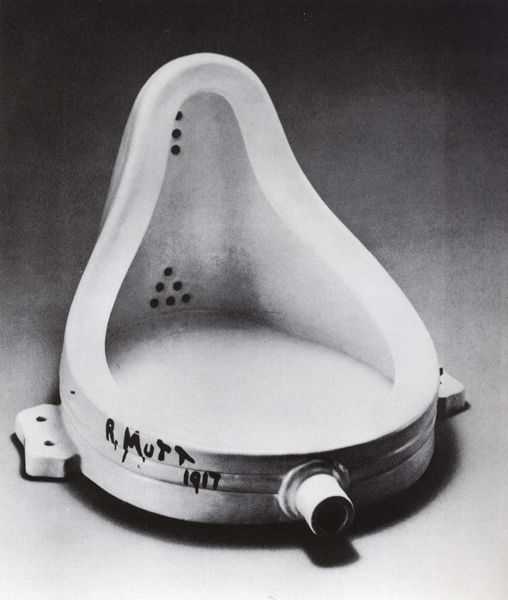
In order to uncover this, let’s delve a little bit into the use of regular objects in art. The use of found objects in 20th century visual art can be found most famously in the works of the Dadaist movement. One particularly well known example is Marcel Duchamp’s Fountain,

Marcel Duchamp’s Fountain, 1917

which is really just a urinal turned on its side with “R. Mutt 1917” scrawled along the base. As one of the first pieces of this iconoclastic genre of modern art, this article states Duchamp’s own summation of the work, a response in a 1917 issue of the avant-garde journal The Blind Man: “Some contended it was immoral, vulgar. Others, it was plagiarism, a plain piece of plumbing.” This touches on some key elements of the Dada movement, and modernism in general: the idea that the concept behind the piece becomes part of the piece itself, and that to be controversial is a positive thing. Dada originated as an avant-garde movement reacting to the terrible bloodshed and brutality seen during World War I. It was meant, in the words of Jean Arp (one of Duchamp’s Dadaist contemporaries), as a way “to destroy the hoaxes of reason and to discover an unreasoned order.” Dadaists placed emphasis on absurdity, repurposing of found objects, and the laws of chance. Though one of many different niches of modernist thought cropping up during the early 20th century, it would later be revived by the Neo-Dadaists in the 1950s and ‘60s.


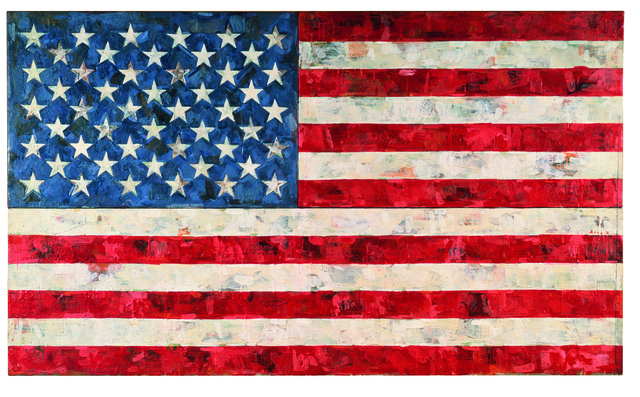
The Neo-Dada movement revived Dadaist thoughts during the Cold War later in the century. Neo-Dadaism used things such as found objects and chance to shift the focus away from the artist him- or herself and instead on the audience’s reaction and interaction with the piece in question. This was not only a movement in visual art (Jasper Johns and Robert Rauschenberg are two big players here — you can read more about them here and here, respectively, if interested) but also in music. John Cage, possibly most famous for claiming silence as music in his work 4’33” (performed below by NOLA the Cat), was an important composer of this school of thought.

Cage followed the Neo-Dadaist philosophy of using found objects and chance in his works, something derived from their earlier Dadaist forerunners. 4’33” is in a sense completely a work of chance music, as the resulting sonic landscape of four minutes and 33 seconds of silence is whatever anyone in the hall happens to hear — the focus shifts from the music itself instead to the audience’s perception of that music. This particular work and others by Cage have influenced many musicians after him (a collection of reactions to his works and his contributions to the music world can be found here). Without Dada, Neo-Dada, and Cage and his like-minded contemporaries, it is unlikely that we would have ever been able to have that lighthearted exchange in our rehearsal concerning the cantabile-ness or lack thereof of a balloon deflating.

This brings us back to our original question: how did I end up in a rehearsal last weekend with someone playing the balloon, and why can we call that a musical instrument? To me, the origin of a balloon as a musical technology isn’t in the actual physical structure of it, but rather can be found in the artistic movements that allow us the freedom and openmindedness to see it as such. Without our avant-garde, Dada, and Neo-Dada forefathers, the use of balloons as a found object musical instrument would not likely be something we could come across in our scores today. Even though it’s something that can be found at any grocery store, the balloon is an instrument that takes practice and patience to get that perfect cantabile sound — and a lifetime to master.

https://www.youtube.com/watch?v=sIskW0xEGvM