Carving out a Path for the Viola

When I first decided I wanted to play an instrument, I went to an instrument “try-out” day at my town’s local music store. I first tried out a flute, then a trumpet. Then I moved on to strings and picked up the violin. I remember that the sound of the bow against the strings was painful to my ears. A few minutes later, I walked over to my identical twin sister, who was smiling at what looked like a big violin. “Let me try!!!” I said, and I put the viola on my shoulder. I drew two bows on the D string, then two on the A string. Thinking, “OMG, I can already play Twinkle Twinkle Little Star”, I told my mom and sister that I wanted to play viola. My twin sister did too! As you can imagine we played a lot of viola duets over the next several years.

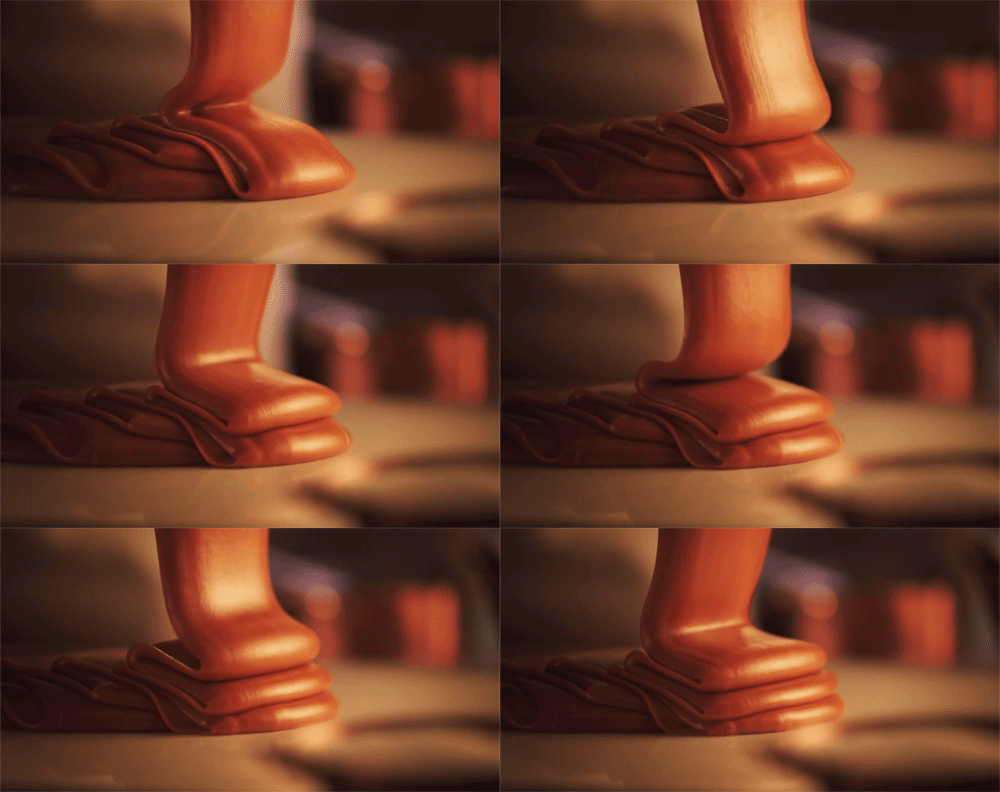
As a violist, I am used to the reputation this instrument has in the music world. In an orchestra, the viola plays a supportive role. Seldom receiving the melody, violists learn how to play harmony very well. When we received this blog post assignment, I knew I wanted to discuss the history of this instrument because there is a lot that goes untold (and unknown). Though, I am biased, I feel the viola’s importance should be projected. What other instrument sounds like caramel and chocolate when it’s played well?!
 Click to play

To emphasize this gif, here is a recording of one of my favorite pieces (and one that shows off that caramel sound of the viola). Just listen to the first 30 seconds- that’s all you’ll need.

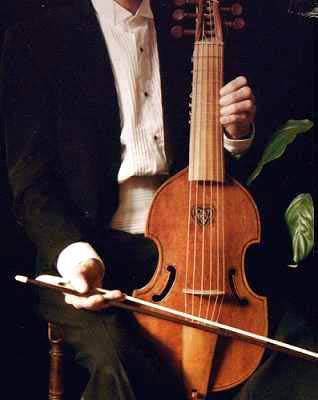
Let us go back to sixteenth century Italy. The viola is a member of the violin family, but there is no clear answer to exactly when this instrument came to be. According to the Vienna Symphonic Library the role of the viola came defined when demands for instruments that would fill out a room with sound for Baroque Opera became necessary. String instruments were often made in different sizes with the same tuning, so when a need had to be met to split the registers and have another instrument played “da braccio”  or played on the arm, the viola was born.

Composers soon composed for sections to mimic the human voice (parts separated by bass, tenor, alto, and soprano registers). Naturally the viola falls into the alto category, and makers had to continually experiment to “find the optimal combination of tone, size, shape, and range to compliment the current trends in orchestra and court music” .

The viola is often misunderstood in terms of size because there is no standardized system for measurement. This makes the viola imperfect acoustically, because in order for the most amazing sound to be achieved, the body of the instrument would have to be huge (and therefore unplayable). Today there are many makers who experiment with string length and the size of the body to achieve the optimal effect. Usually, people with longer limbs and fingers play larger violas and vice versa.

A huge advance in the viola-making world came with the modern bow. Francois Tourte , a Frenchman, is often credited with many string instrument advances but the modern bow is especially important to violists. Because a viola responds less quickly because of the thicker strings, a modern bow allows for more tension between that hair and the strings. This means violists could actually project(!). Soon, the role of the viola became increasingly important in chamber music and the first solo pieces were composed for the instrument.

I encourage you to watch this TEDx talk specifically about the viola. This talk is great because there are frequent playing examples as well as great facts.

Today, there are many amazing solo violists who have created a beautiful new reputation for this instrument. Some of my favorites, including Kim Kashkashian, Nobuko Imai, Yuri Bashmet, etc. have inspired not only violists around the world, but also composers to write new and challenging works for this instrument. In the last decade new commissions and transcriptions have taken off, carving out a new path for this instrument. In this article by TimeOut New York, Steve Smith writes of new CD releases that deserve attention, honing in on many new contemporary works.

Past the viola jokes, I believe we gain a lot from understanding the technology of this instrument, and how it came to fruition. It is important to consider that instrument makers in the 16th century may have had some of the same musical concerns that instrument makers and composers have today, and that the means of creating music are constantly being improved upon.
Fretting over the past

Always known to have a flair for the dramatic, Jaco Pastorius’ 1962 Fender Jazz bass was aptly named the Bass of Doom. Although no one except Jaco knows the origin of the name, as a fellow bassist, one theory I have is simply the awe and terror (of inferiority) instilled in other musicians who witnessed the combination of Jaco and the instrument while on stage.

EXHIBIT A (feat. The Bass of Doom):


Besides the ridiculous chops and musicality displayed in this performance (he flips the notion of people talking during a bass solo on its head), one of the most striking aspects of this video is the warm, fuzzy tone that Jaco produces. Electric basses typically have a defined low-end with precise pitches, such as all fretted instruments, but the distinguishing feature of the Bass of Doom is its’ fretless nature, allowing fluidity between pitches and Jaco’s ability to make the bass sing via vibrato. Legend goes that Jaco found the Jazz Bass for $90 at a pawnshop sometime around 1970 and decided to take out the frets with a butter knife and replace them with polished pieces of “plastic wood”, then finishing the fret(less)board with a few coatings of boat epoxy, thus creating the first fretless bass.


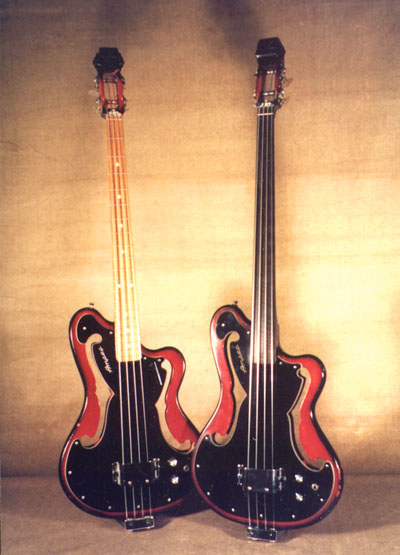
As is the case with many folk-heroes and tales though, these facts are widely disputed, with the possibility that Jaco’s bass may have already been fretless when he purchased the instrument. Not only is the origin story possibly fabricated, but there are also contradictions over the origin of the fretless bass that all come down to a person’s opinion on what defines a fretless bass rather than who was the first to invent the instrument. The following image is of Ampeg AUB and AEB basses made circa 1968, at least two years before Jaco’s “discovery”,and it is apparent that the inspiration for the bass’ design comes from the electric bass’ ancestor, the contrabass (which could be argued is THE original fretless).

From the scroll-like headstock to the ebony fingerboard, both instruments look like and sound like a miniaturized version of an upright. Not only was Ampeg producing them around 1966, but according to Billy Wyman of Rolling Stones fame, “… I made a bass in 1961, before I joined the Stones, and it was a fretless bass. It was the first fretless bass ever made. I didn’t know that at the time, and I didn’t know that until 10 years ago. It predated fretless basses by about five or six years”. Rumor has it that the bass he had purchased was buzzing due to the frets so he decided to take them off. The issue here is that all we have to take for the validity of the claim is his word rather than recorded performances or videos of him with said makeshift bass. These differing origin points are where some debate comes in, as the Ampeg AUB and AEB are obviously derivative of upright basses, while Wyman’s choice was pragmatic in response to a functional issue but had no lasting impact. Jaco’s decision may have been a mixture of both due to his jazz background and influences and the questionable quality of pawnshop purchases, or it may have just been a stylistic quirk, the kinds of which he exhibited so often throughout his career. The main distinguishing factor when discussing any type of bass though is the tone, and any modern-day listener will instantly point to Jaco’s warbling, growling sonorities as the definitive fretless tone, even if it was not necessarily the “first” fretless, or a traditional fretless instrument.

As with so much of rock lore and history, stories are passed down via word of mouth for decades, resulting in tales that are irresistible but also sometimes easily refuted by the internet. While the anecdote about Jaco’s Bass of Doom being the original fretless may not be wholly true, it speaks volumes to how history is written, with the age-old adage of how the “victors” are the ones who write history. These conflicting origin stories pose some interesting questions about how the history of certain innovations is recorded. Does it matter who officially invented a technology if that person is hardly relevant to the cultural impact of said technology? Or, is it wrong to mythologize the origins of certain innovations if there’s an educational purpose behind it? While Jaco in many cases was no victor, in a sense, the history of the fretless electric bass begins and ends with him. Any person who performs on a fretless bass is instantly compared and contrasted with Jaco, similar to Michael Jordan’s shadow hanging over every single NBA superstar. The role of the fretless electric bass in any musical context is so entwined with Jaco’s legacy that even though the fretless had a precedent before the 70’s, it was Jaco and his eponymous debut album in 1976 that led instrument producers to market and produce these fretless instruments while also inspiring legions of bassists to pick them up in efforts to imitate him.


Further exploration:

Jaco Pastorius (Eponymous Debut Album)

Rick Danko (bassist for the Band, on left in yellow jacket) utilizing an Ampeg AMUB-1 Bass


Why F Holes?

One the most notable features of the modern bowed string instrument family is that of the so called “f holes” located centrally on either side of the instruments’ main bodies.  These in particular contrast with the single circular shaped sound hole located in the center of an acoustic guitar.  In the guitar’s case, the single circular hole has been a staple of the instrument’s design for centuries.  In the case of the violin and other bowed string instrument, the f hole is a product of years of development through trial and error.

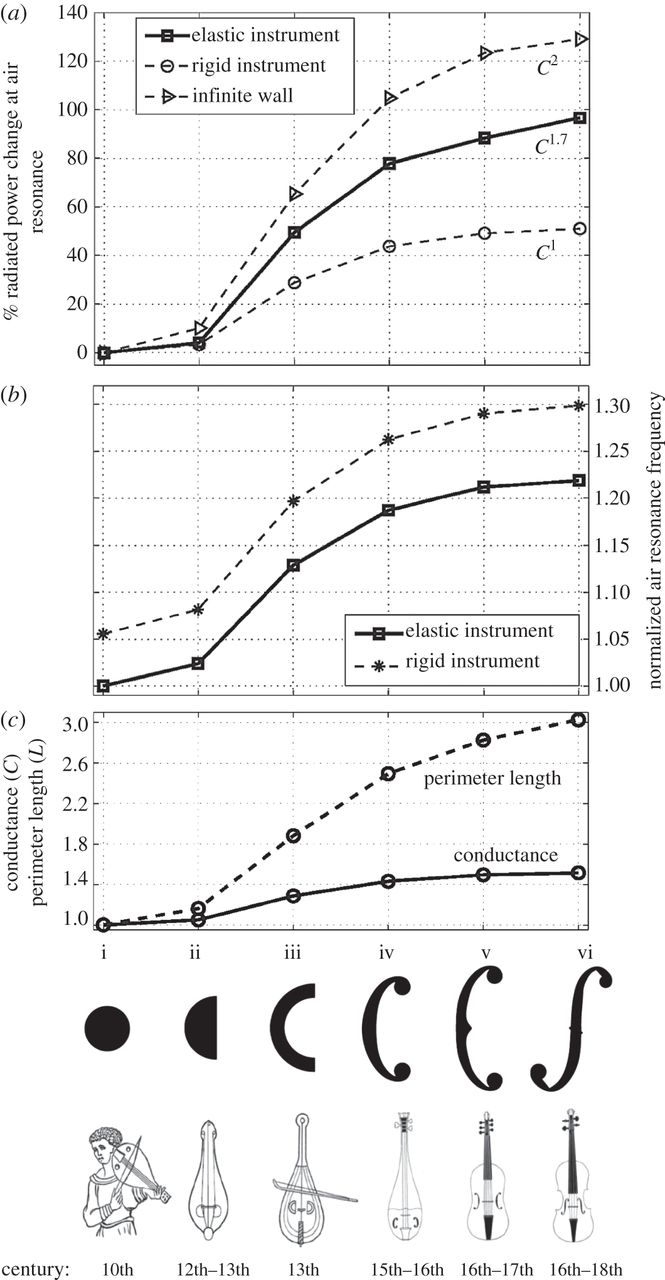
Image source: http://digitalcommons.usu.edu/cgi/viewcontent.cgi?article=1741&context=gradreports

The earliest bowed string instruments actually had the same circular hole design as the guitar.  This probably occurred as some of the first instruments to be played with bows were simply lutes, whose main performance technique remained plucking.  However, as bowing took off as a genuine technique in its own right, the makers of such stringed instruments found that the circular sound holes did not produce the desired results.  And so, they began experimenting with other designs.

In the 10th and 11th centuries, the single circular hole was replaced by two separate circular holes on opposite sides of the instrument’s body, much as the modern f holes are located today.  This double design produced a greater acoustic clarity for bowed instruments than the single holes did, but it was still far from perfect.  And so, the experimenting continued.

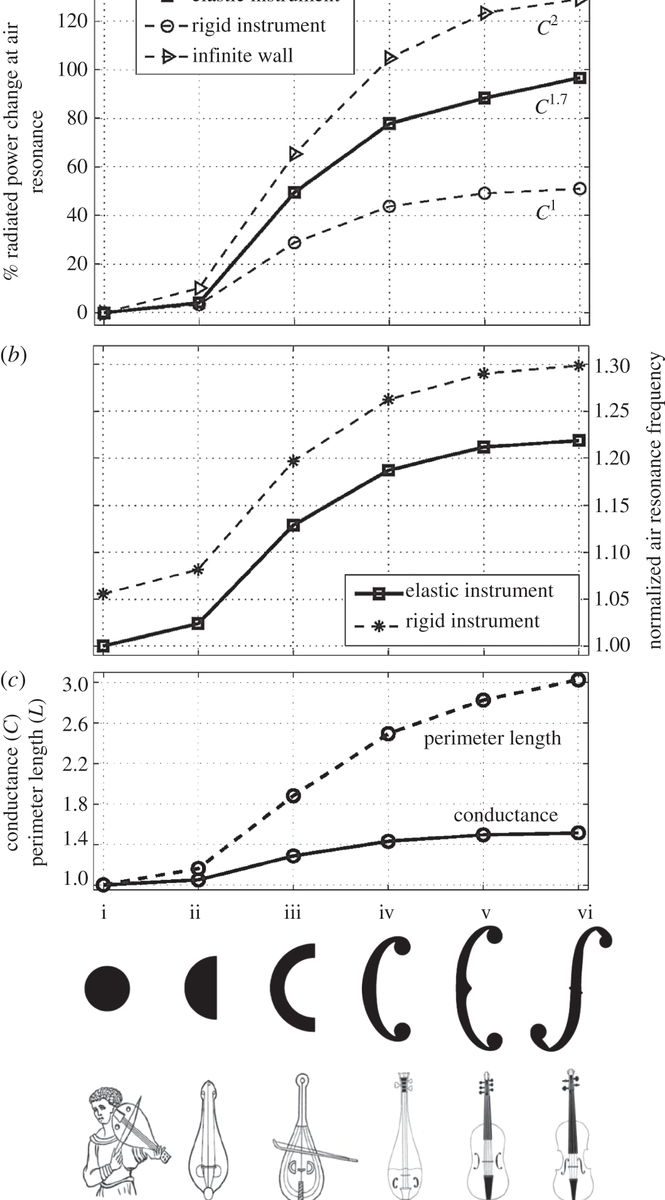
By the 12th and 13th centuries, the circular holes were replaced with half moon shaped holes, followed quickly by C shaped holes.  These, combined with improvements in the technology of the bow itself contributed to a new era in the evolution of the bowed string instruments.  These C holes were so successful, that while they went through many phases of stylization through the centuries to come, they remained a staple through the early baroque.  In fact, many baroque string instruments retain the C shaped sound holes.  However, by the high baroque, influential luthiers – most notably Nicolo Amati – began creating instruments whose sound holes were shaped like an f.  This new design caught on rapidly, and remains in use today, with slight variations between different makers.  Guarnieri, for example, favored a longer and narrower design, while Stradivarius’s design was wider and shorter.

Viola Da Gamba with C shaped sound hole

Image Source: http://www.orpheon.org/OldSite/Seiten/education/ShapeUpEnglish.htm

The reason for the adoption of the f shape is not entirely clear.  However, a separate blog I found poses an interesting theory: namely, that the holes are not intended to be f – shaped.  Rather, the shape is intended as a stylized s, which in turn stood for “sound” in various languages.  Whether this theory is accurate is up to debate, but in either case, the f hole (or s hole), is now an integral part of the design of any modern bowed string instrument.  (side note, the f hole is also shaped like the symbol for integral: )

Interestingly enough, an MIT study from 2015 (in sources) has discovered that the f-hole is actually the ideal shape for sound production.  The vibrations from the f-holes carry longer and louder than that of any other shape on the bowed string instruments, as it is most suited to the sonic vibrations and air flow that bowing the strings produces.

Image source: http://rspa.royalsocietypublishing.org/content/471/2175/20140905#sec-4

It is a curious coincidence that this ideal shape was stumbled upon by what amounts to accident.  While I am certain that the early luthiers could empirically ascertain the superiority of the f-holes, they undoubtedly were unable to replicate the detailed acoustic physics calculations of the MIT researchers.

As a violinist, I am actually rather pleased with the concept of a chance occurrence driving the evolution of an important part of my instrument.  After all, so much of what goes into a good performance is created by chance – the atmosphere of the hall, the artist’s current mood, avoiding an unfortunate mistake – that having the creation of your instrument be coincidental is rather comforting.


Sources:

http://digitalcommons.usu.edu/cgi/viewcontent.cgi?article=1741&context=gradreports

https://newt.phys.unsw.edu.au/music/publications/mclennan/fholes.pdf

http://blog.feinviolins.com/2013/04/why-f-holes.html

https://www.thestrad.com/new-research-into-the-development-of-violin-f-holes-is-simplistic-at-best/4073.article

http://rspa.royalsocietypublishing.org/content/471/2175/20140905#sec-4

http://www.orpheon.org/OldSite/Seiten/education/ShapeUpEnglish.htm

Sampling and why it should be respected in the artistic community

“Sampling: the technique of digitally encoding music or sound and reusing it as part of a composition or recording.” – Google. This is the definition but it has received so many other societal implications depending on your social circle. For conservatory musicians it can be met with distain for people who have so little creativity that they are forced to rip off other’s ideas. For producers of hip hop it is the very essence of their music; a corner stone to their art form and creative process that forces them to hear music a fundamentally different way. Conservatory musicians might here a piece of music and think about the harmony or virtuosity of the musicians playing, while a sampling musician is listening for the timbres, the rhythms, and instrumental breaks with one question in mind: “can I sample this?”

Sampling as an art form many would say started in the 1980s with the MPC 60; a machine that could record audio onto 12 preset, touch-sensitive pads, that revolutionized beat production in hip hop. (See

for more info) While I would agree that for hip hop this is certainly true, I would disagree with it being the beginning of sampling. Since the beginning of recorded history there has always been an element of sampling and recycling material. How else would we develop our theories if there was not some level of commonality between pieces of music. This might seem like I’m thinking to macro in my take on sampling. A more concrete example of sampling in classical music would be Bela Bartok, who literally had a recording devise which he used to record different folk musics from around the world to later use for inspiration for his own works. (If your curious about Bartok field recordings check this out!)

 How is this not sampling? When talking about sampling, Mark Ronson (Producer of Uptown Funk) said that “In music, we take something we love and we build on it.” Does this quote not apply to all music, not just sampled music? So why then is sampling prerecorded music bad?

I think many would argue that it is one thing to play the notes someone else played, it is another to claim someone else’s work is your own. While that argument does have merit it is assuming that by sampling you mean taking someone’s complete work and projecting it as your own, which is not the case with sampling of hip hop music generally speaking. It is actually a highly creative process, which takes parts of a musical excerpt and reinterprets them into a new piece of music that is separate from yet related to the piece that was sampled. Mark Ronson put’s it like this “You have to take an element of those things and bring something fresh and new to it.” Most sampling is viewed as a way of paying homage to the music that you like best, similar to a jazz musician quoting lines from his favorite soloist to show respect for the tradition. In jazz this is viewed as a cornerstone for being steeped in the tradition, improvisors spend hours transcribing their favorite soloist with the goal of sounding like them. And yet many, esp. older, jazz musicians don’t see how J Dilla sampling his favorite soul records and reinventing them, is the same thing with a different instrument. (If you’re asking yourself, who is J Dilla? How did he sample soul music? check this out! )

To sum up, sampling exist, it has been around for decades and should be respected in the art community. It is ridiculous to me that the Grammy’s won’t let a song that has prerecorded samples in it even be considered for song of the year. To my musician friends, take a look in the mirror, it’s not that your bad too, it’s that sampling is always good*. *Granted the original artist receives credit and compensation for their work.

Lastly I will say, if you are interested in sampling, check out whosampled.com it has great resources to see what your favorite artist sampled to create your favorite beats!

Sources in text: How Sampling Transformed Music – Mark Ronson

https://www.youtube.com/watch?v=H3TF-hI7zK

http://www.whosampled.com/sample/4051/Madvillain-M.E.D.-Raid-Bill-Evans-Nardis-(At-the-Montreux-Jazz-Festival)/

Netflix – Hip-Hop Evolution

Ross- The Rest is Just Noise, Chapter 3.

Suggested Listening: Deltron 3030 (self titled)https://www.youtube.com/watch?v=v6YJjkO7F5A

Madvillain- Madvillainy https://www.youtube.com/watch?v=DWY22Blwouc

J Dilla – Donuts https://www.youtube.com/watch?v=5nO7IA1DeeI&list=PL9dk_xtWpAkKXxzv_TfLWmlJj6G3quWQ2