Totino’s Pizza Rolls: A Postmodern Adventure Great Job!

Summarized in this article beautifully as a video in which “grown men … dance to shrill synth beats while eating Totino’s pizza rolls out of a tiny pink backpack,” comedy duo Tim Heidecker and Eric Wareheim’s commercial for Totino’s pizza rolls depicts an authentic and successful marriage between image, music, sound, and editing — a true multimedia experience. After all, as the comment below reminds us, this is a real commercial:

Totino’s actually paid Tim and Eric to create an advertisement featuring their product, and they’re not the first ones to do so (check out these pieces for Absolut and Old Spice). But what exactly is the fine line that separates this masterpiece from a Mountain Dew-fueled fever dream of a last minute assignment thrown together the night before a freshman English presentation?

There’s definitely… a lot to unpack here. Much of the ad’s effectiveness lies in incongruity theory, or the idea that part of what makes something funny is presenting the unexpected. In his Critique of Judgement, Immanuel Kant writes, “In everything that is to excite a lively laugh there must be something absurd.” 

Incongruity theory hard at work

This definition of incongruity theory also touches on irony, which derives power from an awareness of what is expected and plays off of that expectation by subverting it. Much of Tim and Eric’s humor relies on this principle, often pushing past a primary boundary into the absurd. The juxtaposition of a tiny pink backpack on a grown man, for example, is ironic enough, but in the segment from 0:28-0:35 the team takes it further by cutting away from the scene and labeling this backpack as a “Feminine Pizza Bag.” In this cut scene, Tim and Eric are made tiny and the tiny pink backpack is made huge, with the duo standing on top of it. This takes the juxtaposition one degree further — using something that already lies outside a norm (shrinking a backpack and putting it on someone who you would not normally see wearing said backpack), pinpointing some aspect that makes it weird (it’s really small!), and then inverting that quality (let’s make it large and put Tim and Eric on the bag instead of putting the bag on Eric), then sequencing those two visuals back to back to back. This happens in a span of less than ten seconds, which is not a lot of time for your brain to consciously grab on to all of these intricacies, further playing into the absurdity of it all.

Tiny Tim Feat. Big Backpack

Repetition is another powerful tool throughout the video. From an auditory standpoint, the chorus “Totino’s, Totino’s, how did you know!” comes and goes throughout the video in various forms. It opens with the original iteration in the exposition, but later revisits Tim and Eric in a greenscreened kitchen just chanting “Totino’s” over and over. In fact, thanks to a transcript provided in the comments by user HannibalOrJustRex, we know that the word “Totino’s” comes up no less than 29 times. The majority of this repetition is concentrated near the end of the video, which devolves into an Einstein-on-the-Beach-esque chorus of “Totino’s,” “Whoo” (from Tim), and “Yeah” (from Eric), before a closing word from Hard Rock Joe and a final “Whoo/Yeah” from Tim and Eric, respectively. This progression from coherent nonsense distilled down to the most basic dialogue consisting solely of product name and cheers of enthusiasm falls under that same umbrella of absurdist incongruity theory, but does so in a way that still abstractly relates to the original topic at hand (Totino’s = Good). From an advertising standpoint, it also sends the subliminal message tying the product (Totino’s) to a positive reaction (Whoo/Yeah), which strengthens the overall effect of the work.

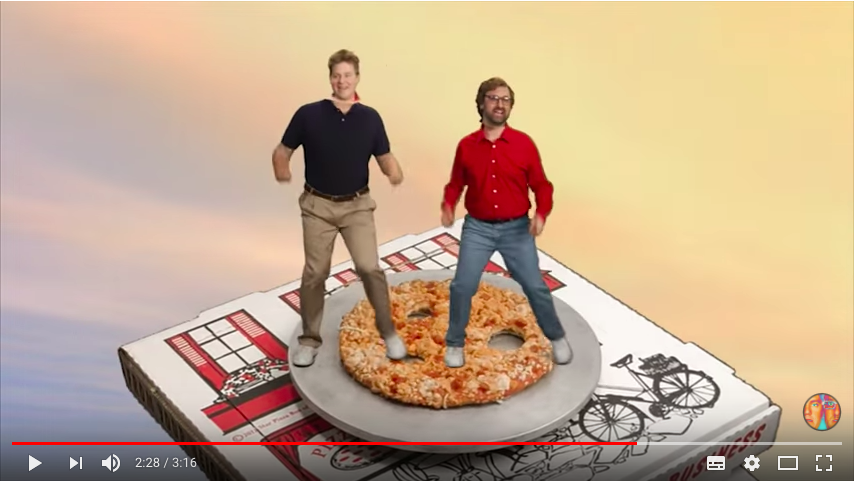
Visual repetition is an equally powerful element at play. The video opens and closes with snippets of Hard Rock Joe talking about his love of punk bass and pizza rolls over a green screen backdrop of a dimly lit brick room. Whenever we see Hard Rock Joe by himself throughout the video, it’s in this setting, and the three principal scenes in this setting are the very beginning, middle (1:35), and very end. Repetition abounds within a lot of these recurring green screen backgrounds — take the layered pizza one at 0:15 (which comes back at 0:25 and 1:15), or the cut and paste city assembled from a combination of pizza rolls, party pizza boxes, and standard run-of-the-mill pizzas at 0:27. The pizza with holes cut out of it here is actually derived from the pizza mask the unnamed woman wears in the exposition at 0:08, and resurfaces in the backdrop at 2:28 (as evidenced below).

Pizza Mask, Upper Right
Pizza Mask, Original
Pizza Mask Returns (also as a bonus, note the face swap of Tim’s head on Eric’s body and vice versa)

A similar repetition out of context can be found with the glasses Eric wears in the pizza chess scene — we saw a cut and paste version of those on Hard Rock Joe near the beginning (0:22). And there are plenty of scenes with duplicates of Tim or Eric — we have three Tims on screen at 1:32, five Tims at 1:59, and three Erics at 2:32, for instance. There’s also two separate scenes where each sings with mouths replacing their eyes — Tim at 1:35, and Eric at 2:29. 
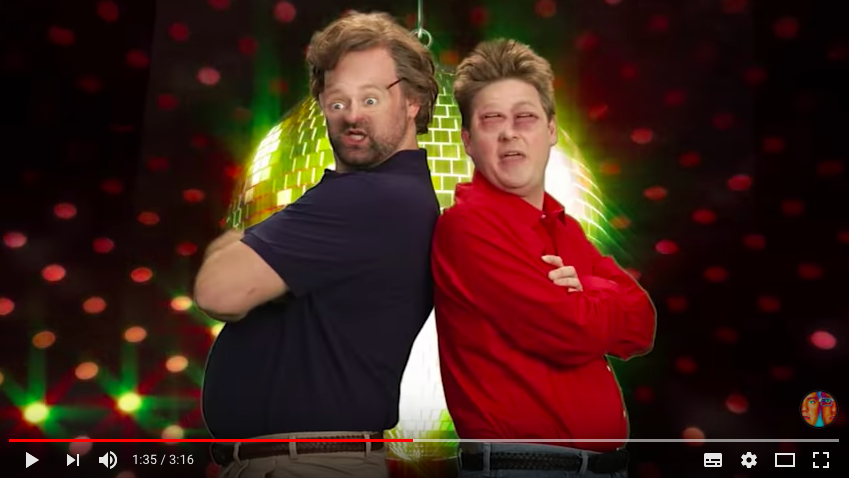
Tim on the right (sans eyes but with triple the mouths)

 This repetition of image and sound provides us with a sense of formal structure throughout, however abstract, whether it’s revisiting Hard Rock Joe in his punk bass dungeon, repeating a backdrop as with the layered pizzas, or repeating a word or phrase. This purposeful reuse of previous material, no matter how fleeting or subtle, provides a thread for our subconscious to follow, which is what allows us to view the whole thing as a (somewhat) coherent single entity as opposed to a string of random unrelated vignettes. Again, this is all presented in a very fast paced manner, not something we consciously pick up on but rather dependent on the fact that the human brain is hard-wired to detect pattern and repetition. 
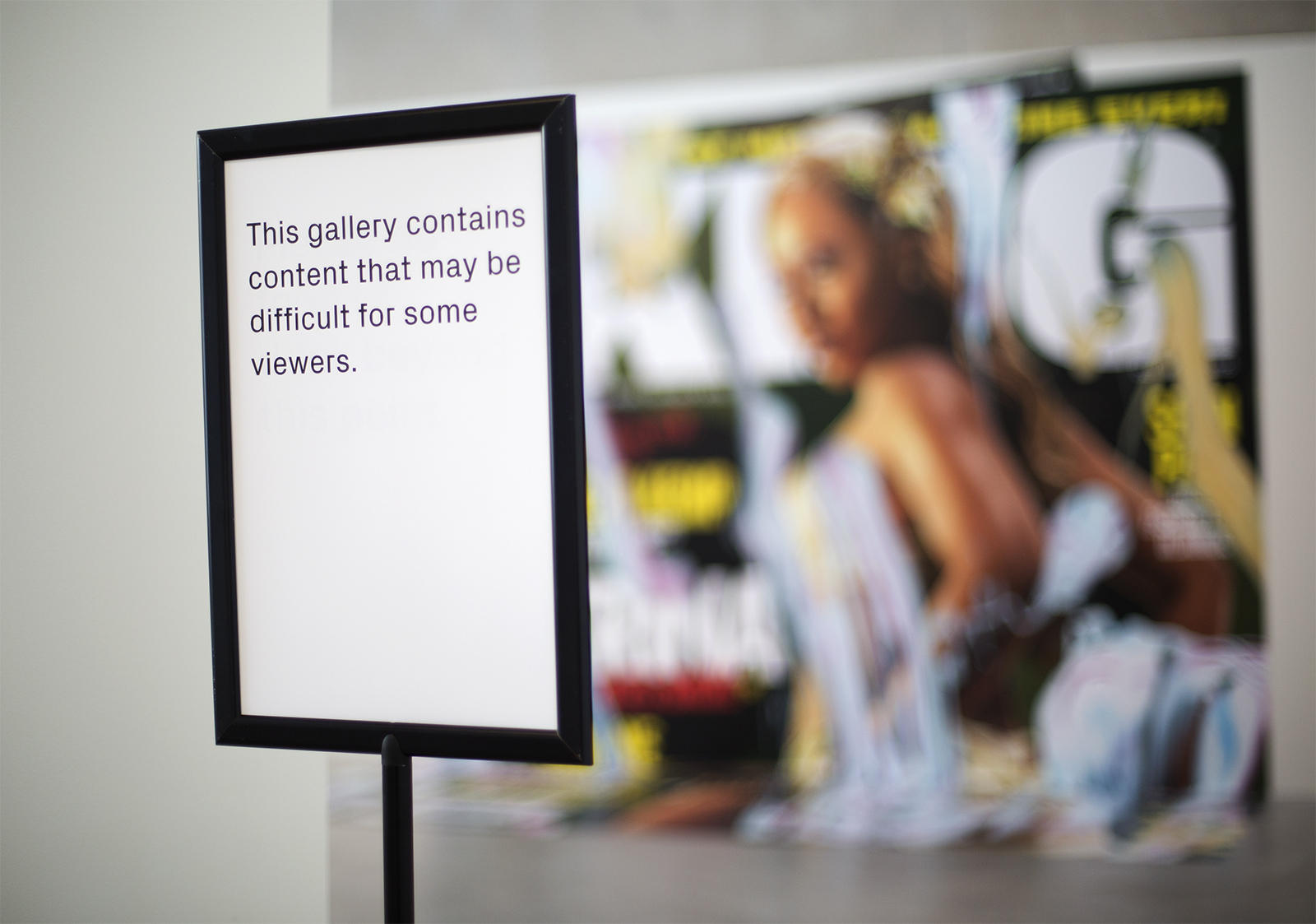
Art is hard sometimes

A lot of the time we hear responses to contemporary art (and by extension contemporary music) like, “My kid could do that — so unimpressive,” or “I can’t tell the difference between that and garbage,” or “What’s this doing in a gallery? That’s not art!” These reactions imply a few things. First, that the artist is not talented; consequentially, that a determining factor of “talent” lies in how easy it is for the viewer to “get” the meaning at first glance; and finally, an output fueled by anger at the museum or concert hall or whatever space said piece of art finds residence for allowing that piece of art to be put on display. To me, comments like this are a visceral negative response that allow the (often narrow-minded) viewer to maintain a sense of superiority, maintain power in an unfamiliar context, and maintain the same worldview they had before it was challenged by the idea that something different or hard to understand could have something powerful and relevant behind it. In the words of this Guardian article, that’s a big part of what makes Contemporary Art art: “As long as someone thinks modern art is rubbish, it is still provocative. It is still dangerous.”

A lot of the negative reactions to Tim and Eric’s work (the Totino’s advertisement being no exception) contain a similar veiled anger. One comment reads:

And to an extent, he does have a point, with regard to timing. I don’t think this kind of humor would have resonated as strongly 20 years ago, and it also seems to resonate better with younger audiences than older demographics. But the reason this dynamic duo finds success is because the “nonsense” they put out is so carefully not random. It toes the line between expectation and absurdity in a way that plays with your head but still leaves you with the impression that you’ve watched some abstraction of a single idea, as opposed to a disparate smattering of screenshots and soundbites of unrelated material. It provokes a powerful reaction from most people because there is intent in the execution and coherency in the concept, no matter how absurd that concept might be. That, to me, is the mark of something great: the ability to evoke a strong emotional response, and make people think, whether or not that response is positive or negative.


Beyonce & Stage Design

Beyonce is known to be one of the quintessential performers of our time. The Queen Bee has set an incredibly high standard for herself with her recordings, performances, and music videos. I would like to take a brief look at how Beyonce maintains continuity with her audience through live performance and her music videos, and also analyze the use of stage design in performance practices as well.

The song we will be looking at is arguably her most famous, “Crazy in Love,” featuring Jay-Z.

This music video has all the tropes of early 2000s stardom. It received 11 awards including the Grammy for Best RnB song. It incorporates all kinds of sex appeal but two that I would like us to pay special attention to: the strut and the group dance. These two characteristics are staples of Beyonce as an icon and should be expected to be seen by an audience member attending her show.

Now I’d like for us to look at a video of a live performance of this same tune.

https://www.youtube.com/watch?v=Q5TyTPMaf1Q

I’d like to walk through this performance as it relates to stage design and audience’s expectations. For my criteria for judging stage design, I would like to use Es Devlin’s discussion of the topic from Abstract: The Art of Design; Stage Design. In this series she discusses the five basic principles of stage design; light, darkness, space, time, and scale. Beyonce uses these as well as other performance aspects with the music to continually keep her audience enticed and engaged through out the whole performance. It is as if the whole song is one big build up and the energy is carefully cultivated through out to give the viewer an iconic and memorable performance.

Let’s start at the beginning of the video. Beyonce is introduced while the audience waits in anticipation. You can only imagine that since purchasing the ticket they have been fantasizing of what this moment will be like and now it is finally here. Beyonce clearly knows this and builds on this excitement from the very beginning. The stage goes from being completely black to illuminating a white triangle, which often symbolizes power and stability. Right in the center of the triangle, much higher than the actual stage stands the silhouette of Beyonce. The music is ambient and atmospheric. Beyonce is heard singing upon fifths but not seen. The audience is dying to see her, and yet they can only hear her. Her fifths are ornamented with an eastern sounding scale, which gives the silhouetted Beyonce an air of mystery. The drums strike and the lyrics to “Crazy in Love” are heard but it is slower and with a lament bass instead of the original bass line. Her silhouette is now projected on large screens. In terms of scale, she is first scene in front of the giant triangle which is much higher than the audience, giving her this larger than life appearance. As she finishes singing and comes down from being much higher up than the audience the band accelerates the time, thus increasing the excitement to the build up of finally seeing Beyonce in the flesh. Finally, write before the song starts, the band drops out to hear just the voices. As they finish the band comes in even louder, which creates an even more dramatic effect, and while this is going on there is a dramatic shift from darkness to lights, with full fireworks and light show. Beyonce simply has to stand triumphantly at this point. Her persona as an other worldly phenomenon has been established long before this moment by all the elements of stage design used to her advantage, and now in this moment simple standing brings the audience to an immense roar. The darkness at the beginning gave mystery, the scale gave power, and the light gave the big reveal.

Before continuing I’d like to bring to light the fact that the entire band is made up of black women wearing all white. The white being seen before in the enormous triangle that first illuminated the stage and generally represents power and stability. As the song opens Beyonce stands firmly and hypes up the audience, without moving her feet at all. Can you imagine the energy she must be feeling and the self control to not move your feet at all during this opening scene? Shortly before the first verse, she turns and struts away from the audience and this is enough to get another enormous response from the audience. Simply her strut is enough to make them bust out in pandemonium at this point, but that will not sustain them again, she will have to continually up the anti if she is to win over the audience, and she does just that. As she sings the first verse there is a point of rest as she has your full attention and delivers the verse again with out moving her feet at all. As the first verse finishes she simply walks again, this time towards the audience, to another round of applause. Before the second verse she does a little dance, in a group. Which is oddly enough, exactly the same time that dance is seen in the music video. The live performance at this moment is coordinated exactly with the music video to create a seamless experience for the audience.

After the second verse we come to a point in the show that simply can not be like the recording, the rap verse. As we saw in the video earlier, Jay-Z is present in support of Beyonce, but does not come out to rap his verse. Instead there is an instrumental break, in which Beyonce hypes up her horn players to play some lines. These lines are again clearly choreographed, but to the audience, this is all an organic experience, or maybe it isn’t, it actually doesn’t matter, because they are seeing Beyonce and everything she does at this moment is sublime. This is because the audience is experiencing the show emotionally rather than logically. The instrumental break also is something fresh that distinguishes her live performance from her recordings thus creating a unique experience that could only have been experienced live.

At the end of the song she seals the whole performance by showing the breadth of her vocal range and more importantly doing a full group dance. From start to finish we’ve had one momentous build. From utter darkness and mystery, to seeing the star, to seeing her strut, to finally seeing her sing the highest highs and dance her signature group dances. This is a textbook performance and it simply could not be accomplished on this scale without the immense work in stage design, choreography, arranging, and so on. This experience was so carefully crafted by master technicians all working to establish Beyonce is this pop goddess radiating female empowerment and inspiration wherever she goes. The truly cultivate an experience that makes her seem super human and solidifies her as a pop icon for the ages.  

Sources: Beyonce Crazy in Love video. First video

Beyonce Glastonbury performance. Second video.

Beyonce awards search.

https://genius.com/Beyonce-crazy-in-love-lyrics

Netflix Abstract the Art of Design.


I Profeti

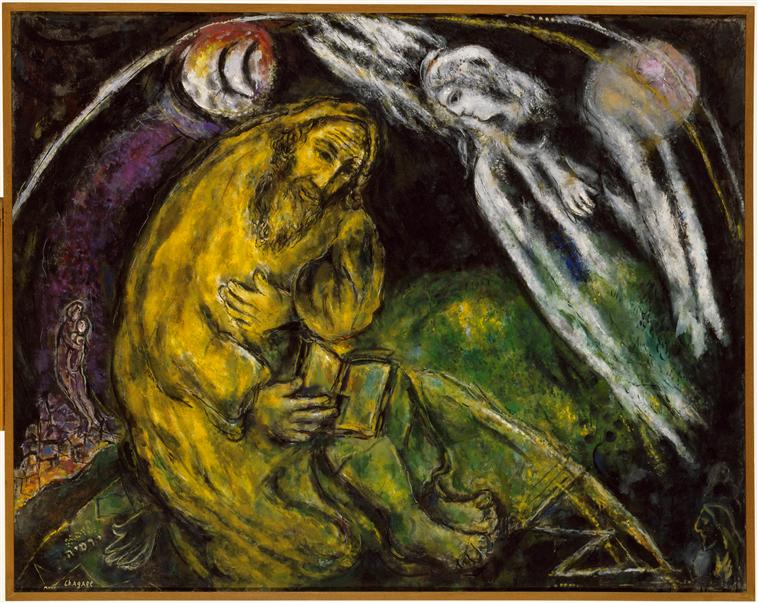
https://uploads4.wikiart.org/images/marc-chagall/prophet-jeremiah-1968.jpg

The year is 1931.  In the United States, the effects of the Great Depression are beginning to take a toll.  In Europe, unease reigns supreme.  The feeble peace brought by the treaty of Versailles still holds, but is beginning to crumble.  Antisemitism is once more on the rise.  As always when times are troubled, a scapegoat is found.  In the lead up to the horrors of World War II, Europe brings back the traditional bogeyman of the Jew.  While it is still years removed from the absolute evil of the Holocaust, Jewish life in Europe feels threatened.

In Italy, Mario Castelnuovo-Tedesco, a famed guitarist and composer of Jewish Heritage is approached by Jascha Heifetz with a request.  Heifetz wishes have a concerto composed for him, to be premiered by himself and Arturo Toscanini.  By 1931, Heifetz is already possessed of fame and glamour he will maintain for the rest of his life.  He has also been a naturalized US citizen for six years.  Castelnuovo-Tedesco accedes Heifetz’s request, and so Castelnuovo-Tedesco’s 2nd Violin Concerto, subtitled I Profeti, is born.  Into this work, Castelnuovo Tedesco channels all his pride in his Jewish Heritage, and all his fear and defiance towards the uncertain grim future.

I Profeti is divided into three movements, each named after a prophet from the Torah (Old Testament).  These movements are, in order:

  1. Grave e meditative Isaiah
  2. Espressivo e dolente Jeremiah
  3. Fiero e impetuoso (ma sostenuto e ben marcato il ritmo) Elijah

While the concerto is generally in minor mode, the final movement Elijah is a rather boisterous march in major.  This, combined with the fireworks in the solo violin may signal Castelnuovo-Tedesco’s optimistic outlook towards the future.  Another, darker interpretation, stems from the religious implications of Elijah’s return.  According to Jewish liturgical lore, Elijah is set to return at the end of the world, at the age of ultimate redemption.  [Side note – every Passover, Jewish Families set aside a cup of wine at Seder for Elijah, and leave a door open for him]  Thus, the celebratory finale may also be seen as a sign of Castelnuovo-Tedesco’s readiness for the end of days.

While the social implications of such a work of art are clear, the political implications may be more obscured.  Unfortunately, both in 1931 and now, Hate is political.  To stand up to it then becomes a poltical gesture in itself.  Castelnuovo-Tedesco was under no obligation to open himself up to further attacks by exposing his Jewishness in such a clear manner.  Yet, he chose to remain true to himself and his heritage.  Often, a work of art becomes more than the simple lines on canvas or sound waves in a concert hall – it becomes imbued with the politics and social standings of its creator.

While a work of art can reflect history, it can not change it.  Castelnuovo-Tedesco’s valiant effort to change his world through his art failed, as history shows.  Persecution of Jews in Italy only escalated.  By the late 1930’s, works by Jewish composers were no longer permitted on the stage or the airwaves.  Castelnuovo-Tedesco’s livelihood is at stake.  In 1939, months before the beginning of World War II, he flees to the United States, where he rejoins Heifetz in California, which has become a hub of the artistic Jewish Émigré community.  He remains there for the rest of his life through his death in 1968, and rebuilds his reputation, composing soundtracks for over two hundred Hollywood films, as well as numerous works for guitar.

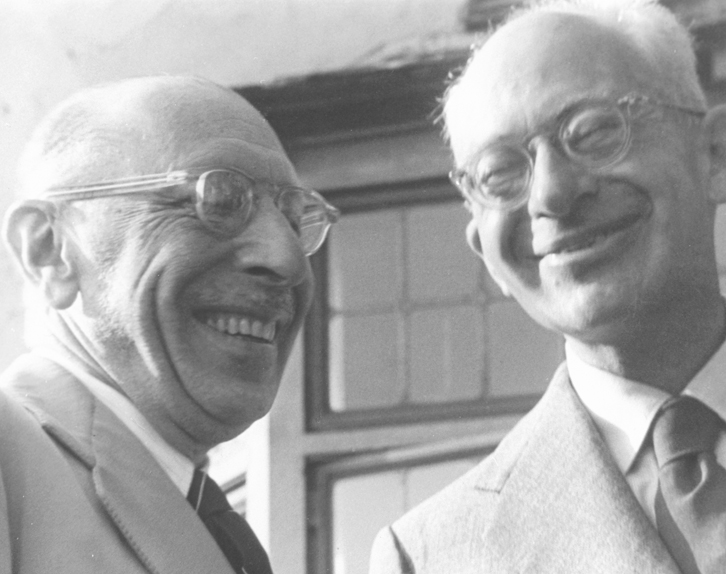
(Castelnuovo-Tedesco with Igor Stravinsky – http://www.milkenarchive.org/artists/view/mario-castelnuovo-tedesco/)

To me, I Profeti holds a special place in the pantheon of works for violin for the defiance that went into its composition.  Castelnuovo-Tedesco refused to be cowed into submission by the forces of hatred.  He chose to celebrate his Jewish Heritage rather than be terrified by the consequences of it.  I Profeti stands strong as a celebration of Jewish Culture and learning, and remains relevant today not just as a work of art, but as an act of political courage.


Sources:

Biography

http://www.milkenarchive.org/music/volumes/view/a-garden-eastward/work/violin-concerto-no-2/

http://www.chabad.org/library/article_cdo/aid/111833/jewish/The-Prophet-Elijah.htm

https://en.wikipedia.org/wiki/Mario_Castelnuovo-Tedesco

Europe in 1931

Elon, Amos. The Pity of It All: a Portrait of German Jews 1743-1933. Penguin, 2004.