
Rock Against Racism: Reaction to Far Right Politics and Eric Clapton in the United Kingdom
A large crowd gathered at London’s East End Victoria Park on April 30th 19781. They came from all over Britain to join forces and support a cause which had become a embroiled in the central struggle of British politics. This struggle was a race struggle thinly veiled as a immigration debate. Political agents such as Enoch Powell and his National Front had, in the years prior, created an atmosphere of xenophobia, hate and White/English supremacy. But there was a reaction to this rhetoric. Rock Against Racism, founded by Red Saunders, was a movement which fought hatred with music. They turned music from a medium of entertainment to a form of political activism. When one looks in retrospect, one might claim that they were central to reclaiming Britain’s youth from the jaws of neo-fascism.
The far right had always been lurking in the back waters of British politics. As far back as the 1920s, fascists such as Oswald Mosley had wielded varying degrees of power and influence2. But ever since the end of WWII support for the far right had dwindled. This was likely due to the increasing radical anti-semitic policy proposals ended Mosley’s Career, the traumatic war against the Nazis and the existence of a centre right party, the conservative party, which contested all elections as one of the two main political parties. However, starting in the late 1960’s there was an unsettling resurgence of Ultra-Nationalist rhetoric entering the mainstream political debate. The main reasons for the resurgence of far right parties such as the National Front was the great influx of immigrants coming from former colonies/ commonwealth realms3. The Troubles, the civil rights movement turned insurgency/ fight for liberation in Northern Ireland, was also a cause for their surge in popularity. They believed in Ulster as an integral part of the UK and advocated for extreme Loyalism in NI. The culmination of this racist populism was a speech given by Enoch Powell (National Front Leader) in 1968. The “River of Blood” speech, as it is now known, voiced Powell’s paranoid concerns that within the century the white british people will become an underclass to the commonwealth immigrants3. While this paranoia is totally unjustified, it resonated with the white working class and lead to a atmosphere of racial intolerance and hatred.
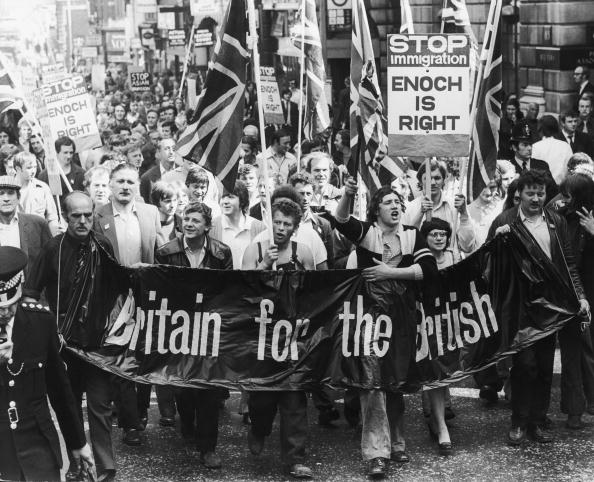

Now with the political context set, we can look at the inciting incident which lead to the formation of Rock Against Racism. On august 5th1976, at a concert in at the Birmingham Odeon,Eric Clapton made remarks which will forever overshadow anything he played that night. Just blocks away from where Powell made his “Rivers of Blood” speech, Clapton went on an alcohol fueled diatribe against the immigrant community and people of colour in general. Below is an slightly censored quote from that night.
“The black w*gs and c**ns and Arabs and f***ing Jamaicans don’t belong here, we don’t want them here”
Clapton then followed up this remark with.
“This is England, this is a white country, we don’t want any black w**s and c**ns living here… Enoch for Prime Minister! Throw the wogs out! Keep Britain white!”4
Drunkenness does not turn someone into a racist, and even if it did it would not matter. Clapton never apologised for his statement that night. This lead to a reaction by a rock photographer and future organizer of Rock Against Racism, Red Saunders . Saunders’ response included a swift denunciation of Clapton, a accurate accusation of appropriating black music and a call to action to support his new found cause1. But why was it Clapton’s comment that prompted such a large response from popular culture and not Enochs Speech? Similarly why didn’t this response come when David Bowie made similar albeit stranger remark a few months earlier? I think what Saunders understood about music was that it had a profound ability to mold the thoughts and outlooks of a generation. It was not so much that Claptons music was overtly racist, but that people felt a deep connection to him due to his immense expressive power. We identify with the artists of our time more so than the politicians of our time. So when Clapton demonstrates his racist attitude openly, it encourages others who feel similarly to overtly convey their attitudes. Furthermore when Clapton does not apologize he vindicates the racists attitudes held by some of these younger fans. This, I think, is what separated Bowie from Clapton, who has since apologized many times and was admittedly under the influence of a lot of narcotics (and Nietzsche?) at the time5.

Western music has been creating cults of personality for many centuries. Since Beethoven, the musician as a demigod has been an unfortunate feature of our musical culture6. However what happens when this elitist attitude transforms from a dog-whistle of white supremacy6 ,suggesting western classical music is superior music written by a superior race, to the bull-horn for fascist ideologies? Luckily in the UK the reaction is the organization of sane people standing up for those who are marginalized. By rejecting the propagators of fascism and reclaiming the idiom of rock the British scene was able to save a generation from shifting two giant steps to the right and played a part in the fall of the National Front.
- https://www.theguardian.com/music/2008/apr/20/popandrock.race
- https://depts.washington.edu/chid/intersections_Autumn_2010/Bret_Rubin_The_Death_of_British_Fascism.pdf
- http://www.telegraph.co.uk/comment/3643826/Enoch-Powells-Rivers-of-Blood-speech.html
- http://thequietus.com/articles/20701-eric-clapton-racism-morrissey
- http://www.playboy.com/articles/playboy-interview-david-bowie
- https://www.nytimes.com/2017/07/30/arts/music/trump-classical-music.html?smid=tw-