
Last week I sat in Kodak Hall as one of my childhood violin heroes played on stage. I couldn’t understand how he was able to produce such a large and beautiful sound that seemed to rip the heart out of my chest. I began to think about how this violinist produced such a large sound and the reason for it. What kind of violin did he have, and what was particularly special about his violin? What went into making it? How did a piece of wood from a tree became a small box that creates beautiful sounds?
There is a belief that orchestral musical instruments are far from any type of technology, but instruments and the process of making them requires more technology than one may think. For example, a tree must be cut down, the wood dried, and then imported to whichever part of the world the violin maker is in. If not already aged, the wood must then be seasoned before luthiers begin their work. Some violin makers require their wood to be seasoned for a minimum of fifteen years. Below is a violin maker with a piece of wood he has been naturally drying and aging for many years.


Once the wood is aged, luthiers are able to begin their work. The first step is the bending of the ribs or outer frame. This requires a bending iron and water in order to bend the wood efficiently. The bending iron temperature should range between 200 and 250 degrees Celsius but other factors apply. These include the type of wood being used and the exact temperature it needs in order to be bent correctly.

The top and back of the violin must be carved next in a process called arching. Modern violin makers still copy Strad and Guarneri models while doing this, as an improved combination of dimensions has still not been discovered. This process is the removing of wood using gouges. Luthiers start with a large gouge and work their way down to smaller gouges in order to achieve desired thickness. When finished, the top must be scraped rather than sanded to provide a crisp and beautiful appearance of the wood. At the end of this process, only twenty percent of the actual wood block ends up being used.

Following gouging, the F-holes are cut in order for air to enter and escape. F-holes give the violin character and can even make the violin look happy, sad, or interesting. One technology that aids in the cutting process is an electric saw shown below.

One of the final steps in violin making is creating the scroll and neck. The scroll is cut out using a saw and hand carved by the maker. This is often when the luthier is able to express his or her individuality and creativity. Scroll carving is usually the only time in the violin making process that a maker can carve freely.
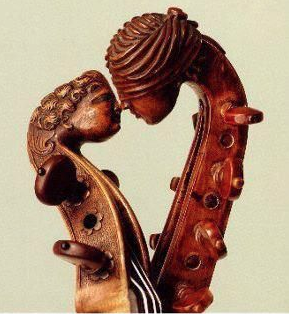
Once the instrument is glued and put together, the final step of varnishing must be completed. Varnish has been known to enhance the tone of the violin while also protecting and giving the wood a beautiful finish. When completed, the varnish must be aged and exposed to sunlight before it can be put into the hands of a performer.

When considering all of the technology and time that goes into making a violin, it’s easy to see why fine handmade instruments are so admired and prized. Even instruments that were made in the last twenty years have had to come from a tree that started growing at least 100 years ago. How did that tree get there and what technologies may have gone into getting it there? Did it grow naturally or did someone plant it? The time it takes to cut, dry, season, and varnish a violin’s wood means that most violins are a lot older than one may think.
One violin maker said that “the violin does not have its beginnings with a musician, but rather with its maker. It can only be used by skillful hands to bring a person into the very presence of God.” With that being said, a violin is a technology musicians can use to communicate whatever they want to be said, using the gift of music which is beyond this world.