Cats and Absurdism

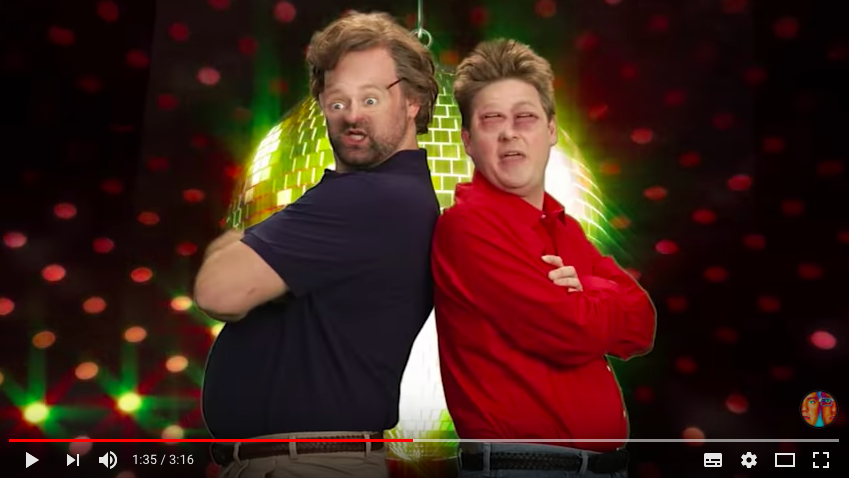
The best part of Thundercat and Eric Andre’s collaboration in the music video for “Tron Song”, is that the images and music absolutely do not combine to create any form of traditionally meaningful or powerful experience. Instead, the video consists of an amalgam Thundercat’s numerous personality quirks slammed together with Eric Andre’s distinctive directorial style and absurdist humor, resulting in three minutes and change of wackiness and tonal ambiguity that both confound and enchant the listener.

A track off of Thundercat’s second album, Apocalypse, Tron Song has all of seven distinct lines of lyrics, with the majority of the track consisting of Thundercat’s chordal bass guitar (emphasis on the guitar) technique, paired with multiple tracks of Thundercat’s floaty falsetto harmonizing over itself. To call the track a ballad is misleading, especially with Flying Lotus’ constantly shifting percussion that occasionally underlines Thundercat, but the feeling behind the track is that of a traditional ballad with the main lines of the hook, “Don’t you ever leave me turbo troooooooooooooooon, Don’t ever wonder where I’m going”, being a loving reference to Thundercat’s cat, Turbo Tron Over 9000 Jesus Baby Sally.

This provides a segue into how a video of this aesthetic even came into existence.  A comedy collective named JASH began a series on YouTube (of which this is the second video) with the simple premise of giving $5,000 and full creative control to a comedian and musician tandem to create a music video. It’s fitting that JASH chose one of the most unique voices in television currently, as Eric Andre hosts quite possibly the most absurd talk-show of all time on Adult Swim. A bonafide master in the art of cringe comedy, low-budget spectacle and all around nonsense (as evidenced by simply the intro of his first show), Andre is the perfect choice to direct for this premise, and pairing him with the most singular bassists since Jaco Pastorius (and one of the most unique personalities in the music scene today) was a great way to extend such as the 5K music video idea.

As for the video itself, low budget is the name of the game as Eric Andre uses effects to create tape glitch or distorted effects, reminiscent of schlocky 90’s b-movies that you would find on VHS in the back of a video store. This could easily come off as gimmicky if it weren’t for the fact that Thundercat looks and dresses like a character straight out of a 90’s B-movie with hair in every direction and a wardrobe that defies any conventions, ranging from varsity jackets to Vegeta’s armor from the TV show Dragon Ball Z. If there was any doubt over the nonsensical direction this music video would take, Andre eliminates it by cutting in an image of Thundercat playing his bass on backside where there are no strings in the first thirty seconds. The breaking point in the video is around the 40th second where Thundercat’s discovery of a handgun (and subsequent suicide?) in a human-sized litter box coincides with Flying Lotus’ drum pattern crashing in. The following images that range from police brutality to Thundercat traveling through Tron’s anus into space to defecation and sexual acts in the aforementioned litter box are almost to an extent disturbing, especially considering the cute quirkiness of the first half a minute. Herein lies Eric Andre’s brilliance though, as he employs a technique he used to make his talk show a viral hit. Andre takes a pre-established format familiar to the average person (such as a talk show, or in this case, a typical love song video), but throws out every semblance of internal logic and coherence, instead attempting to provoke simply any type of reaction, be it disgust, incredulousness or anger via increasingly absurd images. This type of direction and aesthetic is perfect for Thundercat, who as a bassist also capitalizes on a level of incredulity and subversion. The traditional bassist plays on four strings, single notes, and for the most part is part of the background and foundation of the music rather than the ornament. Thundercat turns all of these standards on their heads, playing a six-string bass in a very guitar-like matter, with outrageous eye-catching clothes and a penchant to very rarely play on the low-end of the instrument (similar to his perpetual falsetto), all of which serve to emphasize the absurdity of his existence as a musician.

As for Youtube’s response to the video, the majority of people appear to already have some knowledge of either personality involved so this portrays their general reaction after watching the video.

Some people though, such as Unreal Psycho, are more perplexed that there was any money involved, asking, “where’d the 5k go to?”. In all actuality, my guess would be that the most expensive aspect of the video was having to buy the rights for the outro where Andre’s head blows up and Mortal Kombat’s classic FATALITY is said. Past that, the most expensive part would probably be buying a chroma key program (not expensive) to impose Thundercat playing bass over weird locations.

Jesse Smith states: “fuck this man. This is him just messing around, but the melody is life threateningly good”. I can’t exactly argue with this logic, but I’m not sure what Smith was expecting since none of Thundercat’s previous artistic output has ever been extremely self-serious.  His whole artistic personality is based off of tongue in cheek humor and sarcasm. Finally, with a more serious comment attempting to process the track itself, Hambloko says, “really digging the chord progressions. It’s like Prog R&B”. In general, I feel as though attempting to categorize someone as unique as Thundercat just ends up in redundancy, giving people both expectations that are impossible to fill, since Thundercat doesn’t fit into any category perfectly, while also possibly turning off potential listeners, especially since genres like Prog have a somewhat elitist and indecipherable connotation. He is right that the chord progression is dope though.


Opportunities for further exploration:

Or any other Eric Andre skit or interview (there’s plenty of compilations on Youtube)

An interview to get a better idea of Thundercat and his beliefs in music and life

Hannibal Burress and Chance the Rapper’s JASH video

 

Totino’s Pizza Rolls: A Postmodern Adventure Great Job!

Summarized in this article beautifully as a video in which “grown men … dance to shrill synth beats while eating Totino’s pizza rolls out of a tiny pink backpack,” comedy duo Tim Heidecker and Eric Wareheim’s commercial for Totino’s pizza rolls depicts an authentic and successful marriage between image, music, sound, and editing — a true multimedia experience. After all, as the comment below reminds us, this is a real commercial:

Totino’s actually paid Tim and Eric to create an advertisement featuring their product, and they’re not the first ones to do so (check out these pieces for Absolut and Old Spice). But what exactly is the fine line that separates this masterpiece from a Mountain Dew-fueled fever dream of a last minute assignment thrown together the night before a freshman English presentation?

There’s definitely… a lot to unpack here. Much of the ad’s effectiveness lies in incongruity theory, or the idea that part of what makes something funny is presenting the unexpected. In his Critique of Judgement, Immanuel Kant writes, “In everything that is to excite a lively laugh there must be something absurd.” 

Incongruity theory hard at work

This definition of incongruity theory also touches on irony, which derives power from an awareness of what is expected and plays off of that expectation by subverting it. Much of Tim and Eric’s humor relies on this principle, often pushing past a primary boundary into the absurd. The juxtaposition of a tiny pink backpack on a grown man, for example, is ironic enough, but in the segment from 0:28-0:35 the team takes it further by cutting away from the scene and labeling this backpack as a “Feminine Pizza Bag.” In this cut scene, Tim and Eric are made tiny and the tiny pink backpack is made huge, with the duo standing on top of it. This takes the juxtaposition one degree further — using something that already lies outside a norm (shrinking a backpack and putting it on someone who you would not normally see wearing said backpack), pinpointing some aspect that makes it weird (it’s really small!), and then inverting that quality (let’s make it large and put Tim and Eric on the bag instead of putting the bag on Eric), then sequencing those two visuals back to back to back. This happens in a span of less than ten seconds, which is not a lot of time for your brain to consciously grab on to all of these intricacies, further playing into the absurdity of it all.

Tiny Tim Feat. Big Backpack

Repetition is another powerful tool throughout the video. From an auditory standpoint, the chorus “Totino’s, Totino’s, how did you know!” comes and goes throughout the video in various forms. It opens with the original iteration in the exposition, but later revisits Tim and Eric in a greenscreened kitchen just chanting “Totino’s” over and over. In fact, thanks to a transcript provided in the comments by user HannibalOrJustRex, we know that the word “Totino’s” comes up no less than 29 times. The majority of this repetition is concentrated near the end of the video, which devolves into an Einstein-on-the-Beach-esque chorus of “Totino’s,” “Whoo” (from Tim), and “Yeah” (from Eric), before a closing word from Hard Rock Joe and a final “Whoo/Yeah” from Tim and Eric, respectively. This progression from coherent nonsense distilled down to the most basic dialogue consisting solely of product name and cheers of enthusiasm falls under that same umbrella of absurdist incongruity theory, but does so in a way that still abstractly relates to the original topic at hand (Totino’s = Good). From an advertising standpoint, it also sends the subliminal message tying the product (Totino’s) to a positive reaction (Whoo/Yeah), which strengthens the overall effect of the work.

Visual repetition is an equally powerful element at play. The video opens and closes with snippets of Hard Rock Joe talking about his love of punk bass and pizza rolls over a green screen backdrop of a dimly lit brick room. Whenever we see Hard Rock Joe by himself throughout the video, it’s in this setting, and the three principal scenes in this setting are the very beginning, middle (1:35), and very end. Repetition abounds within a lot of these recurring green screen backgrounds — take the layered pizza one at 0:15 (which comes back at 0:25 and 1:15), or the cut and paste city assembled from a combination of pizza rolls, party pizza boxes, and standard run-of-the-mill pizzas at 0:27. The pizza with holes cut out of it here is actually derived from the pizza mask the unnamed woman wears in the exposition at 0:08, and resurfaces in the backdrop at 2:28 (as evidenced below).

Pizza Mask, Upper Right
Pizza Mask, Original
Pizza Mask Returns (also as a bonus, note the face swap of Tim’s head on Eric’s body and vice versa)

A similar repetition out of context can be found with the glasses Eric wears in the pizza chess scene — we saw a cut and paste version of those on Hard Rock Joe near the beginning (0:22). And there are plenty of scenes with duplicates of Tim or Eric — we have three Tims on screen at 1:32, five Tims at 1:59, and three Erics at 2:32, for instance. There’s also two separate scenes where each sings with mouths replacing their eyes — Tim at 1:35, and Eric at 2:29. 

Tim on the right (sans eyes but with triple the mouths)

 This repetition of image and sound provides us with a sense of formal structure throughout, however abstract, whether it’s revisiting Hard Rock Joe in his punk bass dungeon, repeating a backdrop as with the layered pizzas, or repeating a word or phrase. This purposeful reuse of previous material, no matter how fleeting or subtle, provides a thread for our subconscious to follow, which is what allows us to view the whole thing as a (somewhat) coherent single entity as opposed to a string of random unrelated vignettes. Again, this is all presented in a very fast paced manner, not something we consciously pick up on but rather dependent on the fact that the human brain is hard-wired to detect pattern and repetition. 

Art is hard sometimes

A lot of the time we hear responses to contemporary art (and by extension contemporary music) like, “My kid could do that — so unimpressive,” or “I can’t tell the difference between that and garbage,” or “What’s this doing in a gallery? That’s not art!” These reactions imply a few things. First, that the artist is not talented; consequentially, that a determining factor of “talent” lies in how easy it is for the viewer to “get” the meaning at first glance; and finally, an output fueled by anger at the museum or concert hall or whatever space said piece of art finds residence for allowing that piece of art to be put on display. To me, comments like this are a visceral negative response that allow the (often narrow-minded) viewer to maintain a sense of superiority, maintain power in an unfamiliar context, and maintain the same worldview they had before it was challenged by the idea that something different or hard to understand could have something powerful and relevant behind it. In the words of this Guardian article, that’s a big part of what makes Contemporary Art art: “As long as someone thinks modern art is rubbish, it is still provocative. It is still dangerous.”

A lot of the negative reactions to Tim and Eric’s work (the Totino’s advertisement being no exception) contain a similar veiled anger. One comment reads:

And to an extent, he does have a point, with regard to timing. I don’t think this kind of humor would have resonated as strongly 20 years ago, and it also seems to resonate better with younger audiences than older demographics. But the reason this dynamic duo finds success is because the “nonsense” they put out is so carefully not random. It toes the line between expectation and absurdity in a way that plays with your head but still leaves you with the impression that you’ve watched some abstraction of a single idea, as opposed to a disparate smattering of screenshots and soundbites of unrelated material. It provokes a powerful reaction from most people because there is intent in the execution and coherency in the concept, no matter how absurd that concept might be. That, to me, is the mark of something great: the ability to evoke a strong emotional response, and make people think, whether or not that response is positive or negative.

Roland TB-303 and the rise of Acid House and Techno

Very few electronic musical instruments have left such a lasting impression and influence as the Roland TB-303. This “synth” machine was released in  1982 and marketed as an accompaniment machine for guitarists.  It was quickly written off as a failure due to its unrealistic distortions and confusing interface. The release of this bass machine synthesizer was so poorly received that production was halted in 1942 after the production of a mere 10,000 units. Despite its low price of $400, many groups complained of its unnatural sound which could never duplicate the human intricacies of a bass player.

“The switches and control knobs have several functions, so operating the TB-303 may seem a little complicated. You may find difficulty using the TB-303 at first, because it is so different from a bass guitar or keyboard instrument. There, this manual includes a basic, intermediate, and advanced course to help you understand these operations step by step. However, each individual operation is quite simple, so take your time and master each step.”

-This quote is taken directly from the Roland TB-303’s 1982 user’s manual.

Interestingly enough, the confusion and uselessness it afforded to the guitarists for whom this machine was created led to its ready availability in pawn shops and second hand stores across the country. The cheap and interestingly designed machine caught the eye of many garage-based producers and mixers in impoverished areas across the country. No where was this machine’s impact as immense as in Chicago’s  House and Electronic underground.  A few producers, most notably Chicago based Dj Pierre took this machine’s idiosyncrasies and fashioned  an entirely new bass beat, in effect creating a  new genre of electronic music.

“‘Acid Tracks wasn’t pre-programmed man… DJ Pierre, he was over and he was just messing with this thing and he came up with that pattern, man…So we were listening to it, getting drunk, man. “Hey, this is kinda hot, man. This is a great mood man. Let’s put it out””

-producer Marshall Jefferson

The Roland TB 303 features a keyboard spanning an 8va range, and a total of 6 knobs which control various effects. The machine also left producers to choose wether to work with a saw waveform, a complete revolution and distortion of the traditional square waveform.  When innovators such as DJ Pierre began using these controls to distort and augment simple baselines, they realized the “slippery” and completely new sound world the Roland made accessible.

These “slippery” sounds can be  heard in one of the most revolutionary works in contemporary music in history, the Dj Pierre produced ‘Acid Tracks” This new sound confused audiences at first, but after a few months, this track gained massive support in the underground rave scene and many more Chicago based Djs began to champion the Roland TB-303 and its new soundscape. This new sound in traditional Chicago House was dubbed Acid House, taking its name from the pioneering Dj Pierre track. This popularity spread as far as Britain by way of Ibiza where Acid-House beats reached main-stream popularity, in part aided by the Rave culture of the 1980s and 1990s.

Acid House’s focus on subtle evolution of a beat, and otherworldly sounds quickly became synonymous with the club drug culture already in its peak by the mid 1980s. Drugs like MDMA (known as molly, ecstasy, XTC etc.) LSD, Ketamine and others, quickly became synonymous with the scenes in which Acid House was dominant as the shifts and insistence of its sound provided an excellent compliment to many of these illegal drug’s effects. This led Acid House, by way of the Roland TB-303’s quirky unrealistic sounds, to become the soundtrack for the cultural revolution and  decadent freedom of the era.

“Back in the 80s those early acid records spoke about alienation , they said square peg round hole , the surrounding records were almost gospel like messages of hard times and hope , quite churchy. Or euphoric weekend escape Anthems like Someday ‘Aint no Stopping us now’,they had R n B roots. Something like Phuture or Adonis hit the spot for me with insistent abstraction, it was outsider music with pure energy, it had cut from the line of history, it was a page turned, a clean page. These machines meant we all had the same accent ,previously a UK record and a US record, or a Belgian record or a Dutch record all had an accent musically speaking, Roland was an esperanto.”

-Graham Massy, producer

Acid House’s dominance in the world of electronic and mainstream music came to an end almost as quickly as it rose. By July of 1989 Acid-House had faded into the mid ground of electronic sounds, but this was not before it had influenced the next generation of music. Mainstream dance pop was not immune to the Roland’s new sound, most notably the Madonna track “Ray of Light. New genres like trance, techno, big beat,  and trip hop can all be directly traced back to experimentation with Acid House tracks.  It’s influence is still incredibly apparent today, with many almost exact physical clones on the market, and numerous software dupes. Little did anyone know that this initial market failure, and quirky little piece of confusing plastic would change the face of pop culture in such an extraordinary way.

Fretting over the past

Always known to have a flair for the dramatic, Jaco Pastorius’ 1962 Fender Jazz bass was aptly named the Bass of Doom. Although no one except Jaco knows the origin of the name, as a fellow bassist, one theory I have is simply the awe and terror (of inferiority) instilled in other musicians who witnessed the combination of Jaco and the instrument while on stage.

EXHIBIT A (feat. The Bass of Doom):


Besides the ridiculous chops and musicality displayed in this performance (he flips the notion of people talking during a bass solo on its head), one of the most striking aspects of this video is the warm, fuzzy tone that Jaco produces. Electric basses typically have a defined low-end with precise pitches, such as all fretted instruments, but the distinguishing feature of the Bass of Doom is its’ fretless nature, allowing fluidity between pitches and Jaco’s ability to make the bass sing via vibrato. Legend goes that Jaco found the Jazz Bass for $90 at a pawnshop sometime around 1970 and decided to take out the frets with a butter knife and replace them with polished pieces of “plastic wood”, then finishing the fret(less)board with a few coatings of boat epoxy, thus creating the first fretless bass.


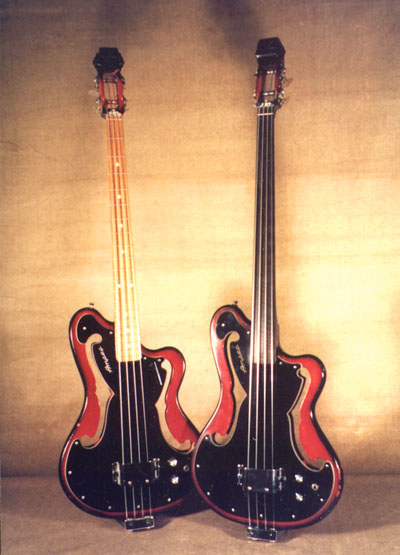
As is the case with many folk-heroes and tales though, these facts are widely disputed, with the possibility that Jaco’s bass may have already been fretless when he purchased the instrument. Not only is the origin story possibly fabricated, but there are also contradictions over the origin of the fretless bass that all come down to a person’s opinion on what defines a fretless bass rather than who was the first to invent the instrument. The following image is of Ampeg AUB and AEB basses made circa 1968, at least two years before Jaco’s “discovery”,and it is apparent that the inspiration for the bass’ design comes from the electric bass’ ancestor, the contrabass (which could be argued is THE original fretless).

From the scroll-like headstock to the ebony fingerboard, both instruments look like and sound like a miniaturized version of an upright. Not only was Ampeg producing them around 1966, but according to Billy Wyman of Rolling Stones fame, “… I made a bass in 1961, before I joined the Stones, and it was a fretless bass. It was the first fretless bass ever made. I didn’t know that at the time, and I didn’t know that until 10 years ago. It predated fretless basses by about five or six years”. Rumor has it that the bass he had purchased was buzzing due to the frets so he decided to take them off. The issue here is that all we have to take for the validity of the claim is his word rather than recorded performances or videos of him with said makeshift bass. These differing origin points are where some debate comes in, as the Ampeg AUB and AEB are obviously derivative of upright basses, while Wyman’s choice was pragmatic in response to a functional issue but had no lasting impact. Jaco’s decision may have been a mixture of both due to his jazz background and influences and the questionable quality of pawnshop purchases, or it may have just been a stylistic quirk, the kinds of which he exhibited so often throughout his career. The main distinguishing factor when discussing any type of bass though is the tone, and any modern-day listener will instantly point to Jaco’s warbling, growling sonorities as the definitive fretless tone, even if it was not necessarily the “first” fretless, or a traditional fretless instrument.

As with so much of rock lore and history, stories are passed down via word of mouth for decades, resulting in tales that are irresistible but also sometimes easily refuted by the internet. While the anecdote about Jaco’s Bass of Doom being the original fretless may not be wholly true, it speaks volumes to how history is written, with the age-old adage of how the “victors” are the ones who write history. These conflicting origin stories pose some interesting questions about how the history of certain innovations is recorded. Does it matter who officially invented a technology if that person is hardly relevant to the cultural impact of said technology? Or, is it wrong to mythologize the origins of certain innovations if there’s an educational purpose behind it? While Jaco in many cases was no victor, in a sense, the history of the fretless electric bass begins and ends with him. Any person who performs on a fretless bass is instantly compared and contrasted with Jaco, similar to Michael Jordan’s shadow hanging over every single NBA superstar. The role of the fretless electric bass in any musical context is so entwined with Jaco’s legacy that even though the fretless had a precedent before the 70’s, it was Jaco and his eponymous debut album in 1976 that led instrument producers to market and produce these fretless instruments while also inspiring legions of bassists to pick them up in efforts to imitate him.


Further exploration:

Jaco Pastorius (Eponymous Debut Album)

Rick Danko (bassist for the Band, on left in yellow jacket) utilizing an Ampeg AMUB-1 Bass