Symphonies and Cyphers: Exploring the Relationship between Power and Presentation

In this New York Times article, music critic Anthony Tommasini discusses the political implications behind Trump’s recent remark that “we write symphonies” as an indicator of cultural superiority. Tommasini further laments this comment, making the point that, “Nothing impedes the appreciation of classical music — and keeps potential listeners away — more than the perception that it is an elitist art form.” The troubling political implication behind this comment, of course, is that Trump is using an art form that he probably in reality knows very little about in order to prove a point of western superiority over other (particularly Islamic) cultures. Trump is, after all, not the first person to exploit Western classical music as a symbol of cultural superiority, and symphonies certainly weren’t written with the intention of being used to showcase this assertion. But it also touches on a concept that’s interesting from a societal standpoint: who (or what) really holds the power within a piece of art? Is it in the art itself, the so-called “experts,” those who hold political power, or with the artist?

Regarding this question, I am reminded of another article I read a while ago on NPR featuring an interview with Sophia Chang — you may have never heard of her, but she’s the total badass management genius behind a lot of early hip-hop stars including A Tribe Called Quest, Q-Tip, RZA, GZA, D’Angelo, and Joey Bada$$, among others. Chang is a powerhouse, a fact made clear from her resume and her no-nonsense tone throughout the article. At the same time, though, she makes it clear that hip-hop is an art form that she loves but is aware does not belong to her or her heritage. She states, “I was welcomed into hip-hop. This was not my house. I didn’t build this house. This wasn’t my culture. I was brought in, and I was welcomed. And that’s an honor.” Hip-hop provides a voice and an outlet for a group of people who are generally marginalized by larger Western culture, which is part of the reason it’s such a powerful art form. Hip-hop and rap are also genres often viewed negatively, for both lyrical content and musicality — Keith Richards says it’s music for “tone deaf people,” and Bob Boilen, host of NPR’s All Songs Considered, can’t relate to it because he feels “the crux of the music is focused on the words and if the words don’t relate to the listener then it’s all is a big disconnect.” Chang, on the other hand, says the following about what drew her to hip-hop in the first place:

It was certainly before social media, so the way that we experienced it was together and in person, right? So I wouldn’t go on and I wouldn’t live stream what’s going on at the club tonight. I actually have to be there. And you wanted to be there because you knew you were gonna see your friends, and you would talk about the music and you would experience it together. It was — it was truly remarkable. It was really a privilege. It was fantastic to be in there and be part of it.Sophia Chang, on the club scene in NYC during the rise of hip-hop and rap in the early ‘80s

So for Chang, this music is powerful to her because, among other things, she holds an emotional tie to it. It’s vibrant, alive, and something she was able to see evolve right from its start. In this interview, as well as in the aforementioned one, even her tone of voice reflects her love of everything involved with what makes hip-hop culture its own. She also treats it with great reverence and respect, and recognizes that her job as a manager is to facilitate the artists, not to be the creator herself. In her own words, “I’m a manager. I am in the service industry. The service industry. I’m Midas f****** Muffler. You come to me. You pay me to fix your muffler. I’ll do it, and you’re gone. I’m not — I’m not the car. I’m not the star. That’s not what it is.” Hip-hop is something that helped shape her identity and something she ties to experience, as opposed to the naysayers cited above, who don’t have any emotional attachment to it or a means of contextualizing the music as something they understand. 

Later in the Times piece, Tommasini (himself an avid classical music fan and critic) clarifies that even though he believes classical music is not elitist, “the art form is certainly ambitious and demanding. It asks for your time and attention. Even a 20-minute Haydn string quartet requires you to focus in order to grasp the structure, content and character.” To me, this provides us with somewhat of a contradiction — though Tommasini has specified that he does not believe classical music to be inherently better or worse than any other genre of music, this comment separates classical music as more complicated music, something difficult to digest and hard to listen to, which is an element not specified explicitly in the context of other music: he briefly mentions Eleanor Rigby, but only speaks about classical music in-depth. Even though he has to go back and clarify he doesn’t actually find it superior, it comes through in his writing all the time that he genuinely loves classical music and likely prefers that genre over most others, which makes sense considering his background. And I think the reason for this likely has more to do with the fact that Tommasini is a classical music aficionado as opposed to a hip-hop mogul, and less to do with the idea that he believes other music to be inferior — after all, he asserts an explicit stance throughout the article refuting that assumption.

The parallel I see between Chang and Tommasini is that both of them are incredibly passionate about a specific genre of music and have significant power in their respective positions regarding those genres, but at the same time their influence is not necessarily directly inherent to the creative process but instead in influencing how an artist’s product is perceived by their audiences. People turn to classical music critics like Tommasini to help guide them in what to listen to. Tommasini’s power as a critic lies not in the creation of classical music but the re-contextualization of it as well as his accessibility through a popular large scale publication. Similarly, Chang’s power lies in a behind-the-scenes service role, recognizing talent and helping that talent become its most successful possible realization in a final artistic product. The difference is Tommasini deals mostly with works of dead people being reimagined by living people and facilitating a conversation about these time honored works, while Chang’s whole career was based on her having a knack for managerial skills an ear for talent, and a drive for success in an entirely new genre of music from its inception in the early 1980s. Though the artist is certainly the reason we have what we have accessible to us to hear, just as important and arguably just as powerful are those working behind the scenes who get the word out and tell us what’s out there and what of that is important to actually sit down and listen to. The power in art often lies just as much in the piece itself as the manner in which it is presented.
The Powers That Be

“Let me tell you the story of Right Hand, Left Hand. It’s a tale of good and evil. Hate: it was with this hand that Cain iced his brother. Love: these five fingers, they go straight to the soul of man. The right hand: the hand of love. The story of life is this: static. One hand is always fighting the other hand, and the left hand is kicking much ass. I mean, it looks like the right hand, Love, is finished. But hold on, stop the presses, the right hand is coming back. Yeah, he got the left hand on the ropes, now, that’s right. Ooh, it’s a devastating right and Hate is hurt, he’s down. Left-Hand, Hate, KO-ed by Love.”

(Actual song starts around 2:00, music video by Spike Lee)

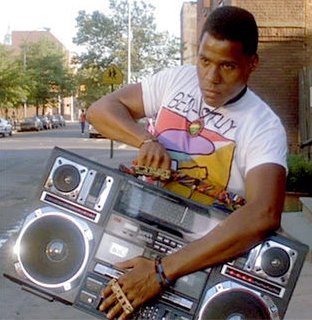
So goes one of the only main monologues attributed to Radio Raheem throughout the film Do the Right Thing. Instead, he spends most of his time cruising the streets of Brooklyn, radio in hand blasting Public Enemy’s “Fight the Power”.

Fight the Power was commissioned by Spike Lee, specifically for the film. The song takes the refrain of a classic Isley Brothers tune and turns up the energy and rhythmic impulse past 10, resulting in an anthem of protest and unity. Fight the Power’s release is a pivotal moment in the development of hip-hop, with Public Enemy injecting political and social values into the nascent genre of hip hop while combining with Spike Lee’s film to create a unified form of social protest for a restless youth population, forever cementing hip-hop as a unique way to combat social institutions.

In the article, “Does music trump politics”, Lamell, an organizer of a community orchestra who hired a controversial political talk show host to conduct a Haydn symphony, states that, “music and politics ‘are two entirely different worlds: Political discourse is one realm, and music is another realm”. While this may be true for some forms of absolute music, the logic behind this statement blatantly ignores the composer and (more importantly), human behind the piece, not to mention the performers who bring that piece to life. Political ideologies perpetually affect every decision humans make, even if this filter occurs unconsciously. Not only that, but this statement also appears to be made under the assumption that only Western classical music is worth acknowledging as “music” because anyone who has been living in America within the past half a century has witnessed politics as a hotbed for music, not just in hip hop but the entire punk movement (notables such as Bad Brains, Dead Kennedys) as well as folk music with Crosby Stills and Nash, Neil young, and Bob Dylan just to name a few. Both Spike Lee and Public Enemy resoundingly reject this idea of fine arts simply being an escape from everyday life, with astute portrayals of urban cultural conflict and unified protest respectively, specifically revolving around power and its’ abuse. In the words of prominent African-American author, Ta-Nehisi Coates, “All the world’s boomboxes were transformed into pulpits for Public Enemy. Before now, the music was escapist and fun– some beats and the dozens, fat chains and gilded belt-buckles. But Chuck D pulled us back into the real….. Here in Baltimore, brothers would put on the Enemy and recoil. We had never heard anything so grating–drums crashed into whistles, sirens blared off-beat. But the cacophony was addictive and everywhere”.

To understand Fight the Power, first one must understand what the hook, “Fight the power, We’ve to fight the powers that be” actually means. It’s easy to take the line at face value and assume that Public Enemy is simply calling for retaliation against any and all authority but instead the line is referencing the systematic abuse of power by those in positions of authority, and how these systems keep the poor and rich (many times along racial lines) disparate. Off of the second verse the lines, “People, people we are the same, No we’re not the same cause we don’t know the game, What we need is awareness, we can’t get careless…” reinforce this concept. Even groups such as NWA (who formed slightly after public enemy but had songs like Fuck the Police that were released before Fight the Power) who had traces of socio-political message hadn’t fully capitalized on how unique of a position hip-hop was in to educate and unite African-Americans, and this mentality coincides with Mike D’s belief mentioned earlier in the second verse, “What counts is that the rhymes, Designed to fill your mind”.

So what exactly is it about Fight the Power that made it so anthemic for millions of people? Firstly, is the song’s (as well as much of early hip hop’s) roots in African American culture, specifically through the use of samples as well as shout outs like, “Sound of the funky drummer” in reference to the James Brown song (a break beat responsible for an unfathomable number of hip hop beats). A cursory glance at the song’s WhoSampled page (a site that breaks down both what samples are used in hip hop songs as well as the ability to look at the various ways in which a single song has been sampled throughout history), brings up names such as James Brown, Isley Brothers, Sly & the Family Stone, the J.B.s, Bob Marley (I know, technically not African American), and Syl Johnson, a who’s who of progressive black artists. Pair these reworked cultural touchstones with scathing lyrics such as,

“Cause I’m Black and I’m proud
I’m ready and hyped plus I’m amped
Most of my heroes don’t appear on no stamps”

and,

“Elvis was a hero to most
But he never meant shit to me you see
Straight up racist that sucker was
Simple and plain
Mother fuck him and John Wayne”

and it becomes easier to understand why this resonated with millions of young black people in the 1980’s, especially after epidemics such as AIDS and the war on drugs that destroyed urban areas had been mishandled by the powers that were. While the Elvis line is a bit of hyperbole considering Elvis himself was respectful to his African-American inspirations (admitted to here by Chuck D), the line is supposed to convey the frustration that for  the majority of America, Elvis was the be all end all of rock music, blocking out any recognition of all of the African-American musicians that preceded and inspired him. John Wayne on the other hand had this to say in a Playboy interview back in 1971, “I believe in white supremacy until the blacks are educated to a point of responsibility. I don’t believe in giving authority and positions of leadership and judgment to irresponsible people”, so the bitterness is understandable.

(Spoiler alert for Do the Right Thing ahead)

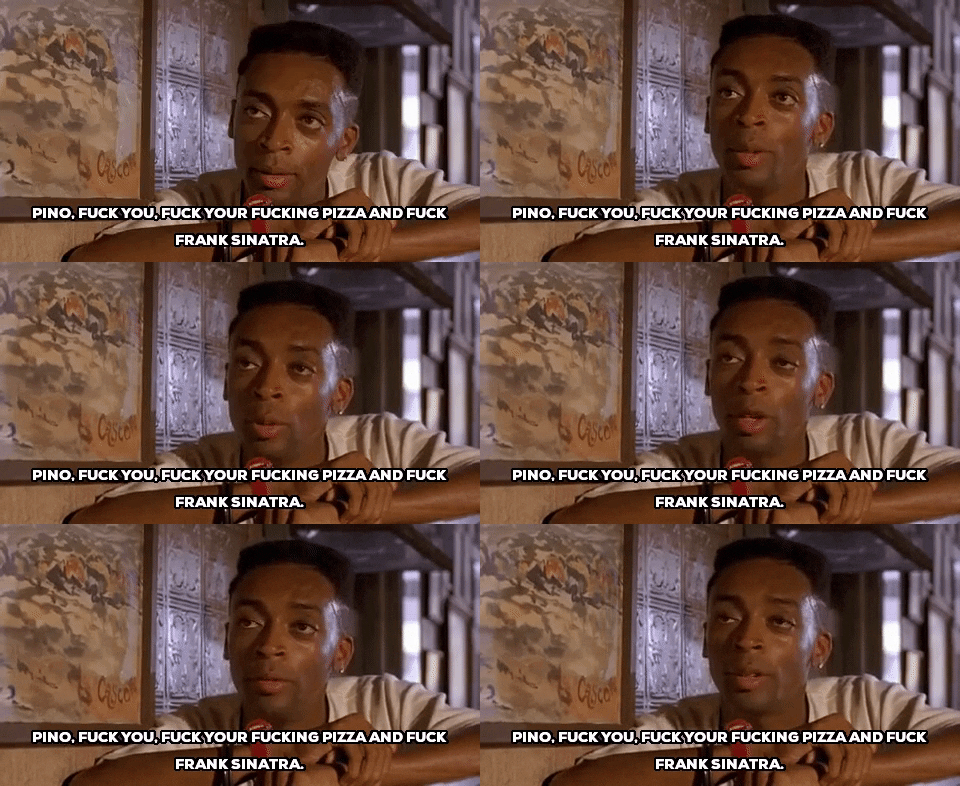
The culmination of all the events in Do the Right Thing leads to a showdown in the only pizza joint in the neighborhood owned by a white Italian family, with a riot catalyzed by the shop owner breaking Radio Raheem’s box with a baseball bat due to his refusal to turn the hip-hop off. This is a mightily simplified version of a very complicated film, yet serves as potent foreshadowing by Spike Lee of both the power of hip-hop as a social statement as well as the apprehension and fear it caused when it first started becoming popular. While the summer of 1989 was maybe not the first moment that politics and hip hop intertwined, it served as a visceral introduction for mainstream America to a very frustrated and very vocal group named Public Enemy.

Further Exploration:
-Do the Right Thing (film)
-http://www.npr.org/event/music/560379652/the-roots-feat-bilal-tiny-desk-concert (very current example of hip-hop and politics)
-Fear of a Black Planet (album by Public Enemy)