Britten’s War Requiem as a Critique of War

Commissioned for the 1962 reopening of Coventry Cathedral, which was destroyed during a World War II bombing raid, Benjamin Britten’s War Requiem offers a critique of war while still maintaining a mournful setting with a traditional Latin text. Britten, a conscientious objector, vehemently adhered to the principles of pacifism and his critique of war shines within this opus through the addition of Wilfred Owen’s poetry. Owen, a soldier, wrote scathing poems about his wartime experiences and his opinions on war. The combination of the traditional Latin text and Owen’s poetry along with Britten’s setting merge within the work to create comforting, mournful environments or these elements contrast drastically forming sharp oppositions, demonstrating the composer’s opposition to war. In addition to textual tension, the personnel and venue of the premiere further the anti-war statement particularly though the hiring of nationally diverse soloists. Britten’s War Requiem acts not only as a lamentation of the dead, but also speaks as a reflection of Britten’s pacifist beliefs shown through the text setting and the premiere.

The texts employed in War Requiem make an anti-war statement through the juxtaposition of the traditional Latin Mass of the Dead and nine poems by Wilfred Owen. Wilfred Owen is revered as one of the greatest war poets; he served in World War I, losing his life one week before armistice day. Throughout the work the texts create tension through opposition and this tension is particularly poignant in the third movement, The Offertorium, scored for boy’s choir, chorus, and tenor and baritone soloists, organ, chamber orchestra, and full orchestra. The movement begins with the boys choir singing Domine Jesu Christe, followed by the juxtaposition of Quam olim Abrahae and Owen’s “Parable of the Young Man and the Old.” The combination of these texts and ensembles demonstrate an anti-war belief through the usage of a boy’s choir, representing the men lost at battle. Wilfred Owen’s Parable of the Old Man and the Young sharply critiques war and the attitudes of national authorities on young people, particularly men. Within the poem, Owen refers to Abraham as Abram, defying Genesis 17:5, the bible verse in which God changes Abram to Abraham because He states “a father of many nations have I made thee.” Besides the name change, the beginning of the poem derives directly from the biblical text of Genesis 22, particularly the King James Version, until the angel telling Abraham to sacrifice the ram instead of Isaac. In Owen’s poem, the angel points out the ram caught in the thicket and refers to it as the “Ram of Pride.” No such reference exists within either version of the bible, and Abraham finds the ram on his accord in the parable, though he knows God provided it. In the poem, Abram rejects the slaying of pride and chooses to murder his own son instead. Instead of sacrificing pride, he opts to kill his offspring, presenting Owen’s views on the world powers’ decision to continue the war rather than end it. Owen offers Abram as a representation the world powers, unfit as the fathers of nations and choosing to kill the youth rather than sacrifice pride, represented by the ram. In contrast to this, the Latin text of the offertory of a Requiem, lauds Abraham as the father of all nations in Quam olim Abrahae and prays for the return of souls to the holy light. Towards the end of the movement, after the slaying of Isaac in the poem and “half the seed of Europe one by one,” the Latin text returns, praying for the sacrifices offered to be accepted for the salvation of the lives recalled during the mass. This creates a vicious cycle of slaughter in which none survive and none are saved, an argument in accordance with Britten’s pacifist views. The juxtaposition of the old Latin text and the newer poetry of Owen creates an irony of an inescapable vicious cycle to which, Britten argues, half of Europe’s young men fell victim during the two world wars.

The premiere of the work was intended to further demonstrate Britten’s pacifist beliefs through venue and personnel. The piece was commissioned for the reopening of Coventry Cathedral, originally a fourteenth century structure
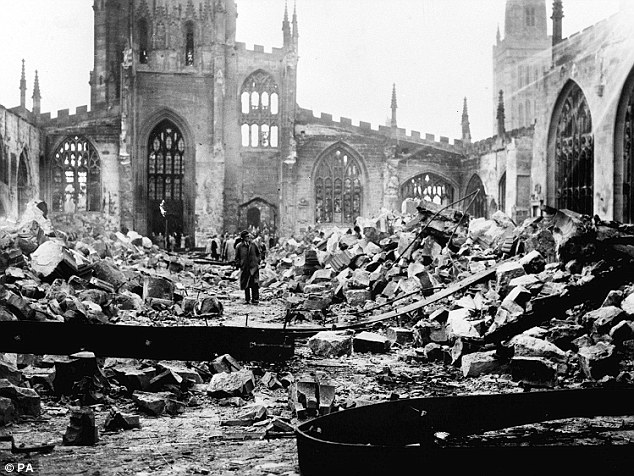
Coventry Cathedral after bombing; 1940.


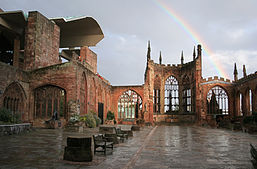
Coventry Cathedral at reopening; 1962. It maintains the bones of the destroyed structure while rebuilding a new church.

in Coventry, England, that was destroyed during a World War II bombing and reopened in 1962. This venue is representative of the destruction caused by war and also faith struggles inflicted by war, as it is a church that was destroyed, making it an ideal venue for a work demonstrating the tragedy of war. In addition to venue, the work was originally written for British tenor, Peter Pears, German baritone, Dietrich Fisher-Dieskau, and Russian soprano, Galina Vishnevskaya. The nationalities of these soloists are representative of the great powers of the war, and having these nations, represented by the singers, unify to perform a work centering on war is inherently pacifist. Because there was such a strong hatred during the war, any art created by these nations together would be pacifist. However, Soviet authorities did not permit Ms. Vishnevskaya to attend the premiere, and English soprano, Heather Harper, stepped in only ten days before the event. The nationalities of the soloists and the venue of the premiere are representative of the composer’s pacifist beliefs as they demonstrate the reunification and rebuilding after war.

 

Benjamin Britten’s War Requiem offers a strong statement against war in a method that still honors the dead. The piece demonstrates the opposition and irony of war powers between the world powers and the young serving and also shows the reunification after war. This struggle between world powers and institutions demonstrated through the juxtaposition of old and new texts is still poignant today. Colin Kaepernick’s use of the Star Spangled Banner as a platform against institutional racism parallels Britten’s use of traditional Requiem mass text as a platform against war. Drawing upon familiar material to illustrate pain and discomfort, but also hope, furthers a goal or message. This message within Britten’s War Requiem was vehemently anti-war, demonstrated through the juxtaposition of traditional Latin text and Wilfred Owen’s poetry and the premiere of the work.


Additional Sources:

Britten, Benjamin. War Requiem. London: Boosey and Hawkes, n.d.

Acid House and the Iron Lady

The Second Summer of Love is a name attributed to the period between 1988 and 1989 where the rise of MDMA and acid house resulted in an explosion in youth culture, and complete resistance to the rise of oppressive conservative politics .

In the autumn of 1989 a very interesting letter came across the desk of a third term Lady Margaret Thatcher. MP Archibald Gavin Hamilton forwarded a letter on behalf of his great uncle Gerald Coke who had become extremely disturbed by an all-night rave party hosted near the outside of his property.  Not only did Coke share a misinformed fear of confrontation but also described his fear of “bloodshed.”

Coke could not be any farther from the reality of this rave, one of 223 known acid house parties during the Second Summer of Love. These underground, mostly illegal parties were marked by the prevalent use of MDMA, also known by the more descriptive name of ecstasy. The feelings of empathy, euphoria and love caused by ecstasy were marked features of these gatherings, and resulted in incredibly low instances of violence.

The ecstasy and music came together. It was all part of the package… That may sound a little sad, but there’s no way acid house would have taken off the way it did without ecstasy.


-Nicky Holloway, DJ

Government research into these parties led to the shocking discovery of “very little alcohol use” and the prevalence of discarded “ecstasy wrappers;” whatever that means… What the government feared more so than public health, was the gathering of young people, of all races and backgrounds, in a defiance of conservative attitudes and politics of the time.

“Because a few people had the power to assemble thousands of young people with a phone call, the government thought there was a political angle to it when there wasn’t.”
Andrew Weatherall , English DJ, producer, and remixer.

Thatchers brand of conservatism was akin to the U.S.’s Reaganism.  An era marked by the triumph of imperialism, offensive against the working class, increased international military aggression, rise in poverty and the exponential growth of ruling class wealth.  Military invasions of Latin America, the fight against Irish Liberation movements and an overall interest in the elite over British workers are just some of the calling cards which have been attributed to Thatcher.

Prime Minister Thatcher became notorious for her no-frills political style and willingness to oppress individual rights of expression in order to protect the  ruling class. In 1988 she introduced a broadcasting  ban on left-wing political views in six countries. In 1982 Thatcher directly ordered the sinking of an Argentine ship, outside of fighting area, in a conflict to protect imperial interests in the area.

In 1981 Britain saw the rise of a social rebellion. Unequal social conditions and high levels of unemployment created pressure to address segregation and opportunity for the youth. Thatcher however rejected the idea that social conditions had any influence on the unrest.

“What absolute nonsense. … No one should condone violence. No one should condone the events. … They were criminal, criminal.”

Margaret Thatcher, in response to the resistance of the Black Caribbean population in Brixton subject to immense police brutality

Her politics and ruling style were considered so oppressive and lacking any interest in its people that her death in 2013 was celebrated by thousands throughout England.

Thatcherism was at its most powerful when Acid House jumped the pond from the underground music scene of Chicago, it first landed on the Island of Ibiza before five major English DJs brought it over to Britain. In celebration of Paul Oakenfold’s 24th birthday, Johnny Walker, Danny Rampling, Nicky Holloway and Oakenfold himself had massive revelation at the iconic Amnesia nightclub. They returned home with a drive to recreate the incredible experience. The sounds and culture of acid house quickly took over the underground music scene in England, much more so than it ever did in the U.S.

https://www.youtube.com/watch?v=JCUPc9zVfyo

Acid House had been playing in Haçienda nightclub in England since 1986 but it wasn’t until the introduction of MDMA in 1987 that the new style began to take. “It was like a tidal wave across the club from their alcove. Suddenly everyone was on ecstasy. I could stop a record and put my hands in the air, and the place would erupt.”Ecstasy also affected what people wore. “It’s quite endearing looking back now,” says DJ Dave Haslam.

When met with the stern and austere rule of Prime Minister Thatcher, the freedom, unity and escape that the rave provided became a de facto form of resistance and delegitimization of Thatcher’s influence and control over the youth of England.  Symbols like the yellow smiley face, whistles and baggy clothes now became synonymous with rave culture and Acid House, a clear resistance to the conservatism of the time.

Thatcher, much like Trump in recent months, utilized the arts and music to elevate the elitist concert experience above the expression and freedom of various disciplines. She utilized the works of Andrew Lloyd Weber, and placed them upon a pedestal as the clear forerunner in artistic and musical expression. Much like Trump, she was very misinformed when it came to the nature and underlying message of the works she chose to champion, In doing so, Thatcher strengthened the political message, legitimacy and social revolution of the New Romantics, Socca producers of South London and DJs throughout the country. 

The government met the social revolution with limited success. Unable to seize profits because the rave gatherings were mostly free, the government found its only solution in banning the music all together and Thatcher’s immediate successor did just that.

“Rave was more about unity … and, unlike other scenes, there weren’t really any faces from the scene for society to grab on to and scapegoat, which must have been frustrating for the government and media at the time. Because it was kind of this big, inclusive faceless mass, I also feel like the social pressures that got people seeking a release from rave did a lot of good things to make the racial divide less of a divide.”

Gavin Watson

By 1994 legislation had been passed banning music with “repetitive beats” and outdoor gatherings with more than 12 people where amplified music would be played. In a shocking, under the radar political statement, artists like Autechre released electronic music, which was labeled as having “no bars contain identical beats ” a music which could legally be played under this new law.

https://www.youtube.com/watch?v=fk0JxXFJMKw

Acid House became the anthem for a new generation of liberal, socially conscious individuals that continue to shape England to this day. The generation that found and elevated Rave culture into the realm of political resistance to this day finds itself across England, taking the ideas of empathy, love and freedom that defined the Summer of Love. Despite the efforts of an oppressive, conservatism government  House music and rave culture are still powerful drivers of culture throughout England and its realm of influence.


Karel Husa and the Paradox of Prague

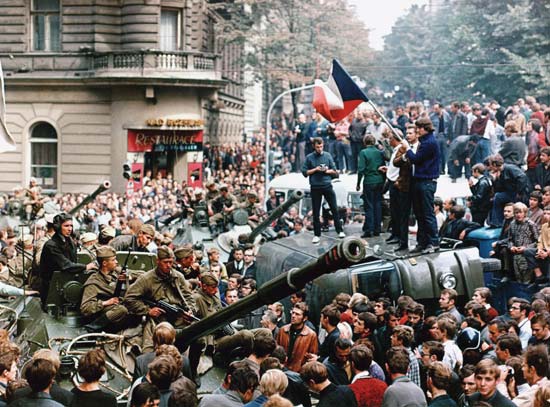
Records of distinct nationalist identity in music have existed since the before the middle ages. And, until approximately the 17th century, the majority of music composition was virtually inseparable from the church, which was virtually inseparable from the state. Thus, nationalism has always been a lens through which to look at the unfading marriage of music and politics. The 20th century musical stage in particular was flooded with nationalist compositions in response to territorial conflicts and as a reaction to oppressive regimes. Karel Husa’s Music for Prague 1968, is a politically motivated composition that reveals a paradox in nationalist music.

Karel Husa was born in Prague, Czechoslovakia in 1921, and later emigrated to the United States. Music for Prague 1968 was written shortly after the Soviet Union crushed the Prague Spring reform movement in Czechoslovakia in August, 1968. When Husa heard of the events that occurred in Prague over the radio, he was deeply moved. The piece serves as a memoriam to the victims of USSR violence, as well as a call for Czech identity.

The work includes a Hussite hymn, which blatantly creates an element of Czech nationalism. The Czech hymn that Husa uses, originally a war song from the 15th century, is titled “Ye Who Are Warriors of God.” It had previously been known for its use in Dvorak’s nationalist composition “Hussite Overture,” and there is no doubt that Husa’s choice to integrate the hymn is due to the tune’s overtly nationalistic connotation. One of the lines from the hymn reads, “Ye warriors of God, if you believe in the future, things will be better in the future.”

Music for Prague 1968 therefore reveals a paradox of nationalist music. In the piece, the Hussite hymn partially represents “solidarity and resistance”. On one hand, Husa is supporting his country by means of using traditional Czech music. The words of the allude to being willing to sacrificing oneself for one’s country and having hope for the well being of it. On the other hand, he is using the hymn to beckon back to a time before Soviet control- or even before the existence of a modern communist state. Hence, the composer is effectively attacking and bolstering his beloved country simultaneously; Music for Prague 1968 seems to portray that Husa is both proud and ashamed of his homeland. This leads to the conclusion that a nation is not characterized by any one political period, and that composers can praise all the good things about a nation while still speaking out against current events.

One of the essential requirements for nationalist music, is a broad audience; the point of such music is for a composer to share his or her feelings about their country with others. Husa’s conviction to write Music for Prague 1968 was also a conviction to share his thoughts about larger political ideas. One interesting source that provides commentary on the intended audience of music, and specifically politically driven music, is the article “Does ‘Music Trump Politics’?” by Ted Gordon. Gorgon quotes Dennis Prager as controversially saying, “Great music should transcend political differences.” Like many members of the Classical music world, I strongly disagree with Prager’s logic. Not only does this way of thinking nullify the point of nationalist music, it also pushes a limitation onto art as a whole. Though not all music is political, some pieces of art are meant to be derisive; Husa’s Music for Prague 1968 was not thought highly of by the Communist government of Czechoslovakia. Furthermore, there is a distinction between the reason for composition (perhaps to speak out against a certain person) and its objective face value meaning to a listener (maybe a piece written to shame a dictator is enjoyable to listen to even by the dictator himself). For example, Shostakovich’s 5th symphony subtly condemns the violence of the USSR, and yet it was praised by the Stalin regime; while this composition is politically influenced, at face value, everyone can appreciate them, included the party against which it was written.

In relation to Husa’s Music for Prague 1968, I think the intended audience is the people of democratic nations, to whom it serves a warning of oppressive regimes. One generally conclusion that Music for Prague 1968 demonstrates is that there can be a paradoxical balance of critique and patriotism that constitutes nationalism. And on a larger scale, Husa himself later reflected in an L.A. Times interview, “I don’t think of [Music for Prague 1968] as a political message for one country… It is universal.”

“Back In the USSR”: Parody or Political Statement?

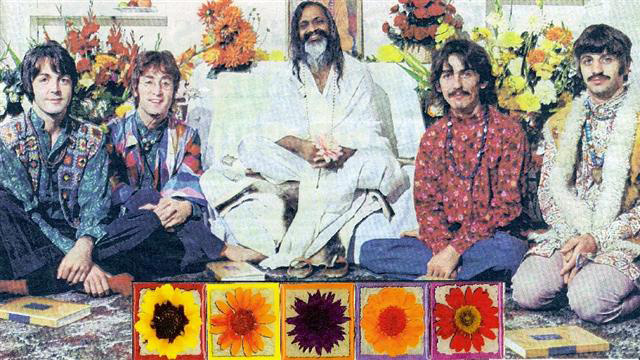
In early 1968 , The Beatles went on a meditation retreat in Rishikesh, India. They aimed to study Transcendental Meditation with their guru Maharishi, and eventually become teachers of this craft. Mike Love, from the Beach Boys, was also on this trip.

The Beatles with the Maharishi Mahesh Yogi

Love recalls  “sitting at the breakfast table and McCartney came down with his acoustic guitar and he was playing ‘Back In The U.S.S.R.’ and I told him that what you ought to do is talk about the girls all around Russia, The Ukraine and Georgia. [Paul] was plenty creative not to need any lyrical help from me but I gave him the idea for that little section”. McCartney did in fact take Love’s suggestion and wrote about admiring girls from Georgia, Ukraine, and Moscow, all locations represented in the USSR (Union of Soviet Socialist Republics).

Album Sleeve


A performance of “Back in the USSR” by the Beatles


“Back to the USSR” represents influence and power that music has in creating political controversy. When the song was released in 1968, America was at war with Vietnam. Because Russia supported the Viet Cong, conservative Americans immediately rejected this song, believing the Beatles were sympathizing with the enemy and promoting communism. The lyrics to this song fueled anger in Americans, especially the John Birch Society, who were particularly offended by the lines “You don’t know how lucky you are, boys”.

Additionally, this song caused controversy in Russia. Rock and roll was not respected at the time and the Beatles were not either. This said, Back in the USSR became wildly popular in Russia, and people sought to listen to the song even from tapes smuggled into the country. Elton John performed the song in Moscow a year after Americans had boycotted the 1980 Summer Olympics in Russia and wrote “they went ape s—. It was like playing ‘Philadelphia Freedom’ in Philadelphia”. The fact that there was such varied reactions to this song only made it more controversial.

Paul McCartney argues the claims of this song being politically charged by explaining this song as a parody of Chuck Berry’s hit “Back in the USA”.

McCartney says “I just liked the idea of Georgia girls…and talking about places like the Ukraine as if they were California, you know?…Its a jokey song, but it’s also become a bit of an anthem now…In my mind its just about a [Russian] spy who’s been in America for a long time and he’s become very American but when he gets back to the USSR he’s saying ‘Leave it ‘til tomorrow to unpack my case, Honey, disconnect the phone’”. It is interesting that McCartney had to defend himself for attempting to humanize young people on the other side of the world, and was also forced to defend the feeling of pride and comfort when a person returns home.

Performance of “Back In the USA” by Chuck Berry


In the article “Colin Kaepernick and the Radical Uses of the Star Spangled Banner”, Robin writes “Our national symbols are always more complicated than their original myths”. Kneeling at a football game to illuminate long-standing racism is viewed as a disrespectful and criminal act amongst conservatives. This can relate to Back in the USSR. Just as kneeling down during the Star Spangled Banner has become a controversial symbol of a larger national issue, Back in the USSR developed into a symbol of controversy during a time when a war was taking place . A parody song aiming to humanize non-American young people became a highly political debate.

This topic is very relevant to our class so far because we have focused so much on audience reception, the power of change and imitation, and how composers adapted to political ideals or brought to light political issues in their music. Politics and music will always be intertwined because politics inspires the cultural environment. As music is a pillar of culture, it is fair to say that these two will always have a powerful connection.

Miriam Makeba: “Mama Africa”

It is crazy to think that apartheid, the system of institutionalized racism in South Africa, was abolished way too recently in 1991. It was just twenty-six years ago that South African people were classified into four different racial groups with the goal of maintaining white supremacy. It gave rise to some of the most influential protest movements, within the country, by characters and heroes such as Nelson Mandela, as well as on a global scale. The arts and specifically music had a huge role in the fight against apartheid, with singer Miriam Makeba as a leading musician campaigning against the cruel injustices of apartheid in South Africa.

I’m sure you will recognize Makeba when listening to her performing her awesome “Pata Pata”:

However, today we will be focusing on her performing of the song “Soweto Blues,” by her one of her husbands, which talks about the 1976 Soweto uprising in South Africa. It was decreed in 1974 that the language Afrikaans was to be taught as much as English in schools. Because Afrikaans is inherently linked with racism, between 10,000 and 20,000 black students took to the streets of Soweto to peacefully protest the new law. The police quickly applied their forces very violently, leaving thousands of people injured and around 100-700 dead (the number of casualties is unclear).

Upon this tremendous tragedy, Miriam Makeba performed “Soweto Blues” at every chance. Its lyrics exclaiming,

“There was a full moon on the golden city Looking at the door was the man without pity / Accusing everyone of conspiracy / Tightening the curfew charging people with walking / Yes, the border is where he was waiting / Waiting for the children, frightened and running / A handful got away but all the others / Hurried their chain without any publicity.”

Miriam Makeba had an extensive musical career and participated in various bands, jazz bands, musicals, and films in Africa since very young. She got to travel to Venice to receive an award for her role in the controversial movie Come Back Africa, a documentary on South Africa. Makeba was soon in trouble with the African authorities for it because it portrayed their true and terrible side, and they obviously didn’t like it. She decided to not come back to South Africa, even if it meant she would practically get no payment for her performances. South Africa then revoked her passport, having Makeba officially in exile and preventing her from attending her mother’s funeral in 1960.

Miriam took refuge in London before coming over to the United States, where she would shoot to fame, performing for president John F. Kennedy, as well as alongside Nina Simone and other legendary artists in different occasions. She became a major activist against the injustice of the apartheid system.

“Music was a central part of the struggle against apartheid. The South African government censored many forms of expression, while many foreign entertainers refused to perform in South Africa and discouraged others from doing so in an attempt to isolate the white authorities and show their opposition to the regime. . . From abroad, Ms. Makeba acted as a constant reminder of the events in her homeland as the white power structure struggled to contain or pre-empt unrest among the black majority.” 

As if her stunning singing wasn’t enough, she even went on to testify for the United Nations Special Committee against Apartheid:

No wonder she is often called “Mama Africa!”

Let’s connect this to present day events, shall we? This movement against apartheid very clearly connects to Colin Kaepernick’s refusal to stand during the rendition of “the Star Spangled Banner” in protest and awareness of the oppression people of color are still living every day in the United States. I find the discussion on the various transformations of the anthem very meaningful and relevant to the crucial issue at hand—the oppression of an entire group of people because of their race—and directly connects to the music of protest and activism against apartheid in South Africa.  The Civil Rights Movement in the U.S. and the anti-apartheid movement in South Africa shared various similarities and both achieved a lot for people of color in terms of legal equality. However,  there is still a lot to be done in terms of social equality, and that’s what characters like Colin Kaepernick are rightfully protesting.


From Phonograph to the Digital Age of Music

Imagine walking through Times Square during rush hour and hearing not a single ounce of music around you. The electronic billboards are silent, the cars passing by are nothing but lifeless metal husks, stores feel drab with not a single catchy jingle, and people are agitatedly pacing the streets. Music does not exist in this bleak world with no way for it to stimulate the people who desperately need it. Dr. Syrigos, a historian, wrote, “Music coordinates emotions, helps important messages to be communicated, motivates people to identify with a group, and motivates individuals to support other group members.”[1] As humans, music occupies our everyday life and is transmitted to us whether we like it or not, and we have playback devices to thank for that. Everywhere you venture, there is some variety of music heard from a known or unknown source, acting as a stimulus. Times Square, as mentioned above, is a location of stimulus overload with billboards advertising products with vivid visuals and all too familiar jingles, and the bustling stores, playing your favorite tunes over the radio. Music players, like phones or MP3 players, are unconsciously used everyday to relay our favorite artists and groups to us, but have we ever thought of how these devices came to be?

Living in the modern age, listening to music is as easy as walking to the bathroom or looking up the latest and spiciest celebrity breakup on the internet. Modern playback devices are portable and are able to store a vast amount of music, all in pristine high quality. However, rewind to 1877 where music playback was in its infancy. Thomas Edison, a fledgling inventor, had just invented the phonograph, the first invention of its kind to record and playback music in one bulky package. To even record a sound on the phonograph required a weird amalgamation of items such as tin foil, a needle, a cylinder, and of course the mouth of the phonograph.

By shouting into the mouth of the phonograph, the needle inside of the cylinder would scribble the sound waves onto the tin foil and would allow for playback, albeit limited as the tin foil would eventually crumple.[2] The phonograph would evolve with time and reinvent itself as the turntable with records serving as the substitute of the cylinder and tin foil. However, the method of needles and grooves would remain. However, it stands that the phonograph allowed the common person to listen to music from the comfort of their own home.

Now, fast forward to 1979 where record players and radio were standard and were the primary sources of listening to music. Tapes were present at the time but were primarily for use in the car as it was more convenient and portable. Now, portable is a word many of us have blissfully experienced before but in 1979, music portability was scarce and almost nonexistent, that is until Sony released The Walkman. The Walkman is a playback device relying on cassette with several buttons functioning as start/stop, fast forward/rewind, and eject. Simple enough right? In actuality, The Walkman’s ability to play music from a cassette was not entirely special as it had been done before for use in journalism. However, the revolutionary addition of The Walkman stemmed from its portability and accessibility which had never been seen before: “Portability and privacy made it the ideal product for thousands of consumers looking for a compact portable stereo that they could take with them anywhere.”[3]

https://www.youtube.com/watch?v=lBqseObEt54

The only glaring weakness of The Walkman was its single capacity limit, which only allowed for one cassette to be inserted at a time. Flash forward to 2001 and this problem would be amended by a device which would revolutionize how we would listen to music for the last time in current history.

“Music is a part of everyone’s life, and because it’s a part of everyone’s life, it’s a very large target market all around the world. It knows no boundaries.”[4] In this quote, entrepreneur Steve Jobs understands the impact of music quite well, and would soon become a technological figurehead only few in history would achieve. Upon returning to Apple in 1997 after resigning in 1985, Jobs envisioned of a product which would forward the digital evolution of music in big strides. In 2001, the first generation of the iPod was released to the public and while it was highly criticized for its price, the innovation of having a device store thousands of songs was unparalleled.

The easy to use interface of the scroll wheel possessing basic functions also made the iPod more accessible than its competitors. Now, why is the iPod such a huge deal in digital music? When Apple had released the iPod in 2001, there were other digital MP3 players on the market previously. However, Apple’s flagship device was the first to usher in a sleek design as well as a simplistic structure and function, making it more appealing than its competitors. Through the years, the iPod would gradually evolve, introducing more internal space, features, designs, and would eventually cement its place in history as one of the most influential digital products to grace the 21st century.[5]

Looking back in history, it’s amazing to look at the progress playback devices have made. From the lack of portability and clunkiness of the Edison phonograph, to the portable yet limited Walkman, to the age of digital music with portability and ultimate accessibility. The strides made in music playback technology is a great technological marvel and thanks to those who made their contributions, music can be heard from the most bustling of cities to the silent confines of the country: music can be heard anywhere.

[1] http://www.ancient-origins.net/ancient-places-europe/origin-music-00972

[2] https://www.nps.gov/edis/learn/kidsyouth/the-phonograph.htm

[3] http://content.time.com/time/nation/article/0,8599,1907884,00.html

[4] https://www.cultofmac.com/124565/an-illustrated-history-of-the-ipod-and-its-massive-impact-ipod-10th-anniversary/

[5] https://www.lifewire.com/history-ipod-classic-original-2000732

Theremin: The World’s Spookiest Instrument

It is astonishing to think how interesting and perplexingly cool the theremin is and how very few people in the world know about its existence even when they have probably heard it somewhere. “In my experience, there are two kinds of people: those who are beguiled by the theremin and those who just haven’t heard of it yet. Because of the way it’s played – gestures, space – it fascinates instantly”  https://www.theguardian.com/music/2015/aug/22/invisible-instrument-theremin. 

To be honest, I didn’t know about it until a few years ago, when I stumbled upon this video of Clara Rockmore playing Saint-Saëns’s “The Swan” which literally looked like she was playing an invisible violin. The string-like sound is there, but it looks like she isn’t playing a particular instrument or even touching anything to that matter; she is playing air.

Leon Theremin (yes, that’s why the Theremin is called that) was a young Russian scientist who was working on a gas meter to measure densities. “‘Leon Theremin was an[n] . . . inventor of what is probably the most unusual musical instrument ever invented. You’re actually moving your two hands through two electromagnetic fields that are around two antennas. . . He was working in a laboratory in Russia as a young scientist, he was actually working on a gas meter to measure the density of gases,’ Glinsky said. ‘So as he brought his hand closer to the gas meter, he heard kind of a higher squeal. And as he brought his hand back to his body and away from the machine, it was a slower squeal’” https://www.cbsnews.com/news/the-theremin-a-strange-instrument-with-a-strange-history/ 

Then Leon started playing melodies on the device while his colleagues at the laboratory stared with amazement. This was the birth of one of the world’s first electronic instruments. The first model of the theremin used a foot pedal to control the volume and a switch to modify pitch. Later, in 1920, it became the mind-boggling instrument which requires zero contact of the performer with the instrument.

You are probably wondering how this thing even works, right? Basically, the first theremins were made up by circuits of vacuum tubes, coils, and wires which created electromagnetic fields around two antennae. By vibrating their fingers, players would raise or lower the pitch and volume. You can see why it is considered by many the world’s most difficult instrument. “A real theremin master can make an instrument soar with the fortissimo of Pavarotti or fade to the most delicate of whispers” http://electronics.howstuffworks.com/gadgets/audio-music/theremin3.htm 

It is really easy to merely produce gross squeaks and cries because only masters can produce the beautiful violin-like sound, like Clara Rockmore, who was actually one of Professor Theremin’s original students. She was an accomplished violinist who was forced to stop playing violin because of injury and therefore picked up the theremin and went on to become the world’s best thereminist. What a great example of how good things can come out of bad situations!

The 1920 theremin was shown at the Moscow Industrial Fair and picked up the interest from Vladimir Lenin, who actually took some lessons on it and commissioned 600 models to be toured around the Soviet Union. Later on, Leon Theremin left for the United States, where he performed at the Metropolitan Opera House as well as Carnegie Hall. He patented his invention in 1928 and its rights were quickly seized by RCA who distributed it during the 30’s. “The Theremin became known in the USA as a home ‘novelty instrument’ and featured in many film soundtracks of the 1940-50’s, it also appeared in several pop records of the 1960’s but never overcame its novelty appeal; used for effect rather than as a ‘serious instrument’, most recordings employ the Theremin as a substitute string instrument rather than exploiting the microtonal and pitch characteristics of the instrument” http://120years.net/the-thereminleon-termensoviet-union1922/ 

Some examples of media were it was used are: “The Green Hornet Radio Show” (1936), “The Day the Earth Stood Still” (1951), “The Flintstones,” “Batman,” and 2004’s “Hellboy.” You can hear it from yourself in the next video clip. The theremin comes in at 1:14.

Leon Theremin went on creating and invented other instruments, such as the “Terpsitone,” the “Rhythmicon,” and the “keyboard Theremin,” and even the “Electronic cello.” He later ended up eventually “disappearing” and returning to his home country. However, in 1954 in a basement in Queens, NY, a young Robert Moog was obsessed with theremins and began building them with his father. “It’s hard to imagine what the evolution of the synthesizer would have been without Leon Theremin. For one, it was Theremin’s invention that first captivated Robert Moog. Theremin kits were Dr. Moog’s first product and many would say, his first electronic instrumental love. That impact was significant, too, on a whole generation” (http://cdm.link/2015/09/read-article-bob-moog-wrote-met-leon-theremin/  Moog’s theremins went on to become the leading company for the instrument and they have sold more theremins than any other company in the last 57 years. What’s marvelous about all this is that Bob Moog is the man behind the Moog synthesizers, and there is no denying that the theremin was a great influence for this development. “Electronic music pioneer Robert Moog built theremins long before he built synthesizers. In the 1960’s, he produced such models as the wedge-shaped Vanguard theremin and the shoebox shaped Moog Melodia theremin. Today, Moog Music Inc. produces the popular Etherwave and Etherwave Plus theremins and kits as well as the new MIDI-enabled Theremini theremin.

Now that we have travelled through a brief history of the Theremin, we can see that is it actually a brief history of the technological advancements in electronic music over the last century. The discovery of the theremin and its technological innovation ended up being an inspiration for the creation of synthesizers, which are nowadays are incredibly popular and key for music production.


Carving out a Path for the Viola

When I first decided I wanted to play an instrument, I went to an instrument “try-out” day at my town’s local music store. I first tried out a flute, then a trumpet. Then I moved on to strings and picked up the violin. I remember that the sound of the bow against the strings was painful to my ears. A few minutes later, I walked over to my identical twin sister, who was smiling at what looked like a big violin. “Let me try!!!” I said, and I put the viola on my shoulder. I drew two bows on the D string, then two on the A string. Thinking, “OMG, I can already play Twinkle Twinkle Little Star”, I told my mom and sister that I wanted to play viola. My twin sister did too! As you can imagine we played a lot of viola duets over the next several years.

As a violist, I am used to the reputation this instrument has in the music world. In an orchestra, the viola plays a supportive role. Seldom receiving the melody, violists learn how to play harmony very well. When we received this blog post assignment, I knew I wanted to discuss the history of this instrument because there is a lot that goes untold (and unknown). Though, I am biased, I feel the viola’s importance should be projected. What other instrument sounds like caramel and chocolate when it’s played well?!

 Click to play

To emphasize this gif, here is a recording of one of my favorite pieces (and one that shows off that caramel sound of the viola). Just listen to the first 30 seconds- that’s all you’ll need.

Let us go back to sixteenth century Italy. The viola is a member of the violin family, but there is no clear answer to exactly when this instrument came to be. According to the Vienna Symphonic Library the role of the viola came defined when demands for instruments that would fill out a room with sound for Baroque Opera became necessary. String instruments were often made in different sizes with the same tuning, so when a need had to be met to split the registers and have another instrument played “da braccio”  or played on the arm, the viola was born.

Composers soon composed for sections to mimic the human voice (parts separated by bass, tenor, alto, and soprano registers). Naturally the viola falls into the alto category, and makers had to continually experiment to “find the optimal combination of tone, size, shape, and range to compliment the current trends in orchestra and court music” .

The viola is often misunderstood in terms of size because there is no standardized system for measurement. This makes the viola imperfect acoustically, because in order for the most amazing sound to be achieved, the body of the instrument would have to be huge (and therefore unplayable). Today there are many makers who experiment with string length and the size of the body to achieve the optimal effect. Usually, people with longer limbs and fingers play larger violas and vice versa.

A huge advance in the viola-making world came with the modern bow. Francois Tourte , a Frenchman, is often credited with many string instrument advances but the modern bow is especially important to violists. Because a viola responds less quickly because of the thicker strings, a modern bow allows for more tension between that hair and the strings. This means violists could actually project(!). Soon, the role of the viola became increasingly important in chamber music and the first solo pieces were composed for the instrument.

I encourage you to watch this TEDx talk specifically about the viola. This talk is great because there are frequent playing examples as well as great facts.

Today, there are many amazing solo violists who have created a beautiful new reputation for this instrument. Some of my favorites, including Kim Kashkashian, Nobuko Imai, Yuri Bashmet, etc. have inspired not only violists around the world, but also composers to write new and challenging works for this instrument. In the last decade new commissions and transcriptions have taken off, carving out a new path for this instrument. In this article by TimeOut New York, Steve Smith writes of new CD releases that deserve attention, honing in on many new contemporary works.

Past the viola jokes, I believe we gain a lot from understanding the technology of this instrument, and how it came to fruition. It is important to consider that instrument makers in the 16th century may have had some of the same musical concerns that instrument makers and composers have today, and that the means of creating music are constantly being improved upon.