Mass Production

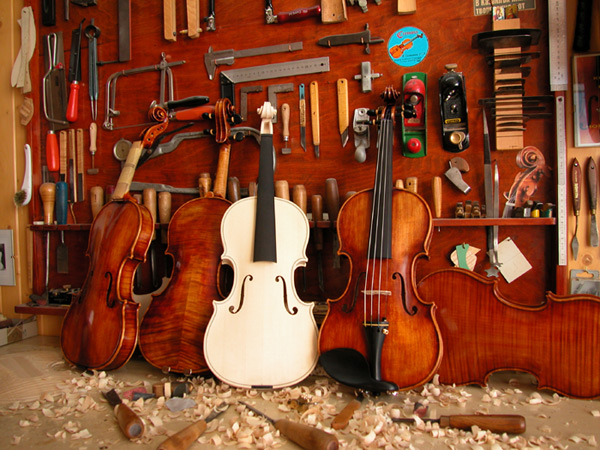
The birth of the first cellos were made almost 500 years ago in Italy by Andrea Amati. They were hand carved pieces of art, and all of the decisions were very deliberately made. The craftsman needed to know exactly which wood to use for each part of the cello, and how to fit it with strings and bridges that would resonate the most on that particular cello. Now in the 21st century, professionals strive to play on those old beautiful instruments especially by the widely popular Stradivarius and Guarneri, which have rich tones and can produce many different qualities of sound. However their prices can become rather high; from hundreds of thousands to millions of dollars. Is it worth spending all that money for a handcrafted, old instrument? Many of the strings and bridges string players use on their instruments cost a fortune on their own, cello string sets costing around $300 and lasting for only a few months. To get a full set of one of the most popular strings for cello, “Larsen”, it costs $227 on Amazon. To get your bow rehaired at Sullivan Violins in Rochester it costs $70, and to get a new bridge could be in the hundreds. Repairing your instrument will always be expensive, so why not buy a mass produced computer-perfected instrument?

Recently, the Chinese have started to sell instruments in the violin family that are under $5,000 (I’m playing on one right now). These instruments, although not as brilliant as a Strad, are not too shabby. They can have beautiful sounds, and can be fixed up with proper strings and a better bridge if needed. The reason these instruments are so cheap, is because they are partially (if not fully) factory made. Yes, instruments are becoming mass produced products, rather than finely crafted pieces of art. Some will be painted with spots trying to look old and used, to appeal to an audience or buyer that appreciates antique instruments (kind of the equivalent to pre-ripped jeans).

Although this baffles the mind of most classical string players, these cellos and violins are not the first factory made and mass produced instruments. Super-stores are selling guitars for very cheap. “Huge U.S. chain stores, such as Costco, Wal-Mart and Sam’s Club, are beginning to sell low-cost instruments, appealing to spontaneous buyers. Those stores have been partly behind a fivefold increase in the sales of electric and acoustic guitars in the U.S. market since 2000. ‘The average selling price (of a guitar) has gone down from $630 or $640 to somewhere in the $300s. That is almost a direct result of Chinese manufacturing,’ Lamond said”. These mass produced instruments are changing the way we think about music and craftsmanship. Is it important to always require authenticity and individuality as artists? Even for poor college students who just want to learn how to play guitar in an elective class during their first semester sophomore year?

This applies to all forms of art, not just music. Just the other day I was shopping in my favorite store, Target, and I saw many pieces of art for sale. It was very obvious that a computer had created it, my good friend Raina pointed out the straight lines on the canvas that suggested an automatic machine painting in a factory setting.

There were many upsetting aspects to this “wall art”, but there were also some nice things to consider. The price is always fairly cheap at Target, the symmetry can be very pleasing to the eye, and the colors in the painting are very real and don’t have anything to do with the artists themselves. If the buyer is not an art expert and wants something that will brighten up the room rather than something to really sit and think about, this should be perfect for them.

So is it really important that someone is handcrafting your instrument? Aren’t machines made to perfect what the human body cannot do on its own? For some it isn’t important, and that is okay. Not everyone needs to be an expert on what the latest painter likes, or all the latest fashion trends, or have the most beautiful sounding cello. Some buyers really want to experience something raw and human; to notice a connection between themselves and the artist. It is obviously not essential to use machines, as the best instruments we have are made by craftsmen in the 17th and 18th centuries who made glorious instruments all on their own.
But do these instruments really sound different? In a blind test where a violinist played the same piece on a Stradivarius and a modern instrument, the results were never actually what we would expect. Some of the time performers and listeners would like the Strad the least!

https://www.youtube.com/watch?v=ZtlTJkbUqkA

Does this mean that mass produced instruments can sound the same as a Strad? Is there actually a difference in the instrument’s sound, or are we just pretentious? Maybe spending thousands or millions on a fancy instrument is just a waste of money, and buying mass produced instruments is the way to go.

The sound of the organ

On July 3, 2017, at 8:30pm, in Montreal, Canada. There was an interesting organ concert played by a well-known organist—Hans-Ola Ericsson—at Church of the Immaculate Conception. That is a huge fantastic church with many historical sculptures and paintings. The recital was an event of the Montreal Organ Festival, and more than 500 audiences (including many organists coming from other places to participate the festival) was waiting for the concert starting since it already had delayed for 30 minutes. The program of the concert is half classical music and half contemporary music. The organ is built by Rudolf von Beckerath which is a German organ company, and it has mechanical touching and action for the keys and the stops. It sounds like the Craighead-Saunders organ at Christ Church in Rochester, NY, and obviously it is one of the ideal organ for playing early music, such as the works of Dietrich Buxtehude and Heinrich Scheidemann.

Von Beckerath, 1961
• 3 manuals, 38 stops, 56 ranks
• Mechanical key and stop action

Four years ago, I met Hans-Ola Ericsson in Leipzig, German, and I went to his masterclasses and recitals. Ericsson is one of Olivier Messiaen’s friends, and he performs lots of Messiaen’s music and other modern music. Also, he is a composer as well. I highly admire his talents and musicianships, and I feel his music can inspire people. So, I was very excited to hear his concert again in Montreal.

The concert began with a contemporary piece called Interactions No. 2 for Organ and Tape (1979) by Tamas Ungvary (b. 1936), and the first-half recital ended by Hans-Ola Ericsson’s own music—Melody to the Memory of a Lost Friend XIII (1985, for Organ and Electronics).

Unfortunately, there were over half of the audiences decided to leave during the intermission, probably because that kind of music did not sound right for them or they thought the performer was just crazy. Well, I guess that makes sense… It is difficult for the audiences to accept that the organist was wearing a Sennheiser headset to hear the electronic part and using the Timer on his iPhone to calculate the timing when he was performing in the concert, and letting two speakers to play the electronic accompaniment to the audiences. To be honest, it is even harder to image the picture in your head.  It might look like a vanilla sundae with whipped cream and some small pieces of bacons on the top—the tasting is absolutely good with the creation, but people will still feel shocking and ridiculous each time when they see it.

However, did the way of the Ericsson’s playing make the audiences feel uncomfortable, so they left in the middle of the concert? The answer is no. Obviously, if that is the reason, the audiences could close their eyes to keep listening and enjoying the music. Thus, what is the main reason making people decide to leave a famous organist’s concert?

From my point, I do not think that using other technologies (such as electronics and tapes) into the organ music is the most important reason making the audiences leave. But, a special way of using organ as a musical technology to produce a unique sound made the audiences feel uncomfortable.

Listening to the Melody to the Memory of a Lost Friend XIII carefully again, you actually cannot hear the absolute pitches from the organ. Sometimes it sounds same as the electronic music with many overtones. This is because Hans-Ola Ericsson uses soundscape on the organ (pulling the stops not fully out, and the players can get different colors by using different stops) to approach the special sound from the organ. Also, this unusual but more colorful sound can give the listeners more imaginations about the music. For example, the Melody to the Memory of a Lost Friend XIII is composed for the three-hundredth anniversary Bach year in 1985, and Ericsson wrote in the album, “(The decision of) a close friend to end his own life was the starting point and the inspiration for this work. His absence of hope and his despair awoke in me a search for meaning.” Therefore, when you are listening, you can deeply understand what is the story behind this piece, even though you cannot hear the certain notes.

But, the soundscape is not the traditional organ’s voice for the audience, and also it is not one of the sound that the audiences usually expect to hear. Many times when the organists perform new music with the technique of the soundscape, many audiences want to leave during the concerts. This situation happened in four years ago in German as well. A very famous Hungarian organist and composer was playing the recital at Nikolaikirche, Leipzig (One of two churches that J.S. Bach worked and played in Leipzig). After his started to use soundscape, a lot of audiences began to leave the church and made the noises to show the dissatisfaction.

Let’s take a guess—what kind of the sound from the organ will not make the audience be too surprised or when the people walk into Nikolaikirche, what kind of the organ music they would like to hear? The imitated voice as a Whistle(soundscape)? The jazz music with a drum accompaniment from a speaker? Or “real music” composed by classical composers, such as J.S. Bach, Franz Liszt and so on. In general, I think the answer possibly would be the third one. Here is the recording of Jesus bleibet mine Freude (nach BWV 147) played by Jurgen Wolf at Nikolaikirche, Leipzig.

Going back to the period before J.S. Bach—during the Medieval Age and the Renaissance (cite from the page 3), the mainly used organs are the portative and the positive (see the pictures below). Normally, they only contained principals stops and the mixtures to accompany with the singers and other instrumentalists. But, it did not have the some special sounds like soundscape. Also, since organ is the core instrument to play in the churches, the major contributions for the organ music (including J.S. Bach) is various types of the chorale settings(reference from the page 96). Some treatises recorded that during the Baroque period, the correct sound from the organ should sounds like a human voice (singing). This tradition lasted for a long time, and it influenced German organ composers and organists, even during the time of Max Reger. For example (reference Preface by Christopher Anderson from An Introduction to the Organ Music of Max Reger), Reger really effected by J.S. Bach’s music, and the people use the term “historicist modernism” to describe him.

portative organ
positive organ

In French, the organists and the composers pursued the orchestral sound from the organ, rather than the human voice in German. For instance, the bright reeds’ stops is one of the main elements for the French style’s organ. Especially in 19th century, after Cavillé-Coll organ company founded in France, the French organists have had more characteristic and easier using organs to approach the loud sound as a big symphony. As Charles-Marie Widor mentioned in his Avant-propos (directly cite from Widor’s Avant-propos), “The modern organ is essentially symphonic.” https://www.youtube.com/watch?v=1oR3P3IfGqo (Widor 6th Organ Symphony, the first movement-Allegro, played by Daniel Roth)

Now being an instrument or a musical technology, the organ does not necessarily need to sound like either the human voice or the orchestra in modern music. However, after more than eight centuries’ traditions, how to make the listeners entirely accept a new sound from the organ will be an interesting topic in the future.