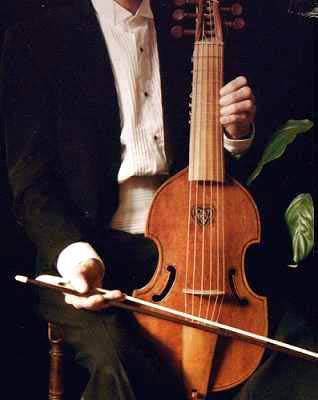
The birth of the first cellos were made almost 500 years ago in Italy by Andrea Amati. They were hand carved pieces of art, and all of the decisions were very deliberately made. The craftsman needed to know exactly which wood to use for each part of the cello, and how to fit it with strings and bridges that would resonate the most on that particular cello. Now in the 21st century, professionals strive to play on those old beautiful instruments especially by the widely popular Stradivarius and Guarneri, which have rich tones and can produce many different qualities of sound. However their prices can become rather high; from hundreds of thousands to millions of dollars. Is it worth spending all that money for a handcrafted, old instrument? Many of the strings and bridges string players use on their instruments cost a fortune on their own, cello string sets costing around $300 and lasting for only a few months. To get a full set of one of the most popular strings for cello, “Larsen”, it costs $227 on Amazon. To get your bow rehaired at Sullivan Violins in Rochester it costs $70, and to get a new bridge could be in the hundreds. Repairing your instrument will always be expensive, so why not buy a mass produced computer-perfected instrument?
Recently, the Chinese have started to sell instruments in the violin family that are under $5,000 (I’m playing on one right now). These instruments, although not as brilliant as a Strad, are not too shabby. They can have beautiful sounds, and can be fixed up with proper strings and a better bridge if needed. The reason these instruments are so cheap, is because they are partially (if not fully) factory made. Yes, instruments are becoming mass produced products, rather than finely crafted pieces of art. Some will be painted with spots trying to look old and used, to appeal to an audience or buyer that appreciates antique instruments (kind of the equivalent to pre-ripped jeans).
Although this baffles the mind of most classical string players, these cellos and violins are not the first factory made and mass produced instruments. Super-stores are selling guitars for very cheap. “Huge U.S. chain stores, such as Costco, Wal-Mart and Sam’s Club, are beginning to sell low-cost instruments, appealing to spontaneous buyers. Those stores have been partly behind a fivefold increase in the sales of electric and acoustic guitars in the U.S. market since 2000. ‘The average selling price (of a guitar) has gone down from $630 or $640 to somewhere in the $300s. That is almost a direct result of Chinese manufacturing,’ Lamond said”. These mass produced instruments are changing the way we think about music and craftsmanship. Is it important to always require authenticity and individuality as artists? Even for poor college students who just want to learn how to play guitar in an elective class during their first semester sophomore year?

This applies to all forms of art, not just music. Just the other day I was shopping in my favorite store, Target, and I saw many pieces of art for sale. It was very obvious that a computer had created it, my good friend Raina pointed out the straight lines on the canvas that suggested an automatic machine painting in a factory setting.

There were many upsetting aspects to this “wall art”, but there were also some nice things to consider. The price is always fairly cheap at Target, the symmetry can be very pleasing to the eye, and the colors in the painting are very real and don’t have anything to do with the artists themselves. If the buyer is not an art expert and wants something that will brighten up the room rather than something to really sit and think about, this should be perfect for them.
So is it really important that someone is handcrafting your instrument? Aren’t machines made to perfect what the human body cannot do on its own? For some it isn’t important, and that is okay. Not everyone needs to be an expert on what the latest painter likes, or all the latest fashion trends, or have the most beautiful sounding cello. Some buyers really want to experience something raw and human; to notice a connection between themselves and the artist. It is obviously not essential to use machines, as the best instruments we have are made by craftsmen in the 17th and 18th centuries who made glorious instruments all on their own.
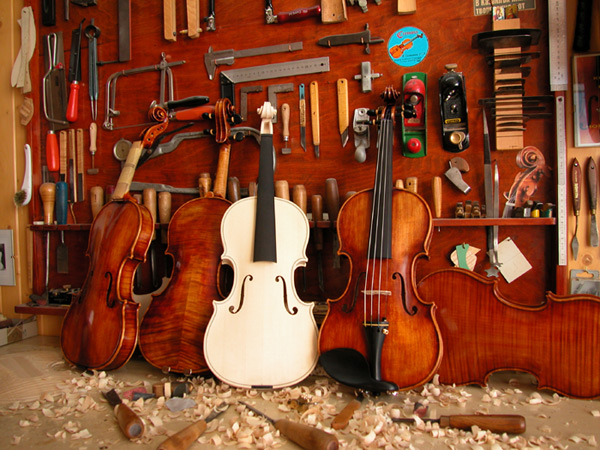
But do these instruments really sound different? In a blind test where a violinist played the same piece on a Stradivarius and a modern instrument, the results were never actually what we would expect. Some of the time performers and listeners would like the Strad the least!
https://www.youtube.com/watch?v=ZtlTJkbUqkA
Does this mean that mass produced instruments can sound the same as a Strad? Is there actually a difference in the instrument’s sound, or are we just pretentious? Maybe spending thousands or millions on a fancy instrument is just a waste of money, and buying mass produced instruments is the way to go.