This Was Tomorrow

Tomorrowland is an annual electronic music festival held in the small, picturesque Belgian town of Boom. Since 2005 it has grown into one of the world’s largest and most noteworthy festivals. From its early years, ID&T who produced the festival, focused  on experience and community over profit and renown. The particular attention to detail and incredible line-up of artists led to world record ticket sale times, with sell out occurring within seconds every year.

https://www.youtube.com/watch?v=6dVFy4d61gU

In the summer of 2011, Tomorrowland took an unprecedented step and uploaded what they titled “Aftermovie[s]” for every festival up to that point. These, at first short, videos posted to YouTube and Vimeo were meant to give attendees a sort of virtual yearbook. The first video “2005 Aftermovie” was a little over 3 minutes long. It was not until 2012’s edition of the Aftermovie that the videos received viral attention. The “Book of Life” themed 2012 edition of the festival produced an “Aftermovie” that received over 140 million views. Riding the massive EDM bubble that had begun to peak in the US, the rise of YouTube as a foremost competitor in the sector of mainstream content production and a generation that valued experience over anything else, Tomorrowland producers understood the value and importance of what they had created. 

Tomorrowland 2012 Aftermovie 

The “Aftermovie” became as much a celebration of the year’s festival as it became a viral marketing tool and celebration of the evolution of electronic music and rave culture. By 2017, it had amassed over a billion views across its Youtube channel. 

2017’s “Amicorum Spectaculum” was a Tomorrowland like no other. The largest stage to date, the most impressive and expansive line-up in Tomorrowland history, the most tickets sold, and the most countries represented by its participants since the festival’s inception.

The 2017 Official Aftermovie was a paragon of seamless interplay between visual and aural experience. The almost half hour long video not only shows off the incredible production value of the event itself, but presents a narrative that explores themes of unity, multiculturalism and acceptance that the festival has preached since 2005.
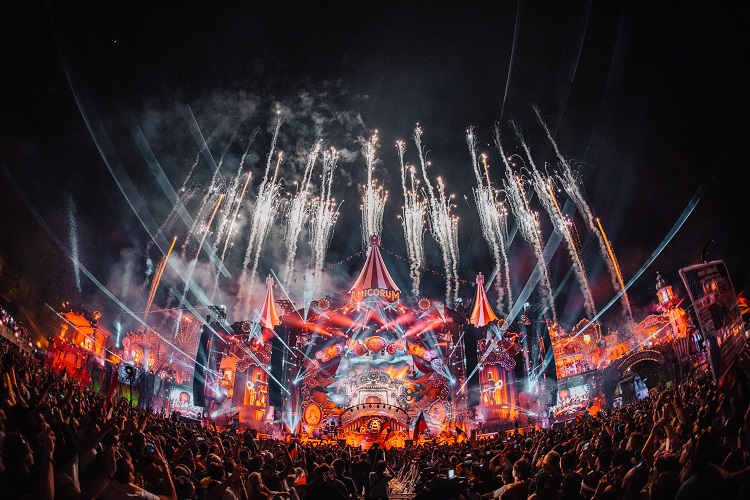
The video opens with a panoramic view of the festival grounds, themed airplanes and an incredible montage of flags from all over the world that festival goers proudly display. These opening scenes are accompanied by atmospheric tracks from Steve Angello’s fittingly titled Genesis EP. The track used in this first scene, Rejoice, is a massive departure from the EDM ( specific genre of pop electronic dance music popularized in the early 2010s) sound that put electronic music on the map in foreign markets. Steve Angello as an artist maps this evolution of electronic dance music, he was at the forefront of the EDM push in the 2010s as a member of the iconic trio Swedish House Mafia. This track explores more underground sounds than those he rose to prominence with, its synthesis of grunge rock and sampling of gospel and religious vocals are indicative of the return of electronic music to its experimental and exploratory roots. An incredibly fitting tune for the opening scene of the worlds foremost electronic music festival.
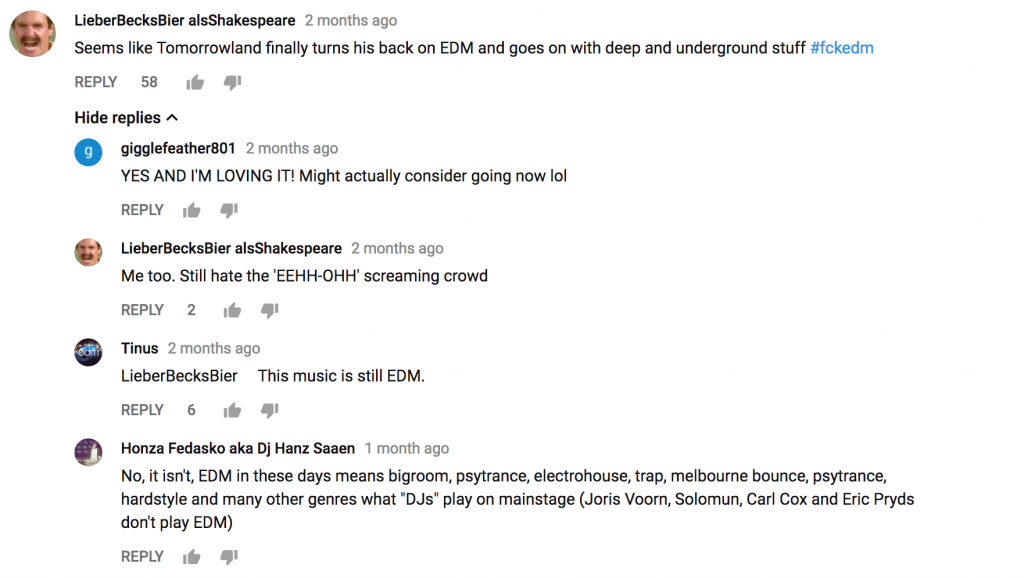
User LieberBecksBier alsShakespeare comments on this return to electronic dance music’s roots. He mentions Tomorrowland “turning its back” from EDM, a term coined in a huge multinational marketing push, meant to make the music more accessible to younger audiences. The term EDM stuck around longer than intended and became a blanket term for the incredibly diverse and imaginative sound world of electronic music. This “blanket effect” led to a long period of homogenization of mainstream dance music, which had a devastating effect on the creativity and individuality of underground artists. The popularity of Skrillex and Swedish House Mafia specifically made  the american perversion of dub-step and a very specific progressive house sound respectively, the overwhelming and sole mainstream sound for many years. Tomorrowland in this video, strategically chooses tracks and artists that embody the return to the creativity and sounds of the pre-EDM rave.

The next few minutes of the video explore the move-in process. A building trance track (Filterheadz’s Kaleidoscope) accompanies time-lapse clips of people walking into the festival’s temporary campgrounds. Interspersed between the clips are  people’s thoughts on attending the festival, representing a variety of shapes, sizes, colors and nationalities. As the music builds, the excitement and speed of the clips build as well, climaxing in the first experience of a hard “four on the floor” beat track, and a first full frame shot of the iconic Tomorrowland mainstage. The frames seem to change in time with every idiosyncrasy of the track, and as the “welcome to the jungle” vocals start to creep in, all of the festival’s 16 stages are presented in a whirlwind of quickly shifting frames. Just as quickly the music stills and nighttime falls.

This is when the incredible cinematography and production of the video and event truly come to life. The House of House, a track by the festivals main headliners Dimitri Vegas and Like Mike builds as the lights and lasers of the festival begin to come alive. The anticipation of the eventual “drop” is heightened by quickly changing frames, odd vantage points, peeks of pyrotechnic displays, as soon as the main portion of the song begins, the camera focuses on the incredible fireworks, lasers and enthusiastic dance from people and artists alike. The music, audience, Djs and stage all move to the same beat, and form a cohesive experience.

A similar cycle of low tempo ambient to high tempo house tracks accompanying a transitioning from day to night is employed in the next part of the video. Smiles, flying hands, bouncing heads are featured from all kinds of festival goers. This concludes with words by the godfather of modern electronic dance music, Armin Van Buuren .
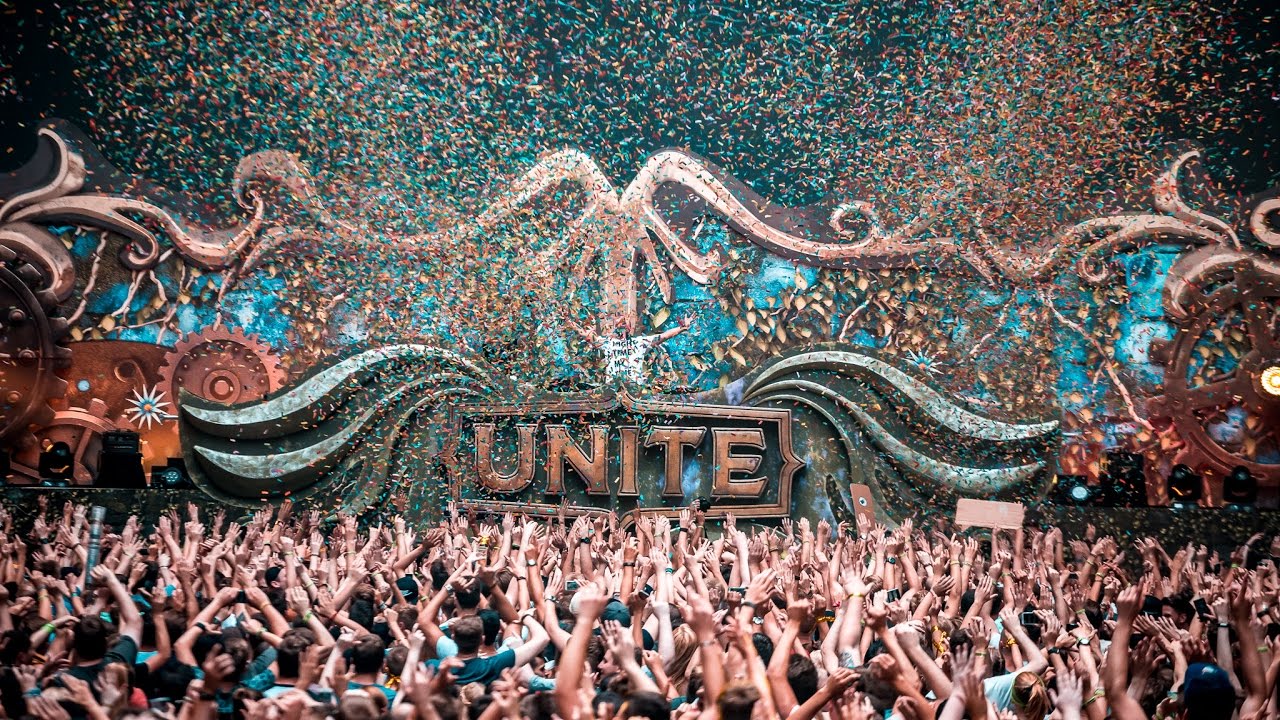
On the  mainstage with the word “UNITE” proudly displayed at its base, he brings attention to the 7 satellite shows providing live stream coverage around the world; Germany, Dubai, Lebanon, Malta, Spain, South Korea, Israel.  This scene is accompanied by Martin Garix’s track Pizza, not only does the incorporation of string instruments make the moment incredibly nostalgic, but it speaks to the future of the genre. A 21 year old wunderkind, Garrix represents a controversial but promising future of globalization and multiculturalism embodied in electronic dance music’s next generation of fans.

“It’s an amazing feeling to know that while you’re getting goosebumps at the MainStage in Belgium, literally millions of people around the world are watching my performance, even organizing home parties and having an amazing time as well.” -Armin Van Buuren

This globalization of the art form, and incredible role technology continues to play on the dissemination and consumption of the music is further explored in user vadeske’s comment:

The festival’s online presence has allowed it to reach homes across the world, in a way that could never have been imagined in its inception. The idea of unity earns a new meaning when social media and live stream engagement for  Tomorrowland’s 2017 edition garnered over 1.2 billion views by more than 200 million unique fans.

 “Not only has the growth of the event itself been amazing but also the content that they produce, like the live registration and after-movie. It just gets better and better each year. I think it’s great that people at home can watch the live stream and experience the festival as if they were there themselves.” -David Guetta

The video ends with an incredibly moving snippet of  London Grammar’s Hell to the Liars Remixed by Kölsch. Along with text thanking performer, artist and visitor alike for the creation of the experience, the music creates a nostalgic and incredibly emotional atmosphere. This track takes an indie-pop Nottingham native band’s song, translates it into trance style sounds, and ultimately fades to a string orchestration, very reminiscent of late romantic music, faded and echoey vocals and incredibly faint acid house sounds are barely perceptible. One would we be hard pressed to find a track that more perfectly embodies the state of transformation electronic music is experiencing so beautifully curated by Tomorrowland.

In its final scene the video urges viewers to take the beauty of the experience and use the impulse to “spread [their] message to the world…” Live today, love tomorrow, unite forever. These egalitarian, utopian and community oriented ideas may seem idealistic, but for three days every year, this video and festival argues that Tomorrowland proves living by these principles is achievable.

Progress and cohesion are central to driving this point home, and many comments below the video praise not only the cinematic and musical content, but the accurate representation of the ideals and atmosphere of the festival experience.

Tomorrowland 2017’s “Official After Movie” is a celebration of its performers, audience, artists, but more importantly explores the real-time evolution of electronic dance music and serves as a platform to further preach its ideas of unity, acceptance and multiculturalism.
Progression of Oppression and Technology

Doom. A Sigh

– Istvan Marta


I’ve always been interested in music that evokes an emotional response. As a performer and listener, having an emotional connection to a piece makes it feel significantly more satisfying. When looking for pieces to match the extreme amount of angst I was feeling at the time (also to put said angst into perspective by having my privilege checked) I began to search for music that was revolving around an intense political movement (something along the lines of Messiaen’s Quartet for the End of Time) and came across the piece “Doom. A Sigh” (https://open.spotify.com/track/1hCNaY6jPujUZjS13qK6bP).

The piece is easily one of the darkest pieces I have ever heard, as it combines the use of electronic sound effects with percussion and string quartet alongside “old sounding” recordings of two women speaking/singing. They appear to be talking/singing about something very that makes them very sad and/or angry. After reading the notes by Marta (https://www.youtube.com/watch?v=e-LQ7nBQcjA&t=0m00s), I understood the context; these women were from the remote village of Trunk, Romania, and were part of the group of around 400 people who lived there called the Csangos. These people had been uninfluenced by the progression of language in the 19th century due to their lack of connection to society and the progression of media. Their language was dying out due to the fact that people rarely left the village, and children would receive education in a language they were unfamiliar with. “…an encroaching government was wearing their sense of identity and family bonds”. Marta recorded these women and actually used one of Bartok’s 3 tiers of composition, in which he created an accompaniment to the exact melody recorded (with the melody being these two women). One of the women is talking about her deceased parents and the other is singing about a battle. Marta then talks about his circumstances with getting the recording and how the people were actually punished for him doing so. He accurately depicts these events happening through his music, and this is through being able to use technology of the recording, and electronics that create this scene of oppression.

Rarely before had a piece moved me so much that I looked up the situations surrounding the piece on my own. I had always been of the mindset that music is only relevant to the listener, but this piece had proven me wrong. I had heard such an intensity of emotion that motivated me to learn more about how this came together as a piece of music, and that was due to the bizarre nature of the musical instrumentation (ie, the recording of the women and the battlefield setting created with electronics)

I think that pieces like this was only really possible through the advances of technology in the 20th century, as the level of recording that had developed now can give rise to a new type of communication in a piece of music. For this, it was conveying the oppression of a society. Although the listener is unable to understand what exactly the speaker is saying, you are immediately able to grasp the emotion and power behind this work.  In the past, when a piece (like a symphony) uses a motive to represent a certain idea, and would incorporate politics into this by inserting the motive at a certain time, there is still a sort of “code” needed to decipher the meaning, whereas with this, you immediately are captivated by the emotion and are curious as to what the meaning is, even though this work is nowhere near anything standard of the previous century. This made me think of the article in which Trump brought up symphonies and somehow used them to convert this idea of elitism to prove whatever ridiculous point he was trying to make. This piece is definitely not a symphony, and in fact some people would maybe describe this more as performance art, as it does not have a standard form that we would be used to in Western music, however, I believe that the confusion itself adds to the meaning if the piece. The piece puts us in this uncomfortable state in which we question many things: what do they mean? how did something like this happen? what happened?. These questions allow for the growth as an individual both politically and musically due to the fact that we do not know, yet are still extremely captivated.(https://www.nytimes.com/2017/07/30/arts/music/trump-classical-music.html?smid=tw-%20nytimes&smtyp=cur&_r=0)

“Back In the USSR”: Parody or Political Statement?

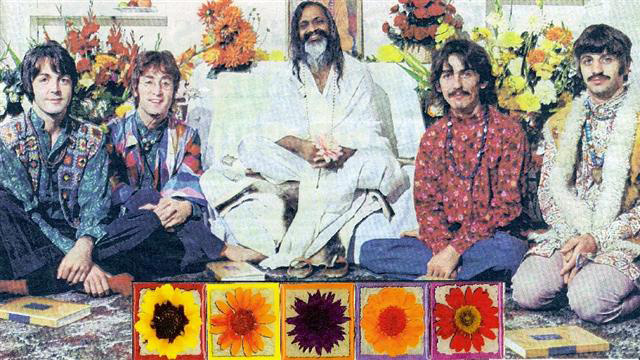
In early 1968 , The Beatles went on a meditation retreat in Rishikesh, India. They aimed to study Transcendental Meditation with their guru Maharishi, and eventually become teachers of this craft. Mike Love, from the Beach Boys, was also on this trip.

The Beatles with the Maharishi Mahesh Yogi

Love recalls  “sitting at the breakfast table and McCartney came down with his acoustic guitar and he was playing ‘Back In The U.S.S.R.’ and I told him that what you ought to do is talk about the girls all around Russia, The Ukraine and Georgia. [Paul] was plenty creative not to need any lyrical help from me but I gave him the idea for that little section”. McCartney did in fact take Love’s suggestion and wrote about admiring girls from Georgia, Ukraine, and Moscow, all locations represented in the USSR (Union of Soviet Socialist Republics).

Album Sleeve


A performance of “Back in the USSR” by the Beatles


“Back to the USSR” represents influence and power that music has in creating political controversy. When the song was released in 1968, America was at war with Vietnam. Because Russia supported the Viet Cong, conservative Americans immediately rejected this song, believing the Beatles were sympathizing with the enemy and promoting communism. The lyrics to this song fueled anger in Americans, especially the John Birch Society, who were particularly offended by the lines “You don’t know how lucky you are, boys”.

Additionally, this song caused controversy in Russia. Rock and roll was not respected at the time and the Beatles were not either. This said, Back in the USSR became wildly popular in Russia, and people sought to listen to the song even from tapes smuggled into the country. Elton John performed the song in Moscow a year after Americans had boycotted the 1980 Summer Olympics in Russia and wrote “they went ape s—. It was like playing ‘Philadelphia Freedom’ in Philadelphia”. The fact that there was such varied reactions to this song only made it more controversial.

Paul McCartney argues the claims of this song being politically charged by explaining this song as a parody of Chuck Berry’s hit “Back in the USA”.

McCartney says “I just liked the idea of Georgia girls…and talking about places like the Ukraine as if they were California, you know?…Its a jokey song, but it’s also become a bit of an anthem now…In my mind its just about a [Russian] spy who’s been in America for a long time and he’s become very American but when he gets back to the USSR he’s saying ‘Leave it ‘til tomorrow to unpack my case, Honey, disconnect the phone’”. It is interesting that McCartney had to defend himself for attempting to humanize young people on the other side of the world, and was also forced to defend the feeling of pride and comfort when a person returns home.

Performance of “Back In the USA” by Chuck Berry


In the article “Colin Kaepernick and the Radical Uses of the Star Spangled Banner”, Robin writes “Our national symbols are always more complicated than their original myths”. Kneeling at a football game to illuminate long-standing racism is viewed as a disrespectful and criminal act amongst conservatives. This can relate to Back in the USSR. Just as kneeling down during the Star Spangled Banner has become a controversial symbol of a larger national issue, Back in the USSR developed into a symbol of controversy during a time when a war was taking place . A parody song aiming to humanize non-American young people became a highly political debate.

This topic is very relevant to our class so far because we have focused so much on audience reception, the power of change and imitation, and how composers adapted to political ideals or brought to light political issues in their music. Politics and music will always be intertwined because politics inspires the cultural environment. As music is a pillar of culture, it is fair to say that these two will always have a powerful connection.

Metronomes on My Mind

I super-duper love my metronome. My metronome is one of the oldest musical friends I have, at least in this leg of my musical journey. I have had it since 8th grade and I’m pretty sure I prepared for one of my first All-state auditions with it. Its been with me since day one. Its also been paramount to my musical success as a percussionist and often its easy to forget the role that metronomes in general have taken as a part of my musical growth.
My metronome and the most popular other metronomes on the market today are a part of a line of metronomes called Doctor Beat that are made by Boss. Now the smallest member of this lineup is the DB-30 which is the cutest little clip on thing you’ve ever seen and it was actually the metronome I had before I bought my current one. Then there’s also the celebrity DB-90 which looks like this:

DB-90 Metronome

The DB-90 is best known for single-handedly keeping every single drumcorp or marching band in the country in time. The mere sound of it has been known to trigger traumatic episodes among former band members, causing them to relive the sights and sounds of getting screamed at by their psychotic band director whilst simultaneously getting roasted by the sun. Its clunky silver plastic casing weighs at least a couple of pounds and it quite literally eats 9 volt batteries. It comes with enough weird, useless grungy beat presets to run an underground Polish nightclub along with probably the most disturbing synthetic counting voice samples in existence that have never once helped anyone play in time better ever. And the worst part, at over $150 on most sites, the DB-90 is probably the stupidest piece of technology available. Yet in spite of the the supreme extra-ness of the DB-90, metronomes have come a long way through history to earn the prominence they enjoy in today’s musical culture.
The history of metronomes is actually not all that fascinating. It pretty much starts out in the same place as clocks, where Galileo observed and the described the properties of a pendulum. As time and discoveries progressed pendulums were able to be made with adjustable weights which affected how fast the period of the swing was. In 1814, a man by the name of Dietrich Nikolaus Winkel invented the metronome while studying pendulums. His design was the first truly successful metronome because it made sound and had a spring acting as as escapement that kept it ticking. Winkel was not successful at patenting his “chronometer” although, and in 1816 another fellow named Johann Maelzel took Winkels design, slapped a scale on it designating certain bpm’s, and called it his own.

Maezel Metronome

This type of metronome is the one we have all come to know and love as the “classic” metronome. With the advent of mass-produced electrical appliances in the 20th century, metronomes like the Franz electric metronome began gaining ground. Nowadays most metronomes are digital, but Maelzel’s classic style metronomes still appear and are even written for in pieces like Casey Cangelosi’s “Slight of And Evil Hand.” Their effect on the way we write, perform and interpret our music today is immense.

My personal metronome in particular has a special place in my heart, unlike the teeny DB-30 and the utterly awful DB-90, I have a DB-60 which is juuuust right. It has all of the basic functions that you actually need in a metronome plus a few other actually useful extra ones. Best of all its extremely durable, I’ve dropped it on hard floors all the time, and I’ve changed the batteries less than ten times in the 6+ years I’ve owned it. I recently misplaced it for a few weeks over the summer and I was pretty surprised by how upset I was, I mean this little guy has been with me this whole time and even though its just a metronome, I really appreciate all it can do for me everyday. Its amazing how much I end up using it and its so easy to take something simple like that for granted every day, so even though my heart doesn’t skip a beat every time I see it, this metronome definitely clicks for me ;D

From Phonograph to the Digital Age of Music

Imagine walking through Times Square during rush hour and hearing not a single ounce of music around you. The electronic billboards are silent, the cars passing by are nothing but lifeless metal husks, stores feel drab with not a single catchy jingle, and people are agitatedly pacing the streets. Music does not exist in this bleak world with no way for it to stimulate the people who desperately need it. Dr. Syrigos, a historian, wrote, “Music coordinates emotions, helps important messages to be communicated, motivates people to identify with a group, and motivates individuals to support other group members.”[1] As humans, music occupies our everyday life and is transmitted to us whether we like it or not, and we have playback devices to thank for that. Everywhere you venture, there is some variety of music heard from a known or unknown source, acting as a stimulus. Times Square, as mentioned above, is a location of stimulus overload with billboards advertising products with vivid visuals and all too familiar jingles, and the bustling stores, playing your favorite tunes over the radio. Music players, like phones or MP3 players, are unconsciously used everyday to relay our favorite artists and groups to us, but have we ever thought of how these devices came to be?

Living in the modern age, listening to music is as easy as walking to the bathroom or looking up the latest and spiciest celebrity breakup on the internet. Modern playback devices are portable and are able to store a vast amount of music, all in pristine high quality. However, rewind to 1877 where music playback was in its infancy. Thomas Edison, a fledgling inventor, had just invented the phonograph, the first invention of its kind to record and playback music in one bulky package. To even record a sound on the phonograph required a weird amalgamation of items such as tin foil, a needle, a cylinder, and of course the mouth of the phonograph.

By shouting into the mouth of the phonograph, the needle inside of the cylinder would scribble the sound waves onto the tin foil and would allow for playback, albeit limited as the tin foil would eventually crumple.[2] The phonograph would evolve with time and reinvent itself as the turntable with records serving as the substitute of the cylinder and tin foil. However, the method of needles and grooves would remain. However, it stands that the phonograph allowed the common person to listen to music from the comfort of their own home.

Now, fast forward to 1979 where record players and radio were standard and were the primary sources of listening to music. Tapes were present at the time but were primarily for use in the car as it was more convenient and portable. Now, portable is a word many of us have blissfully experienced before but in 1979, music portability was scarce and almost nonexistent, that is until Sony released The Walkman. The Walkman is a playback device relying on cassette with several buttons functioning as start/stop, fast forward/rewind, and eject. Simple enough right? In actuality, The Walkman’s ability to play music from a cassette was not entirely special as it had been done before for use in journalism. However, the revolutionary addition of The Walkman stemmed from its portability and accessibility which had never been seen before: “Portability and privacy made it the ideal product for thousands of consumers looking for a compact portable stereo that they could take with them anywhere.”[3]

https://www.youtube.com/watch?v=lBqseObEt54

The only glaring weakness of The Walkman was its single capacity limit, which only allowed for one cassette to be inserted at a time. Flash forward to 2001 and this problem would be amended by a device which would revolutionize how we would listen to music for the last time in current history.

“Music is a part of everyone’s life, and because it’s a part of everyone’s life, it’s a very large target market all around the world. It knows no boundaries.”[4] In this quote, entrepreneur Steve Jobs understands the impact of music quite well, and would soon become a technological figurehead only few in history would achieve. Upon returning to Apple in 1997 after resigning in 1985, Jobs envisioned of a product which would forward the digital evolution of music in big strides. In 2001, the first generation of the iPod was released to the public and while it was highly criticized for its price, the innovation of having a device store thousands of songs was unparalleled.

The easy to use interface of the scroll wheel possessing basic functions also made the iPod more accessible than its competitors. Now, why is the iPod such a huge deal in digital music? When Apple had released the iPod in 2001, there were other digital MP3 players on the market previously. However, Apple’s flagship device was the first to usher in a sleek design as well as a simplistic structure and function, making it more appealing than its competitors. Through the years, the iPod would gradually evolve, introducing more internal space, features, designs, and would eventually cement its place in history as one of the most influential digital products to grace the 21st century.[5]

Looking back in history, it’s amazing to look at the progress playback devices have made. From the lack of portability and clunkiness of the Edison phonograph, to the portable yet limited Walkman, to the age of digital music with portability and ultimate accessibility. The strides made in music playback technology is a great technological marvel and thanks to those who made their contributions, music can be heard from the most bustling of cities to the silent confines of the country: music can be heard anywhere.

[1] http://www.ancient-origins.net/ancient-places-europe/origin-music-00972

[2] https://www.nps.gov/edis/learn/kidsyouth/the-phonograph.htm

[3] http://content.time.com/time/nation/article/0,8599,1907884,00.html

[4] https://www.cultofmac.com/124565/an-illustrated-history-of-the-ipod-and-its-massive-impact-ipod-10th-anniversary/

[5] https://www.lifewire.com/history-ipod-classic-original-2000732

Violin and Technology

Last week I sat in Kodak Hall as one of my childhood violin heroes played on stage. I couldn’t understand how he was able to produce such a large and beautiful sound that seemed to rip the heart out of my chest. I began to think about how this violinist produced such a large sound and the reason for it. What kind of violin did he have, and what was particularly special about his violin? What went into making it? How did a piece of wood from a tree became a small box that creates beautiful sounds?

There is a belief that orchestral musical instruments are far from any type of technology, but instruments and the process of making them requires more technology than one may think. For example, a tree must be cut down, the wood dried, and then imported to whichever part of the world the violin maker is in. If not already aged, the wood must then be seasoned before luthiers begin their work. Some violin makers require their wood to be seasoned for a minimum of fifteen years. Below is a violin maker with a piece of wood he has been naturally drying and aging for many years.

Once the wood is aged, luthiers are able to begin their work. The first step is the bending of the ribs or outer frame. This requires a bending iron and water in order to bend the wood efficiently. The bending iron temperature should range between 200 and 250 degrees Celsius but other factors apply. These include the type of wood being used and the exact temperature it needs in order to be bent correctly.

http://https://www.google.com/search?q=bending+iron+and+water+violin+making&rlz=1C5CHFA_enUS728US729&source=lnms&tbm=isch&sa=X&ved=0ahUKEwjm46DQgbDWAhXG6iYKHcX3CwgQ_AUIDCgD&biw=1082&bih=638#imgrc=3aZYxrBWJiQSEM:

The top and back of the violin must be carved next in a process called arching. Modern violin makers still copy Strad and Guarneri models while doing this, as an improved combination of dimensions has still not been discovered. This process is the removing of wood using gouges. Luthiers start with a large gouge and work their way down to smaller gouges in order to achieve desired thickness. When finished, the top must be scraped rather than sanded to provide a crisp and beautiful appearance of the wood. At the end of this process, only twenty percent of the actual wood block ends up being used.

Following gouging, the F-holes are cut in order for air to enter and escape. F-holes give the violin character and can even make the violin look happy, sad, or interesting. One technology that aids in the cutting process is an electric saw shown below.

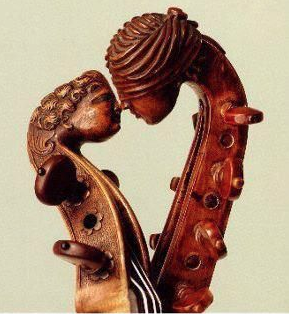
One of the final steps in violin making is creating the scroll and neck. The scroll is cut out using a saw and hand carved by the maker. This is often when the luthier is able to express his or her individuality and creativity. Scroll carving is usually the only time in the violin making process that a maker can carve freely.  

Once the instrument is glued and put together, the final step of varnishing must be completed. Varnish has been known to enhance the tone of the violin while also protecting and giving the wood a beautiful finish. When completed, the varnish must be aged and exposed to sunlight before it can be put into the hands of a performer.

When considering all of the technology and time that goes into making a violin, it’s easy to see why fine handmade instruments are so admired and prized. Even instruments that were made in the last twenty years have had to come from a tree that started growing at least 100 years ago. How did that tree get there and what technologies may have gone into getting it there? Did it grow naturally or did someone plant it? The time it takes to cut, dry, season, and varnish a violin’s wood means that most violins are a lot older than one may think.

One violin maker said that “the violin does not have its beginnings with a musician, but rather with its maker. It can only be used by skillful hands to bring a person into the very presence of God.” With that being said, a violin is a technology musicians can use to communicate whatever they want to be said, using the gift of music which is beyond this world.