
Commissioned for the 1962 reopening of Coventry Cathedral, which was destroyed during a World War II bombing raid, Benjamin Britten’s War Requiem offers a critique of war while still maintaining a mournful setting with a traditional Latin text. Britten, a conscientious objector, vehemently adhered to the principles of pacifism and his critique of war shines within this opus through the addition of Wilfred Owen’s poetry. Owen, a soldier, wrote scathing poems about his wartime experiences and his opinions on war. The combination of the traditional Latin text and Owen’s poetry along with Britten’s setting merge within the work to create comforting, mournful environments or these elements contrast drastically forming sharp oppositions, demonstrating the composer’s opposition to war. In addition to textual tension, the personnel and venue of the premiere further the anti-war statement particularly though the hiring of nationally diverse soloists. Britten’s War Requiem acts not only as a lamentation of the dead, but also speaks as a reflection of Britten’s pacifist beliefs shown through the text setting and the premiere.
The texts employed in War Requiem make an anti-war statement through the juxtaposition of the traditional Latin Mass of the Dead and nine poems by Wilfred Owen. Wilfred Owen is revered as one of the greatest war poets; he served in World War I, losing his life one week before armistice day. Throughout the work the texts create tension through opposition and this tension is particularly poignant in the third movement, The Offertorium, scored for boy’s choir, chorus, and tenor and baritone soloists, organ, chamber orchestra, and full orchestra. The movement begins with the boys choir singing Domine Jesu Christe, followed by the juxtaposition of Quam olim Abrahae and Owen’s “Parable of the Young Man and the Old.” The combination of these texts and ensembles demonstrate an anti-war belief through the usage of a boy’s choir, representing the men lost at battle. Wilfred Owen’s “Parable of the Old Man and the Young” sharply critiques war and the attitudes of national authorities on young people, particularly men. Within the poem, Owen refers to Abraham as Abram, defying Genesis 17:5, the bible verse in which God changes Abram to Abraham because He states “a father of many nations have I made thee.” Besides the name change, the beginning of the poem derives directly from the biblical text of Genesis 22, particularly the King James Version, until the angel telling Abraham to sacrifice the ram instead of Isaac. In Owen’s poem, the angel points out the ram caught in the thicket and refers to it as the “Ram of Pride.” No such reference exists within either version of the bible, and Abraham finds the ram on his accord in the parable, though he knows God provided it. In the poem, Abram rejects the slaying of pride and chooses to murder his own son instead. Instead of sacrificing pride, he opts to kill his offspring, presenting Owen’s views on the world powers’ decision to continue the war rather than end it. Owen offers Abram as a representation the world powers, unfit as the fathers of nations and choosing to kill the youth rather than sacrifice pride, represented by the ram. In contrast to this, the Latin text of the offertory of a Requiem, lauds Abraham as the father of all nations in Quam olim Abrahae and prays for the return of souls to the holy light. Towards the end of the movement, after the slaying of Isaac in the poem and “half the seed of Europe one by one,” the Latin text returns, praying for the sacrifices offered to be accepted for the salvation of the lives recalled during the mass. This creates a vicious cycle of slaughter in which none survive and none are saved, an argument in accordance with Britten’s pacifist views. The juxtaposition of the old Latin text and the newer poetry of Owen creates an irony of an inescapable vicious cycle to which, Britten argues, half of Europe’s young men fell victim during the two world wars.
The premiere of the work was intended to further demonstrate Britten’s pacifist beliefs through venue and personnel. The piece was commissioned for the reopening of Coventry Cathedral, originally a fourteenth century structure
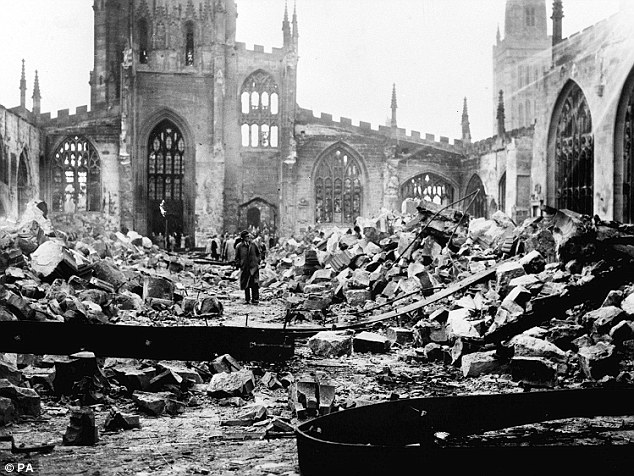
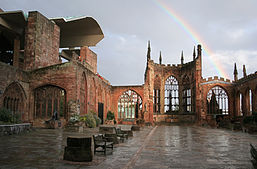
in Coventry, England, that was destroyed during a World War II bombing and reopened in 1962. This venue is representative of the destruction caused by war and also faith struggles inflicted by war, as it is a church that was destroyed, making it an ideal venue for a work demonstrating the tragedy of war. In addition to venue, the work was originally written for British tenor, Peter Pears, German baritone, Dietrich Fisher-Dieskau, and Russian soprano, Galina Vishnevskaya. The nationalities of these soloists are representative of the great powers of the war, and having these nations, represented by the singers, unify to perform a work centering on war is inherently pacifist. Because there was such a strong hatred during the war, any art created by these nations together would be pacifist. However, Soviet authorities did not permit Ms. Vishnevskaya to attend the premiere, and English soprano, Heather Harper, stepped in only ten days before the event. The nationalities of the soloists and the venue of the premiere are representative of the composer’s pacifist beliefs as they demonstrate the reunification and rebuilding after war.