
“Is there any way you can make that more cantabile?” the conductor asked. His question was met with resounding laughter from the rest of the ensemble, myself included. Though this is certainly not an odd request for a conductor to make in a rehearsal, the fact that the target of this question (a percussionist by trade) held in his hand an only-just-recently-deflated balloon made the whole thing seem just a little absurd. Found more commonly at amusement parks or clown conventions, your everyday garden-variety Mylar balloon also happens to be an instrument called for in the score of Talhoffer’s Crawfish (below), a piece of contemporary classical music. The question now becomes, how did a balloon make its way into our rehearsal space as an instrument as opposed to an accessory to a 5-year-old’s birthday party?
In order to uncover this, let’s delve a little bit into the use of regular objects in art. The use of found objects in 20th century visual art can be found most famously in the works of the Dadaist movement. One particularly well known example is Marcel Duchamp’s Fountain,
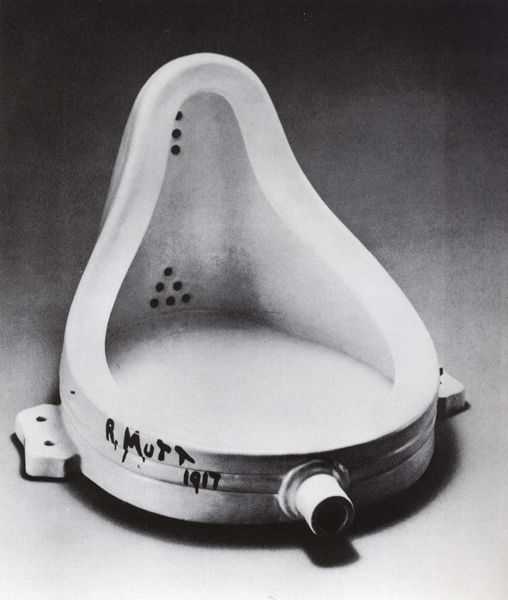
which is really just a urinal turned on its side with “R. Mutt 1917” scrawled along the base. As one of the first pieces of this iconoclastic genre of modern art, this article states Duchamp’s own summation of the work, a response in a 1917 issue of the avant-garde journal The Blind Man: “Some contended it was immoral, vulgar. Others, it was plagiarism, a plain piece of plumbing.” This touches on some key elements of the Dada movement, and modernism in general: the idea that the concept behind the piece becomes part of the piece itself, and that to be controversial is a positive thing. Dada originated as an avant-garde movement reacting to the terrible bloodshed and brutality seen during World War I. It was meant, in the words of Jean Arp (one of Duchamp’s Dadaist contemporaries), as a way “to destroy the hoaxes of reason and to discover an unreasoned order.” Dadaists placed emphasis on absurdity, repurposing of found objects, and the laws of chance. Though one of many different niches of modernist thought cropping up during the early 20th century, it would later be revived by the Neo-Dadaists in the 1950s and ‘60s.
The Neo-Dada movement revived Dadaist thoughts during the Cold War later in the century. Neo-Dadaism used things such as found objects and chance to shift the focus away from the artist him- or herself and instead on the audience’s reaction and interaction with the piece in question. This was not only a movement in visual art (Jasper Johns and Robert Rauschenberg are two big players here — you can read more about them here and here, respectively, if interested) but also in music. John Cage, possibly most famous for claiming silence as music in his work 4’33” (performed below by NOLA the Cat), was an important composer of this school of thought.


Cage followed the Neo-Dadaist philosophy of using found objects and chance in his works, something derived from their earlier Dadaist forerunners. 4’33” is in a sense completely a work of chance music, as the resulting sonic landscape of four minutes and 33 seconds of silence is whatever anyone in the hall happens to hear — the focus shifts from the music itself instead to the audience’s perception of that music. This particular work and others by Cage have influenced many musicians after him (a collection of reactions to his works and his contributions to the music world can be found here). Without Dada, Neo-Dada, and Cage and his like-minded contemporaries, it is unlikely that we would have ever been able to have that lighthearted exchange in our rehearsal concerning the cantabile-ness or lack thereof of a balloon deflating.
This brings us back to our original question: how did I end up in a rehearsal last weekend with someone playing the balloon, and why can we call that a musical instrument? To me, the origin of a balloon as a musical technology isn’t in the actual physical structure of it, but rather can be found in the artistic movements that allow us the freedom and openmindedness to see it as such. Without our avant-garde, Dada, and Neo-Dada forefathers, the use of balloons as a found object musical instrument would not likely be something we could come across in our scores today. Even though it’s something that can be found at any grocery store, the balloon is an instrument that takes practice and patience to get that perfect cantabile sound — and a lifetime to master.
This was a nice post! I now know about a lot more an interesting movement and how it was applied in art and music. You used links, media, and sources very well! That being said, the links can be utilized to steer people in the direction of more information about a topic, if they want it, as to avoid spending too much time on a topic. While I enjoyed reading the blog, I found that I was expecting more information about everyday items or such being used in the orchestra, for instance “Concerto for Florist” and other such works, instead of just focusing on one piece, John Cage’s 4’33”, which is focused on silence and ambiance. I also found that more time could’ve been spent discussing the musical side of things, rather than discussing the entire history of an artistic movement.