
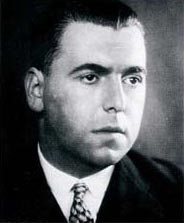
Erwin Schulhoff was born in 1894 to a Jewish family in Prague. He died in 1942 in a Bavarian concentration camp. He studied with Debussy in his early writing years and was heavily influenced by ideas of the Second Viennese School. He was also one of the first European composers to experiment with elements of jazz and incorporate them into his own works. He was drawn to avant-garde trends and experimented with the less traditional ideas during that time. Schulhoff studied in the cities of Vienna, Leipzig and Cologne before he was drafted to serve in the Austrian Army at the outbreak of WWI. However, he continued to compose throughout the war and had his first pieces published immediately after the war ended. Politically, Schulhoff, an outspoken socialist, was very liberal throughout his life and would turn even more left towards the end of his life. He was described as a “radical artist”. Being of Jewish decent, Schulhoff found himself drawn to communist ideas as his life became more difficult as he was committed to Soviet Communism, a party that promoted democracy. In the 1930s, Schulhoff moved back to Prague, but once he realized he and his family were in danger, applied for Soviet citizenship. Shortly after, Hitler would attack the USSR and Schulhoff was sent off to the Wulzburg concentration camp in Bavaria. He stayed committed to his political ideas to the end of his life in 1942.
One of his works written before his turn towards socialist realism is Five Pieces for string quartet, written in 1923. The quartet I am a part of has been working on this piece this semester, which is what inspired me for this blogpost. While not long or particularly difficult in a technical sense, this piece is filled with musical ideas that take a lot of conversation amongst the members of the group. For example, the first movement has waltz-like qualities with a feeling of 1, 2, 3, 1, 2, 3. However, it is written in 4/4 meter. There is a lot of chromaticisms and harmonic idiosyncrasies that might take a couple of hearings to be able to grasp on to. I would say that this piece, although early for the genre, hints at some “jazz-y” ideas in the Tango, the fourth movement. His music was rejected by the Nazi regime as he was of Jewish and German descent. I think it is safe to say that music is inspired by experience. And even if we are not the ones writing the music, when we perform it, we reach for ideas of experiences that would strengthen our performance of any given pieces.
He was a supporter of the ideas of Socialist Realism. He was both jewish and a communist which put him in danger once World War II started. Schulhoff commissioned libretto based off the Communist Manifesto which he would go on to write music to in 1932 for choir, vocal soloists and wind ensemble. His goal was to make his works easily accessible by audiences and the general public as he wished to “convey politically meaningful programs”. The Communist Manifesto by Erwin Schulhoff was written after his writing style took a turn towards socialist realism. In 1931, he participated in a workers’ theatre group, as he continued to stay heavily invested in music. His later music was aimed towards pleasing the audiences. His past works had been well received and his career had been at a peak when Germany invaded. This work, the Communist Manifesto, in comparison to Five Pieces, sounds much more tonal. It has a militaristic element to it rhythmically. Also, with it being written for wind ensemble, and no strings, I think one might be reminded of a military bands, with the drums keeping steady and very taut rhythms. Also, from the beginning of this piece, there is a steadiness which makes me thinking of marching in unison. The choir sings in unison rhythmically, which, when added to the instruments, gives the sense of unity, which may have been a political statement that suggests “us against them”. There is a very clear difference between the music of his earlier influences with the music after he became interested in the idea of socialist realism.
Socialist Realism is an idea that music serves a political purpose and is easily accessible by public and audiences. The article, Colin Kaepernick and the Radical Uses of “ The Star Spangled Banner” talks about the anthem and how it has been changed politically over time. I think there is a fair point to the Kaepernick’s argument. There are lyrics in the anthem, “land of the free, home of the brave”, which seem a little dark and ironic when one takes into account the fact that it was written by a Francis Scott Key, who is believed to have been a slave owner. It may be a stretch, but Schulhoff’s music also changed as his political views became more prominent and important to himself and his music. It is definitely interesting to see how music of such different genres have so much in common (in this case, representing political ideas in music), and how they are still thought over and understood by individuals today.
http://orelfoundation.org/images/composers/schulhoff.jpg
Great post! Incredibly informative and well written. I did not know much about Schulhoff before and after reading this post I am very much so interested in learning more about his story. I especially liked the portion where you drew personal connection to the blog by describing your experience playing one of his pieces, and particularly resonated with the line at the end of that paragraph “And even if we are not the ones writing the music, when we perform it, we reach for ideas of experiences that would strengthen our performance of any given pieces. ” I found this to be the most interesting and engaging portion of your already great post. If I had one thing to say, it would be that the reading became quite dense at times, only because the text was organized into thick blocks, breaking them up and inserting the other media between these new smaller chunks would be easier on the eyes. Thanks so much for an interesting and informative post!