Smells Like Success: ‘Weird Al Yankovic’ and Musical Parody in the Age of MTV

Parody has long been an important device in music composition and production. Its form and purpose have changed drastically over the years from the parody masses of the late sixteenth century to the more humorous musical embellishments of Spike Jones and the silly lyrics of “Weird Al” Yankovic. In the last thirty years Yankovic has found unprecedented commercial success in parodying iconic pop and rock songs as well as their associated music videos. These multimedia masterpieces have held the public’s attention through fourteen studio albums, the latest of which reached the top spot on the U.S. charts. Yankovic’s success can in large part be attributed to his music’s accompanying fifty-four music videos, many of which mimic the music video of the original song.

One of his earlier parodies in particular, “Smells Like Nirvana”, effectively incorporates the music video as an additional element of parody. It closely copies the original Nirvana video to simultaneously provide additional continuity as well as make fun of some aspects of the alternative rock movement. The song, which parodies Nirvana’s “Smells Like Teen Spirit”, is also exceptionally effective. Rather than using the original tune as a vehicle to sing about an unrelated topic (as in his Michael Jackson parody, “Eat It”, or the Madonna rip-off, “Like A Surgeon”), Yankovic uses “Smells Like Nirvana” to playfully poke fun at the lack of clarity in Kurt Cobain’s diction. The overall effect results in some of Yankovic’s most compelling work.

The original Nirvana song, as described by Chuck Crisafulli in his book, is “a typically murky Cobain exploration of meaning and meaninglessness.” The song seems to be about some kind of cultural revolution but many of the lyrics are inherently contradictory and Kurt himself has indicated the song actually makes fun of the idea of having a revolution. The music video certainly supports the revolution hypothesis as it depicts an originally dispassionate crowd at a high school pep rally rise up into a frenzy and destroy the stage. Cobain’s incoherent vocal delivery coupled with the fact that the lyrics were not released in the original liner notes meant the the song grew to be very popular without anyone really being sure of the words. It’s not surprising then that it has been widely documented that Cobain often scribbled down the lyrics for a song in the studio just before the band would record. This, of course, provides the basis for “Weird Al’s” parody.


Yankovic’s video is almost a shot for shot recreation of Nirvana’s and he takes the lead role of playing Kurt. “Weird Al” even went so far as shoot the video on the same set and with many of the same actors! The song doesn’t mess around, making fun of Cobain’s vocal delivery from the start (lyrics). The first verse begins, “What is this song all about/Can’t figure any lyrics out” and it doesn’t let up with “Now I’m mumblin’, and I’m screamin’/And I don’t know what I’m singin’”. The video also embraces the silliness from the outset with the janitor (the same guy from the original Nirvana video) pulling a donut out of his mop bucket. This could be a reference to some of Yankovic’s earlier successful food related parodies (in fact when originally asked for permission to make the parody, Cobain asked if it would be about food). The video reaches a climax at about 2:12 when Yankovic imitates the guitar solo by gargling water in his mouth. This is followed by the audience of high schoolers continuing the solo in unison kazoo before the final phrase is played by the janitor on the tuba. “Weird Al” doesn’t let up in third verse with the lyrics, “And I forgot the next verse/Oh, well, I guess it pays to rehearse” and he takes one final shot at the screaming alternative rock style by finishing the song in a coughing fit.

Cover for “Weird Al’s” single “Smells Like Nirvana”

Yankovic’s silly lyrics and skillfully accurate musical recreations of popular songs have guided him into the public eye. The combination of parody in both lyrics and music video is what has allowed him to stay for decades. This much can be seen in the Youtube comments: “Tony R” comments on all the things they find “hilarious” in the video including the “Guy with ‘This space for rent’ written on the back of his head” and the “Man on fire during gargling solo”.  While I’m sure Tony likes the song too, what keeps them coming back for more is the video. Another commenter, “Super Nintendo Chalmers”, fondly remembers “ALtv”, a show on MTV in which “Weird Al” himself hosted a “3 hour block”of his parody videos. Yet another commenter sums it all up in their fierce defense of Yankovic’s talent in raving, “Heck just LOOK at this video.” It is clear “Weird Al’s” immense success is owed at least in part to his ability to produce and distribute equally wacky parody videos with his songs.

The ubiquity of music videos in today’s music industry and their accessibility through Youtube sometimes concerns me. These days it often seems that artists put more time into their music videos than into the songs that accompany them! One would think this is contributing to the decline in quality of popular music. “Weird Al”, however, gives me hope that music videos can be used effectively to compliment the music. His ability to incorporate parody into both the lyrics and video, especially as seen in “Smells Like Nirvana”, is inspiring.
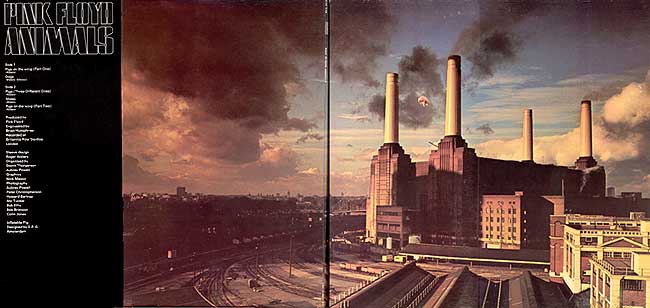
 

Echoes of Floyd: Animals

Sixty years after the Russian Revolution and thirty-two years after the publication of George Orwell’s Animal Farm, Pink Floyd released the politically charged album Animals. Whereas Orwell’s novel critiqued Stalinist corruption and the exploitation of the Soviet proletariat class through allegory, Animals, primarily written and sung by Roger Waters, criticized the economic and social conditions of Britain in the 1970s. The cohesive five track album’s primary message is to expose the negative effects of capitalism and social repression on inter-human connection and empathy. Although Pink Floyd’s music and George Orwell’s novel were written about different societies in very different historical contexts, both make similar overall points about social and political revolution. The only revolutions that can effect real change must be led by an aware populous. As long as the “sheep” of a society are at least partially ignorant to their exploitation, they are doomed to continue suffering at the hands of the ruling “pigs”. Animals remains just as relevant today as it was in 1977 as Roger Waters just completed a four month North American tour in which he performed the song “Pigs” to demeaning images of Donald Trump. Concerned now, as always, for the fate of humanity, Waters continues to use his music to alert the masses to their exploitation in search of true social and political change.

(Lyrics and some analysis can be found here.)

Inspired by Orwell’s allegory, Pink Floyd’s album classifies people into three animal-designated categories by their socioeconomic class. The sheep are the blind proletariat class, unaware of their conditions and thus unlikely to challenge their rulers. The dogs are the greedy and ambitious that seek to climb the economic food change to materialistic prosperity. The dogs are uncaring in their pursuit and unknowingly support the tilted system they hope to conquer. This keeps the pigs, the wealthy capitalist class and owners of the “means of production”, in power.

The album is split into four main sections: an opening acoustic poem-like song that also returns with more percipient lyrics to close the album and a song for each of the three previously mentioned animals. Each song dedicated to an animal extends beyond the ten minute mark, allowing for the development of distinct grooves and for complex evolution of character and story line.

The first song, “Pigs on the Wing (Part One)”, introduces Waters’ main issue with the state of society. It opens, “If you didn’t care what happened to me/And I didn’t care for you/We would zig zag our way through the boredom and pain”. Without human compassion life is largely painful and meaningless. Phillip Rose, in his thesis on the music of Pink Floyd, points out that the use of acoustic guitar in this song, as on the final song of the album, conveys a feeling of “honesty” and humanity which is in sharp contrast to the electronic sounds of the other tracks.

The next track, “Dogs” immediately transitions into a darker character which signals the approach of the dog. There are two distinct voices in this song, indicated by the two different singers. David Gilmour sings the first three verses in which he describes the tough and ruthless life of a dog. The song begins, “You got to be crazy, you gotta have a real need,” stating how ambitious one must be to fight for material wealth. It continues, “You got to be able to pick out the easy meat with your eyes closed,” which exposes the “dog-eat-dog” mentality one must have to survive. Rogers then explicitly frames the dogs in a corporate businessperson light with the lyrics, “And after a while, you can work on points for style/Like the club tie, and the firm handshake”. Clearly the more skilled dogs can climb the corporate ladder to achieve greater wealth and prosperity.

After a long atmospheric instrumental section, the dog’s attitude changes as Roger Water’s vocals enter. This verse shows the dog is becoming disillusioned by the system with the lyrics, “Gotta admit that I’m a little bit confused/Sometimes it seems to me as if I’m just being used”. The dog is shown to have a lack of personal connection as it continues to pretend “That everyone’s expendable, and no one has a real friend”. The final verse exposes everything the dog missed in its greed for wealth: “…trained not to spit in the fan” – it was trained to conform and not pursue social change, “…broken by trained personnel” – it was used by the system for the gain of those at the top, “Who was only a stranger at home” – it had no intimate familial relationships. By the end of its life the dog finally realizes that it was duped. The superficial material success that it achieved in place of human connection and compassion did not provide the meaning or purpose for which it originally hoped.

Album cover for Animals (1977). The cover shows a pig floating over the Battersea Power Station in West London. The power station embodies capitalism which the “pigs” control.

The following song, “Pigs (Three Different Ones)”, derides the ruling capitalist class and takes aim at some specific characters of the British social and political scene. The first verse concerns a generic pig who is so caught up in its own greed that’s its almost funny. “Pig stain on your fat chin/…You’re nearly a laugh/You’re nearly a laugh/But you’re really a cry”. The obvious indulgence of the pig is so sloppy that it would be comical if it wasn’t so depressing. The third verse is the only place on the album that explicitly names a real person, starting, “Hey you, Whitehouse”. This refers to Mary Whitehouse, a British social conservative that used religion to justify and promote censorship of blasphemous texts and the banning of sex toys and pornography. Rogers yells, “You’re trying to keep our feelings off the street” at her before mockingly saying, “You gotta stem the evil tide/And keep it all on the inside”.

The final animal-based song on the album, “Sheep”, is where all the action happens. It begins with a depiction of the mindless masses: “Harmlessly passing your time in the grassland away/Only dimly aware of a certain unease in the air/…Things are not what they seem”. The sheep are shown to be blind to their oppression and unknowingly prop up the system for the benefit of the pigs. The sheep then “obedient[ly]… follow the leader” down to “the valley of steel” which, following the allegory, likely means their death. The following section of the song features an altered version of Psalm 23:1 which is recited robotically through a vocoder (Here is the real Biblical version). The new version of the passage depicts the shepherd killing the sheep and “convert[ing]” them to “lamb cutlets”. Philip Rose interprets the shepherd as the pigs who have “great power” and “great hunger”. By the end of the verse, however, the sheep have begun to formulate an uprising as is evidenced by “Lo, we shall rise up”.

In the final verse, the sheep attack the dogs. The use of the word “babbling” in the line “Bleating and babbling we fell on his neck with a scream” implies that the sheep aren’t really sure why they’re rising up so violently. In the next line the sheep are referred to as “demented avengers,” furthering the idea that they are without clear-minded purpose. In the final lines of the song the cycle is shown to be complete. The sheep have risen up to overthrow the dogs and those with newfound power tell the others, “You better stay home/And do as you’re told”. The point here is that the rebellious sheep have now taken over the role of the previously powerful (but also exploited) dogs, ready now to achieve great wealth as they “March cheerfully out of obscurity into the dream”. Of course the real reason for the other animals pain, the pigs, have remained solidly in power.

Whereas the end of “Sheep” presents a fairly pessimistic message, the final track is hopeful. Featuring only guitar and voice, like the opening song, “Pigs on the Wing (Part 2)” tells the story of a dog who has forged some meaningful human connections. It no longer “feel[s] alone” and now has a “shelter” from the pigs. This song says that even in the inherently cutthroat world of capitalism, people can find safety in human empathy.

Despite this final moment of optimism, Roger Waters has more often seen the ending depicted in “Sheep”  in the years since the album was released. Over the last forty years he has performed selections from the album frequently but most recently, on his 2016 tour, the songs have a new target: Donald Trump. Below is a live video from October 1st, 2016 in Mexico City. Waters performs “Pigs (Three Different Ones)” and it is clear that he has repurposed the line “Hey you, Whitehouse” in the third verse to point to the residency of the president of the United States (8:10).

In a recent interview about the tour Waters takes issue with Trump “living in an ivory tower” and “treating everyone as the enemy”. Undoubtedly rhetoric that implies the “superiority of Western culture” like Trump’s “We write symphonies”  comment in Poland is ignorant and dangerous. And “The wall just got 10 feet higher” comments clearly go against Waters promotion of human connection and empathy. In a world that often seems as if it hasn’t changed at all since the release of Animals, the final idea of the album that shelter and safety can be found in human connection is more important than ever.

In 1917 George Orwell witnessed a revolution in Russia which he felt effected not “radical improvement” but only a “change in masters”. In 1977 Pink Floyd warned of this problem in socially repressive capitalist Britain through an Animal Farm-like allegorical album. Today Roger Waters is carrying that message on in light of the “us versus them” rhetoric of Donald Trump. Will the “sheep” ever rise up to enact fundamental social and political change? Or are they (we?) doomed to be content with mere changes of pig-like masters forever?

Losing Touch: the age of headphones

Remove your headphones and an odd scene is revealed before you. All around people smile and laugh as they sway and shuffle about and yet there is something missing. This dance floor is eerily quite. There is no band. There’s not even any music playing out loud! Every person is in fact in their own world, isolated by a wall of sound in their brightly colored headphones. This is the silent disco!

It has been a long road to the world of “mobile clubbing”. Like many modern technologies, headphones have had a long and often static history, with more rapid evolution coming in recent years. The first headphones, designed by Ernest Mercadier, were used in the late nineteenth century for telephone operators. Shortly thereafter headphones were introduced to the music industry as the company Electrophone began a service in which Londoners could listen to live broadcasted performances of music and theatre. After a long stretch in which developments in headphone technology mainly came from the military, John Koss achieved the next defining moment. An avid music listener, Koss designed the first stereophonic headphones which resulted in higher audio quality and a more authentic listening experience. The most current advancement has not come in the form of headphones but in music players. Sony’s “Walkman” and more recently Apple’s “iPod” have worked hand in hand with headphones to enact fundamental changes in the way we consume and produce music

Electrophone headphones and stand.

The advent and widespread use of headphones has motivated adjustments in the way recorded music is produced. The primary reason behind these changes is physical; unlike stereo speakers, headphones contain a relatively small audio-producing mechanism and feed directly into each ear. These two differences create some issues and a quick Google search will uncover a raging debate on the proper methods of mixing music in today’s world. How can one make music sound good on monitors and in headphones? Is it ok to mix a recording using headphones? Is it absolutely necessary to mix with headphones?

In an article on forbes.com, Nick Messitte explains how producers boost the mid-range overtones of bass sounds to “fool” your ears into thinking there is more bass than earbuds can actually produce. What headphones lack in bass output, they more than make up for in mid-range frequencies and producers have learned to take full advantage.

The “in-ear” nature of headphones has also necessitated some changes in effective music recording methods. This article explains why panning instruments to different channels is no longer a good option. When instruments are panned to one side or the other on stereo speakers, it can make the recording sound more authentic; when we hear live music, the musicians are generally set up in some configuration in front of us so that we hear each instrument slightly more strongly in one ear than the other. There is a phenomenon by the name of “crossfeed” in play here. If a sound emanates from your right, your right ear will receive the signal more strongly and fraction of a second before your left. Your brain has learned to localize the source of sounds from this specific set of signals. The issue with headphones is that they eliminate natural crossfeed as each ear hears only what comes out of its respective side. If a recording includes panned tracks then it will sound somewhat unnatural as we hear the instrument more strongly in one ear, associate it with being positioned to the corresponding side, but then don’t receive the validation of the weak delayed signal in our other ear. A good example of this is The Beatles’ “Eleanor Rigby”. The Youtube version features all the tracks sounding straight down the middle (more or less) while the Spotify version has heavily panned lead vocals. Listen with headphones to each version, paying special attention to 0:13 where the first verse begins.

The panned version sounds as though Paul McCartney is singing directly into your right ear! The more recently adjusted version sounds more natural. As illustrated by this example, it makes sense for producers to move away from panning in favor of pleasing headphone listeners, even at the expense of losing the more “live” atmosphere of well mixed stereo recordings.

In a more abstract but just as important way, headphones have changed the way humans consume and interact with music. In an article in The Atlantic, Derek Thompson points out research that music evolved to “serve as a technology of social bonding”. Although Western cultures have been moving toward a more elite and specialized use of music for some time, the widespread use of headphones completes the about-face from “social bonding”. Headphones allow us to enjoy music completely alone, acting as a portable auditory social barrier even in the midst of a crowded social space.

While losing interpersonal connections is concerning, David Byrne worries at an even deeper level about the lose of connection with ourselves. In his book, How Music Works, Byrne argues that the constant presence of recorded music in our lives, enabled in large part by the technology of headphones, prevents us from hearing the “music ‘playing’ in our heads”. His point is that the humming, whistling, and audiating we constantly engage in while not listening to music is much more than a silly habit. It is in fact an essential creative process that connects us more deeply to music. In the age of headphones, music is more and more often a solitary one-way street in which we consume but fail to interact. Too often we defer to listening to what Byrne calls the “experts” (recorded artists) and forget that silence is absolutely necessary to allow for processing, synthesizing, and creating. Music is interactive in nature and we must avoid allowing headphones to lead us to becoming increasingly passive listeners.

From the tangible effects of adjusted production techniques to less obvious changes in the ways we consume music, headphones have had profound impacts on our lives. In conjunction with the advent of recorded music and portable music players, headphones have allowed music to be both more present in our lives and also more isolating than ever before. While headphones can be a wonderfully convenient and useful technology, it would be smart of us to be conscious of when and why we use them and how they effect our relationship to the music we can’t seem to get enough of.

Sources:

www.forbes.com/sites/nickmessitte/2014/04/19/how-earbuds-have-changed-the-sound-and-business-of-pop/2/#aab6b0a7c189

www.theatlantic.com/technology/archive/2012/05/how-headphones-changed-the-world/257830/

www.smithsonanmag.com/arts-culture/a-partial-history-of-headphones-4693742

www.stuff.tv/features/headphones-complete-history/rise-walkman-1979-1990

https://ehomerecordingstudio.com/best-mixing-headphones/

Byrne, David. “How Music Works.” Three Rivers Press, an Imprint of the Crown Publishing Group, a Division of Penguin Random House LLC, 2017, pp. 139–141.