
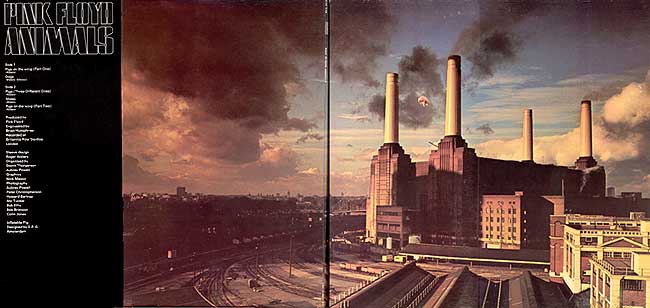
Sixty years after the Russian Revolution and thirty-two years after the publication of George Orwell’s Animal Farm, Pink Floyd released the politically charged album Animals. Whereas Orwell’s novel critiqued Stalinist corruption and the exploitation of the Soviet proletariat class through allegory, Animals, primarily written and sung by Roger Waters, criticized the economic and social conditions of Britain in the 1970s. The cohesive five track album’s primary message is to expose the negative effects of capitalism and social repression on inter-human connection and empathy. Although Pink Floyd’s music and George Orwell’s novel were written about different societies in very different historical contexts, both make similar overall points about social and political revolution. The only revolutions that can effect real change must be led by an aware populous. As long as the “sheep” of a society are at least partially ignorant to their exploitation, they are doomed to continue suffering at the hands of the ruling “pigs”. Animals remains just as relevant today as it was in 1977 as Roger Waters just completed a four month North American tour in which he performed the song “Pigs” to demeaning images of Donald Trump. Concerned now, as always, for the fate of humanity, Waters continues to use his music to alert the masses to their exploitation in search of true social and political change.
(Lyrics and some analysis can be found here.)
Inspired by Orwell’s allegory, Pink Floyd’s album classifies people into three animal-designated categories by their socioeconomic class. The sheep are the blind proletariat class, unaware of their conditions and thus unlikely to challenge their rulers. The dogs are the greedy and ambitious that seek to climb the economic food change to materialistic prosperity. The dogs are uncaring in their pursuit and unknowingly support the tilted system they hope to conquer. This keeps the pigs, the wealthy capitalist class and owners of the “means of production”, in power.
The album is split into four main sections: an opening acoustic poem-like song that also returns with more percipient lyrics to close the album and a song for each of the three previously mentioned animals. Each song dedicated to an animal extends beyond the ten minute mark, allowing for the development of distinct grooves and for complex evolution of character and story line.
The first song, “Pigs on the Wing (Part One)”, introduces Waters’ main issue with the state of society. It opens, “If you didn’t care what happened to me/And I didn’t care for you/We would zig zag our way through the boredom and pain”. Without human compassion life is largely painful and meaningless. Phillip Rose, in his thesis on the music of Pink Floyd, points out that the use of acoustic guitar in this song, as on the final song of the album, conveys a feeling of “honesty” and humanity which is in sharp contrast to the electronic sounds of the other tracks.
The next track, “Dogs” immediately transitions into a darker character which signals the approach of the dog. There are two distinct voices in this song, indicated by the two different singers. David Gilmour sings the first three verses in which he describes the tough and ruthless life of a dog. The song begins, “You got to be crazy, you gotta have a real need,” stating how ambitious one must be to fight for material wealth. It continues, “You got to be able to pick out the easy meat with your eyes closed,” which exposes the “dog-eat-dog” mentality one must have to survive. Rogers then explicitly frames the dogs in a corporate businessperson light with the lyrics, “And after a while, you can work on points for style/Like the club tie, and the firm handshake”. Clearly the more skilled dogs can climb the corporate ladder to achieve greater wealth and prosperity.
After a long atmospheric instrumental section, the dog’s attitude changes as Roger Water’s vocals enter. This verse shows the dog is becoming disillusioned by the system with the lyrics, “Gotta admit that I’m a little bit confused/Sometimes it seems to me as if I’m just being used”. The dog is shown to have a lack of personal connection as it continues to pretend “That everyone’s expendable, and no one has a real friend”. The final verse exposes everything the dog missed in its greed for wealth: “…trained not to spit in the fan” – it was trained to conform and not pursue social change, “…broken by trained personnel” – it was used by the system for the gain of those at the top, “Who was only a stranger at home” – it had no intimate familial relationships. By the end of its life the dog finally realizes that it was duped. The superficial material success that it achieved in place of human connection and compassion did not provide the meaning or purpose for which it originally hoped.
The following song, “Pigs (Three Different Ones)”, derides the ruling capitalist class and takes aim at some specific characters of the British social and political scene. The first verse concerns a generic pig who is so caught up in its own greed that’s its almost funny. “Pig stain on your fat chin/…You’re nearly a laugh/You’re nearly a laugh/But you’re really a cry”. The obvious indulgence of the pig is so sloppy that it would be comical if it wasn’t so depressing. The third verse is the only place on the album that explicitly names a real person, starting, “Hey you, Whitehouse”. This refers to Mary Whitehouse, a British social conservative that used religion to justify and promote censorship of blasphemous texts and the banning of sex toys and pornography. Rogers yells, “You’re trying to keep our feelings off the street” at her before mockingly saying, “You gotta stem the evil tide/And keep it all on the inside”.
The final animal-based song on the album, “Sheep”, is where all the action happens. It begins with a depiction of the mindless masses: “Harmlessly passing your time in the grassland away/Only dimly aware of a certain unease in the air/…Things are not what they seem”. The sheep are shown to be blind to their oppression and unknowingly prop up the system for the benefit of the pigs. The sheep then “obedient[ly]… follow the leader” down to “the valley of steel” which, following the allegory, likely means their death. The following section of the song features an altered version of Psalm 23:1 which is recited robotically through a vocoder (Here is the real Biblical version). The new version of the passage depicts the shepherd killing the sheep and “convert[ing]” them to “lamb cutlets”. Philip Rose interprets the shepherd as the pigs who have “great power” and “great hunger”. By the end of the verse, however, the sheep have begun to formulate an uprising as is evidenced by “Lo, we shall rise up”.
In the final verse, the sheep attack the dogs. The use of the word “babbling” in the line “Bleating and babbling we fell on his neck with a scream” implies that the sheep aren’t really sure why they’re rising up so violently. In the next line the sheep are referred to as “demented avengers,” furthering the idea that they are without clear-minded purpose. In the final lines of the song the cycle is shown to be complete. The sheep have risen up to overthrow the dogs and those with newfound power tell the others, “You better stay home/And do as you’re told”. The point here is that the rebellious sheep have now taken over the role of the previously powerful (but also exploited) dogs, ready now to achieve great wealth as they “March cheerfully out of obscurity into the dream”. Of course the real reason for the other animals pain, the pigs, have remained solidly in power.
Whereas the end of “Sheep” presents a fairly pessimistic message, the final track is hopeful. Featuring only guitar and voice, like the opening song, “Pigs on the Wing (Part 2)” tells the story of a dog who has forged some meaningful human connections. It no longer “feel[s] alone” and now has a “shelter” from the pigs. This song says that even in the inherently cutthroat world of capitalism, people can find safety in human empathy.
Despite this final moment of optimism, Roger Waters has more often seen the ending depicted in “Sheep” in the years since the album was released. Over the last forty years he has performed selections from the album frequently but most recently, on his 2016 tour, the songs have a new target: Donald Trump. Below is a live video from October 1st, 2016 in Mexico City. Waters performs “Pigs (Three Different Ones)” and it is clear that he has repurposed the line “Hey you, Whitehouse” in the third verse to point to the residency of the president of the United States (8:10).
In a recent interview about the tour Waters takes issue with Trump “living in an ivory tower” and “treating everyone as the enemy”. Undoubtedly rhetoric that implies the “superiority of Western culture” like Trump’s “We write symphonies” comment in Poland is ignorant and dangerous. And “The wall just got 10 feet higher” comments clearly go against Waters promotion of human connection and empathy. In a world that often seems as if it hasn’t changed at all since the release of Animals, the final idea of the album that shelter and safety can be found in human connection is more important than ever.
In 1917 George Orwell witnessed a revolution in Russia which he felt effected not “radical improvement” but only a “change in masters”. In 1977 Pink Floyd warned of this problem in socially repressive capitalist Britain through an Animal Farm-like allegorical album. Today Roger Waters is carrying that message on in light of the “us versus them” rhetoric of Donald Trump. Will the “sheep” ever rise up to enact fundamental social and political change? Or are they (we?) doomed to be content with mere changes of pig-like masters forever?
Interesting post! I thought your analysis on the album was very well thought out and informative. The organization also made it easy to follow. I’d be interested to know if they were the first to make this connection to people being sheep and dogs. These terms are very common these days when people talk about social trends, especially the sheep idea. That concept reminded me of those questions where people ask “If all your friends jumped off a cliff would you jump too?”. So, how did this album influence people during the time? Did it motivate people to change? I liked how you referenced the social climate regarding trump to answer these questions. It seems like there are still dogs, sheep, and pigs around, but there is more drive for people to change. Maybe this is because I know more about the social climate I grew up in than the social climate then. Clearly, there was drive to change if there was a whole album dedicated to it, but it seems like people are less closeted about the need to change.