Everlong-The Timeless Music Video to a Foo-Fighters Classic

The music video for the Foo Fighters’ “Everlong” is a long-time favorite of mine. The song itself has always been dear to me, as it has to millions of other young people who grew up on alternative/2000s rock, and the music video is a perfect match for the song’s grungy, melancholy, nostalgic tone. Watching the music video was always a cathartic kind of experience for me during my adolescence, simultaneously invigorating and calming. I recently rewatched the video after having not seen it for a long while, and I was once again struck by the perfect marriage between the tone of the video and the song’s tone. My slightly older eyes and ears now realize that the video is so encapturing because it puts you in the protagonist’s role, and thus you feel a sense of victory when the protagonist overcomes his challenges and opponents.

I will explain, but first you should see the video for yourself; The Music Video to “Everlong”.

For those of you who haven’t seen the video and don’t want to see it but for some reason want to read my analysis of it, here’s a synopsis: The first 25 seconds of the video is a roaming, black and white view of a quiet suburban night. The song’s hushed instrumental intro plays as the camera goes into a house where our protagonist, Foo-Fighters frontman Dave Grohl, is asleep. The camera zooms in on his head, and the screen fades into color as we enter his dream. At this point we as a viewer unconsciously understand that we are are viewing things from Dave’s perspective. During the first verse Dave, and thus the viewer, saves a girl from some thugs at a house party by slapping them with his oversized hands. In the second verse he does the same thing in a log cabin. A cabin which, by the way, is a homage to the setting from the Evil Dead (http://www.imdb.com/title/tt5688654/). In the songs triumphant final chorus we return to Dave’s bedroom where he and his bandmates shed the costumes they’ve been wearing in the video, instruments appear and they jam to the end of the song.

Dave Grohl’s hand grows to a size fit for slapping his foes

The video is directed by Michel Gondry, who would later go on to direct Eternal Sunshine of the Spotless Mind, and his surreal style is pervasive throughout the video (http://teamrock.com/feature/2016-10-05/foo-fighters-videography). From the cartoonish costumes, to the scene in a which there is a massive telephone that Dave climbs on, to the wonderful moment where Dave’s bed collapses to reveal that there was a drumset underneath it the whole time, the video takes you to another reality where the normal laws of our world don’t necessarily apply. This otherworldly style is befitting of a “pensive ode to a blossoming romance”, because isn’t the beginning of love rather like being on another planet (https://pitchfork.com/reviews/albums/10473-the-colour-and-the-shape-10th-anniversary-special-edition/)?

Anyway, what makes the video so satisfying is the connection established between the viewer and the protagonist. Because we feel like we’re right there with Dave, we feel the victories that he has against the cartoonish bad guys all the more. The peaks and valleys of the video also follow the song’s contours to a tee. The quiet, tense B-minor verses accompany Dave’s struggles and his girlfriend’s peril, while the jubilant D-major choruses play as he defeats the bad do-ers and jams with his bandmates.

However I know what you, dear reader, have been thinking the whole time you’ve been reading this blog. You’ve been thinking “what did the YouTube commenters have to say about the video”? Well dear reader it is the YouTube comment section so most of the comments were rather pointless, like Leanne Mutis’s all-caps masterpiece; “WHOS WATCHING IN 2017” with no question mark. There were some comments, though, that demonstrate that the music video resonates with other people in the same empowering, if not goofy way it resonates with me. For example unnamed715 says “my favorite part is when he starts b**ch-slapping people with that big a** hand”. User marsh marlou says “I imagine myself driving in a a car with my dog with the windows open and this song blasting” (the double a is their typo not mine). While both of these comments are lighthearted I believe they attest to the energizing experience that watching Everlong’s music video provides.

Aaaaaaaaaaaaangsty goodness

By some combination of corniness, surrealism, and genuine emotion, the music video to “Everlong” is a perfect match for the song. The campy visual style and sets that don’t look even remotely realistic balance perfectly with the adolescent sincerity of the song and Dave Grohl’s genuine emotion at the end of the video. In short, I believe it is a timeless video, and I hope angsty teenagers of many future generations will find some solace in it.


For further reading on Michel Gondry’s music videos: https://bluechat.io/list/top-ten-music-videos-directed-by-michel-gondry 

For More on “Everlong” https://www.youtube.com/watch?v=E9qB2aVamjM
Why Jimi Hendrix’s Rendition of “The Star Spangled Banner” is More Relevant Than Ever

It’s well known that the 1960’s were a unique and crazy time in United States history. The civil right’s movement, the assassination of President Kennedy, the controversial policies of President Nixon, the Vietnam war, the space race/moon landing, the complete overhaul of the popular music world as Rock and Roll swept in from England, and many other phenomena set a political stage where controversy roared. It seemed impossible to make a meaningful statement that people would listen to.

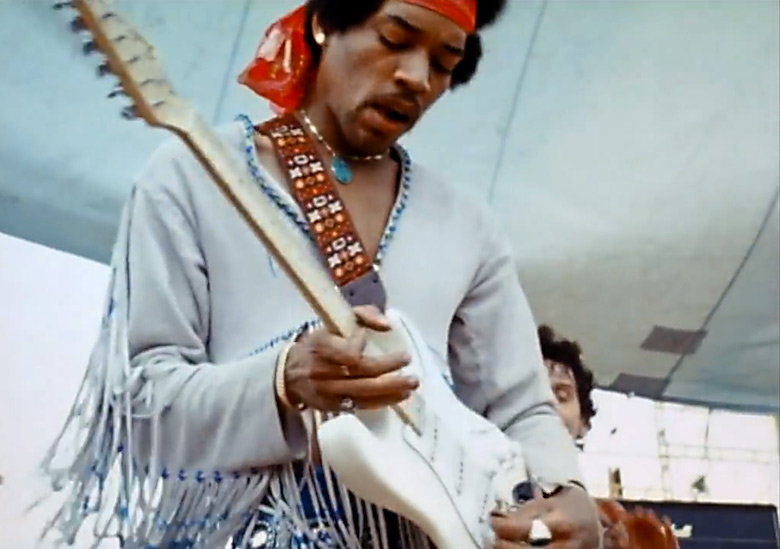
Amidst all of this, on August 18th, 1969, Jimi Hendrix did just that. On the final day of Woodstock, towards the end of his set, he played a distorted, extended, somewhat mangled version of the star spangled banner. If you haven’t seen and heard it before, check it out before you read any further.

https://www.youtube.com/watch?v=MwIymq0iTsw


Jimi Hendrix at Woodstock, 1969                            http://www.guitarhive.com/images/Hendrix-Woodstock_small.jpg


Hendrix plays the melody painfully slowly, lingering on every moment and letting his guitar feedback into his wall of amps. He is accompanied only by drummer Mitch Mitchell-http://www.drummerworld.com/drummers/Mitch_Mitchell.html. Throughout the entire song he lets his vibrato pedal create a churning effect on his sound, almost like the whirring off helicopter propellers starting up-http://www.rockprophecy.com/shop.html. Following the lyrics-”rocket’s red glare” he uses his tremolo bar and string-bending to morph his guitar’s feedback into a violent visual. After “bomb’s bursting in air” Hendrix uses his guitar’s whammy-bar to drop the high note down over two octaves, crashing into harsh noise as bombs dropped in Vietnam across the world. He even quotes “Taps”, the bugle call played at military funerals, so as to lament the military lives being lost in that same conflict http://www.music.army.mil/music/buglecalls/taps.asp. Regardless of one’s opinion on it as a piece of history or a political statement, I don’t think anyone can deny that the performance is encapturing.

New York Times writer William Robins points out that the Star Spangled Banner has a “long, polarizing history” in which Hendrix’s performance is only a chapter. There was a harsh parody of the song made in 1844 criticizing the lingering institution of slavery in which the last line is “O’er the death-bed of freedom/ the home of the slave. –https://www.newyorker.com/culture/culture-desk/colin-kaepernick-and-the-radical-uses-of-the-star-spangled-banner. Since then it has long been a target vehicle for critiquing the state of the nation, as is true today with the Colin Kaepernick/NFL protests.

And it’s in light of the recent political climate that I believe that Hendrix’s interpretation of the anthem is as meaningful as it has ever been. Instead of bombs dropping on Vietnam it’s on the middle east. Instead of Nixon’s hardline republican policies it’s Trump’s heartless and insane policies. The anger in the performance could just as well be directed at the killings of Trayvon Martin or Philando Castile as it could that of Martin Luther King Jr. The patriotism in Hendrix’s beautifully powerful sound as he screams the melody still applies to those who are able to look past the numerous deep problems the U.S has and appreciate the beauty of the nation. Woodstock attendee said that Hendrix’s performance “was the most electrifying moment of Woodstock, and it was probably the single greatest moment of the sixties. You finally heard what that song was about, that you can love your country, but hate the government”-https://hooksanalysis.wordpress.com/2014/06/14/improvised-jimi-hendrix-star-spangled-banner-1969-and-john-bonham-moby-dick-1970/. I believe that in current times, as a misogynistic narcissist runs the country, and every American lives with the knowledge that our private information is legally sold from corporation to corporation through questionable means, that message holds up powerfully. 

On the Dick Cavett show  in 1970, Cavett remarked that Hendrix was bound to recieve some “nasty letters” about his performance of the anthem, which Hendrix quickly shrugged off saying “I thought it was beautiful.” And to me that inner confidence that Hendrix had about his work is part of what makes it so great. I personally hear it every time I listen to the Woodstock national anthem performance, and I hope it inspires any listener to have that confidence in the beauty of the USA, while acknowledging it’s flaws and struggles.

.

On V-Picks and Why They’re overrated

On V-Picks and Why They Are Overrated 

By Garrett Mader 


A collection of standard celluloid guitar picks

The pick, or more formally plectrum, is a small, generally triangular object that a guitarist, banjoist, or mandolinist holds in/attaches to their dominant-hand to strike their guitars’ strings and create sound from the instrument. Picks date back to the start of recorded history, with writings about music from ancient greece recounting that Lyres had picks attached to them by a string(https://www.premierguitar.com/articles/25204-the-surprisingly-long-history-of-the-guitar-pick).Those picks were made of ivory, bone, or wood, while since approximately 1922 the most common material for picks has been celluloid (http://surfpick.com/history/). Today the market for picks is massive and varied from brand to brand. For the purpose of this blog, however, I would like to narrow in on V-Picks.

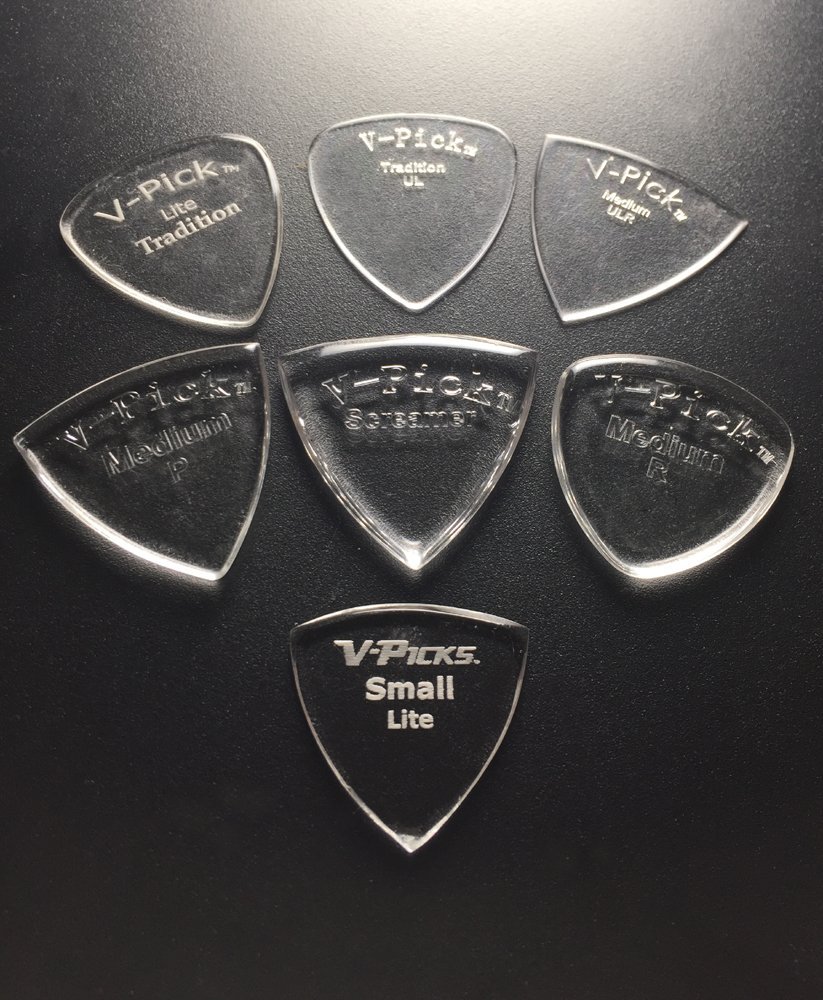
Some of the many varieties of V-Picks


V-picks are the creation of amatuer guitarist Vinni Smith (v-picks.com/v-picks-about-us/). They are produced in Nashville, TN and Modesto, CA. They’re made sheets of acrylic instead of celluloid, giving them a sleek, glossy look, and smooth feel. Acrylic is essentially a tough plastic used for windows, taillights, and bulletproof “glass”. For a brief chemistry lesson, Acrylic sheets are made by “reacting a monomer, such as methyl methacrylate, with a catalyst,” such as organic peroxide (madehow.com/Volume-2/Acrylic-P lastic.html). I discovered a video on Youtube called “How It’s Made-V-Picks”, in which some fans of these picks visited Vinni in his home and recorded him making a pick. The process is as follows; Vinni takes a sheet of acryllic covered with evenly-spaced V-Picks logos/labels into a laser cutting machine. The laser cutter cuts the acrylic into pick-shapes around the text. The rest of the process is done by hand-a point of pride in V-pick advertising. Vinni takes a pick cutout and puts it to a grindstone to craft the edges to be smoother. After this the pick is too hot to continue working with, so Vinni takes it to his backyard and leaves it in his dog’s water bowl to cool down for a few mins. Once its cooled he dries it on his shirt then puts a hydrogen flame, the clearest known combustible he says, to it to take away the roughness from the grindstone and the V-Pick is finished.  


A V-Pick is more than just the sum of it’s materials and processes though. Guitar-gear culture is a sprawling universe full of kingpin brands (fender stratocasters and telecasters are arguably as standard as TV sets in the American home) as well as niche corners, and V-picks are a relatively new phenomenon (the company started in 2004) that has quickly made itself a widely esteemed product (wikipedia.org/wiki/V-Picks_Guitar_Picks)*. There is a certain reverence for them in the guitar-iverse that doesn’t exist for most products. I believe this is derived from their unique, shiny look and the fact that most people believe they’re made of glass, which seems much classier than plastic. That last bit comes from my own experience; the first several people to mention V-Picks to me all told me they are made of glass. There is also some celebrity endorsement-Carlos Santana and Billy Gibbons have both officially endorsed V-Picks as their main pick brand. Not to downplay the contributions of those guys, who do you know who’s all-time favorite guitarist is Gibbons or Santana? V-Picks are also pricier than your average pick, with a single pick costing upwards of 5 dollars. I believe the elevated price, general esteem, and celebrity endorsement are as much parts of the product as the acrylic and the logo at this point. When a guitarist buys a V-Pick they aren’t just buying a pick but they are buying what hundreds of youtube/guitar forum commenters have told them, and buying the idea that because they are paying more for a pricy, celebrity-endorsed pick that they are buying a more high-end product that will make them a better player in record-time. In the aforementioned Youtube video Vinni himself says of one of his products “I guarantee you this pick will make you a better player”.


I personally think V-Picks are sorely overrated. To me they generally don’t give your sound much mid-range or warmth, and they got scratched up fairly quickly when I tried them which made them sound worse. I respect that some people swear by them, but I believe that they have fallen under the hype surrounding them in the guitar-world. I do respect V-Picks for the brand they’ve created for themselves and the esteem they’ve created for their product, but  when it comes to picks I think it’s always imperative to remember that some of the most iconic guitar solos in the world were recorded by Brian May of Queen using a sixpence, so sometimes simpler is better.


*I understand that generally Wikipedia is not a reliable source, but the V-Picks website explicitly refers those interested in their product to the wiki page, giving it legitimacy in my eyes.  


Links to Media


http://www.guitarmania.co.uk/ekmps/shops/guitarmania/images/assorted-medium-guitar-picks-plectrum-pk-of-12-for-acoustic-or-electric-210-p[ekm]300×229[ekm].jpg


https://www.youtube.com/watch?v=urywl-Jy4yo

https://images-na.ssl-images-amazon.com/images/I/71eysAIzVAL._SL1000_.jpg