
It’s well known that the 1960’s were a unique and crazy time in United States history. The civil right’s movement, the assassination of President Kennedy, the controversial policies of President Nixon, the Vietnam war, the space race/moon landing, the complete overhaul of the popular music world as Rock and Roll swept in from England, and many other phenomena set a political stage where controversy roared. It seemed impossible to make a meaningful statement that people would listen to.
Amidst all of this, on August 18th, 1969, Jimi Hendrix did just that. On the final day of Woodstock, towards the end of his set, he played a distorted, extended, somewhat mangled version of the star spangled banner. If you haven’t seen and heard it before, check it out before you read any further.
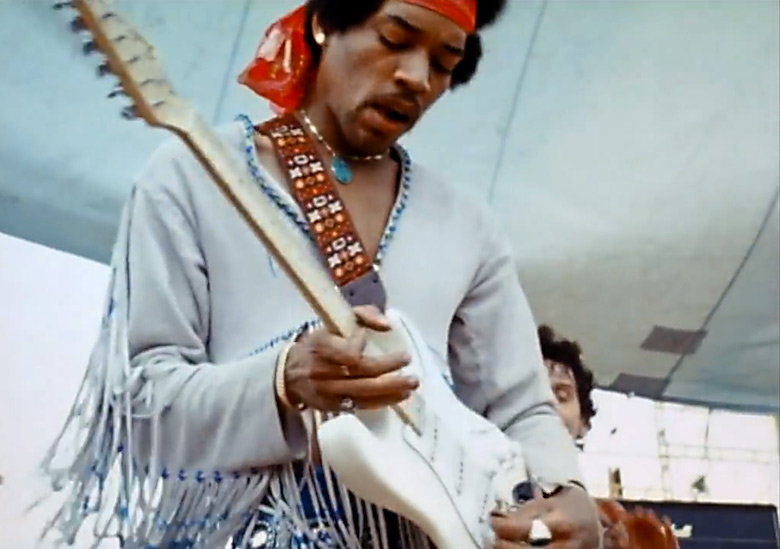
Hendrix plays the melody painfully slowly, lingering on every moment and letting his guitar feedback into his wall of amps. He is accompanied only by drummer Mitch Mitchell-http://www.drummerworld.com/drummers/Mitch_Mitchell.html. Throughout the entire song he lets his vibrato pedal create a churning effect on his sound, almost like the whirring off helicopter propellers starting up-http://www.rockprophecy.com/shop.html. Following the lyrics-”rocket’s red glare” he uses his tremolo bar and string-bending to morph his guitar’s feedback into a violent visual. After “bomb’s bursting in air” Hendrix uses his guitar’s whammy-bar to drop the high note down over two octaves, crashing into harsh noise as bombs dropped in Vietnam across the world. He even quotes “Taps”, the bugle call played at military funerals, so as to lament the military lives being lost in that same conflict http://www.music.army.mil/music/buglecalls/taps.asp. Regardless of one’s opinion on it as a piece of history or a political statement, I don’t think anyone can deny that the performance is encapturing.
New York Times writer William Robins points out that the Star Spangled Banner has a “long, polarizing history” in which Hendrix’s performance is only a chapter. There was a harsh parody of the song made in 1844 criticizing the lingering institution of slavery in which the last line is “O’er the death-bed of freedom/ the home of the slave. –https://www.newyorker.com/culture/culture-desk/colin-kaepernick-and-the-radical-uses-of-the-star-spangled-banner. Since then it has long been a target vehicle for critiquing the state of the nation, as is true today with the Colin Kaepernick/NFL protests.
And it’s in light of the recent political climate that I believe that Hendrix’s interpretation of the anthem is as meaningful as it has ever been. Instead of bombs dropping on Vietnam it’s on the middle east. Instead of Nixon’s hardline republican policies it’s Trump’s heartless and insane policies. The anger in the performance could just as well be directed at the killings of Trayvon Martin or Philando Castile as it could that of Martin Luther King Jr. The patriotism in Hendrix’s beautifully powerful sound as he screams the melody still applies to those who are able to look past the numerous deep problems the U.S has and appreciate the beauty of the nation. Woodstock attendee said that Hendrix’s performance “was the most electrifying moment of Woodstock, and it was probably the single greatest moment of the sixties. You finally heard what that song was about, that you can love your country, but hate the government”-https://hooksanalysis.wordpress.com/2014/06/14/improvised-jimi-hendrix-star-spangled-banner-1969-and-john-bonham-moby-dick-1970/. I believe that in current times, as a misogynistic narcissist runs the country, and every American lives with the knowledge that our private information is legally sold from corporation to corporation through questionable means, that message holds up powerfully.
On the Dick Cavett show in 1970, Cavett remarked that Hendrix was bound to recieve some “nasty letters” about his performance of the anthem, which Hendrix quickly shrugged off saying “I thought it was beautiful.” And to me that inner confidence that Hendrix had about his work is part of what makes it so great. I personally hear it every time I listen to the Woodstock national anthem performance, and I hope it inspires any listener to have that confidence in the beauty of the USA, while acknowledging it’s flaws and struggles.
.
Great job covering the event as well as expanding on what we had discussed in class! That interview with Dick Cavett and Jimi’s comments about having to sing the anthem in school as well as his assertion that the performance wasn’t unorthodox give great insight into how he wasn’t attempting to make a grandiose statement of hatred against America, he was just calling it as he saw it. The way in which you create parallels between the chaos of the sixties and the political turbulence of our times is quite tastefully done and even further clarifies your point of how relevant Jimi’s interpretation of the anthem is today. One recommendation I would make would be to hyperlink your citations to specific words or phrases (for example the Mitch Mitchell you can just highlight his name and make the name a link rather than having a url immediately following), as that simply makes the blog post more aesthetically pleasing.