Tyler, the Creator is a leading figure in rap music as a rapper and producer. One of his most famous songs is called Yonkers, apparently based on the town Yonkers, NY. What is so interesting about this song is that everything contradicts itself, and the music video doesn’t seem to connect much to the lyrics. Many try to read between the lines to find deeper meanings, but Tyler always denies that there is a deeper meaning in any of his music. It is very easy to believe that something is more special than it is meant to be, and it seems to be very important to the listener that there is predetermined intent in the music.
Tyler, the Creator uses many techniques in his rapping that reminds me of some other artists we know in the classical world like Schumann. I find this because he uses characters in his pieces, the most important one being his alter-ego Wolf Haley, as well as a fictional therapist named Dr. TC. Much of his rapping uses extremely offensive slurs and plots, including rape and violence against women, and homophobic slurs. Yet Tyler always says none of it means anything, and it is all “simply…an admittedly absurd story that was never meant to be taken seriously”. He was one of the first to publicly support Frank Ocean when he came out, and has never been known to use violence. After knowing this about Tyler, the Creator, does it make sense to treat his music seriously or try to look deeper into his music to find hidden meanings?
Yonkers uses lyrics that contradict themselves at every turn. Starting at the beginning, “I’m a f***in’ walkin’ paradox – No I’m not”. These lyrics make no sense, but many in comments on sites used to describe what the song means, say that one of the sides is Tyler and the other side is Wolf Haley. All the contradictions are really happening in his own mind, at least that’s what the song is about. Many of the youtube comments however are very different, I found dozens that commented on the line “I’m not gay, I just want to boogie to some Marvin” suggesting that Tyler is gay (many of these comments came out because in Tyler’s new album he comes out as gay). “”I’m not gay, I just wanna boogie to some Marvin.” yah okay” – AKFORTYKAVIN. Some comment on the contradictions between the lyrics: “the reason he did this is because wolf haley (the kid with button ups and shorts) is his evil self. if you look closely at the lyrics he is constantly contradicting himself, like him fighting against his other self. its pretty cool.” -DirtWormGames. But most just comment on how crazy they think Tyler is or how bad they think the song is: “Well f*** me, this was seriously bad all the way through. I came to this YouTube-account to understand what even makes this guy a thing to begin with, and I did not get any wiser. This was just terrible along with the rest of the things he made.” -IcaJerry and “This n**** still freaks me out to this day.”.
The music video is quite simple. It is black and white picture, of Tyler sitting on a stool rapping with a cockroach that he eventually eats and throws up. His eyes then turn completely black before he hangs himself (shown by him knocking down the stool). It is interesting because it doesn’t really have anything to do with the lyrics, agreeing with what he said in his interviews about there not being any meaning behind the lyrics. A connection I do find between the video and the lyrics, is this conflict between Tyler and his alter-ego. You can see this when the video blurs back and forth between sides of him, and with the suicide at the end of the video.
Whether or not Tyler, the Creator really meant for any of these lyrics or this video to have meaning behind it, it is still natural for the listener to find some human connection. When something is random, we try to find a pattern even if there is none. If a piece is atonal, we will hear some bits of tonality just naturally. Is it wrong to try to find meaning in something that didn’t mean to have meaning? Is it wrong to write a song that has no meaning behind it? Whether it is or isn’t, listeners have a natural magnetic pull to connecting dots and finding meaning in the random.
Background info: This is the “Scene d`Amour” from Alfred Hitchcock`s 1958 film Vertigo, widely considered one of Hitchcock`s greatest achievements. The story involves a retired police officer named Scotty (Jimmy Stewart) who falls into an obsessive relationship with a woman he meets in San Francisco named Judy (Kim Novak). Judy bears an uncanny resemblance to Scotty`s former lover, Madeline. Scotty failed to save suicidal Madeline from jumping of a bell tower due to his Vertigo, a sense of rotation, rocking, and spinning (https://www.medicinenet.com/vertigo_overview/article.htm). Scotty blames himself for Madeline`s death, and his overwhelming guilt has led him to madness. Now that Scotty has met Judy, he has her dress up to look exactly like Madeline.
The Scene-What you see: Judy emerges from the bathroom dressed exactly like Madeline. As she walks toward Scotty, Judy/Madeline is covered in green light appearing ghastly. The soundtrack increases in intensity with its repetitive motifs as Judy walks towards Scotty. The two kiss, and the camera begins to revolve 360 degrees around them. Suddenly Scotty looks up and sees himself not in the hotel room but in the barn beside the mission, the last place he kissed Madeline before she died. The soundtrack continues in intensity as the camera continues to revolve around the two and the background changes back to the hotel room and the music cadences in a major tonality.
The Artists:
Bernard Hermann: Bernard Hermann was born in New York City in 1911. He wrote his first film score in 1941 for the Orson Wells` Citizen Kane. Hermann wrote many soundtracks for Hitchcock, his last being Taxi Driver. Hermann`s techniques were unconventional for his time. “In place of lush melodies, he wrote short, obsessively repeated figures, static collections of chords, parodies of past styles” writes Alex Ross in The Rest is Noise (http://www.therestisnoise.com/2006/07/vertigo.html). You will hear short repeated
motifs throughout Vertigo, especially in the “Scene d`Amour”.
Hitchcock: Alfred Hitchcock was born in London in 1899 (https://en.wikipedia.org/wiki/Alfred_Hitchcock). Often referred to as the “master of suspense”, Hitchcock used many innovative camera techniques such as the 360 degree revolving camera used in the “Scene d`Amour”. The supernatural plot of Vertigo aided by Hitchcock`s visuals (the green light covered Judy) help create a feeling of mysticism, which comes complete with the addition of Hermann`s score. To learn more about Hitchcock`s techniques, watch this video: https://www.youtube.com/watch?v=UgnNakO6JZw.
The Scene: Why it works:
Film Music Scholar Tom Schneller identifies several main motifs throughout the Vertigo soundtrack. Two of main themes are ‘Madeline’ and ‘Obsession’ (http://writings.tomschneller.net/VertigoN.htm). ‘Madeline’ consists of a light 8th note motif that never cadences, is used throughout the movie when Scotty first looks upon Madeline. There is also a theme called ‘Obsession’ consists of the familiar sweeping melody present throughout the soundtrack. The beginning of the scene consists of variations on the obsession theme, which starts accelerating as Judy enters the room and begins talking. As Scotty waits for Judy to emerge from the bathroom different variations of the ‘Madeline’ theme play. The music accelerates and reaches a high pointwith the ‘Obsession’ theme as Judy emerges from the bathroom, clad in ghastly green light as the ghost of Madeline. When Scotty sees himself in the barn beside the mission the ‘Madeline’ theme emerges accelerating and moving upward-driving the scene forward. The scene ends with the ‘Obsession’ theme which ultimately cadences in a major tonality. When Hitchcock was filming this scene his instructions were“We should let all traffic noises fade, because Mr. Herrmann may have something to say here!” (https://csosoundsandstories.org/bernard-herrmanns-score-of-longing-and-loss-in-vertigo/) Hermann`s score augments the scene beautifully.
Tradition:
Although incredibly bold and daring as a soundtrack, Hermann uses techniques that were used in late 19th early 20th cent. Romantic music. The themes that Schneller identifies throughout the soundtrack can be compared to the Leitmotifs used in the music of Salome by Richard Strauss. Alex Ross in his book The Rest is Noise compares the “Scene d`Amour” to the “Liebestod” from Wagner`s opera Tristan and Isolde, concerning the themes of doomed love and leitmotifs. (http://www.therestisnoise.com/2006/07/vertigo.html) To compare Hermann and Wagner, watch this clip of “Liebestod”. https://www.youtube.com/watch?v=RLoHcB8A63M.
Conclusion:
In 2011Michel Hazanavicius`s film The Artist used cues from Vertigo in its soundtrack, causing controversy. (https://csosoundsandstories.org/bernard-herrmanns-score-of-longing-and-loss-in-vertigo/) Many people feel that Hermann`s music is inseparable from the Hitchcock`s film. One thing is for certain, Vertigo is a masterpiece of both film and music.
Tomorrowland is an annual electronic music festival held in the small, picturesque Belgian town of Boom. Since 2005 it has grown into one of the world’s largest and most noteworthy festivals. From its early years, ID&T who produced the festival, focused on experience and community over profit and renown. The particular attention to detail and incredible line-up of artists led to world record ticket sale times, with sell out occurring within seconds every year.
https://www.youtube.com/watch?v=6dVFy4d61gU
In the summer of 2011, Tomorrowland took an unprecedented step and uploaded what they titled “Aftermovie[s]” for every festival up to that point. These, at first short, videos posted to YouTube and Vimeo were meant to give attendees a sort of virtual yearbook. The first video “2005 Aftermovie” was a little over 3 minutes long. It was not until 2012’s edition of the Aftermovie that the videos received viral attention. The “Book of Life” themed 2012 edition of the festival produced an “Aftermovie” that received over 140 million views. Riding the massive EDM bubble that had begun to peak in the US, the rise of YouTube as a foremost competitor in the sector of mainstream content production and a generation that valued experience over anything else, Tomorrowland producers understood the value and importance of what they had created.
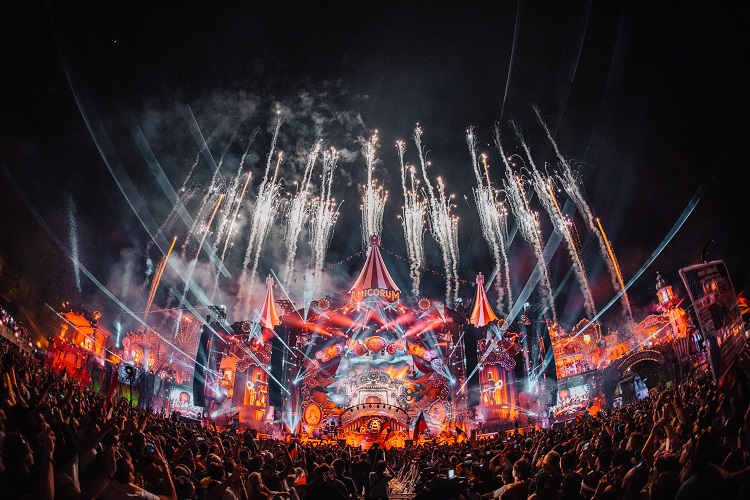
2017’s “Amicorum Spectaculum” was a Tomorrowland like no other. The largest stage to date, the most impressive and expansive line-up in Tomorrowland history, the most tickets sold, and the most countries represented by its participants since the festival’s inception.
The 2017 Official Aftermovie was a paragon of seamless interplay between visual and aural experience. The almost half hour long video not only shows off the incredible production value of the event itself, but presents a narrative that explores themes of unity, multiculturalism and acceptance that the festival has preached since 2005.
The video opens with a panoramic view of the festival grounds, themed airplanes and an incredible montage of flags from all over the world that festival goers proudly display. These opening scenes are accompanied by atmospheric tracks from Steve Angello’s fittingly titled Genesis EP. The track used in this first scene, Rejoice, is a massive departure from the EDM ( specific genre of pop electronic dance music popularized in the early 2010s) sound that put electronic music on the map in foreign markets. Steve Angello as an artist maps this evolution of electronic dance music, he was at the forefront of the EDM push in the 2010s as a member of the iconic trio Swedish House Mafia. This track explores more underground sounds than those he rose to prominence with, its synthesis of grunge rock and sampling of gospel and religious vocals are indicative of the return of electronic music to its experimental and exploratory roots. An incredibly fitting tune for the opening scene of the worlds foremost electronic music festival.
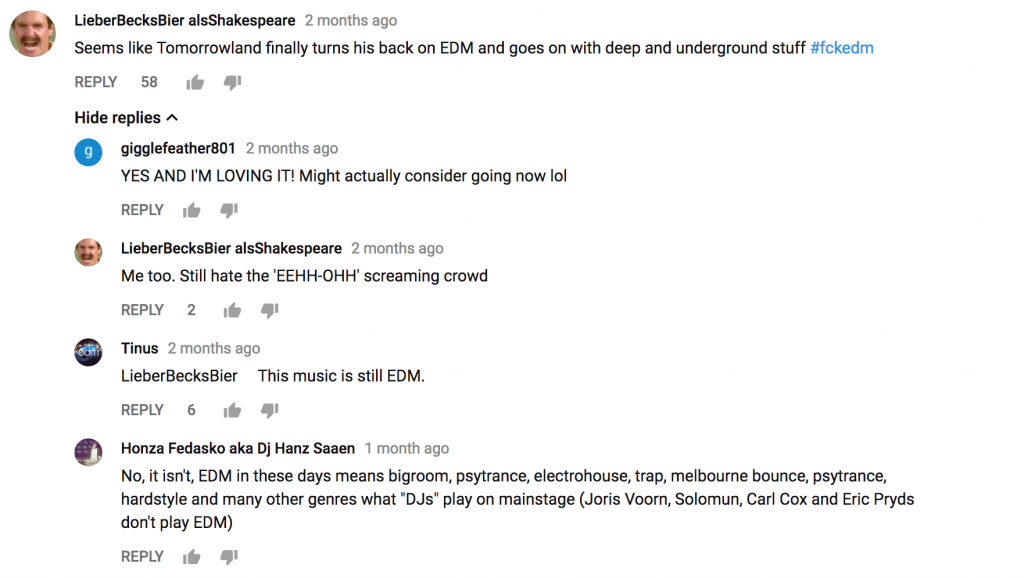
User LieberBecksBier alsShakespeare comments on this return to electronic dance music’s roots. He mentions Tomorrowland “turning its back” from EDM, a term coined in a huge multinational marketing push, meant to make the music more accessible to younger audiences. The term EDM stuck around longer than intended and became a blanket term for the incredibly diverse and imaginative sound world of electronic music. This “blanket effect” led to a long period of homogenization of mainstream dance music, which had a devastating effect on the creativity and individuality of underground artists. The popularity of Skrillex and Swedish House Mafia specifically made the american perversion of dub-step and a very specific progressive house sound respectively, the overwhelming and sole mainstream sound for many years. Tomorrowland in this video, strategically chooses tracks and artists that embody the return to the creativity and sounds of the pre-EDM rave.
The next few minutes of the video explore the move-in process. A building trance track (Filterheadz’s Kaleidoscope) accompanies time-lapse clips of people walking into the festival’s temporary campgrounds. Interspersed between the clips are people’s thoughts on attending the festival, representing a variety of shapes, sizes, colors and nationalities. As the music builds, the excitement and speed of the clips build as well, climaxing in the first experience of a hard “four on the floor” beat track, and a first full frame shot of the iconic Tomorrowland mainstage. The frames seem to change in time with every idiosyncrasy of the track, and as the “welcome to the jungle” vocals start to creep in, all of the festival’s 16 stages are presented in a whirlwind of quickly shifting frames. Just as quickly the music stills and nighttime falls.
This is when the incredible cinematography and production of the video and event truly come to life. The House of House, a track by the festivals main headliners Dimitri Vegas and Like Mike builds as the lights and lasers of the festival begin to come alive. The anticipation of the eventual “drop” is heightened by quickly changing frames, odd vantage points, peeks of pyrotechnic displays, as soon as the main portion of the song begins, the camera focuses on the incredible fireworks, lasers and enthusiastic dance from people and artists alike. The music, audience, Djs and stage all move to the same beat, and form a cohesive experience.
A similar cycle of low tempo ambient to high tempo house tracks accompanying a transitioning from day to night is employed in the next part of the video. Smiles, flying hands, bouncing heads are featured from all kinds of festival goers. This concludes with words by the godfather of modern electronic dance music, Armin Van Buuren .
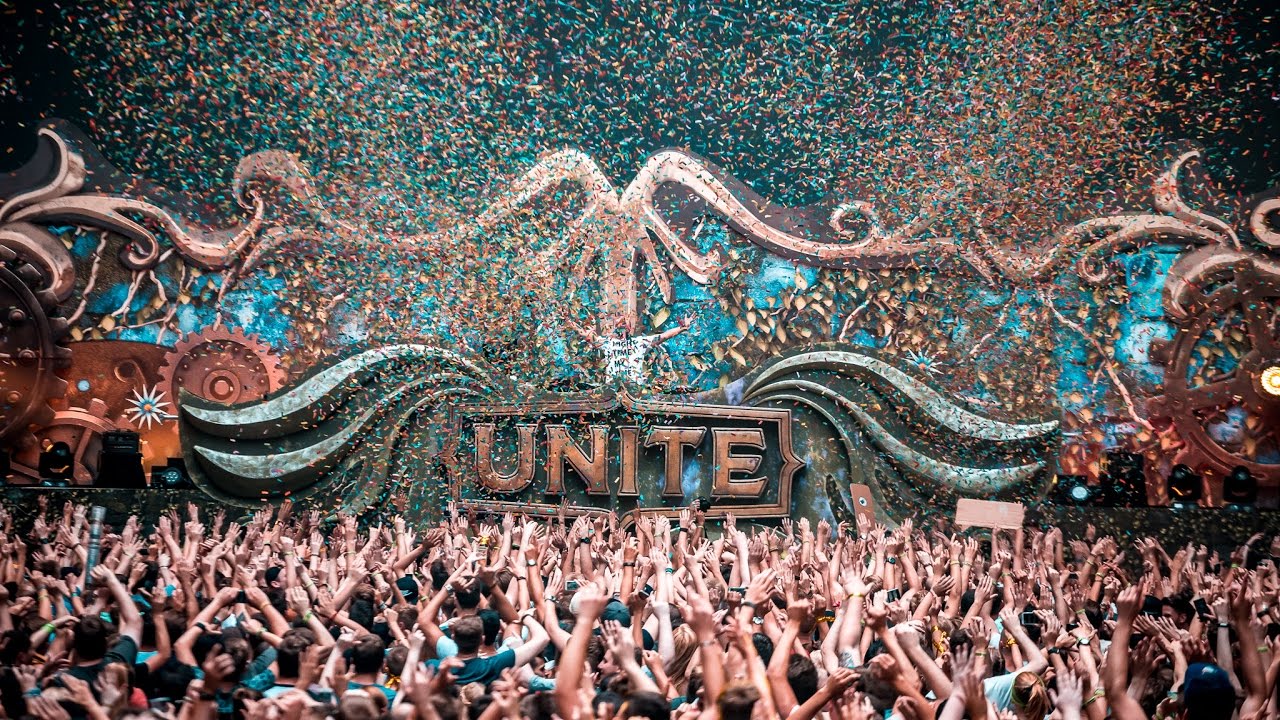
On the mainstage with the word “UNITE” proudly displayed at its base, he brings attention to the 7 satellite shows providing live stream coverage around the world; Germany, Dubai, Lebanon, Malta, Spain, South Korea, Israel. This scene is accompanied by Martin Garix’s track Pizza, not only does the incorporation of string instruments make the moment incredibly nostalgic, but it speaks to the future of the genre. A 21 year old wunderkind, Garrix represents a controversial but promising future of globalization and multiculturalism embodied in electronic dance music’s next generation of fans.
“It’s an amazing feeling to know that while you’re getting goosebumps at the MainStage in Belgium, literally millions of people around the world are watching my performance, even organizing home parties and having an amazing time as well.” -Armin Van Buuren
This globalization of the art form, and incredible role technology continues to play on the dissemination and consumption of the music is further explored in user vadeske’s comment:
“Not only has the growth of the event itself been amazing but also the content that they produce, like the live registration and after-movie. It just gets better and better each year. I think it’s great that people at home can watch the live stream and experience the festival as if they were there themselves.” -David Guetta
The video ends with an incredibly moving snippet of London Grammar’s Hell to the Liars Remixed by Kölsch. Along with text thanking performer, artist and visitor alike for the creation of the experience, the music creates a nostalgic and incredibly emotional atmosphere. This track takes an indie-pop Nottingham native band’s song, translates it into trance style sounds, and ultimately fades to a string orchestration, very reminiscent of late romantic music, faded and echoey vocals and incredibly faint acid house sounds are barely perceptible. One would we be hard pressed to find a track that more perfectly embodies the state of transformation electronic music is experiencing so beautifully curated by Tomorrowland.
In its final scene the video urges viewers to take the beauty of the experience and use the impulse to “spread [their] message to the world…” Live today, love tomorrow, unite forever. These egalitarian, utopian and community oriented ideas may seem idealistic, but for three days every year, this video and festival argues that Tomorrowland proves living by these principles is achievable.
Progress and cohesion are central to driving this point home, and many comments below the video praise not only the cinematic and musical content, but the accurate representation of the ideals and atmosphere of the festival experience.
Tomorrowland 2017’s “Official After Movie” is a celebration of its performers, audience, artists, but more importantly explores the real-time evolution of electronic dance music and serves as a platform to further preach its ideas of unity, acceptance and multiculturalism.
The best part of Thundercat and Eric Andre’s collaboration in the music video for “Tron Song”, is that the images and music absolutely do not combine to create any form of traditionally meaningful or powerful experience. Instead, the video consists of an amalgam Thundercat’s numerous personality quirks slammed together with Eric Andre’s distinctive directorial style and absurdist humor, resulting in three minutes and change of wackiness and tonal ambiguity that both confound and enchant the listener.
A track off of Thundercat’s second album, Apocalypse, Tron Song has all of seven distinct lines of lyrics, with the majority of the track consisting of Thundercat’s chordal bass guitar (emphasis on the guitar) technique, paired with multiple tracks of Thundercat’s floaty falsetto harmonizing over itself. To call the track a ballad is misleading, especially with Flying Lotus’ constantly shifting percussion that occasionally underlines Thundercat, but the feeling behind the track is that of a traditional ballad with the main lines of the hook, “Don’t you ever leave me turbo troooooooooooooooon, Don’t ever wonder where I’m going”, being a loving reference to Thundercat’s cat, Turbo Tron Over 9000 Jesus Baby Sally.
This provides a segue into how a video of this aesthetic even came into existence. A comedy collective named JASH began a series on YouTube (of which this is the second video) with the simple premise of giving $5,000 and full creative control to a comedian and musician tandem to create a music video. It’s fitting that JASH chose one of the most unique voices in television currently, as Eric Andre hosts quite possibly the most absurd talk-show of all time on Adult Swim. A bonafide master in the art of cringe comedy, low-budget spectacle and all around nonsense (as evidenced by simply the intro of his first show), Andre is the perfect choice to direct for this premise, and pairing him with the most singular bassists since Jaco Pastorius (and one of the most unique personalities in the music scene today) was a great way to extend such as the 5K music video idea.
As for the video itself, low budget is the name of the game as Eric Andre uses effects to create tape glitch or distorted effects, reminiscent of schlocky 90’s b-movies that you would find on VHS in the back of a video store. This could easily come off as gimmicky if it weren’t for the fact that Thundercat looks and dresses like a character straight out of a 90’s B-movie with hair in every direction and a wardrobe that defies any conventions, ranging from varsity jackets to Vegeta’s armor from the TV show Dragon Ball Z. If there was any doubt over the nonsensical direction this music video would take, Andre eliminates it by cutting in an image of Thundercat playing his bass on backside where there are no strings in the first thirty seconds. The breaking point in the video is around the 40th second where Thundercat’s discovery of a handgun (and subsequent suicide?) in a human-sized litter box coincides with Flying Lotus’ drum pattern crashing in. The following images that range from police brutality to Thundercat traveling through Tron’s anus into space to defecation and sexual acts in the aforementioned litter box are almost to an extent disturbing, especially considering the cute quirkiness of the first half a minute. Herein lies Eric Andre’s brilliance though, as he employs a technique he used to make his talk show a viral hit. Andre takes a pre-established format familiar to the average person (such as a talk show, or in this case, a typical love song video), but throws out every semblance of internal logic and coherence, instead attempting to provoke simply any type of reaction, be it disgust, incredulousness or anger via increasingly absurd images. This type of direction and aesthetic is perfect for Thundercat, who as a bassist also capitalizes on a level of incredulity and subversion. The traditional bassist plays on four strings, single notes, and for the most part is part of the background and foundation of the music rather than the ornament. Thundercat turns all of these standards on their heads, playing a six-string bass in a very guitar-like matter, with outrageous eye-catching clothes and a penchant to very rarely play on the low-end of the instrument (similar to his perpetual falsetto), all of which serve to emphasize the absurdity of his existence as a musician.
As for Youtube’s response to the video, the majority of people appear to already have some knowledge of either personality involved so this portrays their general reaction after watching the video.
Some people though, such as Unreal Psycho, are more perplexed that there was any money involved, asking, “where’d the 5k go to?”. In all actuality, my guess would be that the most expensive aspect of the video was having to buy the rights for the outro where Andre’s head blows up and Mortal Kombat’s classic FATALITY is said. Past that, the most expensive part would probably be buying a chroma key program (not expensive) to impose Thundercat playing bass over weird locations.
Jesse Smith states: “fuck this man. This is him just messing around, but the melody is life threateningly good”. I can’t exactly argue with this logic, but I’m not sure what Smith was expecting since none of Thundercat’s previous artistic output has ever been extremely self-serious. His whole artistic personality is based off of tongue in cheek humor and sarcasm. Finally, with a more serious comment attempting to process the track itself, Hambloko says, “really digging the chord progressions. It’s like Prog R&B”. In general, I feel as though attempting to categorize someone as unique as Thundercat just ends up in redundancy, giving people both expectations that are impossible to fill, since Thundercat doesn’t fit into any category perfectly, while also possibly turning off potential listeners, especially since genres like Prog have a somewhat elitist and indecipherable connotation. He is right that the chord progression is dope though.
Opportunities for further exploration:
Or any other Eric Andre skit or interview (there’s plenty of compilations on Youtube)
An interview to get a better idea of Thundercat and his beliefs in music and life
This past weekend I went to see the new Thor movie with my dad, and one thing I really liked about it was the soundtrack. As a trombonist I’ve always been a fan of the rather epic soundtracks associated with sci-fi and adventure films, but this one was enjoyable in a much different way. The soaring french horn melodies as the heroes descended onto the battlefield were replaced with driving rhythmic beats and synthesized sounds mimicking the 1980’s, the dramatic choral accompaniment when the villain ascends the steps of the castle were replaced by the sounds of Led Zeppelin’s loud guitar chords, and the beautiful love themes were replaced by pulsating synthesizer underneath edited vocals.
The most interesting thing I found in the movie was the transition. It begins with a fairly normal soundtrack, but slowly begins to switch over to mainly synthesizer. The first scene of the movie I noticed this was when Thor’s father dies and that event triggers the arrival of the movie’s main villain, Hela. As Odin fades away, the music turns to a minor setting as Thor grieves his loss (around 3:11). Then as the music gets darker and the portal from which Hela arrives opens, the earthy woodwind/string sound slowly gets replaced by heavy brooding brass and synthesizer. They begin to fight and the synthesizer is there, but very low and still not a main part of the score until Thor arrives on the alien planet, this is just the first instance where I noticed it’s presence and the effects of it.
Once Thor arrives on the alien planet of Sakaar where everything is 80’s colored and exciting, the music really blows up with electronic sounds. From here on out the movie is very electronic sounding and it creates a very different experience than what a normal Marvel fan might expect. I think for me at least the integration of the orchestra and the synthesizers was extremely cool and effective. The music was written by Mark Mothersbaugh, and he has stated that he combined his knowledge of synthesizers from Devo with his knowledge and access to a 100 piece orchestra to create the score.
The video I chose is a teaser trailer for this film. I particularly like this trailer because it highlights this transition of old to new in terms of score. The trailer begins with Thor hanging by a chain and voicing over, while a quiet choral interval is repeated in the background. As the scene fades and Thor begins to explain some background, the Led Zeppelin comes in nice and strong. If you go back and listen to the opening of the trailer you can hear that the choral interval is the same exact interval featured in “Immigrant Song”‘s iconic call. Also if you go back with the knowledge of the upcoming Immigrant Song, you can hear the drums very softly present underneath the chorus. This trailer does a great job in my opinion of integrating the new and old styles of soundtrack from the dramatic orchestral score to the similarly dramatic and maybe even more exciting rock and roll background music. Even though the Led Zeppelin music had different connotations with it’s release and wasn’t written specifically to match this scene of film, it’s effects are similar and even more effective in many ways. This could be possible because of the nordic connotations already in the song and the fact that it’s supposed to be “powerful and funny“, something the movie strives for in itself.
These are some comments that I thought sum up my point very well. The first uses some crass language to describe the popularity of the movie and associates it all with the music, while I don’t necessarily agree with them because who knows what the music is going to be like before watching? But whatever. The second goes as far to place the music over the aesthetic attraction to Cate Blanchett! I’d say that’s a pretty cool statement in today’s sexist world of stupid men who love fighting movies with pretty women in them. Finally the third comment reveals that the song is also used in the movie and even though it is repeated, it’s presence only amplifies the experience! That’s cool, sometimes things get overused.
All in all I thought this movie was pretty cool, and it’s use of both orchestra and synthesized sounds made it a very interesting aural experience for me. I urge you to watch the movie and even listen to the soundtrack!
Zach Hill is a drummer and visual artist from Sacramento that has been involved in numerous influential bands throughout the last 15 years including Hella, The I.L.Y’s and Death Grips. This particular track comes from his self released album, FACE TAT. His music is generally stupidly fast and has a crazed energy to it. It also should be said that his drumming chops are borderline too good.
https://www.youtube.com/watch?v=nCWiogdCMY0
The music video for “The Sancto Smile” stuck out to me because of the rapid camera movement as well as the general plot of the video. The plot is relatively straightforward; a girl goes crazy with rage all of the sudden and starts breaking everything and disrupting the peace around her. She also starts making out with herself in the mirror, steals and blows up a car, and gets into other sinister things. The plot is accelerated by shortly cut clips of video linked together in rapid succession. This fits nicely with the plot and the music, which is also fast and features indecipherable lyrics and quick interruptions of noise within the song. The video is also interrupted repeatedly with closeups of her making out in the mirror and paint peeling off a wall as she carves an upside down cross in it with a knife. I’m not sure if there’s any deeper meaning to this video.
Most people in the comments were fans because of the relative obscurity of this video/artist. People are sharing background information on the actors and making jokes mostly, nothing analytical. “Herbert” wants to talk about the explosion effect on the car, which was understandably done cheaply. “Gabriel Molina” notices that an actor in the video was another member of Death Grips, Andy Morin. “The Scare Pusher” realizes that this video is an excerpt from a longer project, “California Bird Dudes”.
Overall the comments make you realize how close knit fans of different artists have become, and how segregated different styles of art and the artists of these groups are. You realize that all the people in the making of this video are supporting each other in each individual’s artistic endeavors, which is not immediately apparent. This re enforces the fact that making connections with like-minded people early on is essential.
Even though this video was made 7 years ago it still brings up the question about where this style of music could go from here. It seems like the music has gotten as fast and crazy as possible and is on the verge of exploding. Fortunately, soon after the release of FACE TAT, Zach Hill met rapper Stefan Burnett and brought his talents and ideas to Death Grips, making radically different music.
“The Sancto Smile” also shows that music videos can now be easily made by independent artists on their own terms, and can be made for lots of different songs without much cost. For example, the Death Grips album, “Government Plates” features a music video for every song. Artists can now easily intermingle their musical art with their visual art. With this there will and already have been music videos that are basically short movies centered around a song. Kendrick Lamar has done this as well as many others. Combining and mixing more than one song into what becomes a short film. I’m still waiting for a single video to accompany a whole album.
When listening to and becoming a fan of a style of music nowadays, you’re throwing yourself into a whole culture and way of life that includes music, fashion and visual art, and as I’ve said before these different cultures will multiply and segregate as the internet allows people to satisfy themselves the niche or niches that are just right for them.
Beyoncé’s song “XO” is track number 10 on her 2013 self-titled album, “Beyoncé”. Beyoncé labeled this album her “visual album” , as every song also has a music video. “XO” quickly gained popularity after its release. The majority of fans loved the song, however others had a negative reaction.
The music video, set in Coney Island (Brooklyn, NYC), illustrates what Beyoncé intended with the message of this song. I will break up my analysis into a few pieces: text painting, camera footage, and the effect of the music within the pace of the video’s visual story.
The music video begins with flashing colorful lights, and the first lyrics we hear Beyoncé sing are “Your love is bright as ever/ Even in the Shadows”. Immediately viewers see the contrast of light and dark. There is a sense of temporality both in the video and the lyrics, as we start seeing different scenes of Beyoncé singing individually, Beyoncé with friends in the amusement park and arcade, and random people having fun in the park. The lyrics “We don’t have forever/ Baby daylight’s wasting” Is shown with some scenes of the video being filmed in daylight, and some at night. When Beyoncé sings, “In the darkest night hour/ I searched through the crowd, Beyoncé is surrounded by people. Sun sets in the video with the lyrics “We don’t have forever”. I could go on and on, but basically this video does a great job visually representing the literal meanings behind the lyrics. This makes the song not only more digestible, but it becomes an experience of multiple senses.
The camera shots in this video are also very effective in creating a powerful musical experience. We see the juxtaposition of more intimate and close up angles of Beyoncé alongside moving and sometimes out of focus shots of people in the park. The clip of Beyoncé and her friends on the roller coaster is also an interesting camera shot because we can almost experience the ride as if we were Beyoncé. The camera is also very focused on people smiling and loving each other, which again makes the experience more intimate both visually and musically.
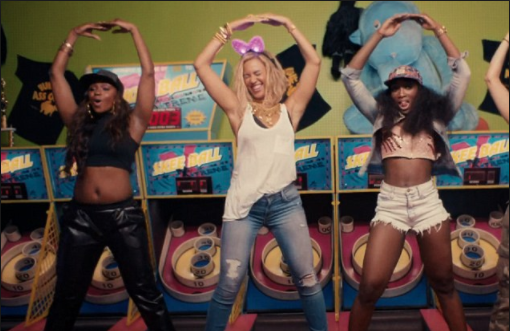
The music and the video come together harmoniously. Scenes are pieces in rhythm to the music, and because most of the clips are moving, the video compliments how upbeat the song is. Beyoncé and her friends also make a dance move out of “XO” with their hands that goes along with the music.
Overall this music video is very stimulating and makes listening to the song that much more meaningful. As I scrolled through the comments, I found three that sum up the general reaction to this music video.
These comments about being able to “feel” the music and the song taking them back to a certain place or atmospheric feeling are definitely influenced by the powerful experience of the video! Anyone who has been to an amusement park, have been out with friends late at night, or have even just had a great time with loved ones at any time can relate to this song and video, which is why it is such a powerful piece of art.
I hope watching this video inspires you to go check out some of Beyoncé’s other awesome music videos. Here are three that I was considering for this blog post and are just as cool and a testament to how music can be a multisensory experience with image, sound, and screen!
Summarized in this article beautifully as a video in which “grown men … dance to shrill synth beats while eating Totino’s pizza rolls out of a tiny pink backpack,” comedy duo Tim Heidecker and Eric Wareheim’s commercial for Totino’s pizza rolls depicts an authentic and successful marriage between image, music, sound, and editing — a true multimedia experience. After all, as the comment below reminds us, this is a real commercial:
Totino’s actually paid Tim and Eric to create an advertisement featuring their product, and they’re not the first ones to do so (check out these pieces for Absolut and Old Spice). But what exactly is the fine line that separates this masterpiece from a Mountain Dew-fueled fever dream of a last minute assignment thrown together the night before a freshman English presentation?
There’s definitely… a lot to unpack here. Much of the ad’s effectiveness lies in incongruity theory, or the idea that part of what makes something funny is presenting the unexpected. In his Critique of Judgement, Immanuel Kant writes, “In everything that is to excite a lively laugh there must be something absurd.”
Incongruity theory hard at work
This definition of incongruity theory also touches on irony, which derives power from an awareness of what is expected and plays off of that expectation by subverting it. Much of Tim and Eric’s humor relies on this principle, often pushing past a primary boundary into the absurd. The juxtaposition of a tiny pink backpack on a grown man, for example, is ironic enough, but in the segment from 0:28-0:35 the team takes it further by cutting away from the scene and labeling this backpack as a “Feminine Pizza Bag.” In this cut scene, Tim and Eric are made tiny and the tiny pink backpack is made huge, with the duo standing on top of it. This takes the juxtaposition one degree further — using something that already lies outside a norm (shrinking a backpack and putting it on someone who you would not normally see wearing said backpack), pinpointing some aspect that makes it weird (it’s really small!), and then inverting that quality (let’s make it large and put Tim and Eric on the bag instead of putting the bag on Eric), then sequencing those two visuals back to back to back. This happens in a span of less than ten seconds, which is not a lot of time for your brain to consciously grab on to all of these intricacies, further playing into the absurdity of it all.
Tiny Tim Feat. Big Backpack
Repetition is another powerful tool throughout the video. From an auditory standpoint, the chorus “Totino’s, Totino’s, how did you know!” comes and goes throughout the video in various forms. It opens with the original iteration in the exposition, but later revisits Tim and Eric in a greenscreened kitchen just chanting “Totino’s” over and over. In fact, thanks to a transcript provided in the comments by user HannibalOrJustRex, we know that the word “Totino’s” comes up no less than 29 times. The majority of this repetition is concentrated near the end of the video, which devolves into an Einstein-on-the-Beach-esque chorus of “Totino’s,” “Whoo” (from Tim), and “Yeah” (from Eric), before a closing word from Hard Rock Joe and a final “Whoo/Yeah” from Tim and Eric, respectively. This progression from coherent nonsense distilled down to the most basic dialogue consisting solely of product name and cheers of enthusiasm falls under that same umbrella of absurdist incongruity theory, but does so in a way that still abstractly relates to the original topic at hand (Totino’s = Good). From an advertising standpoint, it also sends the subliminal message tying the product (Totino’s) to a positive reaction (Whoo/Yeah), which strengthens the overall effect of the work.
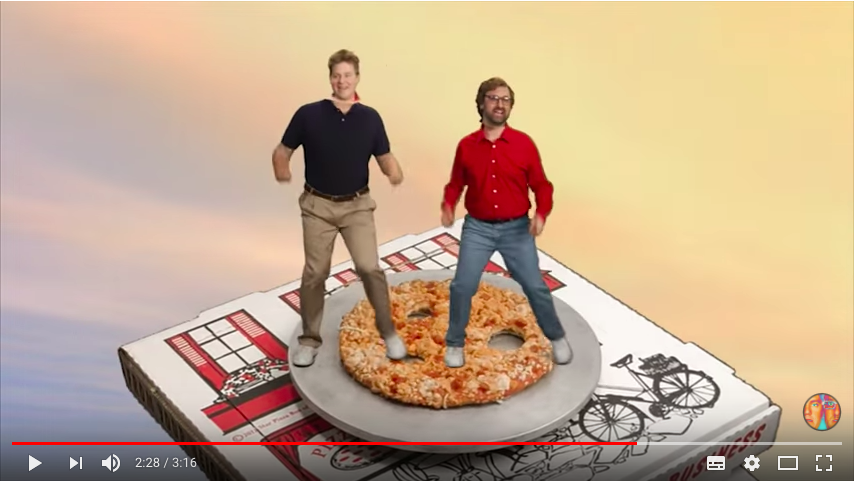
Visual repetition is an equally powerful element at play. The video opens and closes with snippets of Hard Rock Joe talking about his love of punk bass and pizza rolls over a green screen backdrop of a dimly lit brick room. Whenever we see Hard Rock Joe by himself throughout the video, it’s in this setting, and the three principal scenes in this setting are the very beginning, middle (1:35), and very end. Repetition abounds within a lot of these recurring green screen backgrounds — take the layered pizza one at 0:15 (which comes back at 0:25 and 1:15), or the cut and paste city assembled from a combination of pizza rolls, party pizza boxes, and standard run-of-the-mill pizzas at 0:27. The pizza with holes cut out of it here is actually derived from the pizza mask the unnamed woman wears in the exposition at 0:08, and resurfaces in the backdrop at 2:28 (as evidenced below).
Pizza Mask, Upper RightPizza Mask, OriginalPizza Mask Returns (also as a bonus, note the face swap of Tim’s head on Eric’s body and vice versa)
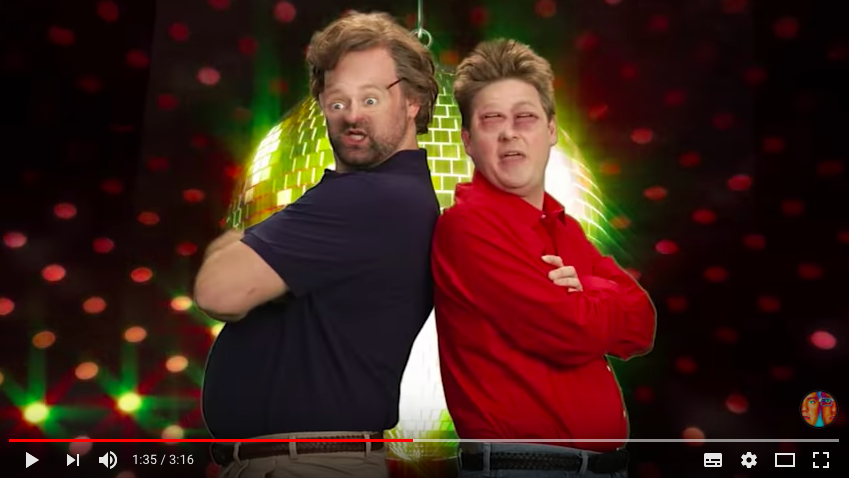
A similar repetition out of context can be found with the glasses Eric wears in the pizza chess scene — we saw a cut and paste version of those on Hard Rock Joe near the beginning (0:22). And there are plenty of scenes with duplicates of Tim or Eric — we have three Tims on screen at 1:32, five Tims at 1:59, and three Erics at 2:32, for instance. There’s also two separate scenes where each sings with mouths replacing their eyes — Tim at 1:35, and Eric at 2:29.
Tim on the right (sans eyes but with triple the mouths)
This repetition of image and sound provides us with a sense of formal structure throughout, however abstract, whether it’s revisiting Hard Rock Joe in his punk bass dungeon, repeating a backdrop as with the layered pizzas, or repeating a word or phrase. This purposeful reuse of previous material, no matter how fleeting or subtle, provides a thread for our subconscious to follow, which is what allows us to view the whole thing as a (somewhat) coherent single entity as opposed to a string of random unrelated vignettes. Again, this is all presented in a very fast paced manner, not something we consciously pick up on but rather dependent on the fact that the human brain is hard-wired to detect pattern and repetition.
Art is hard sometimes
A lot of the time we hearresponses to contemporary art (and by extension contemporary music) like, “My kid could do that — so unimpressive,” or “I can’t tell the difference between that and garbage,” or “What’s this doing in a gallery? That’s not art!” These reactions imply a few things. First, that the artist is not talented; consequentially, that a determining factor of “talent” lies in how easy it is for the viewer to “get” the meaning at first glance; and finally, an output fueled by anger at the museum or concert hall or whatever space said piece of art finds residence for allowing that piece of art to be put on display. To me, comments like this are a visceral negative response that allow the (often narrow-minded) viewer to maintain a sense of superiority, maintain power in an unfamiliar context, and maintain the same worldview they had before it was challenged by the idea that something different or hard to understand could have something powerful and relevant behind it. In the words of this Guardian article, that’s a big part of what makes Contemporary Art art: “As long as someone thinks modern art is rubbish, it is still provocative. It is still dangerous.”
A lot of the negative reactions to Tim and Eric’s work (the Totino’s advertisement being no exception) contain a similar veiled anger. One comment reads:
And to an extent, he does have a point, with regard to timing. I don’t think this kind of humor would have resonated as strongly 20 years ago, and it also seems to resonate better with younger audiences than older demographics. But the reason this dynamic duo finds success is because the “nonsense” they put out is so carefully not random. It toes the line between expectation and absurdity in a way that plays with your head but still leaves you with the impression that you’ve watched some abstraction of a single idea, as opposed to a disparate smattering of screenshots and soundbites of unrelated material. It provokes a powerful reaction from most people because there is intent in the execution and coherency in the concept, no matter how absurd that concept might be. That, to me, is the mark of something great: the ability to evoke a strong emotional response, and make people think, whether or not that response is positive or negative.
Beyonce is known to be one of the quintessential performers of our time. The Queen Bee has set an incredibly high standard for herself with her recordings, performances, and music videos. I would like to take a brief look at how Beyonce maintains continuity with her audience through live performance and her music videos, and also analyze the use of stage design in performance practices as well.
The song we will be looking at is arguably her most famous, “Crazy in Love,” featuring Jay-Z.
This music video has all the tropes of early 2000s stardom. It received 11 awards including the Grammy for Best RnB song. It incorporates all kinds of sex appeal but two that I would like us to pay special attention to: the strut and the group dance. These two characteristics are staples of Beyonce as an icon and should be expected to be seen by an audience member attending her show.
Now I’d like for us to look at a video of a live performance of this same tune.
I’d like to walk through this performance as it relates to stage design and audience’s expectations. For my criteria for judging stage design, I would like to use Es Devlin’s discussion of the topic from Abstract: The Art of Design; Stage Design. In this series she discusses the five basic principles of stage design; light, darkness, space, time, and scale. Beyonce uses these as well as other performance aspects with the music to continually keep her audience enticed and engaged through out the whole performance. It is as if the whole song is one big build up and the energy is carefully cultivated through out to give the viewer an iconic and memorable performance.
Let’s start at the beginning of the video. Beyonce is introduced while the audience waits in anticipation. You can only imagine that since purchasing the ticket they have been fantasizing of what this moment will be like and now it is finally here. Beyonce clearly knows this and builds on this excitement from the very beginning. The stage goes from being completely black to illuminating a white triangle, which often symbolizes power and stability. Right in the center of the triangle, much higher than the actual stage stands the silhouette of Beyonce. The music is ambient and atmospheric. Beyonce is heard singing upon fifths but not seen. The audience is dying to see her, and yet they can only hear her. Her fifths are ornamented with an eastern sounding scale, which gives the silhouetted Beyonce an air of mystery. The drums strike and the lyrics to “Crazy in Love” are heard but it is slower and with a lament bass instead of the original bass line. Her silhouette is now projected on large screens. In terms of scale, she is first scene in front of the giant triangle which is much higher than the audience, giving her this larger than life appearance. As she finishes singing and comes down from being much higher up than the audience the band accelerates the time, thus increasing the excitement to the build up of finally seeing Beyonce in the flesh. Finally, write before the song starts, the band drops out to hear just the voices. As they finish the band comes in even louder, which creates an even more dramatic effect, and while this is going on there is a dramatic shift from darkness to lights, with full fireworks and light show. Beyonce simply has to stand triumphantly at this point. Her persona as an other worldly phenomenon has been established long before this moment by all the elements of stage design used to her advantage, and now in this moment simple standing brings the audience to an immense roar. The darkness at the beginning gave mystery, the scale gave power, and the light gave the big reveal.
Before continuing I’d like to bring to light the fact that the entire band is made up of black women wearing all white. The white being seen before in the enormous triangle that first illuminated the stage and generally represents power and stability. As the song opens Beyonce stands firmly and hypes up the audience, without moving her feet at all. Can you imagine the energy she must be feeling and the self control to not move your feet at all during this opening scene? Shortly before the first verse, she turns and struts away from the audience and this is enough to get another enormous response from the audience. Simply her strut is enough to make them bust out in pandemonium at this point, but that will not sustain them again, she will have to continually up the anti if she is to win over the audience, and she does just that. As she sings the first verse there is a point of rest as she has your full attention and delivers the verse again with out moving her feet at all. As the first verse finishes she simply walks again, this time towards the audience, to another round of applause. Before the second verse she does a little dance, in a group. Which is oddly enough, exactly the same time that dance is seen in the music video. The live performance at this moment is coordinated exactly with the music video to create a seamless experience for the audience.
After the second verse we come to a point in the show that simply can not be like the recording, the rap verse. As we saw in the video earlier, Jay-Z is present in support of Beyonce, but does not come out to rap his verse. Instead there is an instrumental break, in which Beyonce hypes up her horn players to play some lines. These lines are again clearly choreographed, but to the audience, this is all an organic experience, or maybe it isn’t, it actually doesn’t matter, because they are seeing Beyonce and everything she does at this moment is sublime. This is because the audience is experiencing the show emotionally rather than logically. The instrumental break also is something fresh that distinguishes her live performance from her recordings thus creating a unique experience that could only have been experienced live.
At the end of the song she seals the whole performance by showing the breadth of her vocal range and more importantly doing a full group dance. From start to finish we’ve had one momentous build. From utter darkness and mystery, to seeing the star, to seeing her strut, to finally seeing her sing the highest highs and dance her signature group dances. This is a textbook performance and it simply could not be accomplished on this scale without the immense work in stage design, choreography, arranging, and so on. This experience was so carefully crafted by master technicians all working to establish Beyonce is this pop goddess radiating female empowerment and inspiration wherever she goes. The truly cultivate an experience that makes her seem super human and solidifies her as a pop icon for the ages.
Famous Auschwitz survivor, writer, and activist Elie Wiesel once said, “Without memory, there is no culture. Without memory, there would be no civilization, no society, no future.” The quote by itself seems to be just about memory in a general sense but considering the context of Wiesel’s experiences and activism, there is a very poignant truth: there is no hope for future generations to create a better future unless they remember and understand the past. Culture and art as a whole are very reflective of this sense of collective memory. Our movies, book, shows, and art all reflect the accomplishments we remember the most triumphantly and the losses that we feel most the most acutely as a society, particularly on a national scale. The question I am addressing is where music fits in our cultural memory and how a piece like David T. Little’s Haunt of Last Nightfall can serve as a sort of cultural artifact, expanding the awareness, breadth, and influence of a certain point in time on todays cultural memory.
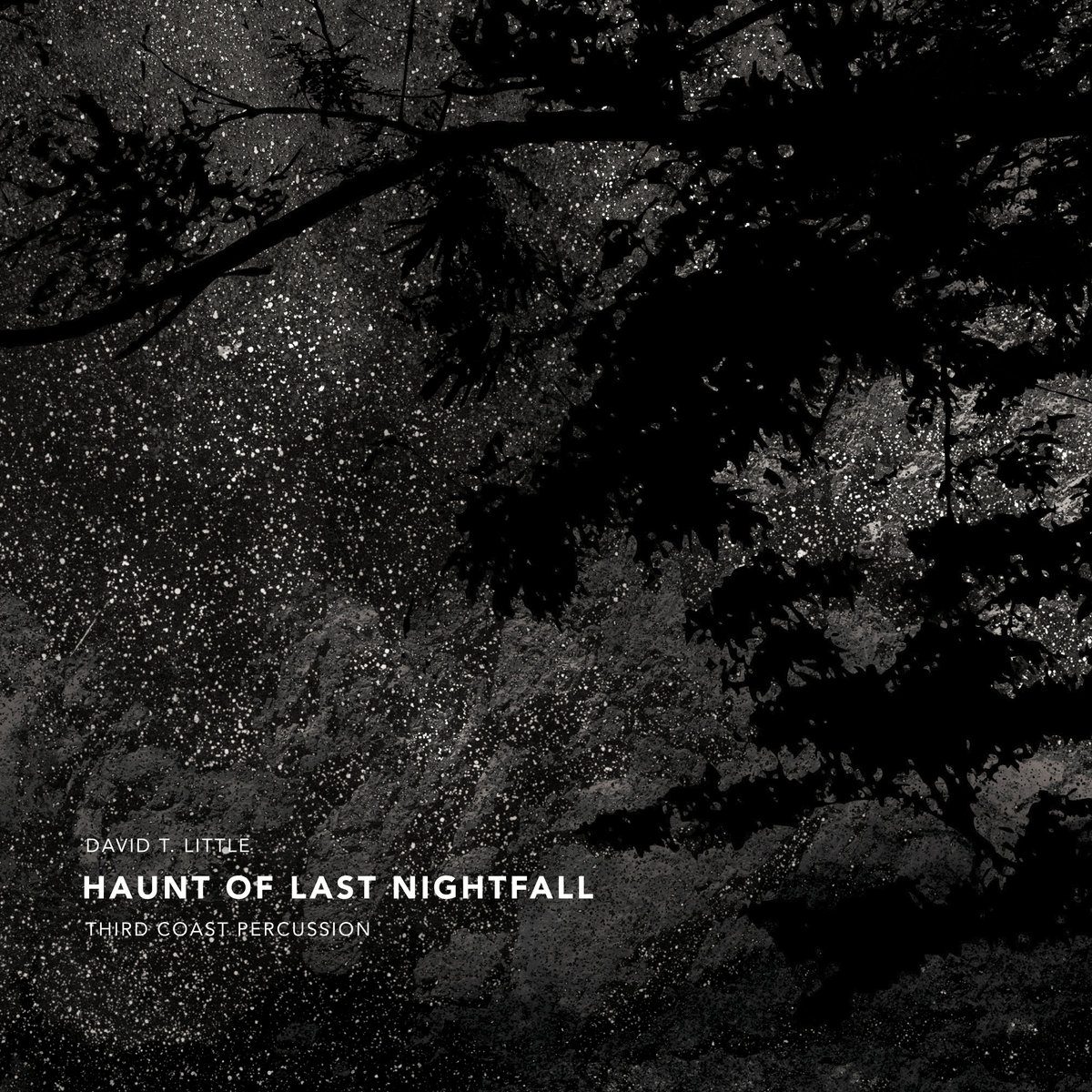
Haunt of Last Nightfallwas premiered and commissioned by Grammy Award winning percussion group Third Coast Percussion. The piece takes influence from experimental metal music, specifically the bands Sunn O))) and One Day as a Lion, and is inspired by the events that took place on December 11th, 1981 in El Mozote, El Salvador where an elite battalion of the Salvadoran government, funded by the United States, slaughtered over 800 innocent civilians. While it is not my intention to be unnecessarily graphic, I believe that this story is important and needs to be told in order to understand what this piece is really about and what it and this history means for us today.
CONTENT WARNING: The accounts of these events involve frequent mention of extreme violence such as murder, decapitation, and rape.
The source material for the account I am about to give comes entirely from Mark Danner’s amazing piece of journalism “The Truth of El Mozote” published in the New Yorker in 1993 which was the first definitive piece written on El Mozote after both the Salvadoran and U.S. governments attempted to deny that the massacre took place. It is a highly fascinating read and delves much more into the details of the Cold War-era politics of the story than I will here.
In the early eighties, El Salvador found itself at the onset of a messy civil war between leftist guerrilla groups and the national government. The right-wing U.S. administration felt responsibility to make sure that fascism crept no further into the western hemisphere and thus had aligned priorities with the Salvadoran government. Avoiding trying to create another Vietnam, the U.S. chose to provide funding and training for the highly inept Salvadoran armies rather than actually send in troops. Early on in the war the guerrilla groups remained ever elusive to the government but with military reform, the government began an operation called “Hammer and Anvil” in the northeast portion of El Salvador called Morazán where they knew guerrillas were hiding. The operation was spear-headed by an elite group of government soldiers called the Atlacatl Battalion lead by the ruthless Domingo Monterrosa. The Atlacatl had a fire in them that the rest of the army didn’t when it came to exterminating the guerrillas or as they called them, “delinquent terrorists”. They proceeded throughout Morozán destroying all villages that could be guerrilla outposts, not matter the cost. Locals in villages in the area knew that the army was headed their way and were actually told by richer villagers that they trusted to stay put and that the relatively small town of El Mozote would be safe since they largely did not deal with guerrilla fighters. El Mozote also had a large population of Protestant Evangelical Christians which helped their case considering Catholic liberation theology had been contributing to guerrilla recruitment in other villages, so guerrillas had learned not to recruit there.
This fact is what made El Mozote special. Most of the towns ravaged by the Atlacatl in Morazán did at least have some guerillas there or civilian guerrilla sympathizers, but El Mozote was known to be largely outside the sphere of influence of the guerrilla fighters. Yet because of great intelligence and mobility the guerillas were able to stay one step ahead of the government and the army grew increasingly frustrated. Then on the evening of Thursday, December 10th, 1981, the Atlacatl arrived in El Mozote and went around through the village banging on doors, forcing the residents from their homes into the street. As night fell, the soldiers lined the entire village up and forced them to lie literally mouth down in the street. Much what actually happened in El Mozote is known from a single eye-witness account, Rufina Amaya, who was the sole survivor of the massacre.
She, along with her husband and four children were among those laying in the dirt that night as the soldiers kicked them and asked where the guerrillas were. After some time the soldiers ordered everyone back into their homes threatening that they would be shot if “even so much as their noses” were poking out of the door.
David T. Little’s piece follows this narrative of events pretty faithfully although it is not completely programmatic. The first movement “Curtain, El Mozote” sets the scene for the piece and story with a sultry marimba voice, clapping, and deep synthesized bass. It is also worth noting that in the video recording of Third Coast playing the piece, the stage is almost completely dark except for a few lights lighting the instruments and performers. This adds to the haunting, night-time feeling the piece capitalizes on. The second movement, “Between the Hammer and the Anvil“, is quicker, full of deep, aggressive drumming, piercing brake drum sounds and introduces electric guitar which plays a prominent role representing violence throughout the rest of the piece. The third and fourth movements then begin to focus on the events of the night that the Atlacatl arrive. The third is called “Last Nightfall” and to me it evokes the feeling of silent dread and uncertainty of that night. The fourth movement “Line Up/ Face Down” returns briefly back to the chaotic drumming and guitar of the second movement before melting into the lush, hammond organ sounds of the fifth movement: “Coda: And there was evening…” This concludes the first half of the piece which David T. Little describes as ” a ghost play in two acts”.
On the morning of Friday December 11th, 1981 the soldiers ordered everyone in El Mozote out of their homes and into the plaza again. From there they were divided into groups of men and then women and children and then sent into separate locations: men in the church and women and children into the home of one of the local residents. An officer involved in the operation later said that the plan was to interrogate the village for information about the guerrillas yet it is unclear how strong this intention was because after roughly an hour of questioning, Rufina and the other women and children could hear the men shouting from the church and see the soldiers marching bound and blind-folded men out of the church and into the plaza and streets. From a small window in the house they were held Rufina and her nine year-old son Cristino saw her husband Domingo Claros in one of the groups try to escape with another man and watched as the Atlacatl soldiers gunned them down on the spot and then walk over to the still breathing men and use their machetes to behead them. After a similarly brief questioning period with the women, the soldiers came in and started picking off young women and girls as young as ten and marching them out of the village and into the nearby hills named El Chingo and La Cruz. The rest of the women soon could hear the screaming coming from the hills of the girls being raped and shot. As the afternoon wore on, the soldiers began taking the mothers from the children and out into the town to be killed as well. Rufina was in one of the last groups, leaving behind a house full of screaming children, to be marched into the streets where the soldiers began burning houses full of corpses. Once the women saw the bodies screaming and chaos broke out. Rufina fell to her knees in despair and managed to crawl out of sight of the guards under a bush near a crab-apple tree. Some of the soldiers came to rest near where Rufina was hiding after they started burning more buildings. She could overhear them discussing whether they should kill all of the children or not. She heard one finally say, “We have orders to finish everyone and we have to complete our orders. That’s it.” After that she could hear the children begin screaming as the soldiers finished them off too.
As evening fell, shrieks could still be heard from the girls left on the hills and the soldiers began to burn the rest of the village. Soon silence began to fall and the Atlacatl eventually marched out of El Mozote, killing even the animals, leaving nothing behind. Rufina eventually escaped far enough to reach the guerrillas and share her story of survival through their underground radio.
The second half of Haunt of Last Nightfall opens up with the sixth movement “… and there was morning- the Second Day”. The beginning starts as softly and innocently as the people of El Mozote woke up that fateful morning, conjuring images of a sunrise with small metallic sounds. The movement drastically shifts towards some of the most aggressive music heard yet on the piece, with large, all-encompassing electric guitar chords that become almost unbearable. The next movement “Smoldering Hymn” still uses the ominous and terrifying guitar sounds but pairs it with Hammond Organ at a much slower pace. The eighth movement of the piece is entitled “Prayer (for No. 59)“. This title has an interesting background though that isn’t immediately obvious. In the beginning of Mark Danner’s article he describes the work of Argentinian Forensic Anthropology Unit that is there to examine some of the remains of the people that died in El Mozote. One young woman is examining the remains of a young child labeled No. 59, and finds in the shreds of clothing left, a bright orange plastic horse. In his program notes David T. Little makes the sad connection that although this child’s family was well off enough to provide them with a nice toy, it was not enough to be able to escape a horrible fate.
The last movement of the piece also has a bizarre backstory. Entitled “Postlude: The Girl on La Cruz“, it refers to a haunting story told by soldiers in the battalion that was also recorded in an official report of the operation. The story is of a girl who instead of screaming while being raped repeatedly on La Cruz, sang strange evangelical hymns. Even after being shot in the chest it was told that she continued to sing. Mark Danner’s article describes it best:
“She had lain there on La Cruz with the blood flowing from her chest, and had kept on singing — a bit weaker than before, but still singing. And the soldiers, stupefied, had watched and pointed. Then they had grown tired of the game and shot her again, and she sang still, and their wonder began to turn to fear — until finally they had unsheathed their machetes and hacked through her neck, and at last the singing had stopped.”
Danner explains that this story is related to a certain supernatural fear the soldiers came to have for the people of El Mozote. Guides with the soldiers at the time told of hearing the soldiers talk about the evangelicals as if they had a strange power about them. Some, like the girl on La Cruz, also sang as they died, while others did not resist the soldiers and delivered themselves over to God as they died. I think that David Little’s description of this piece as a ghost play relates to this idea. Theres a strong sense in his piece of the permanence of memory. To me, this piece doesn’t come across necessarily as a purely programmatic piece that accompanies these events like a film score. Rather, it seems like this piece is almost revisiting the memory of these events or perhaps visiting them for the first time as someone who doesn’t know of these stories.
I think that power of this piece comes from that idea of reflecting on something that has come to light, because I, and I assume most other people, have never heard of this tragedy. I find it absolutely astounding that an event that can be called the largest massacre in modern Latin American history can be something that lives outside of the public eye. And while I can’t speak for many other nations, I believe that it has a lot to do with America’s unwillingness to deal with ugly parts of its past. Even in the decade of civil war El Salvador endured following the massacre at El Mozote the U.S. continued to support and fund the Salvadoran government, in light of these atrocities. The worst part about the immediate aftermath of El Mozote is that while in El Salvador, where Rufina’s story was being blatantly denied or ignored, the story was widely reported in America but failed to garner any real action from Congress, who decided that it better let the atrocities in El Salvador slide because who knows what will happen if the communist guerrillas win, all the while downplaying the extent of the massacre in El Mozote to try to save face and rationalize their decisions.
To me it all seems very relevant in today’s discussion about preservation or removal of Confederate monuments. If we as a nation cannot agree that the actions taken to suppress the humanity of others over 150 years ago were wrong and motivated by hatred, then it begins to make sense why America would rather collectively forget the hundreds of families that were slaughtered by our guns in the hands of troops we trained. Mark Danner’s article was published in 1993 and his book on the subject was released in 1994. Danner has been the only real voice on the subject since then yet the Salvadoran government did not formally apologize for the atrocities until December of 2011.
This is why I think that pieces like Haunt of Last Nightfall are so important. I would never have known about these events had I not heard of this piece and been interested enough to look up what it was about. I really love pieces that suck you in and make you want to learn more about them. Because now I can say that I know something about the United States’ response to the Cold War and how it relates to politics today that I definitely didn’t know about earlier and might not have ever known. Its very similar to what the Santa Monica Symphony was trying to do by inviting Dennis Prager. They wanted to use him as a tool to reach a larger classical music audience. David T. Little essentially does the opposite by using music to reach and connect with a larger audience that may not know about this terrible political tragedy.
This piece and this story are not ones that you are likely to forget and I think thats important especially considering the distance between these events and today’s generation. I think that as a part of this generation we have a responsibility to history that needs to be shared and learned from, and not only to tragedies like this that we are removed from but especially to mistakes and pasts that we may be a little closer to. And I think that art makes encountering those things a little more bearable, or at least a little more humbling. It provides a common ground on which we can meet with others and helps us remember what is most important, individually and as a society. I think that David Little sums it up perfectly in his thoughts about why he wrote the piece:
“What we know shapes us, and whether I like it or not, I now know this.”



 Tomorrowland 2012 Aftermovie