The History of the Sample

With the vast quantity of recorded music, now in an ever more accelerated pace of expansion with the music sharing sites such as Bandcamp and Soundcloud, and technology (logic, ableton, pro tools) in place to quickly download, move, and tamper with audio files, the question arises, is there any point to creating new sounds or composing new pieces, of utilizing analog sources to create familiar sounds and songs of all too familiar character? The catalog of recorded material is already so great that it would take thousands of lifetimes to listen to it in its entirety, but perhaps even more exciting or intimidating are the countless ways in which to alter and create entirely new purely from this great catalog.


While the radical idea of all modern music being entirely created from past records hasn’t taken hold, sampling in fact entered into the mainstream years ago and has remained there today. For example the music of artists like Kendrick Lamar includes samples, and his new album is on the billboard top 200. I wouldn’t be surprised if most of the music on the billboard 200 includes samples, as samples are ingrained into the way a lot of pop music (primarily black music) is produced. While the process and utilization of sampling has changed, its popularity has remained constant in changing populations for roughly 40 years.


This idea to create music purely or partially from previously recorded material began in the late 1940s with a man named Pierre Schaeffer. He spliced together and looped different tapes together to create music. Schaeffer’s believed that classical music began as an abstraction that was later produced as audible music. He strove to start with “concrete” sounds and late abstract them into music. This began the term “musique concrete”.

This process of tape loop sampling was taken up by a wide range of artists from minimalists like Terry Riley to people like John Cage to jamaican dub producers like King Tubby and Lee “Scratch” Perry. All of whom utilized tape recordings in their own unique and preconditioned musical language.


In the 1960s a new process of sampling emerged, this was digital sampling. The most notable early samplers were the Mellotron, the Fairlight CMI, and later the Akai MPCs. The digital samplers took pre recorded sounds into an interface which could be played with ease; the musician could play and sample he or she want to with the push of a button. The earliest innovators with this new technology were bands like Yellow Magic Orchestra and Big Audio Dynamite.https://www.dawsons.co.uk/blog/the-sampler-a-history-in-5-landmarks

Sampling however became most widespread and popular not in synth based pop music but in hip hop. In fact, sampling has been engrained in hip hop from the beginning, hip hop has a history not of analog or digital instruments, but of utilizing turntables and samplers to create music from pre-recorded sounds. The beats in popular hip hop from the 70s to around the mid 200s centered around break beatsl; beats taken from isolated drum sections of funk songs and looped. For example, the isolated drum beat from the James Brown song “Funky Drummer” has been sampled countless times in both hip hop and jamaican drum and bass and jungle music.

Not only were break beats sampled though, hip hop producers looking for melody and harmony as well as good bass lines turned to whatever they had in their record collection in order to create good music derived from a patchwork of previously recorded material.   

Today sampling is more fluid and there are mountains sampling software. Altering the sample is also very easy- there is software for it. At this point one finds that as a composer it’s equally acceptable to be fluent in the language of theory as it is to be fluent in the language of the sample.


http://singletrackworld.com/forum/topic/albumsbands-who-use-lots-of-samples

https://en.wikipedia.org/wiki/Sampling_(music)

http://120years.net/musys-and-mouse-audio-synthesis-language-peter-grogono-untied-kingdom-1965/
Mass Production

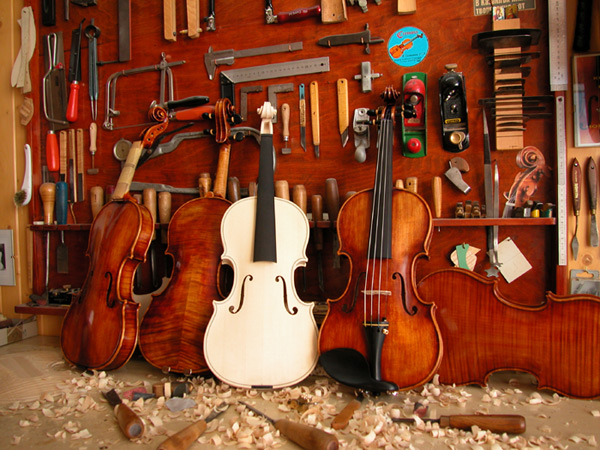
The birth of the first cellos were made almost 500 years ago in Italy by Andrea Amati. They were hand carved pieces of art, and all of the decisions were very deliberately made. The craftsman needed to know exactly which wood to use for each part of the cello, and how to fit it with strings and bridges that would resonate the most on that particular cello. Now in the 21st century, professionals strive to play on those old beautiful instruments especially by the widely popular Stradivarius and Guarneri, which have rich tones and can produce many different qualities of sound. However their prices can become rather high; from hundreds of thousands to millions of dollars. Is it worth spending all that money for a handcrafted, old instrument? Many of the strings and bridges string players use on their instruments cost a fortune on their own, cello string sets costing around $300 and lasting for only a few months. To get a full set of one of the most popular strings for cello, “Larsen”, it costs $227 on Amazon. To get your bow rehaired at Sullivan Violins in Rochester it costs $70, and to get a new bridge could be in the hundreds. Repairing your instrument will always be expensive, so why not buy a mass produced computer-perfected instrument?

Recently, the Chinese have started to sell instruments in the violin family that are under $5,000 (I’m playing on one right now). These instruments, although not as brilliant as a Strad, are not too shabby. They can have beautiful sounds, and can be fixed up with proper strings and a better bridge if needed. The reason these instruments are so cheap, is because they are partially (if not fully) factory made. Yes, instruments are becoming mass produced products, rather than finely crafted pieces of art. Some will be painted with spots trying to look old and used, to appeal to an audience or buyer that appreciates antique instruments (kind of the equivalent to pre-ripped jeans).

Although this baffles the mind of most classical string players, these cellos and violins are not the first factory made and mass produced instruments. Super-stores are selling guitars for very cheap. “Huge U.S. chain stores, such as Costco, Wal-Mart and Sam’s Club, are beginning to sell low-cost instruments, appealing to spontaneous buyers. Those stores have been partly behind a fivefold increase in the sales of electric and acoustic guitars in the U.S. market since 2000. ‘The average selling price (of a guitar) has gone down from $630 or $640 to somewhere in the $300s. That is almost a direct result of Chinese manufacturing,’ Lamond said”. These mass produced instruments are changing the way we think about music and craftsmanship. Is it important to always require authenticity and individuality as artists? Even for poor college students who just want to learn how to play guitar in an elective class during their first semester sophomore year?

This applies to all forms of art, not just music. Just the other day I was shopping in my favorite store, Target, and I saw many pieces of art for sale. It was very obvious that a computer had created it, my good friend Raina pointed out the straight lines on the canvas that suggested an automatic machine painting in a factory setting.

There were many upsetting aspects to this “wall art”, but there were also some nice things to consider. The price is always fairly cheap at Target, the symmetry can be very pleasing to the eye, and the colors in the painting are very real and don’t have anything to do with the artists themselves. If the buyer is not an art expert and wants something that will brighten up the room rather than something to really sit and think about, this should be perfect for them.

So is it really important that someone is handcrafting your instrument? Aren’t machines made to perfect what the human body cannot do on its own? For some it isn’t important, and that is okay. Not everyone needs to be an expert on what the latest painter likes, or all the latest fashion trends, or have the most beautiful sounding cello. Some buyers really want to experience something raw and human; to notice a connection between themselves and the artist. It is obviously not essential to use machines, as the best instruments we have are made by craftsmen in the 17th and 18th centuries who made glorious instruments all on their own.

But do these instruments really sound different? In a blind test where a violinist played the same piece on a Stradivarius and a modern instrument, the results were never actually what we would expect. Some of the time performers and listeners would like the Strad the least!

https://www.youtube.com/watch?v=ZtlTJkbUqkA

Does this mean that mass produced instruments can sound the same as a Strad? Is there actually a difference in the instrument’s sound, or are we just pretentious? Maybe spending thousands or millions on a fancy instrument is just a waste of money, and buying mass produced instruments is the way to go.

On V-Picks and Why They’re overrated

On V-Picks and Why They Are Overrated 

By Garrett Mader 


A collection of standard celluloid guitar picks

The pick, or more formally plectrum, is a small, generally triangular object that a guitarist, banjoist, or mandolinist holds in/attaches to their dominant-hand to strike their guitars’ strings and create sound from the instrument. Picks date back to the start of recorded history, with writings about music from ancient greece recounting that Lyres had picks attached to them by a string(https://www.premierguitar.com/articles/25204-the-surprisingly-long-history-of-the-guitar-pick).Those picks were made of ivory, bone, or wood, while since approximately 1922 the most common material for picks has been celluloid (http://surfpick.com/history/). Today the market for picks is massive and varied from brand to brand. For the purpose of this blog, however, I would like to narrow in on V-Picks.

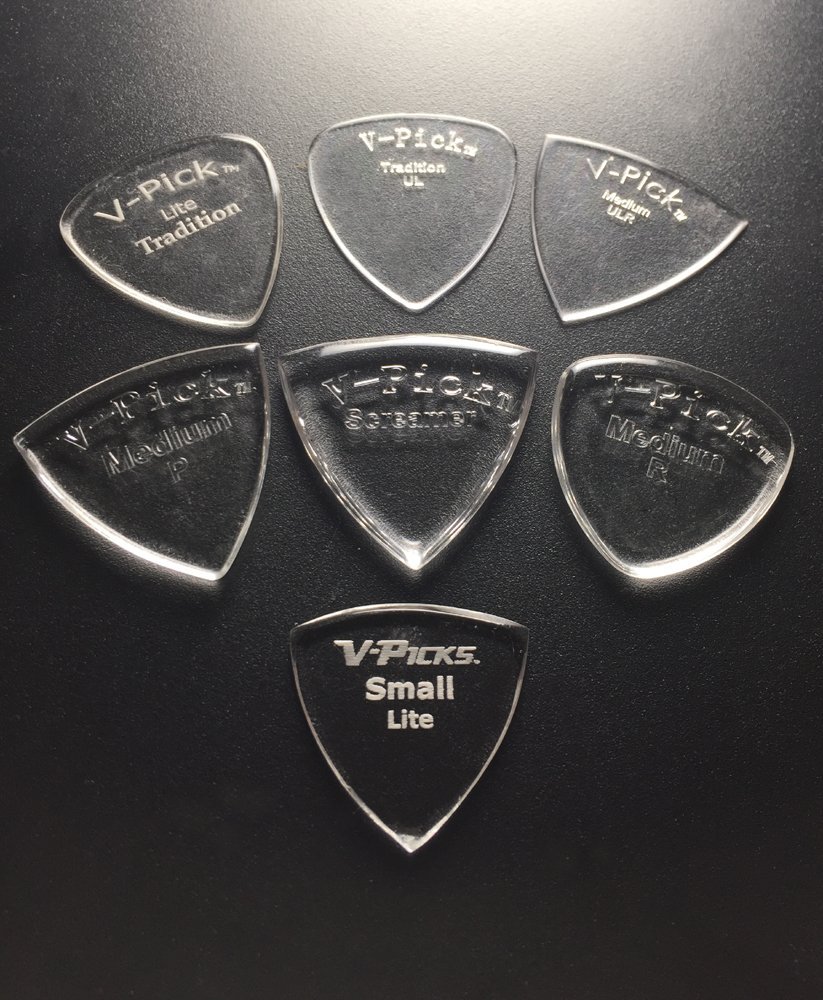
Some of the many varieties of V-Picks


V-picks are the creation of amatuer guitarist Vinni Smith (v-picks.com/v-picks-about-us/). They are produced in Nashville, TN and Modesto, CA. They’re made sheets of acrylic instead of celluloid, giving them a sleek, glossy look, and smooth feel. Acrylic is essentially a tough plastic used for windows, taillights, and bulletproof “glass”. For a brief chemistry lesson, Acrylic sheets are made by “reacting a monomer, such as methyl methacrylate, with a catalyst,” such as organic peroxide (madehow.com/Volume-2/Acrylic-P lastic.html). I discovered a video on Youtube called “How It’s Made-V-Picks”, in which some fans of these picks visited Vinni in his home and recorded him making a pick. The process is as follows; Vinni takes a sheet of acryllic covered with evenly-spaced V-Picks logos/labels into a laser cutting machine. The laser cutter cuts the acrylic into pick-shapes around the text. The rest of the process is done by hand-a point of pride in V-pick advertising. Vinni takes a pick cutout and puts it to a grindstone to craft the edges to be smoother. After this the pick is too hot to continue working with, so Vinni takes it to his backyard and leaves it in his dog’s water bowl to cool down for a few mins. Once its cooled he dries it on his shirt then puts a hydrogen flame, the clearest known combustible he says, to it to take away the roughness from the grindstone and the V-Pick is finished.  


A V-Pick is more than just the sum of it’s materials and processes though. Guitar-gear culture is a sprawling universe full of kingpin brands (fender stratocasters and telecasters are arguably as standard as TV sets in the American home) as well as niche corners, and V-picks are a relatively new phenomenon (the company started in 2004) that has quickly made itself a widely esteemed product (wikipedia.org/wiki/V-Picks_Guitar_Picks)*. There is a certain reverence for them in the guitar-iverse that doesn’t exist for most products. I believe this is derived from their unique, shiny look and the fact that most people believe they’re made of glass, which seems much classier than plastic. That last bit comes from my own experience; the first several people to mention V-Picks to me all told me they are made of glass. There is also some celebrity endorsement-Carlos Santana and Billy Gibbons have both officially endorsed V-Picks as their main pick brand. Not to downplay the contributions of those guys, who do you know who’s all-time favorite guitarist is Gibbons or Santana? V-Picks are also pricier than your average pick, with a single pick costing upwards of 5 dollars. I believe the elevated price, general esteem, and celebrity endorsement are as much parts of the product as the acrylic and the logo at this point. When a guitarist buys a V-Pick they aren’t just buying a pick but they are buying what hundreds of youtube/guitar forum commenters have told them, and buying the idea that because they are paying more for a pricy, celebrity-endorsed pick that they are buying a more high-end product that will make them a better player in record-time. In the aforementioned Youtube video Vinni himself says of one of his products “I guarantee you this pick will make you a better player”.


I personally think V-Picks are sorely overrated. To me they generally don’t give your sound much mid-range or warmth, and they got scratched up fairly quickly when I tried them which made them sound worse. I respect that some people swear by them, but I believe that they have fallen under the hype surrounding them in the guitar-world. I do respect V-Picks for the brand they’ve created for themselves and the esteem they’ve created for their product, but  when it comes to picks I think it’s always imperative to remember that some of the most iconic guitar solos in the world were recorded by Brian May of Queen using a sixpence, so sometimes simpler is better.


*I understand that generally Wikipedia is not a reliable source, but the V-Picks website explicitly refers those interested in their product to the wiki page, giving it legitimacy in my eyes.  


Links to Media


http://www.guitarmania.co.uk/ekmps/shops/guitarmania/images/assorted-medium-guitar-picks-plectrum-pk-of-12-for-acoustic-or-electric-210-p[ekm]300×229[ekm].jpg


https://www.youtube.com/watch?v=urywl-Jy4yo

https://images-na.ssl-images-amazon.com/images/I/71eysAIzVAL._SL1000_.jpg

Will Musicians ever learn to Breathe?

https://www.youtube.com/watch?v=k1dbb5x7PSQ

Breathe Dammit!

rants by Livio Fasullo 9/17/17

Every morning hundreds of tired Eastman Students get out of bed and walk across Main St. to begin their morning practice sessions in the Eastman School of Music Annex. Some of these students play string and percussion instruments while others sing and wind instruments. Most of these young and ambitious Eastmanites are completely unaware that they are constantly filtering oxygen through their lungs in a process known as breathing (too focused on the next seating audition, or concerto competition). Those who are aware and conscious of their breathing and how it can create greater ease in their playing will likely see much improvement in their studies, regardless of instrument (yes, even string players).

Ironically, many of us take deep and shallow breathes from our chest, keeping us nervous and un-focused (with the additional aid of Java`s Coffee) and then spend hours in the practice room trying to get better. In the weeks leading up to juries Eastman feels like an Urgent Care with countless students in casts due to practicing injuries. Many of us forget that we can incorporate much more ease into our practice and life by simply breathing, and it`s free! (Unlike PT).  Our breathing system is an essential technology for us humans that when used naturally allows for enhanced quality of life by relaxing our mind and focusing our muscles.

Breathing as a Technology

According the Merriam-Webster online dictionary a technology consists of “the practical application of knowledge especially in a particular area”. (https://www.merriam-webster.com/dictionary/technology) We are all unconsciously applying our breathing apparatus (diaphragm, lungs, brain, veins/arteries) every day (if you didn`t you would die), but many of us have allowed our minds to turn our breathing apparatus on auto pilot. To understand this better let`s take a look at how breathing works.

  The Science of Breathing

The actual scientific process of breathing is quite complicated, but luckily for us, we can breathe instinctively without thought. Breathing generally consists of  two large phases, inspiration and exhalation. As we inhale our diaphragms move downward increasing the volume of the upper body (thorax), which lowers the existing air pressure in the lungs allowing air to enter from the atmosphere. As we exhale the diaphragm relaxes and the volume of the upper thorax decreases forcing existing air to leave the lungs. (https://www.unm.edu/~lkravitz/Article%20folder/Breathing.html).

When we go into our Sympathetic Nervous System (Fight or Flight) which involves heightened senses and quick shallow breathing when our mind believes that we are in a dangerous situation.(https://www.sciencedaily.com/terms/sympathetic_nervous_system.htm) Eastman students regularly experience their Sympathetic Nervous System when trying to find a practice room one hour before their lesson or when being “vibed” by other students. Unfortunately, many students also experience their sympathetic nervous system when practicing and performing.

The Parasympathetic Nervous System takes hold when we our minds are at ease. (http://www.medicinenet.com/script/main/art.asp?articlekey=4770)  The Parasympathetic Nervous System can always be reached through deep breathing.

History of Deep Breathing

Most Eastern cultures and nearly all martial arts consider deep breathing to be fundamental skill that all should have. Deep breathing helps relax muscle and focus the mind. It is a essential part of Tai Chi, Karate, Qi Qong, and Yoga. The Pranayama is a series of deep breathing techniques used throughout the practice of Yoga. Pranayama roughly translates to extend the life force/breath that is sustaining the body (https://www.yogajournal.com/practice/healing-breath). Yoga has been in existence for thousands of years, while common practice classical music was (arguably) first written in the 17th-18th century. But proper breathing can actually be traced back to the beginning of mankind. We all have the innate programming to breathe properly. If you watch a baby sleep, you will notice that it sleeps on its back and its stomach moves through the deep breathing process. We can lose that process as we get older due to an overabundance in stimulus in the digital age. As musicians we can find ourselves taking shallow breathes while worrying about our careers and upcoming performances. In the book Effortless Mastery, Kenny Werner refers to these dominating powers over  our lives as fear and ego (pg. 21). For a video on deep breathing check out his link:

https://www.youtube.com/watch?v=k1dbb5x7PSQ

Musical Benefits

As previously stated, deep breathing helps relax muscle and focus the mind. So how does this help us as musicians? Kenny Werner talks about the “Space”, a meditative state of being achieved through deep breathing and the release of ego. In the “Space”, a musician performs music effortlessly and thoughtlessly. (pg. 77) From a less philosophical standpoint breathing helps you to clear your mind of distracting thoughts and release unnecessary tension during practice and performance. Here is a video describing deep breathing for wind players:

https://www.youtube.com/watch?time_continue=34&v=sCEj3R_26wY

Some musicians who have mastered deep breathing do not need to move dramatically when they perform or play. In his book Effortless Mastery, Kenny Werner describes the excessive movement and shallow breathing of musicians as an attempt to coax out unmastered music (pg. 59). If you watch the first minute of this video of Ralph Bowen improvising on the saxophone, you will notice how he plays from the “Space” that Kenny Werner writes about. Take note of his deep breathing. You can see his chest and stomach move as he inhales. Also note that his mastery of  breath allows him to be still, almost at rest as he plays complicated music effortlessly.

https://www.youtube.com/watch?v=6IoUnl_1fgc&t=58s

Ralph Bowen has said that all playing the saxophone really involves is “air and fingers” (http://jazzprofiles.blogspot.com/2017/05/ralph-bowen.html). By practicing his deep breathing in conjunction with his instrument he becomes more relaxed and focused every time that he plays his instrument- as can all of us if we make deep breathing a regular part of out practice routine.

What does this mean for me?

Regardless of your profession, by understanding the technology of deep breathing you can become more relaxed and focused, allowing you to complete tasks at a higher level of efficiency. As musicians, deep breathing helps us to play and learn more efficiently, gain confidence in practice and performance and save time and money avoiding physical therapy. I hope that all Eastman students will take time to develop their breathing and become the best stress-free musicians that they can possibly be.

  Sources:

https://www.unm.edu/~lkravitz/Article%20folder/Breathing.html

https://www.merriam-webster.com/dictionary/technology

https://www.drdavidwilliams.com/proper-breathing-improves-health

https://www.bluedragonkungfu.com/breathing-exercises-martial-arts/

http://jazzprofiles.blogspot.com/2017/05/ralph-bowen.html

Effortless Mastery by Kenny Werner

History of the Saxophone

The History of the Saxophone


The saxophone is one of the most ubiquitous instruments in America and Europe today. From the jazz clubs to the concert hall to the band room, it seems as though the saxophone is and always has been a common fixture of the musical landscape in America. To the average american, the saxophone is much more familiar to their eyes and ears than say the oboe or viola. This certainly seemed to be the case for me growing up in New Jersey. In New Jersey most people have heard of Clarence Clemons of the East Street Band while almost no one has heard of Juilliard and Curtis educated Principal oboist of the Philadelphia Orchestra John Mack. This is despite the fact the John Mack is a New Jersey Native while The Big Man (Clemmons) is actually from Virginia. Yet, this has not always been the case. The saxophone is a relatively new addition to the woodwind family and did not find its way into american popular music until approximately 1915.


Most instruments in evolve over long periods of time from one more primitive version to a successively more refined version. One may point to C. H. Denner1 who modernized the Chalumeau in the 1740’s as an example of someone “inventing” an instrument. While he did radically improve the instrument by adding the second upper register and addressing intonation issues, he was still building upon centuries of previous designs and methods in order to create his clarinetto. In contrast, the saxophone was invented by Adolphe Sax in 1841 and officially patented in 19462. Sax was a born in Belgium in 1814 to master instrument maker Charles Joseph Sax. By the age of 16, Adolphe was an accomplished instrument maker in his own right3. He had made improvements on the clarinet and cornet and created high quality flutes and clarinets 3. He was also an accomplished musician and had studied at the Brussels conservatory. When Adolphe Sax was creating the saxophone, he was looking to create an instrument which would have the timbre of woodwind instrument but the power and volume of brass instrument. He originally intended for his creation to find its way into the orchestra. With elements from both brass and woodwind instrument families he envisioned it bridging the sonic gap between the two families. However this vision would never be realised.


The saxophone was largely rejected by most “serious” musicians and composers of the day with many regarding it as “unacceptable”. However, the Bb Tenor and Eb alto saxophones were officially adopted into the French military band and thus began the history of popular saxophone music. This is not to say the saxophone was totally out of the classical establishment. Sax himself was instructor of saxophone at the Paris Conservatory and romantic composers such as Jean-Baptiste Singelée5 wrote for the saxophone in the mid to late 1800’s. But most of the music played on the saxophone in the late 19th and early 20th century was military band music. However, around 1915 the saxophone was starting to show up in early recordings of jazz music6. In early jazz music the clarinet was the main woodwind instrument being utilized. However, with its superior projection and volume, the saxophone was a good replacement for the clarinet as jazz band began to play in loud dance halls. Given the saxophones gradual takeover of roles traditionally left to the clarinet, it isn’t surprising that the first jazz saxophone soloist was Sidney Bechet, originally a clarinetist. In the 1930’s the standard big bands grew to have five saxophones, two altos (Eb), two tenors (Bb) and a Baritone (Eb). As big band music matured, the role of the saxophonist as soloist did as well. These early luminaries include Johnny Hodges, Lester Young, Coleman Hawkins, Ben Webster and Don Byas just to name a few.  These early swing players really set the stage for the explosion of jazz saxophonists who revolutionised jazz and american music in the following decades. They inspired the likes of Charlie Parker, Dexter Gordon, John Coltrane, Ornette Coleman and many others who further explored the technical and expressive range of the saxophone.


The saxophone maybe be as important an instrument as the violin when it comes to western (particularly american) music. However, it had its beginnings in unusual circumstances and was nearly doomed to obscurity. Yet through chance and circumstance was propelled to the forefront of musical exploration in the 20th century.


  1. http://www.the-clarinets.net/english/clarinet-history.html
  2. https://www.thoughtco.com/history-of-the-saxophone-2456519
  3. http://www.madehow.com/Volume-6/Saxophone.html
  4. https://www.britannica.com/art/saxophone#ref138721
  5. http://www.dolmetsch.com/cdefss.htm
  6. http://teenjazz.com/the-development-of-the-saxophone/#sthash.HBgXPwhJ.dpbs

Roland TB-303 and the rise of Acid House and Techno

Very few electronic musical instruments have left such a lasting impression and influence as the Roland TB-303. This “synth” machine was released in  1982 and marketed as an accompaniment machine for guitarists.  It was quickly written off as a failure due to its unrealistic distortions and confusing interface. The release of this bass machine synthesizer was so poorly received that production was halted in 1942 after the production of a mere 10,000 units. Despite its low price of $400, many groups complained of its unnatural sound which could never duplicate the human intricacies of a bass player.

“The switches and control knobs have several functions, so operating the TB-303 may seem a little complicated. You may find difficulty using the TB-303 at first, because it is so different from a bass guitar or keyboard instrument. There, this manual includes a basic, intermediate, and advanced course to help you understand these operations step by step. However, each individual operation is quite simple, so take your time and master each step.”

-This quote is taken directly from the Roland TB-303’s 1982 user’s manual.

Interestingly enough, the confusion and uselessness it afforded to the guitarists for whom this machine was created led to its ready availability in pawn shops and second hand stores across the country. The cheap and interestingly designed machine caught the eye of many garage-based producers and mixers in impoverished areas across the country. No where was this machine’s impact as immense as in Chicago’s  House and Electronic underground.  A few producers, most notably Chicago based Dj Pierre took this machine’s idiosyncrasies and fashioned  an entirely new bass beat, in effect creating a  new genre of electronic music.

“‘Acid Tracks wasn’t pre-programmed man… DJ Pierre, he was over and he was just messing with this thing and he came up with that pattern, man…So we were listening to it, getting drunk, man. “Hey, this is kinda hot, man. This is a great mood man. Let’s put it out””

-producer Marshall Jefferson

The Roland TB 303 features a keyboard spanning an 8va range, and a total of 6 knobs which control various effects. The machine also left producers to choose wether to work with a saw waveform, a complete revolution and distortion of the traditional square waveform.  When innovators such as DJ Pierre began using these controls to distort and augment simple baselines, they realized the “slippery” and completely new sound world the Roland made accessible.

These “slippery” sounds can be  heard in one of the most revolutionary works in contemporary music in history, the Dj Pierre produced ‘Acid Tracks” This new sound confused audiences at first, but after a few months, this track gained massive support in the underground rave scene and many more Chicago based Djs began to champion the Roland TB-303 and its new soundscape. This new sound in traditional Chicago House was dubbed Acid House, taking its name from the pioneering Dj Pierre track. This popularity spread as far as Britain by way of Ibiza where Acid-House beats reached main-stream popularity, in part aided by the Rave culture of the 1980s and 1990s.

Acid House’s focus on subtle evolution of a beat, and otherworldly sounds quickly became synonymous with the club drug culture already in its peak by the mid 1980s. Drugs like MDMA (known as molly, ecstasy, XTC etc.) LSD, Ketamine and others, quickly became synonymous with the scenes in which Acid House was dominant as the shifts and insistence of its sound provided an excellent compliment to many of these illegal drug’s effects. This led Acid House, by way of the Roland TB-303’s quirky unrealistic sounds, to become the soundtrack for the cultural revolution and  decadent freedom of the era.

“Back in the 80s those early acid records spoke about alienation , they said square peg round hole , the surrounding records were almost gospel like messages of hard times and hope , quite churchy. Or euphoric weekend escape Anthems like Someday ‘Aint no Stopping us now’,they had R n B roots. Something like Phuture or Adonis hit the spot for me with insistent abstraction, it was outsider music with pure energy, it had cut from the line of history, it was a page turned, a clean page. These machines meant we all had the same accent ,previously a UK record and a US record, or a Belgian record or a Dutch record all had an accent musically speaking, Roland was an esperanto.”

-Graham Massy, producer

Acid House’s dominance in the world of electronic and mainstream music came to an end almost as quickly as it rose. By July of 1989 Acid-House had faded into the mid ground of electronic sounds, but this was not before it had influenced the next generation of music. Mainstream dance pop was not immune to the Roland’s new sound, most notably the Madonna track “Ray of Light. New genres like trance, techno, big beat,  and trip hop can all be directly traced back to experimentation with Acid House tracks.  It’s influence is still incredibly apparent today, with many almost exact physical clones on the market, and numerous software dupes. Little did anyone know that this initial market failure, and quirky little piece of confusing plastic would change the face of pop culture in such an extraordinary way.

Full of Hot Air: Balloons, Dadaism, and The Avant-Garde

“Is there any way you can make that more cantabile?” the conductor asked. His question was met with resounding laughter from the rest of the ensemble, myself included. Though this is certainly not an odd request for a conductor to make in a rehearsal, the fact that the target of this question (a percussionist by trade) held in his hand an only-just-recently-deflated balloon made the whole thing seem just a little absurd. Found more commonly at amusement parks or clown conventions, your everyday garden-variety Mylar balloon also happens to be an instrument called for in the score of Talhoffer’s Crawfish (below), a piece of contemporary classical music. The question now becomes, how did a balloon make its way into our rehearsal space as an instrument as opposed to an accessory to a 5-year-old’s birthday party?

https://soundcloud.com/user-893617903/talhoffers-crawfish

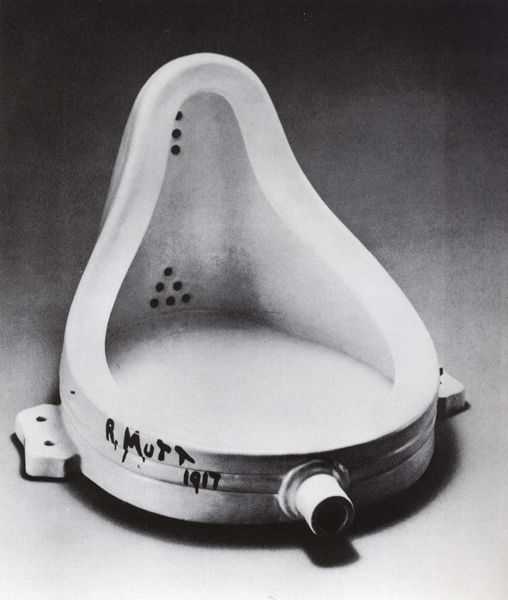
In order to uncover this, let’s delve a little bit into the use of regular objects in art. The use of found objects in 20th century visual art can be found most famously in the works of the Dadaist movement. One particularly well known example is Marcel Duchamp’s Fountain,

Marcel Duchamp’s Fountain, 1917

which is really just a urinal turned on its side with “R. Mutt 1917” scrawled along the base. As one of the first pieces of this iconoclastic genre of modern art, this article states Duchamp’s own summation of the work, a response in a 1917 issue of the avant-garde journal The Blind Man: “Some contended it was immoral, vulgar. Others, it was plagiarism, a plain piece of plumbing.” This touches on some key elements of the Dada movement, and modernism in general: the idea that the concept behind the piece becomes part of the piece itself, and that to be controversial is a positive thing. Dada originated as an avant-garde movement reacting to the terrible bloodshed and brutality seen during World War I. It was meant, in the words of Jean Arp (one of Duchamp’s Dadaist contemporaries), as a way “to destroy the hoaxes of reason and to discover an unreasoned order.” Dadaists placed emphasis on absurdity, repurposing of found objects, and the laws of chance. Though one of many different niches of modernist thought cropping up during the early 20th century, it would later be revived by the Neo-Dadaists in the 1950s and ‘60s.


The Neo-Dada movement revived Dadaist thoughts during the Cold War later in the century. Neo-Dadaism used things such as found objects and chance to shift the focus away from the artist him- or herself and instead on the audience’s reaction and interaction with the piece in question. This was not only a movement in visual art (Jasper Johns and Robert Rauschenberg are two big players here — you can read more about them here and here, respectively, if interested) but also in music. John Cage, possibly most famous for claiming silence as music in his work 4’33” (performed below by NOLA the Cat), was an important composer of this school of thought.

Cage followed the Neo-Dadaist philosophy of using found objects and chance in his works, something derived from their earlier Dadaist forerunners. 4’33” is in a sense completely a work of chance music, as the resulting sonic landscape of four minutes and 33 seconds of silence is whatever anyone in the hall happens to hear — the focus shifts from the music itself instead to the audience’s perception of that music. This particular work and others by Cage have influenced many musicians after him (a collection of reactions to his works and his contributions to the music world can be found here). Without Dada, Neo-Dada, and Cage and his like-minded contemporaries, it is unlikely that we would have ever been able to have that lighthearted exchange in our rehearsal concerning the cantabile-ness or lack thereof of a balloon deflating.

This brings us back to our original question: how did I end up in a rehearsal last weekend with someone playing the balloon, and why can we call that a musical instrument? To me, the origin of a balloon as a musical technology isn’t in the actual physical structure of it, but rather can be found in the artistic movements that allow us the freedom and openmindedness to see it as such. Without our avant-garde, Dada, and Neo-Dada forefathers, the use of balloons as a found object musical instrument would not likely be something we could come across in our scores today. Even though it’s something that can be found at any grocery store, the balloon is an instrument that takes practice and patience to get that perfect cantabile sound — and a lifetime to master.

https://www.youtube.com/watch?v=sIskW0xEGvM

Losing Touch: the age of headphones

Remove your headphones and an odd scene is revealed before you. All around people smile and laugh as they sway and shuffle about and yet there is something missing. This dance floor is eerily quite. There is no band. There’s not even any music playing out loud! Every person is in fact in their own world, isolated by a wall of sound in their brightly colored headphones. This is the silent disco!

It has been a long road to the world of “mobile clubbing”. Like many modern technologies, headphones have had a long and often static history, with more rapid evolution coming in recent years. The first headphones, designed by Ernest Mercadier, were used in the late nineteenth century for telephone operators. Shortly thereafter headphones were introduced to the music industry as the company Electrophone began a service in which Londoners could listen to live broadcasted performances of music and theatre. After a long stretch in which developments in headphone technology mainly came from the military, John Koss achieved the next defining moment. An avid music listener, Koss designed the first stereophonic headphones which resulted in higher audio quality and a more authentic listening experience. The most current advancement has not come in the form of headphones but in music players. Sony’s “Walkman” and more recently Apple’s “iPod” have worked hand in hand with headphones to enact fundamental changes in the way we consume and produce music

Electrophone headphones and stand.

The advent and widespread use of headphones has motivated adjustments in the way recorded music is produced. The primary reason behind these changes is physical; unlike stereo speakers, headphones contain a relatively small audio-producing mechanism and feed directly into each ear. These two differences create some issues and a quick Google search will uncover a raging debate on the proper methods of mixing music in today’s world. How can one make music sound good on monitors and in headphones? Is it ok to mix a recording using headphones? Is it absolutely necessary to mix with headphones?

In an article on forbes.com, Nick Messitte explains how producers boost the mid-range overtones of bass sounds to “fool” your ears into thinking there is more bass than earbuds can actually produce. What headphones lack in bass output, they more than make up for in mid-range frequencies and producers have learned to take full advantage.

The “in-ear” nature of headphones has also necessitated some changes in effective music recording methods. This article explains why panning instruments to different channels is no longer a good option. When instruments are panned to one side or the other on stereo speakers, it can make the recording sound more authentic; when we hear live music, the musicians are generally set up in some configuration in front of us so that we hear each instrument slightly more strongly in one ear than the other. There is a phenomenon by the name of “crossfeed” in play here. If a sound emanates from your right, your right ear will receive the signal more strongly and fraction of a second before your left. Your brain has learned to localize the source of sounds from this specific set of signals. The issue with headphones is that they eliminate natural crossfeed as each ear hears only what comes out of its respective side. If a recording includes panned tracks then it will sound somewhat unnatural as we hear the instrument more strongly in one ear, associate it with being positioned to the corresponding side, but then don’t receive the validation of the weak delayed signal in our other ear. A good example of this is The Beatles’ “Eleanor Rigby”. The Youtube version features all the tracks sounding straight down the middle (more or less) while the Spotify version has heavily panned lead vocals. Listen with headphones to each version, paying special attention to 0:13 where the first verse begins.

The panned version sounds as though Paul McCartney is singing directly into your right ear! The more recently adjusted version sounds more natural. As illustrated by this example, it makes sense for producers to move away from panning in favor of pleasing headphone listeners, even at the expense of losing the more “live” atmosphere of well mixed stereo recordings.

In a more abstract but just as important way, headphones have changed the way humans consume and interact with music. In an article in The Atlantic, Derek Thompson points out research that music evolved to “serve as a technology of social bonding”. Although Western cultures have been moving toward a more elite and specialized use of music for some time, the widespread use of headphones completes the about-face from “social bonding”. Headphones allow us to enjoy music completely alone, acting as a portable auditory social barrier even in the midst of a crowded social space.

While losing interpersonal connections is concerning, David Byrne worries at an even deeper level about the lose of connection with ourselves. In his book, How Music Works, Byrne argues that the constant presence of recorded music in our lives, enabled in large part by the technology of headphones, prevents us from hearing the “music ‘playing’ in our heads”. His point is that the humming, whistling, and audiating we constantly engage in while not listening to music is much more than a silly habit. It is in fact an essential creative process that connects us more deeply to music. In the age of headphones, music is more and more often a solitary one-way street in which we consume but fail to interact. Too often we defer to listening to what Byrne calls the “experts” (recorded artists) and forget that silence is absolutely necessary to allow for processing, synthesizing, and creating. Music is interactive in nature and we must avoid allowing headphones to lead us to becoming increasingly passive listeners.

From the tangible effects of adjusted production techniques to less obvious changes in the ways we consume music, headphones have had profound impacts on our lives. In conjunction with the advent of recorded music and portable music players, headphones have allowed music to be both more present in our lives and also more isolating than ever before. While headphones can be a wonderfully convenient and useful technology, it would be smart of us to be conscious of when and why we use them and how they effect our relationship to the music we can’t seem to get enough of.

Sources:

www.forbes.com/sites/nickmessitte/2014/04/19/how-earbuds-have-changed-the-sound-and-business-of-pop/2/#aab6b0a7c189

www.theatlantic.com/technology/archive/2012/05/how-headphones-changed-the-world/257830/

www.smithsonanmag.com/arts-culture/a-partial-history-of-headphones-4693742

www.stuff.tv/features/headphones-complete-history/rise-walkman-1979-1990

https://ehomerecordingstudio.com/best-mixing-headphones/

Byrne, David. “How Music Works.” Three Rivers Press, an Imprint of the Crown Publishing Group, a Division of Penguin Random House LLC, 2017, pp. 139–141.

The sound of the organ

On July 3, 2017, at 8:30pm, in Montreal, Canada. There was an interesting organ concert played by a well-known organist—Hans-Ola Ericsson—at Church of the Immaculate Conception. That is a huge fantastic church with many historical sculptures and paintings. The recital was an event of the Montreal Organ Festival, and more than 500 audiences (including many organists coming from other places to participate the festival) was waiting for the concert starting since it already had delayed for 30 minutes. The program of the concert is half classical music and half contemporary music. The organ is built by Rudolf von Beckerath which is a German organ company, and it has mechanical touching and action for the keys and the stops. It sounds like the Craighead-Saunders organ at Christ Church in Rochester, NY, and obviously it is one of the ideal organ for playing early music, such as the works of Dietrich Buxtehude and Heinrich Scheidemann.

Von Beckerath, 1961
• 3 manuals, 38 stops, 56 ranks
• Mechanical key and stop action

Four years ago, I met Hans-Ola Ericsson in Leipzig, German, and I went to his masterclasses and recitals. Ericsson is one of Olivier Messiaen’s friends, and he performs lots of Messiaen’s music and other modern music. Also, he is a composer as well. I highly admire his talents and musicianships, and I feel his music can inspire people. So, I was very excited to hear his concert again in Montreal.

The concert began with a contemporary piece called Interactions No. 2 for Organ and Tape (1979) by Tamas Ungvary (b. 1936), and the first-half recital ended by Hans-Ola Ericsson’s own music—Melody to the Memory of a Lost Friend XIII (1985, for Organ and Electronics).

Unfortunately, there were over half of the audiences decided to leave during the intermission, probably because that kind of music did not sound right for them or they thought the performer was just crazy. Well, I guess that makes sense… It is difficult for the audiences to accept that the organist was wearing a Sennheiser headset to hear the electronic part and using the Timer on his iPhone to calculate the timing when he was performing in the concert, and letting two speakers to play the electronic accompaniment to the audiences. To be honest, it is even harder to image the picture in your head.  It might look like a vanilla sundae with whipped cream and some small pieces of bacons on the top—the tasting is absolutely good with the creation, but people will still feel shocking and ridiculous each time when they see it.

However, did the way of the Ericsson’s playing make the audiences feel uncomfortable, so they left in the middle of the concert? The answer is no. Obviously, if that is the reason, the audiences could close their eyes to keep listening and enjoying the music. Thus, what is the main reason making people decide to leave a famous organist’s concert?

From my point, I do not think that using other technologies (such as electronics and tapes) into the organ music is the most important reason making the audiences leave. But, a special way of using organ as a musical technology to produce a unique sound made the audiences feel uncomfortable.

Listening to the Melody to the Memory of a Lost Friend XIII carefully again, you actually cannot hear the absolute pitches from the organ. Sometimes it sounds same as the electronic music with many overtones. This is because Hans-Ola Ericsson uses soundscape on the organ (pulling the stops not fully out, and the players can get different colors by using different stops) to approach the special sound from the organ. Also, this unusual but more colorful sound can give the listeners more imaginations about the music. For example, the Melody to the Memory of a Lost Friend XIII is composed for the three-hundredth anniversary Bach year in 1985, and Ericsson wrote in the album, “(The decision of) a close friend to end his own life was the starting point and the inspiration for this work. His absence of hope and his despair awoke in me a search for meaning.” Therefore, when you are listening, you can deeply understand what is the story behind this piece, even though you cannot hear the certain notes.

But, the soundscape is not the traditional organ’s voice for the audience, and also it is not one of the sound that the audiences usually expect to hear. Many times when the organists perform new music with the technique of the soundscape, many audiences want to leave during the concerts. This situation happened in four years ago in German as well. A very famous Hungarian organist and composer was playing the recital at Nikolaikirche, Leipzig (One of two churches that J.S. Bach worked and played in Leipzig). After his started to use soundscape, a lot of audiences began to leave the church and made the noises to show the dissatisfaction.

Let’s take a guess—what kind of the sound from the organ will not make the audience be too surprised or when the people walk into Nikolaikirche, what kind of the organ music they would like to hear? The imitated voice as a Whistle(soundscape)? The jazz music with a drum accompaniment from a speaker? Or “real music” composed by classical composers, such as J.S. Bach, Franz Liszt and so on. In general, I think the answer possibly would be the third one. Here is the recording of Jesus bleibet mine Freude (nach BWV 147) played by Jurgen Wolf at Nikolaikirche, Leipzig.

Going back to the period before J.S. Bach—during the Medieval Age and the Renaissance (cite from the page 3), the mainly used organs are the portative and the positive (see the pictures below). Normally, they only contained principals stops and the mixtures to accompany with the singers and other instrumentalists. But, it did not have the some special sounds like soundscape. Also, since organ is the core instrument to play in the churches, the major contributions for the organ music (including J.S. Bach) is various types of the chorale settings(reference from the page 96). Some treatises recorded that during the Baroque period, the correct sound from the organ should sounds like a human voice (singing). This tradition lasted for a long time, and it influenced German organ composers and organists, even during the time of Max Reger. For example (reference Preface by Christopher Anderson from An Introduction to the Organ Music of Max Reger), Reger really effected by J.S. Bach’s music, and the people use the term “historicist modernism” to describe him.

portative organ
positive organ

In French, the organists and the composers pursued the orchestral sound from the organ, rather than the human voice in German. For instance, the bright reeds’ stops is one of the main elements for the French style’s organ. Especially in 19th century, after Cavillé-Coll organ company founded in France, the French organists have had more characteristic and easier using organs to approach the loud sound as a big symphony. As Charles-Marie Widor mentioned in his Avant-propos (directly cite from Widor’s Avant-propos), “The modern organ is essentially symphonic.” https://www.youtube.com/watch?v=1oR3P3IfGqo (Widor 6th Organ Symphony, the first movement-Allegro, played by Daniel Roth)

Now being an instrument or a musical technology, the organ does not necessarily need to sound like either the human voice or the orchestra in modern music. However, after more than eight centuries’ traditions, how to make the listeners entirely accept a new sound from the organ will be an interesting topic in the future.

Metronomes on My Mind

I super-duper love my metronome. My metronome is one of the oldest musical friends I have, at least in this leg of my musical journey. I have had it since 8th grade and I’m pretty sure I prepared for one of my first All-state auditions with it. Its been with me since day one. Its also been paramount to my musical success as a percussionist and often its easy to forget the role that metronomes in general have taken as a part of my musical growth.
My metronome and the most popular other metronomes on the market today are a part of a line of metronomes called Doctor Beat that are made by Boss. Now the smallest member of this lineup is the DB-30 which is the cutest little clip on thing you’ve ever seen and it was actually the metronome I had before I bought my current one. Then there’s also the celebrity DB-90 which looks like this:

DB-90 Metronome

The DB-90 is best known for single-handedly keeping every single drumcorp or marching band in the country in time. The mere sound of it has been known to trigger traumatic episodes among former band members, causing them to relive the sights and sounds of getting screamed at by their psychotic band director whilst simultaneously getting roasted by the sun. Its clunky silver plastic casing weighs at least a couple of pounds and it quite literally eats 9 volt batteries. It comes with enough weird, useless grungy beat presets to run an underground Polish nightclub along with probably the most disturbing synthetic counting voice samples in existence that have never once helped anyone play in time better ever. And the worst part, at over $150 on most sites, the DB-90 is probably the stupidest piece of technology available. Yet in spite of the the supreme extra-ness of the DB-90, metronomes have come a long way through history to earn the prominence they enjoy in today’s musical culture.
The history of metronomes is actually not all that fascinating. It pretty much starts out in the same place as clocks, where Galileo observed and the described the properties of a pendulum. As time and discoveries progressed pendulums were able to be made with adjustable weights which affected how fast the period of the swing was. In 1814, a man by the name of Dietrich Nikolaus Winkel invented the metronome while studying pendulums. His design was the first truly successful metronome because it made sound and had a spring acting as as escapement that kept it ticking. Winkel was not successful at patenting his “chronometer” although, and in 1816 another fellow named Johann Maelzel took Winkels design, slapped a scale on it designating certain bpm’s, and called it his own.

Maezel Metronome

This type of metronome is the one we have all come to know and love as the “classic” metronome. With the advent of mass-produced electrical appliances in the 20th century, metronomes like the Franz electric metronome began gaining ground. Nowadays most metronomes are digital, but Maelzel’s classic style metronomes still appear and are even written for in pieces like Casey Cangelosi’s “Slight of And Evil Hand.” Their effect on the way we write, perform and interpret our music today is immense.

My personal metronome in particular has a special place in my heart, unlike the teeny DB-30 and the utterly awful DB-90, I have a DB-60 which is juuuust right. It has all of the basic functions that you actually need in a metronome plus a few other actually useful extra ones. Best of all its extremely durable, I’ve dropped it on hard floors all the time, and I’ve changed the batteries less than ten times in the 6+ years I’ve owned it. I recently misplaced it for a few weeks over the summer and I was pretty surprised by how upset I was, I mean this little guy has been with me this whole time and even though its just a metronome, I really appreciate all it can do for me everyday. Its amazing how much I end up using it and its so easy to take something simple like that for granted every day, so even though my heart doesn’t skip a beat every time I see it, this metronome definitely clicks for me ;D