Circus Music

A lot of people have heard of Cirque Du Soleil or has seen a movie or a play. These forms of entertainment are heavily influenced by the circus. Circuses have been around since the Roman times. Circuses were originally accompanied by a fiddler or a flautist. A Roman circus was often put on by the Roman government. Back in the day, “People anxiously desired bread and circuses.” so the government would put on these huge spectacles with free bread to keep their people happy

Later, the first circus showed up in Paris in 1782.  It was directed by Philip Astley and composing and financing was done by Charles Dibdin.  The written pieces were either intermezzos or comedies and were performed by singing and dancing children.  These pieces were officially called “marches” and sometimes called “screamers”.  I think the reason for this was because a march was used for grand entrances and usually people cheer and clap when a performer enters the stage.  The other style of music was a “Galop”.  This style was for accompanying dangerous acts and was sometimes performed on xylophone (Wikipedia).  I found this really interesting because in a lot of cartoons, a xylophone is used in suspenseful and exciting scenes.

Here is an example of a “tip toe” xylophone effect:


One composer, Karl King, lived in a time when circus music needed to be it’s own style since other music of his age didn’t quite fit the acts.  So, he composed the ever so famous “Barnum and Bailey’s Favorite”.  (wikipedia) I was hoping the name of the irish cream, “Bailey’s Favorite”  would have sprung out of a disagreement with Barnum about what good liquor is, but unfortunately these two things are unrelated

In the early 1900’s, brass bands started to gain popularity in circus music.  The idea was that, people would be more likely to come to the circus if they could hear the music from miles away.  In fact, many circuses had a steam powered piano that could be heard from far away called a “calliope”!  (Wikipedia)


Often times, circus music involved a wide range of styles.   “Handel’s Hallelujah Chorus was performed alongside “Life’s a Bumper” in the Bostock and Wombwell’s travelling Circus”.  This combined classical music alongside popular music.  This isn’t so uncommon today as it was back then.  Movies often use pop songs alongside classical music to create different effects and experience throughout a movie.   (Baston)

One example of Circus Music is in “The Little Rascals” at 2:17


Many modern concerts contain a large array of music.  It’s not uncommon to see Maurice Ravel, John Williams, and Robert Russell Bennett scheduled in the same concert.  In fact, the ever so popular Cirque Du Soleil uses a wide variety of music.  Mixing Rock, Jazz, French influences, and Opera into one show isn’t anything special for them.  Not only that, but according to Kim Baston of La Trobe University, Australia who wrote an extensive paper on Circus music and performance, “Circus is a global entertainment form, as it is not reliant on the spoken word, and has easily incorporated performers of different nationalities”.  Watching Cirque Du Soleil shows online demonstrates just that.  The performers represent a wide range of ethnicities and the language they sing in the show is one that is made up.  When the clowns get up on stage, a lot of their vocalization is gibberish with a few spoken words of an actual language here and there as shown in the video below:

https://www.youtube.com/watch?v=Ys5o5mfXzh0

The use of popular music in circus bands also helped popularize brass bands in America.  Although music attracted larger audiences, the music was inferior to the physical performances.  Even in contemporary circuses, music is always seen as the accompaniment unless it is performed in a purely auditory setting like a concert.  Overall the combination of circus acts and music can be seen as similar to opera or musicals.  It sprouts from the same concept, but grew into something uniquely it’s own.


Mighty Impactful Data Interface: The History and Effects of the MIDI File

While I am not technically savvy as a person, I am generally savvy, so when my hard drive crashed with all of my arrangements for my various ensembles and projects on it, I was able to scrounge up the only files I had saved to cloud storage. Those files were, you guessed it, Standard MIDI files. Slightly too big for email, slightly incompatible for Google Drive, just right for Dropbox. Once I found those files, I was able to run them through a music notation software and regenerate the arrangements, narrowly avoiding a fearsome confrontation with my film music ensemble colleagues. But what went into this software that I, a stressed out music student, was able to so easily rebuild something that was thought to be lost with only a poorly tempered synthesizer file and a dream?

This answer begins in the 1980’s with the collaboration between Ikutaro Kakehashi, Tom Oberheim, and Dave Smith. Kakehashi was the serving president of Roland, an instrument and software company which has begun the development of an interface for electronic instruments, early models including SYNC and Digital Control Bus. Kakehashi dreamt of a standardization among synthesizer interface, allowing for direct communication between equipment produced by different manufacturers. He took this idea to Oberheim and Smith, the leaders of Oberheim Electronics and Sequential Circuits, respectively. The plan was to use a combination of  Kakehashi’s original DCB and SYNC interfaces as a foundation to build upon; DCB managed the pitch and SYNC managed tempo. The three men then opened communication with other major electronic musical equipment manufacturers, including Yamaha and Kawai, and thus, the Musical Instrument Digital Interface was born.

Standard (slightly outdated) complete MIDI studio set up

MIDI revolutionized the musical industry of the late 20th century. Though it was originally produced to allow musicians and producers to directly communicate with each other electronically, it quickly sparked the development of new equipment for the age of electronic music and personal computers. People with little to no experience in notation software could now create sequences of synthesizer and beats, and immediate playback allowed untrained musicians the ability to immediately hear their compositions, giving more room for experimentation.  MIDI is not often a stand-alone performance tool, but it is the standard production tool. In contrast with digital audio, MIDI is a set of commands recording pitch and duration rather than a recording or representation of sound.  The setup as a series of commands makes it ideal for sequencing, sampling, and music notation software. This is why I was able to regenerate my lost scores through its use; MIDI is a set of instructions to be used with other equipment.

Although Standard MIDI files still sound like a 1980’s synth, the most exciting thing about MIDI is its ability to run sequences and cues. This is the clearest development of the software through the years. As seen in the linked video, a beat can be sequenced to also run a melody given a cue. Additionally, without MIDI, lights and sound could not easily be synchronized in theatrical productions. At stadium concerts, performers, production, and effects teams remain synchronized through the usage of MIDI files within tracks. These files are the reason that Disney’s lights and fireworks go off perfectly in sync; MIDI Show Control provides the interface for lighting, pyrotechnics, and other effects, allowing for cues in the track to cue other events. More information on this software can be found at this poorly designed but informative website: http://www.richmondsounddesign.com/.

In our current age of advancement of audio engineering, it is amazing that a 1980’s interface has lasted as the foundation for electronic musical files and so much more. This system has provided the foundation for Logic Pro X, a software used in the development of scores and click tracks for film. MIDI also is the file used for ringtones, and is now used for recording and automation of faders in audio engineering. Despite its musical background, MIDI is now in use for many ubiquitous domestic events that require cues, such as automatic home lighting, thermostat regulation, and traffic lights.  Originally developed as a standard communication interface for musical instruments, the Musical Instrument Digital Interface has expanded to be a foundation of not only music production, but computer technology itself.

History of MIDI: https://www.midi.org/articles/midi-history-chapter-6-midi-is-born-1980-1983

MIDI Show Control Specification: http://www.richmondsounddesign.com/docs/midi-show-control-specification.pdf

Introduction to MIDI: http://www.doc.ic.ac.uk/~nd/surprise_97/journal/vol1/aps2/

Why Is MIDI Still Used? https://music.tutsplus.com/articles/8-reasons-midi-is-still-alive-and-kicking–audio-1811

How MIDI works: http://www.indiana.edu/~emusic/etext/MIDI/chapter3_MIDI2.shtml


Reed All About It

The bane of every saxophonist, such as myself, is a small, tan piece of wood—  the reed. According to esteemed saxophone pedagogue Larry Teal, “the principle task of the reed is its function as an air valve, which opens and closes on the mouthpiece at various speeds, [thus creating a tone].”1 Reeds are a technology I take for granted every day. My daily view of a reed begins with opening a blue, vacuum-sealed package, wetting the reed in my mouth, slapping it on my mouthpiece, and jumping right in to my practice session. Yet, reeds, in addition to being finicky at all the wrong times, possess a much more complex back story, and carry relatively unmentioned environmental implications.

The modern reed came about with the standardization of the clarinet in the late 17th century, 2 but the plant itself has been used for much longer. The reed species Arundo donax “has played an important role in the culture of the western world through its influence on the development of music, which can be traced back 5000 years.”3 The first musical use of Arundo donax was for making flutes, and only later was it used a reed. Nowadays, it is this species, grown in the Var region of France, that reed manufactures harvest, cut, and sell to customers.5

As simple as a reed may seem, the manufacturing process of cane is surprisingly complex, and the transformation to its use for musical instruments is a lengthy journey. As this video from the Rico reed company shows, the reed-making process takes many months to several years from planting the cane to harvesting and finishing the final product.

When I open a reed, I am actually opening up to two years worth of production time. The harvested plants must spend varying lengths of time drying naturally in the sun, depending on the manufacturer. The finished product is also a result of precise manufacturing tools and close inspection for reed imperfections. Yet, even the best reed will last no longer than a month of heavy use.

I have rarely heard anyone talk about the environmental impact of this technology, but, being a natural resource, reeds production does indeed carry environmental implications. Upon close inspection of the history and process of reed making, I found that there are significant environmental drawbacks, as there too often are with even the simplest of technologies. The first concern involves the plant itself; Arundo donax is considered in many regions, including the United States, an invasive species. Due to its musical and nonmusical uses alike, people have taken the plant out of its native region in the Mediterranean and cultivated it across the globe. Its ability to survive in many different conditions makes it a serious threat to indigenous plant species.4

Another negative environmental impact of this technology is its wasteful production. In a magazine published by one of the largest reed manufacturers, Vandoren, the company describes the complete process of making a reed. According to the company, up to 90% of cultivate plant material is discarded before it even enter the reed-making process, as high-quality reeds require very specific physical features of the original cane. Plants that are deemed usable also create significant waste products; out of the six-meter long stalk, only 20-30% is made into reeds.5

Due to more precise cutting and measuring equipment, reeds have become increasingly consistent over the last several decades. Some of the most dramatic developments have been in synthetic reeds, which have the same shape and function as traditional reeds, but are made from plastics.

Now, more than ever, synthetic reeds are reaching the ability to offer as great tone quality as cane reeds. Perhaps continuing to pursue the development of quality synthetic reeds will offer a better alternative to the wasteful use of cane.

The small piece of wood I use every single day is both a modern and ancient technology. Reeds have been used for thousands of years, but the last several decades have seen bounding progress in reed making and innovation. Yet, the complexity of the reed and its back story never fail to slip my mind, even though my ability to play the saxophone depends on a high quality piece of cane. This shows that the seemingly simple technology we use every day can have an immense, unseen history as well as a global impact.

  1. Teal, Larry. The Art of Saxophone Playing. U.S.: Summy-Birchard, 2000. p. 21
  2. Editors of Encyclopædia Britannica. “Reed instrument.” Encyclopædia Britannica. July 20, 1998. Accessed September 18, 2017. https://www.britannica.com/art/reed-instrument.
  3. Rojas-Sandoval, Julissa, and Pedro Acevedo-Rodríguez. “Arundo donax (giant reed).” Invasive Species Compendium. Accessed September 18, 2017. http://www.cabi.org/isc/datasheet/1940.
  4. Perdue, Robert E., Jr. “Arundo donax-Source of Musical Reeds and Industrial Cellulose .” Economic Botany 12, no. 4 (December 1958): 368-404. Accessed September 18, 2017. http://www.jstor.org/stable/4287997.
  5. Van Doren, Bernard. “SELECTION OF THE REED : FROM THE PLANT TO THE INSTRUMENT.” Edited by Jean-Marie Paul. Vandoren Magazine, 4-7.

Media:

https://www.reidys.com/images/products.large/vandoren_tenor_reed.jpg


https://www.google.com/search?hl=en&tbm=isch&q=parts+of+a+reed&oq=&gs_l=#imgrc=Tjj1rKWa0cnOxM:

http://www.bettermusic.com.au/media/catalog/product/cache/1/image/9df78eab33525d08d6e5fb8d27136e95/l/e/legerereed_1_7_1.jpg


Technology of Percussion: Gesture and the drum

Drums and percussion instruments were some of the earliest forms of music. They were used as a way to communicate many different things. They have been used throughout time in militaries as a way to pace troops and intimidate their enemies,  used as part of religious ceremonies, and even some animals use drumming for mating. There are two main ways that I believe that have led to the progression of to what percussion is today: the technology of the drum itself, and the reason behind the act of drumming (which I am referring to as the technology of the gesture).

There are many different forms of gestures, a gesture of love, war, musical gesture, and I think that gestures have largely shaped the aspects of  percussion today. This is due to the fact that percussion is such a physical instrument compared to others. In a lot of contemporary works, body percussion has been used quite often in making good effect of a gesture. In the piece “?Corporel” by Vinko Globokar , The drum is actually removed entirely, and the piece is based off of gestures that depict a very dark story, and I think that this is a great example of what a gesture can represent: a motion that can communicate a certain emotion/thought/or action without words. “Corporel seems, on one level, to dehumanize the performer by transforming him into an instrument and stripping away the veneer of civilization – or at least it seems to make him regress into a sort of primal unconscious. At the same time, his gestures, percussive and vocal, generate an oddly compelling sense of authentic expression, one not filtered through convention.” Taking this piece, along with the video of the birds drumming for a mate, it draws attention that, even without some form of societal conditioning,  gestures are one of the more effective forms of communication. Gestures, although seemingly complex, haven’t themselves changed at all, although ways for using them has. As society and music started to evolve, and music/instruments began to do so as well, leading to developments of an aesthetic alongside music, the idea of virtuosity.

Physical gestures that relate to a musical gesture, as a performer, also allow us to help further along the understanding of a piece as well (example). In an intense atonal piece like this, using physical gestures really make the audience able to connect to the piece on a first listening, and I believe that this idea comes from dance. In dance, using physical gestures are used alone to show a story. As music becomes more intellectual, and some pieces (like the Mantovani) that wouldn’t be immediately understood, combining the music to gestures that were inherited by dancers (although not exactly a dance) is allowing percussionists to further explore new ways of performing. A middle ground between dance and the marimba piece would be this; this clearly has aspects of dance and percussion that are both using gestures to portray a narrative of playing with a ball.

A much smaller scale of using gestures in percussion, (and skipping past the years and years of societal evolutions that led to this) is the development of the moeller stroke. This stroke allows the percussionist to add a gesture of fluidity and efficiency to their playing, which is slowly becoming integrated into the lives of most percussionists.

Without even getting into the technology of the drum itself and how that has changed since we developed from animals hitting drums from war or mates, the technology of the gesture, although it is still being used for a lot of the same reasons, has developed to a level of nuance through the progression of different art forms that has greatly impacted the percussion world and will continue to do so.


Timber and Timbre: the Precedent for Change in Woodwind Playing

For experts and amateurs alike, the unique and personal tone colors from the back of the orchestra in the wind section can be among the most memorable and emotionally invigorating aspects of a concert performance. Composers use this palette in very engaging ways – from the lamenting sighs of the bassoon to effervescent bird song on the flute – or vice versa. But what came first – the sounds or the music? What I mean is: have composers always imagined the color palette we associate with wind instruments today? The simple answer is no, and our concept of these sounds keep changing.

The woodwind sound we know and love today began to take shape roughly in 1850 and was fairly well established by the turn of the century (although new and different models continued to be made available until about 1930). This is largely because of the contributions of an instrument maker named Theobald Boehm who led to the implementation of new key systems on oboe, clarinet, flute, and bassoon. His work effectively pushed manufacturers to make instruments that were more even in pitch in all twelve keys and provided easier technical facility by using more automatic key work. His work was one of many efforts to make orchestral instruments that could meet the needs of 19th and 20th century composers and audiences.

Some musicians specialize in the performance of historical woodwind instruments that were used before the widespread reconstruction of woodwind mechanisms. Consider this video published by the Orchestra of the Age of Enlightenment. Oboist Katharina Spreckelsen explains some of the unique characteristics of the baroque oboe and the way in which the material and keys on an instrument impact its sound. Of similar interest is this article by David Brown detailing some of the differences between wooden key-less flutes and Boehm-system metal flutes. 

Now consider in contrast this recording of living oboist Eugene Izotov performing the showpiece “La Favorita” by Antonio Pasculli. As Katharina Spreckelsen mentioned, the addition of keys and the use of a more dense wood in the modern oboe drastically changed the sound and it also made virtuosic showmanship on the oboe possible. Also consider the difference in the way the way the instrument sounds when it articulates – it is a very unique and somewhat jarring sound on the baroque oboe, but the sound of articulation does not stand out on the modern instrument. This allows the instrument to blend in with the string and brass sound of a modern orchestra.

So why does changing woodwind instrument technology matter? Because both the music written today, the people playing it, and the people listening to it have new ideas about what woodwinds can and should sound like. Check out this recording of Chris Fisher-Lochhead’s piece for bassoon called grandFather. The performer is Ben Roidl-Ward. This piece uses a great deal of extended technique, produces sounds that are complex harmonics, uses amplification, and even the sound of breath and shouting. This is a marked departure from the standard range of sounds we expect from a bassoon. We can also hear these characteristics in more subtle and standard ways when we hear “flutter tonguing” or “growling” or pitch bending on woodwind instruments in more mainstream repertoire. For further reading about extended techniques consider this article by Matthew Burtner in New Music Box: Making Noise: Extended Techniques after Experimentalism.

As a result of the new sonic demands, can we expect woodwind instruments to expand their ranges or perhaps have optional built-in amplification output technology? I think it is likely that with new aesthetics we will start making an even wider variety of woodwind instruments for different performance purposes and we will consider new conditions under which to play them.

We should also consider the material with which we make our instruments. Oboes and clarinets are both made from a wood called grenadilla, which is an extremely dense wood that only grows in Africa. As is illustrated in this article, the Mpingo tree from which it grows is endangered and, while supplies dwindle, it has been illegally logged which has serious environmental concerns. While this has long been the choice material among instrument makers, they are also already accustomed to building oboes and clarinets in other mediums like rosewood, rubber, resin, and plastic (although this implies other environmental issues such as reliance on fossil fuels). In fact, synthetically made instruments are in particularly high demand already among young musicians because they are a fraction of the cost of grenadilla instruments. And synthetically produced cork for woodwind instruments is available even at WalMart. 

Many people have strong opinions about the sanctity and sound quality of particular woodwind instruments. This leads to consumer brand loyalty and also material divides between different styles of playing. But economic and environmental factors will push us into new territory with the manufacturing of instruments. I think that the musical examples provided above prove that there is a historical, sound-based precedent for altering our instruments and that the next few decades will reveal new timbres made possible by different woodwinds.

Steel or No Steel?

The strings on my violin are an everyday technology for me. They do not get changed as often as they should, but about once every couple of months. Strings are much more than just “the four thin strands of metal” we bow, (or pluck), on our instruments. A lot of thought is put into the string, what brand to use, what material, the thickness, et cetera.

Strings have made quite an evolution over time. The strings that were first used and used on baroque instruments are gut-strings. They were mostly made from sheep and lamb intestines. The gut strings are said to have a warmness in quality that has yet to be matched. They are still used today. Sometimes, people use different types of strings on their instruments and like the use of both metal and gut strings on their instrument, as they prefer the qualities in their sounds or tones that are the result of these combinations. For example, among my many hours of research, I read that Jascha Heifetz would use gut A and D strings, which is uncommon because on the modern violin, one would tend to use a gut string on the upper strings, not the middle combination.

These days, the most popular are the metal, steel core strings. The metal strings were introduced in the early 20th century. They produce vibrant sounds with many colors. However, it is said that they do not have the same richness to the core that gut strings provide. Also, metal strings tend to have a bigger and brighter sound and are more stable in pitch. It is interesting to see how there used to be no choice in the type of string one used to play and now there are many options within the three main material families of strings. We have to take into account that metal strings tend to last longer. Thus, it is a better investment to buy them so one does not have to spend too much money and change his/her strings too frequently.

There are also synthetic strings, which are described as the “bridge” between metal and gut strings. These were introduced in the early ’70s and produce a sound that is said to be more similar to the gut strings but synthetic strings are more durable. However, they lack the “complexity” that gut strings are popular for.

I would say that the reason I use the strings I do is because it is what has been suggested to me by family, teachers, and the luthier who I usually bring my violin to. Overtime, it has become a habit to just stick with what I am used to. These days, I always buy Dominant A, D (silver wound) and G strings and a Goldbrokat E string. The Goldbrokat E string is the newest member of the set, suggested by the luthier I see in my town. I have not ever experimented with gut strings on my own violin but I have played instruments with gut strings on them, and I do understand why some may prefer them. From what I remember, the tone quality is very sweet and rich. I do like a more sweet and vibrant tone quality on the top without it being too bright, while I prefer a darker, richer sound on the bottom range. I understand that it takes more than just four strings to produce the type of sound that I like but something that I have learned through this research is that it is important to understand how each string has its unique qualities. I wonder now if I have found the best combination for my instrument, but at the moment, I will probably stick with what I am used to and what I know works for me and my violin.

Sources:
http://www.violinstringreview.com/history.html

https://www.gamutmusic.com/new-page

http://www.violinist.com/wiki/violin-strings/

http://www.ifshinviolins.com/Articles/articleType/ArticleView/articleId/411/Guide-To-Choosing-and-Using-Strings-for-Violins-Violas-and-Cellos

http://www.the-violin.com/violinstrings/ (Helpful layout of the pros/cons of each type of string)

Media:
Slideshow of how strings are wound : https://www.gamutmusic.com/violin-setups-1

Video of violin strings slow motion: https://www.youtube.com/watch?v=QXjdGBZQvLc
4:36-4:50

How gut strings are made: https://www.youtube.com/watch?v=wRQq_0VM110

The Evolution of Headphones

Today, if you were to walk outside and observe others meandering through town, or rushing from place to place, you would probably notice that almost everyone is in their own world. It may not be obvious at first glance, but if you look closer, you’ll see two small white ear buds in each ear, playing a wide range of music, hand picked by the listener themselves. These tiny headphones have evolved so much over the past decade, let alone century, and have changed the way people listen and hear music.

Seeing as when the first headphone appeared, and how they have evolved, everyone should be very grateful that they do not have to use the first one. Weighing around 10lbs and carried on one shoulder (of your choosing of course), the first headphones were obviously not ones people enjoyed using [1]. 

Woman using the first headphone

This evolved into a different headphone, which was created in 1910 by Nathaniel Baldwin [2]. This is what people could consider the first modern headphone, however they were not used for music, but instead for the Navy. This use for the headphone continued until around the end of World War II, in which “record bars” began showing up around towns which resulted in headphones being used to listen to music there [2]. Having grown up with music as such an individual entity, thinking about people gathering in one place just to listen to music on their own is just so fascinating. Just like the movie theatre, people had a place to gather and enjoy art, alone or with friends, and did not have to worry about anything else, however not having music whenever they wished, and having to go to a store for individual music is a concept very foreign to me, and I’m sure for all of my fellow millennials.

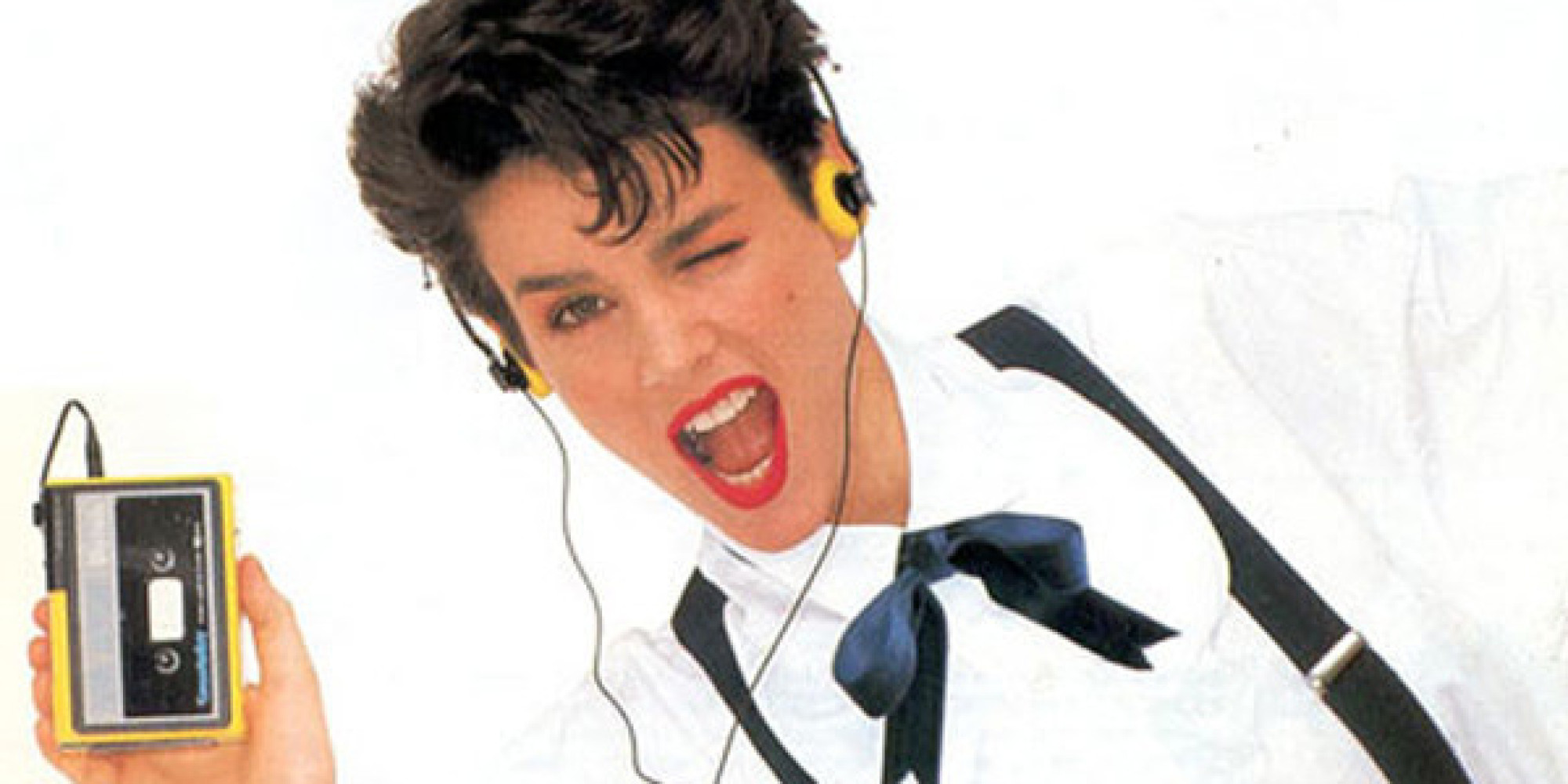
What really led rise to the use of headphones in an “every day” type of situation was when the Walkman was released. All of a sudden, people could use their Walkman, play music with headphones and walk anywhere they wanted to. From when it came out in 1979 until its decline in 1990, this device led a huge revolution in the audio world and improved how people were able to listen to music that they liked, whenever they wanted [1,3].

As you can see, people thought they were real cool when they had one of these.

In the 1990’s, the noise cancelling headphone came about, allowing people to have a new experience while listening to music. Instead of dealing with extra outside noise, people were now able to experience music where they did not have to deal with distractions other than the music itself. Originally, these headphones were designed for aviators as flights are very loud with out any sound reduction, however they soon began to produce them for the average person [4]. 

As headphones began to advance, out came the iPod and so began the era of portable music (in a much broader sense). In October of 2001, the iPod Classic was released, and depending on the number of gigabytes bought, could hold around 2,000 songs [5]. This was revolutionary as no other device had been able to store so many songs in such a small place. With this device, Apple also released small, in ear “earbuds” [5]. After this, the trend became for people to use smaller, in ear headphones that made it less obvious they were listening to music compared to the larger and clunkier over ear headphones [1]. Through out the years, this trend continued, and soon, even smaller headphones were created, such as wireless in-ear earbuds, which are so small that no one would be able to tell someone was listening to music with out getting a close look at their ear.

Apple’s new “Airpods” which are wireless in-ear earbuds.

For about the past hundred years, how people listen to music has changed drastically, and the ability for people to customize their playlists has improved drastically. Now, people have the option of playing music whenever and wherever they like without disrupting anyone else in the process. So, because of all of these innovations, hundreds of people are able to walk down the same street, not distract each other, and listen to completely different music while to someone just watching everyone, it would appear as if everything were silent.

  1. Newman, Mike. “The History of Headphones.” Cool Material. Accessed September 18, 2017. http://coolmaterial.com/roundup/history-of-headphones/.

2. “The History of Headphones.” Visual.ly. Accessed September 18, 2017. https://visual.ly/community/infographic/technology/history-headphones.

3. “Headphones: The Complete History.” Stuff. Accessed September 15, 2017. https://www.stuff.tv/features/headphones-complete-history/rise-walkman-1979-1990.

4. Denison, Caleb. “From Pilot to Passenger: A history of the noise-cancelling headphone.” Digital Trends. October 3, 2014. Accessed September 16, 2017. https://www.digitaltrends.com/home-theater/a-history-of-the-noise-cancelling-headphone-as-told-by-bose/.

5. Costello, Sam. “History of the iPod: From the first iPod to the iPod Classic.” Lifewire. September 22, 2016. Accessed September 16, 2017. https://www.lifewire.com/history-ipod-classic-original-2000732.

From Phonograph to the Digital Age of Music

Imagine walking through Times Square during rush hour and hearing not a single ounce of music around you. The electronic billboards are silent, the cars passing by are nothing but lifeless metal husks, stores feel drab with not a single catchy jingle, and people are agitatedly pacing the streets. Music does not exist in this bleak world with no way for it to stimulate the people who desperately need it. Dr. Syrigos, a historian, wrote, “Music coordinates emotions, helps important messages to be communicated, motivates people to identify with a group, and motivates individuals to support other group members.”[1] As humans, music occupies our everyday life and is transmitted to us whether we like it or not, and we have playback devices to thank for that. Everywhere you venture, there is some variety of music heard from a known or unknown source, acting as a stimulus. Times Square, as mentioned above, is a location of stimulus overload with billboards advertising products with vivid visuals and all too familiar jingles, and the bustling stores, playing your favorite tunes over the radio. Music players, like phones or MP3 players, are unconsciously used everyday to relay our favorite artists and groups to us, but have we ever thought of how these devices came to be?

Living in the modern age, listening to music is as easy as walking to the bathroom or looking up the latest and spiciest celebrity breakup on the internet. Modern playback devices are portable and are able to store a vast amount of music, all in pristine high quality. However, rewind to 1877 where music playback was in its infancy. Thomas Edison, a fledgling inventor, had just invented the phonograph, the first invention of its kind to record and playback music in one bulky package. To even record a sound on the phonograph required a weird amalgamation of items such as tin foil, a needle, a cylinder, and of course the mouth of the phonograph.

By shouting into the mouth of the phonograph, the needle inside of the cylinder would scribble the sound waves onto the tin foil and would allow for playback, albeit limited as the tin foil would eventually crumple.[2] The phonograph would evolve with time and reinvent itself as the turntable with records serving as the substitute of the cylinder and tin foil. However, the method of needles and grooves would remain. However, it stands that the phonograph allowed the common person to listen to music from the comfort of their own home.

Now, fast forward to 1979 where record players and radio were standard and were the primary sources of listening to music. Tapes were present at the time but were primarily for use in the car as it was more convenient and portable. Now, portable is a word many of us have blissfully experienced before but in 1979, music portability was scarce and almost nonexistent, that is until Sony released The Walkman. The Walkman is a playback device relying on cassette with several buttons functioning as start/stop, fast forward/rewind, and eject. Simple enough right? In actuality, The Walkman’s ability to play music from a cassette was not entirely special as it had been done before for use in journalism. However, the revolutionary addition of The Walkman stemmed from its portability and accessibility which had never been seen before: “Portability and privacy made it the ideal product for thousands of consumers looking for a compact portable stereo that they could take with them anywhere.”[3]

https://www.youtube.com/watch?v=lBqseObEt54

The only glaring weakness of The Walkman was its single capacity limit, which only allowed for one cassette to be inserted at a time. Flash forward to 2001 and this problem would be amended by a device which would revolutionize how we would listen to music for the last time in current history.

“Music is a part of everyone’s life, and because it’s a part of everyone’s life, it’s a very large target market all around the world. It knows no boundaries.”[4] In this quote, entrepreneur Steve Jobs understands the impact of music quite well, and would soon become a technological figurehead only few in history would achieve. Upon returning to Apple in 1997 after resigning in 1985, Jobs envisioned of a product which would forward the digital evolution of music in big strides. In 2001, the first generation of the iPod was released to the public and while it was highly criticized for its price, the innovation of having a device store thousands of songs was unparalleled.

The easy to use interface of the scroll wheel possessing basic functions also made the iPod more accessible than its competitors. Now, why is the iPod such a huge deal in digital music? When Apple had released the iPod in 2001, there were other digital MP3 players on the market previously. However, Apple’s flagship device was the first to usher in a sleek design as well as a simplistic structure and function, making it more appealing than its competitors. Through the years, the iPod would gradually evolve, introducing more internal space, features, designs, and would eventually cement its place in history as one of the most influential digital products to grace the 21st century.[5]

Looking back in history, it’s amazing to look at the progress playback devices have made. From the lack of portability and clunkiness of the Edison phonograph, to the portable yet limited Walkman, to the age of digital music with portability and ultimate accessibility. The strides made in music playback technology is a great technological marvel and thanks to those who made their contributions, music can be heard from the most bustling of cities to the silent confines of the country: music can be heard anywhere.

[1] http://www.ancient-origins.net/ancient-places-europe/origin-music-00972

[2] https://www.nps.gov/edis/learn/kidsyouth/the-phonograph.htm

[3] http://content.time.com/time/nation/article/0,8599,1907884,00.html

[4] https://www.cultofmac.com/124565/an-illustrated-history-of-the-ipod-and-its-massive-impact-ipod-10th-anniversary/

[5] https://www.lifewire.com/history-ipod-classic-original-2000732

Just Play Along!

Every living jazz musician has had to contend at some point or another with the idea of using a play-along track. For those who aren’t familiar, this is an audio track consisting of rhythm section instruments (most commonly drum set, string bass and either piano or guitar) playing behind an imaginary soloist. Jazz musicians use them to practice when they have no live rhythm section of their own to play with. The musicians who record the track (except in cases where the track is computer-generated) simply play the chord progression of a familiar tune together for anywhere from two to ten minutes, and the consumer at home can use it to pretend they’re playing with real people while they practice this tune. Here is what one of these tracks sounds like:

Perhaps to the untrained ear this just sounds like normal jazz music, but to a jazz musician it sounds like something is missing – what’s missing is you, the soloist who needs to practice Giant Steps. So how did this strange, anonymous musical collaboration come to be? How did this sort of virtual reality become the norm for aspiring students of jazz music?

50 years ago (roughly half the amount of time jazz as we know it has existed) a young saxophonist named Jamey Aebersold stumbled into one of the most prominent tools in jazz education (an educational field virtually nonexistent at this time). Seemingly without realizing it, he launched the Jamey Aebersold Play-Along Series after students at a summer camp requested that he make them a recording of piano accompaniment for a few standard jazz tunes. You can read about how this series took off unexpectedly and became one of the most recognizable volumes in jazz music here.  For more from Aebersold himself on jazz education, which itself as a technology has only been around for half a century, you can check out his article “Music is for Life“.

Fast forward to today: Learn Jazz Standards is a free online resource with literally hundreds of videos including backing tracks and podcasts about common jazz education topics like tune-learning and improvisation techniques. This page gives you a good idea of the sheer volume of content they have available.  Apps like iReal and Drumgenius offer a seemingly endless array of customizable backing tracks for anyone with a mobile device.  This is a remarkable difference from Aebersold’s earliest tracks, which were recorded in his basement studio and sold in an LP format with an attached book of lead sheets. (For reference, this is a lead sheet, or simple statement of the main theme of a tune with the basic underlying harmony, to be expanded upon by improvising jazz musicians. This is the sheet music the players from the above video would be looking at. Giant Steps) 

Of course, there is disagreement among jazz players and educators over the merit of playing with pre-recorded tracks. Some say this detracts from the spontaneous and improvisational spirit of the music, training the student to treat rhythm section players like a static background drone instead of living, constantly improvising musicians. Kelly Rossum, professor of trumpet and jazz studies and Christopher Newport University insists that his students play with real jazz recordings with interacting musicians instead of backing tracks, even if it means the student plays over John Coltrane’s saxophone solo. On the other hand, many insist that playing with tracks is the only way to develop one’s aural skills as an improviser, as practicing alone or with a metronome doesn’t give one a sense of the form and harmony of a jazz standard, and playing over another soloist is not indicative of real playing situations. Others see the tracks as a sort of unique challenge: Bill Dobbins, professor of jazz composition and arranging at Eastman says of the tracks’ repetitive nature: “Some people complain that when they’ve played with a track a few times, they know exactly what’s coming. Well, you should use that to your advantage. Get creative with it!”

Play-along tracks have undoubtedly made great strides since they first came about in the 1960’s. As a technology they have clearly made a seamless transition into the digital age through the internet and mobile technology, and as a tool of jazz education they have at the very least become ubiquitous enough to warrant specific opinions from jazz pedagogues. In any case, backing tracks are out their for students of all ages to use, for better or for worse…

Violin and Technology

Last week I sat in Kodak Hall as one of my childhood violin heroes played on stage. I couldn’t understand how he was able to produce such a large and beautiful sound that seemed to rip the heart out of my chest. I began to think about how this violinist produced such a large sound and the reason for it. What kind of violin did he have, and what was particularly special about his violin? What went into making it? How did a piece of wood from a tree became a small box that creates beautiful sounds?

There is a belief that orchestral musical instruments are far from any type of technology, but instruments and the process of making them requires more technology than one may think. For example, a tree must be cut down, the wood dried, and then imported to whichever part of the world the violin maker is in. If not already aged, the wood must then be seasoned before luthiers begin their work. Some violin makers require their wood to be seasoned for a minimum of fifteen years. Below is a violin maker with a piece of wood he has been naturally drying and aging for many years.

Once the wood is aged, luthiers are able to begin their work. The first step is the bending of the ribs or outer frame. This requires a bending iron and water in order to bend the wood efficiently. The bending iron temperature should range between 200 and 250 degrees Celsius but other factors apply. These include the type of wood being used and the exact temperature it needs in order to be bent correctly.

http://https://www.google.com/search?q=bending+iron+and+water+violin+making&rlz=1C5CHFA_enUS728US729&source=lnms&tbm=isch&sa=X&ved=0ahUKEwjm46DQgbDWAhXG6iYKHcX3CwgQ_AUIDCgD&biw=1082&bih=638#imgrc=3aZYxrBWJiQSEM:

The top and back of the violin must be carved next in a process called arching. Modern violin makers still copy Strad and Guarneri models while doing this, as an improved combination of dimensions has still not been discovered. This process is the removing of wood using gouges. Luthiers start with a large gouge and work their way down to smaller gouges in order to achieve desired thickness. When finished, the top must be scraped rather than sanded to provide a crisp and beautiful appearance of the wood. At the end of this process, only twenty percent of the actual wood block ends up being used.

Following gouging, the F-holes are cut in order for air to enter and escape. F-holes give the violin character and can even make the violin look happy, sad, or interesting. One technology that aids in the cutting process is an electric saw shown below.

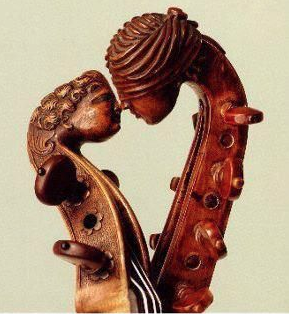
One of the final steps in violin making is creating the scroll and neck. The scroll is cut out using a saw and hand carved by the maker. This is often when the luthier is able to express his or her individuality and creativity. Scroll carving is usually the only time in the violin making process that a maker can carve freely.  

Once the instrument is glued and put together, the final step of varnishing must be completed. Varnish has been known to enhance the tone of the violin while also protecting and giving the wood a beautiful finish. When completed, the varnish must be aged and exposed to sunlight before it can be put into the hands of a performer.

When considering all of the technology and time that goes into making a violin, it’s easy to see why fine handmade instruments are so admired and prized. Even instruments that were made in the last twenty years have had to come from a tree that started growing at least 100 years ago. How did that tree get there and what technologies may have gone into getting it there? Did it grow naturally or did someone plant it? The time it takes to cut, dry, season, and varnish a violin’s wood means that most violins are a lot older than one may think.

One violin maker said that “the violin does not have its beginnings with a musician, but rather with its maker. It can only be used by skillful hands to bring a person into the very presence of God.” With that being said, a violin is a technology musicians can use to communicate whatever they want to be said, using the gift of music which is beyond this world.