The Last of Us: Blend between Music and Screen

When I was younger, I remember the thrill of playing video games with my brother to see who would get the highest score, who could get the farthest, or who was just overall better at the game. Today, while these elements of competitive drive still resides within the medium, the evolution of the video game is astounding. Just a decade or more ago, video games used to be viewed through a very specific lens by the general public as being a type of “nerd culture” that possessed no grounded place in the entertainment market. However, much like the Marvel Cinematic Universe, video games have become accepted by the public and has transformed into a mainstream form of entertainment. Now, why is this?

The evolution and growing success of video games can be attributed to the sense of immersion one can receive. Image, sound, and most importantly music, come together to create a multisensory experience not easily attainable in other forms of entertainment. In 2013, American video game company Naughty Dog released the PlayStation 4 exclusive title, The Last of Us, which has been regarded by critics to be a masterpiece in the medium. The title’s intense action and survival horror elements created a beautifully executed atmosphere not seen in other titles but what elevated it further was the incredible compositional works by Gustavo Santaolalla.

One of the most incredible aspects of Santaolalla’s compositions is that even though they are categorized as “minimalist”, there’s an incredible amount of meaning put into each texture and note. During the production of the soundtrack, Santaolalla experimented with an incredible amount of different instruments to see which ones captured the atmosphere of the game and then recorded them to see how they blended with one another. Also by collaborating with Neil Druckmann, the game’s creative director, Santaolalla was able to create music with a great deal of creative freedom, allowing for a soundtrack that helped to further strengthen the connection between the player and game.

Santaolalla’s compositional style not only reflects the atmosphere present within the game, but is also able to invoke an incredible amount of emotion without any context but with it, a whole new level of immersion is introduced. In a documentary with Santaolalla concerning the game’s soundtrack he says,

“The most important thing that makes The Last of Us what it is, is that it’s a very different project than other projects with more emotional content, with more emotional connection between the players and the characters.”(3:22)


One scene to further strengthen Santaolalla’s point is the reaction of Druckmann, during a very particular moment in the prologue (47:26 in this documentary). In the scene, linked here, the player narrowly avoids the chaos of a viral outbreak all the while protecting the protagonist’s daughter from danger throughout the entire prologue. The player’s actions are for naught however and the daughter is shot, resulting in her death. It is important to note that the first connection the player receives in the game is the father-daughter bond that is established within the first few minutes of the prologue. Due to the authentic relationship between the two, the player has the desire to make sure that not only the protagonist survives but the daughter as well.  These string of events culminated an extremely powerful and effective emotional impact and with the soundtrack at the forefront, not even Druckmann himself was able to leave unscathed from the balance between scene and music. During the father’s lament at his daughter’s passing, the use of strings and solo cello was an excellent way for Santaolalla to convey the despair to the player and the transition to the main theme was a fantastic way to dense the texture to reflect the chaotic nature of the plot.

The Last of Us is a masterpiece of a game, telling a story through visceral gameplay and immersive soundtrack. The passion Naughty Dog placed into the game can be wholeheartedly felt and the care Gustavo Santaolalla placed into the music is astounding, even more so after learning his history in music. The combined efforts of creating an unforgettable piece of entertainment are certainly present and showcases just how far video games have come since the late 1900’s. To end, here are the words of Bruce Straley, the game’s director:

“We feel that the interactive medium has an untapped potential to touch the feelings of the player. You have that connectivity, the fact that I am actually in the world and participating in what’s happening on the screen in front of me gives us some sort of advantage to make you feel connected with what’s actually happening.”

                                             –Grounded: The making of The Last of Us (6:34)


[1] https://en.wikipedia.org/wiki/Marvel_Cinematic_Universe

[2] https://www.naughtydog.com/company

[3] https://en.wikipedia.org/wiki/Gustavo_Santaolalla

[4] https://www.youtube.com/watch?v=Ejdjcun2Jo4

[5] https://youtu.be/R0l7LzC_h8I?t=2846

[6] https://youtu.be/s3_cP_jJ-9w?t=725

Fell in Love with a Stupid, Ridiculous, Painstakingly Difficult and Time-Consuming Medium

Unless you’ve been inhabiting the space under a rock for the last half-century or so, you’re probably familiar with a certain wildly successful Dutch company known as Lego. Lego has captured the imaginations of millions of children (and adults) worldwide with their system of stackable colored bricks, offering endless possibilities for creation and even more endless opportunities for toe-stubbing. If you actually are unfamiliar with Legos, their website might give you some idea as to what I’m talking about. In any case, you can understand the ubiquity of this toy, its iconic status in popular culture. This status makes it all the more impressive that an artist could take this toy and use it in ways not previously conceived of, could re-appropriate it for artistic purposes in a totally novel way.

At first view, one might be tempted to believe that the “Fell in Love with a Girl” video is the product of some kind of pixelation filter applied to an otherwise-normal music video. However, in a style similar to claymation (a la Wallace and Gromit created by Nick Park – watch this video if you’re unfamiliar, it is well worth your time) the video was in fact created frame-by-frame with real Lego sets, shown in rapid montage to give the illusion of movement. Why this artistically bold-yet-inherently childish style for the video? The lyrics to the song suggest a kind of paradoxical struggle between love and lust, with the narrator trying (and failing) to distinguish between the two. Perhaps this duality is meant to be expressed by the silly-yet-complex Lego animation. Perhaps the depiction of people with small plastic bricks is meant to convey the humanizing force of love versus the more animal force of lust. Indeed, the people depicted in the video (often Jack and Meg White) are often stark white – is this a sign of ghastliness or purity? (It should be noted that they are rather pale in real life as well, though…) Or perhaps, and in all  honesty this is where I would put my money, this song was chosen for the Lego video because it is incredibly short.

The collective hive-mind of YouTube users tends to agree with this assessment. TheAndrewj96 writes: “THIS SONG IS TOO DAMN SHORT. You can’t put this much kickass in a song and just make it less than two minutes in length. I mean, this should be at least three minutes long.” Andrew J raises an interesting point about artistic compromise here – is it okay for an artist to limit their output due to a labor-intensive medium? Andrew isn’t forthcoming about whether or not he has ever constructed an elaborate stop-motion Lego video synchronized to music, but in case he has, he makes a valid point. The song is relatively short, for better or worse.

Other viewers seem less perturbed by the song’s length, instead focusing on its status as something of an anthem within its genre. Nugie simply writes “Timeless punk jam.” This seems to say it all, in three simple words nailing down the White Stripes’ origins in punk as well as their rise to iconic status over the last 20 years, thanks in large part to bold and recognizable songs like this one. For some interesting accounts on how the band (Jack White in particular) developed this sound, check out this series of brief interviews with some of the band’s early associates and friends.

However popular the band has become, though, there is evidently some question about their place in history, as evidenced by comments like this one, from Memedkemal Aksoy roughly one year ago: “The white stripes was a legend in the 2000’s” While on the surface this appears to be a compliment to the band, it can be read as a thinly-veiled jab at the importance of the White Stripes’ music. Were they really only at this legendary status for one decade? Has the musical culture that once welcomed them since forgotten about innovations like “Fell in Love with a Girl”? In fact, often the White Stripes are excluded from discussions of their own genre, as in this article detailing the shape of punk music over the last half-century.

Indeed, the White Stripes have only made their way into the limelight of popular music a handful of times in their existence. But does this prove the assertions of nonbelievers like Memedkemal Aksoy? Or do legends come from beyond the realm of popularity, ascending by their art alone?

Beyoncé’s “XO” : A Multisensory Music Video

Beyoncé’s song “XO” is track number 10 on her 2013 self-titled album, “Beyoncé”. Beyoncé labeled this album her “visual album” , as every song also has a music video. “XO” quickly gained popularity after its release. The majority of fans loved the song, however others had a negative reaction.

The song begins with the voice of a NASA Public Affairs Officer moments after the space shuttle Challenger exploded in 1986. Some of Beyoncé’s fans deemed using this recording insensitive, especially those who had lost loved ones in the disaster. Beyoncé responded to this saying “The song ‘XO’ was recorded with the sincerest intention to help heal those who have lost loved ones and to remind us that unexpected things happen, so love and appreciate every minute you have with those who mean the most to you”.

The music video, set in Coney Island (Brooklyn, NYC), illustrates what Beyoncé intended with the message of this song. I will break up my analysis into a few pieces: text painting, camera footage, and the effect of the music within the pace of the video’s visual story.

The music video begins with flashing colorful lights, and the first lyrics we hear Beyoncé sing are “Your love is bright as ever/ Even in the Shadows”. Immediately viewers see the contrast of light and dark. There is a sense of temporality both in the video and the lyrics, as we start seeing different scenes of Beyoncé singing individually, Beyoncé with friends in the amusement park and arcade, and random people having fun in the park. The lyrics “We don’t have forever/ Baby daylight’s wasting” Is shown with some scenes of the video being filmed in daylight, and some at night. When Beyoncé sings, “In the darkest night hour/ I searched through the crowd, Beyoncé is surrounded by people. Sun sets in the video with the lyrics “We don’t have forever”. I could go on and on, but basically this video does a great job visually representing the literal meanings behind the lyrics. This makes the song not only more digestible, but it becomes an experience of multiple senses.

The camera shots in this video are also very effective in creating a powerful musical experience. We see the juxtaposition of more intimate and close up angles of Beyoncé alongside moving and sometimes out of focus shots of people in the park. The clip of Beyoncé and her friends on the roller coaster is also an interesting camera shot because we can almost experience the ride as if we were Beyoncé. The camera is also very focused on people smiling and loving each other, which again makes the experience more intimate both visually and musically.


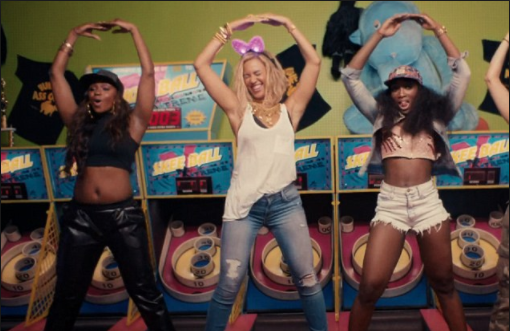
The music and the video come together harmoniously. Scenes are pieces in rhythm to the music, and because most of the clips are moving, the video compliments how upbeat the song is. Beyoncé and her friends also make a dance move out of “XO” with their hands that goes along with the music.

Overall this music video is very stimulating and makes listening to the song that much more meaningful. As I scrolled through the comments, I found three that sum up the general reaction to this music video.

These comments about being able to “feel” the music and the song taking them back to a certain place or atmospheric feeling are definitely influenced by the powerful experience of the video! Anyone who has been to an amusement park, have been out with friends late at night, or have even just had a great time with loved ones at any time can relate to this song and video, which is why it is such a powerful piece of art.

I hope watching this video inspires you to go check out some of Beyoncé’s other awesome music videos. Here are three that I was considering for this blog post and are just as cool and a testament to how music can be a multisensory experience with image, sound, and screen!

“Love on Top”

“Pretty Hurts”

“Halo”


Karel Husa and the Paradox of Prague

Records of distinct nationalist identity in music have existed since the before the middle ages. And, until approximately the 17th century, the majority of music composition was virtually inseparable from the church, which was virtually inseparable from the state. Thus, nationalism has always been a lens through which to look at the unfading marriage of music and politics. The 20th century musical stage in particular was flooded with nationalist compositions in response to territorial conflicts and as a reaction to oppressive regimes. Karel Husa’s Music for Prague 1968, is a politically motivated composition that reveals a paradox in nationalist music.

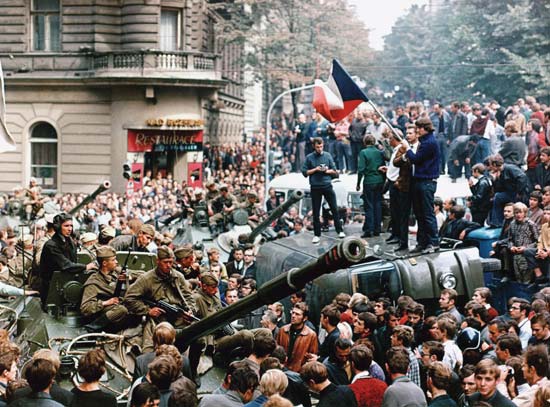
Karel Husa was born in Prague, Czechoslovakia in 1921, and later emigrated to the United States. Music for Prague 1968 was written shortly after the Soviet Union crushed the Prague Spring reform movement in Czechoslovakia in August, 1968. When Husa heard of the events that occurred in Prague over the radio, he was deeply moved. The piece serves as a memoriam to the victims of USSR violence, as well as a call for Czech identity.

The work includes a Hussite hymn, which blatantly creates an element of Czech nationalism. The Czech hymn that Husa uses, originally a war song from the 15th century, is titled “Ye Who Are Warriors of God.” It had previously been known for its use in Dvorak’s nationalist composition “Hussite Overture,” and there is no doubt that Husa’s choice to integrate the hymn is due to the tune’s overtly nationalistic connotation. One of the lines from the hymn reads, “Ye warriors of God, if you believe in the future, things will be better in the future.”

Music for Prague 1968 therefore reveals a paradox of nationalist music. In the piece, the Hussite hymn partially represents “solidarity and resistance”. On one hand, Husa is supporting his country by means of using traditional Czech music. The words of the allude to being willing to sacrificing oneself for one’s country and having hope for the well being of it. On the other hand, he is using the hymn to beckon back to a time before Soviet control- or even before the existence of a modern communist state. Hence, the composer is effectively attacking and bolstering his beloved country simultaneously; Music for Prague 1968 seems to portray that Husa is both proud and ashamed of his homeland. This leads to the conclusion that a nation is not characterized by any one political period, and that composers can praise all the good things about a nation while still speaking out against current events.

One of the essential requirements for nationalist music, is a broad audience; the point of such music is for a composer to share his or her feelings about their country with others. Husa’s conviction to write Music for Prague 1968 was also a conviction to share his thoughts about larger political ideas. One interesting source that provides commentary on the intended audience of music, and specifically politically driven music, is the article “Does ‘Music Trump Politics’?” by Ted Gordon. Gorgon quotes Dennis Prager as controversially saying, “Great music should transcend political differences.” Like many members of the Classical music world, I strongly disagree with Prager’s logic. Not only does this way of thinking nullify the point of nationalist music, it also pushes a limitation onto art as a whole. Though not all music is political, some pieces of art are meant to be derisive; Husa’s Music for Prague 1968 was not thought highly of by the Communist government of Czechoslovakia. Furthermore, there is a distinction between the reason for composition (perhaps to speak out against a certain person) and its objective face value meaning to a listener (maybe a piece written to shame a dictator is enjoyable to listen to even by the dictator himself). For example, Shostakovich’s 5th symphony subtly condemns the violence of the USSR, and yet it was praised by the Stalin regime; while this composition is politically influenced, at face value, everyone can appreciate them, included the party against which it was written.

In relation to Husa’s Music for Prague 1968, I think the intended audience is the people of democratic nations, to whom it serves a warning of oppressive regimes. One generally conclusion that Music for Prague 1968 demonstrates is that there can be a paradoxical balance of critique and patriotism that constitutes nationalism. And on a larger scale, Husa himself later reflected in an L.A. Times interview, “I don’t think of [Music for Prague 1968] as a political message for one country… It is universal.”

Lingering Discord: K-Pop Star Vs. Politics

K-Pop. What can be said which already hasn’t been said? K-Pop, or Korean Pop, has become a music sensation spanning the entire globe, destroying the cultural barriers separating the West and Eastern hemispheres. With upbeat rhythms, insane choreography,

and overall presentation, it’s no wonder that K-Pop has become the global phenomenon it is currently today. However, it’s all ingrained in a fog of limbo between music and politics. Tiffany Hwang[1], a budding K-Pop artist and member of the popular group “Girls’ Generation”, made a critical mistake due to her lack of knowledge in cross country tensions and almost led to the end of her career.

Before getting into any form of politics, some important historical background of Korea is needed. During the early 1900’s, specifically from 1910-1945, Japan placed Korea under colonial rule and tensions were high between the two countries. Japanese occupation was ruthless as any of amount of freedom was severely limited. Koreans were forced to ban their own native language in schools, and were even demanded to change their names to Japanese, with a whole 80% of the populace complying with their demands.[2] However, the biggest atrocity to come out of Japanese occupation was the use of “comfort women”; essentially Korean women who were used as sexual slaves for Japanese soldiers.

Korean Comfort Women

This caused an immense rift between the two countries, one which still lasts to this day. In this article,[3] Jazeera writes “But they [Japanese] misjudged how deeply ingrained the issue is in South Korean society.” This single quote demonstrates the decades long strained relationship between both Korean and Japan.

Now, why include historical background when discussing K-Pop? It’s due to the fact that something as worldwide and influential as K-Pop cannot escape the grasp of past misdoings and politics. First, let me point out that K-Pop as a medium is extremely successful in East Asian countries, especially in Japan. KARA, a five member girl group, was able to generate a whopping $60 million dollars of revenue in Japanese CD and DVD sales alone on their 2011 tour.

The five members of KARA

On the surface, this seems like a simple transaction of cultural exchange and in way, it is. There was no ill intent both by the members of KARA and the Japanese audience. However, while the same could be said of Tiffany Hwang, the reception was drastically different and demonstrated the lingering political tensions between Korea and Japan. During Girls’ Generation’s tour in Japan during August 2016, Hwang posted several pictures on Snapchat with the Japanese Imperial Flag, serving as a way for her fans to know her current location.

This act in itself poses no political outcry and was just an innocent way of communicating between performer and audience. The problem comes from the fact that she posted these pictures on Korea’s Liberation Day.[4] As the name implies, this was the day when Korea broke free from Japanese occupation, liberated by both United States and Soviet Union forces. Due to the dense history between the two East Asian countries, this act by Hwang was deemed incredibly offensive to the Korean populace, especially on their day of liberation. Hwang was able to delete the pictures in a quick three minutes, but it was far too late: “Her career literally came to a halt,”[5] with sponsorships and television roles being taken from her instantly. In a way, this story correlates with Colin Kaepernick’s refusal to stand during “The Star-Spangled Banner”, albeit with differing connotations. In an article from The New Yorker, Kaepernick says, ““I am not going to stand up to show pride in a flag for a country that oppresses black people and people of color.”[6] This type of mindset is reminiscent of the people of Korea in how the Japanese Imperial Flag represents the same type of oppression Kaepernick himself feels. The Imperial flag is a symbol of inhumane oppression and is shrouded in decades of dark history and in Kaepernick’s mind, the United States shares this trait. It is also important to note that Kaepernick’s own devotion to protest the anthem is different than Hwang’s unknowing mistake; one was purposeful and the other was accidental. However, the theme of oppression is apparent in both and demonstrates the correlation between both stories.

In my mind, both Kaepernick and the people of Korea are justified in their reactions. I believe Blake put it well when he used the phrase “us and them” in his blogpost. In Kaepernick’s position, he was protesting against the history of the United States and the recent events which painted the country’s flag as a symbol of oppression; a fight between minority vs. majority. In Hwang’s position, it was almost as if the people of Korea were asking her the question, “Japan or us”. Hwang’s mistake essentially cements the idea that K-Pop stars are not immune to such scrutiny, especially with their celebrity status in Korea. Politics, those especially concerning Japan, are still touchy subjects and possesses the power to bring down the cultural powerhouse of K-Pop should the opportunity arise.

[1] https://en.wikipedia.org/wiki/Tiffany_Hwang

[2] http://afe.easia.columbia.edu/main_pop/kpct/kp_koreaimperialism.htm

[3] http://www.aljazeera.com/news/2017/09/south-korea-world-longest-protest-comfort-women-170908024721239.html

[4] https://www.army.mil/article/192286/korean_national_liberation_day

[5] http://thepolitic.org/when-pop-music-goes-nuclear-the-explosive-politics-of-k-pop-in-asia/

[6] https://www.newyorker.com/culture/culture-desk/colin-kaepernick-and-the-radical-uses-of-the-star-spangled-banner

“Back In the USSR”: Parody or Political Statement?

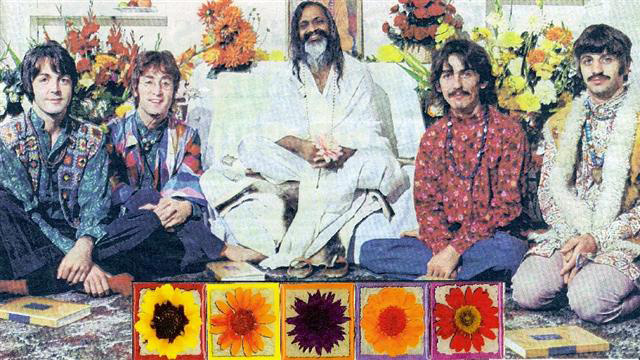
In early 1968 , The Beatles went on a meditation retreat in Rishikesh, India. They aimed to study Transcendental Meditation with their guru Maharishi, and eventually become teachers of this craft. Mike Love, from the Beach Boys, was also on this trip.

The Beatles with the Maharishi Mahesh Yogi

Love recalls  “sitting at the breakfast table and McCartney came down with his acoustic guitar and he was playing ‘Back In The U.S.S.R.’ and I told him that what you ought to do is talk about the girls all around Russia, The Ukraine and Georgia. [Paul] was plenty creative not to need any lyrical help from me but I gave him the idea for that little section”. McCartney did in fact take Love’s suggestion and wrote about admiring girls from Georgia, Ukraine, and Moscow, all locations represented in the USSR (Union of Soviet Socialist Republics).

Album Sleeve


A performance of “Back in the USSR” by the Beatles


“Back to the USSR” represents influence and power that music has in creating political controversy. When the song was released in 1968, America was at war with Vietnam. Because Russia supported the Viet Cong, conservative Americans immediately rejected this song, believing the Beatles were sympathizing with the enemy and promoting communism. The lyrics to this song fueled anger in Americans, especially the John Birch Society, who were particularly offended by the lines “You don’t know how lucky you are, boys”.

Additionally, this song caused controversy in Russia. Rock and roll was not respected at the time and the Beatles were not either. This said, Back in the USSR became wildly popular in Russia, and people sought to listen to the song even from tapes smuggled into the country. Elton John performed the song in Moscow a year after Americans had boycotted the 1980 Summer Olympics in Russia and wrote “they went ape s—. It was like playing ‘Philadelphia Freedom’ in Philadelphia”. The fact that there was such varied reactions to this song only made it more controversial.

Paul McCartney argues the claims of this song being politically charged by explaining this song as a parody of Chuck Berry’s hit “Back in the USA”.

McCartney says “I just liked the idea of Georgia girls…and talking about places like the Ukraine as if they were California, you know?…Its a jokey song, but it’s also become a bit of an anthem now…In my mind its just about a [Russian] spy who’s been in America for a long time and he’s become very American but when he gets back to the USSR he’s saying ‘Leave it ‘til tomorrow to unpack my case, Honey, disconnect the phone’”. It is interesting that McCartney had to defend himself for attempting to humanize young people on the other side of the world, and was also forced to defend the feeling of pride and comfort when a person returns home.

Performance of “Back In the USA” by Chuck Berry


In the article “Colin Kaepernick and the Radical Uses of the Star Spangled Banner”, Robin writes “Our national symbols are always more complicated than their original myths”. Kneeling at a football game to illuminate long-standing racism is viewed as a disrespectful and criminal act amongst conservatives. This can relate to Back in the USSR. Just as kneeling down during the Star Spangled Banner has become a controversial symbol of a larger national issue, Back in the USSR developed into a symbol of controversy during a time when a war was taking place . A parody song aiming to humanize non-American young people became a highly political debate.

This topic is very relevant to our class so far because we have focused so much on audience reception, the power of change and imitation, and how composers adapted to political ideals or brought to light political issues in their music. Politics and music will always be intertwined because politics inspires the cultural environment. As music is a pillar of culture, it is fair to say that these two will always have a powerful connection.

Will Musicians ever learn to Breathe?

https://www.youtube.com/watch?v=k1dbb5x7PSQ

Breathe Dammit!

rants by Livio Fasullo 9/17/17

Every morning hundreds of tired Eastman Students get out of bed and walk across Main St. to begin their morning practice sessions in the Eastman School of Music Annex. Some of these students play string and percussion instruments while others sing and wind instruments. Most of these young and ambitious Eastmanites are completely unaware that they are constantly filtering oxygen through their lungs in a process known as breathing (too focused on the next seating audition, or concerto competition). Those who are aware and conscious of their breathing and how it can create greater ease in their playing will likely see much improvement in their studies, regardless of instrument (yes, even string players).

Ironically, many of us take deep and shallow breathes from our chest, keeping us nervous and un-focused (with the additional aid of Java`s Coffee) and then spend hours in the practice room trying to get better. In the weeks leading up to juries Eastman feels like an Urgent Care with countless students in casts due to practicing injuries. Many of us forget that we can incorporate much more ease into our practice and life by simply breathing, and it`s free! (Unlike PT).  Our breathing system is an essential technology for us humans that when used naturally allows for enhanced quality of life by relaxing our mind and focusing our muscles.

Breathing as a Technology

According the Merriam-Webster online dictionary a technology consists of “the practical application of knowledge especially in a particular area”. (https://www.merriam-webster.com/dictionary/technology) We are all unconsciously applying our breathing apparatus (diaphragm, lungs, brain, veins/arteries) every day (if you didn`t you would die), but many of us have allowed our minds to turn our breathing apparatus on auto pilot. To understand this better let`s take a look at how breathing works.

  The Science of Breathing

The actual scientific process of breathing is quite complicated, but luckily for us, we can breathe instinctively without thought. Breathing generally consists of  two large phases, inspiration and exhalation. As we inhale our diaphragms move downward increasing the volume of the upper body (thorax), which lowers the existing air pressure in the lungs allowing air to enter from the atmosphere. As we exhale the diaphragm relaxes and the volume of the upper thorax decreases forcing existing air to leave the lungs. (https://www.unm.edu/~lkravitz/Article%20folder/Breathing.html).

When we go into our Sympathetic Nervous System (Fight or Flight) which involves heightened senses and quick shallow breathing when our mind believes that we are in a dangerous situation.(https://www.sciencedaily.com/terms/sympathetic_nervous_system.htm) Eastman students regularly experience their Sympathetic Nervous System when trying to find a practice room one hour before their lesson or when being “vibed” by other students. Unfortunately, many students also experience their sympathetic nervous system when practicing and performing.

The Parasympathetic Nervous System takes hold when we our minds are at ease. (http://www.medicinenet.com/script/main/art.asp?articlekey=4770)  The Parasympathetic Nervous System can always be reached through deep breathing.

History of Deep Breathing

Most Eastern cultures and nearly all martial arts consider deep breathing to be fundamental skill that all should have. Deep breathing helps relax muscle and focus the mind. It is a essential part of Tai Chi, Karate, Qi Qong, and Yoga. The Pranayama is a series of deep breathing techniques used throughout the practice of Yoga. Pranayama roughly translates to extend the life force/breath that is sustaining the body (https://www.yogajournal.com/practice/healing-breath). Yoga has been in existence for thousands of years, while common practice classical music was (arguably) first written in the 17th-18th century. But proper breathing can actually be traced back to the beginning of mankind. We all have the innate programming to breathe properly. If you watch a baby sleep, you will notice that it sleeps on its back and its stomach moves through the deep breathing process. We can lose that process as we get older due to an overabundance in stimulus in the digital age. As musicians we can find ourselves taking shallow breathes while worrying about our careers and upcoming performances. In the book Effortless Mastery, Kenny Werner refers to these dominating powers over  our lives as fear and ego (pg. 21). For a video on deep breathing check out his link:

https://www.youtube.com/watch?v=k1dbb5x7PSQ

Musical Benefits

As previously stated, deep breathing helps relax muscle and focus the mind. So how does this help us as musicians? Kenny Werner talks about the “Space”, a meditative state of being achieved through deep breathing and the release of ego. In the “Space”, a musician performs music effortlessly and thoughtlessly. (pg. 77) From a less philosophical standpoint breathing helps you to clear your mind of distracting thoughts and release unnecessary tension during practice and performance. Here is a video describing deep breathing for wind players:

https://www.youtube.com/watch?time_continue=34&v=sCEj3R_26wY

Some musicians who have mastered deep breathing do not need to move dramatically when they perform or play. In his book Effortless Mastery, Kenny Werner describes the excessive movement and shallow breathing of musicians as an attempt to coax out unmastered music (pg. 59). If you watch the first minute of this video of Ralph Bowen improvising on the saxophone, you will notice how he plays from the “Space” that Kenny Werner writes about. Take note of his deep breathing. You can see his chest and stomach move as he inhales. Also note that his mastery of  breath allows him to be still, almost at rest as he plays complicated music effortlessly.

https://www.youtube.com/watch?v=6IoUnl_1fgc&t=58s

Ralph Bowen has said that all playing the saxophone really involves is “air and fingers” (http://jazzprofiles.blogspot.com/2017/05/ralph-bowen.html). By practicing his deep breathing in conjunction with his instrument he becomes more relaxed and focused every time that he plays his instrument- as can all of us if we make deep breathing a regular part of out practice routine.

What does this mean for me?

Regardless of your profession, by understanding the technology of deep breathing you can become more relaxed and focused, allowing you to complete tasks at a higher level of efficiency. As musicians, deep breathing helps us to play and learn more efficiently, gain confidence in practice and performance and save time and money avoiding physical therapy. I hope that all Eastman students will take time to develop their breathing and become the best stress-free musicians that they can possibly be.

  Sources:

https://www.unm.edu/~lkravitz/Article%20folder/Breathing.html

https://www.merriam-webster.com/dictionary/technology

https://www.drdavidwilliams.com/proper-breathing-improves-health

https://www.bluedragonkungfu.com/breathing-exercises-martial-arts/

http://jazzprofiles.blogspot.com/2017/05/ralph-bowen.html

Effortless Mastery by Kenny Werner

Losing Touch: the age of headphones

Remove your headphones and an odd scene is revealed before you. All around people smile and laugh as they sway and shuffle about and yet there is something missing. This dance floor is eerily quite. There is no band. There’s not even any music playing out loud! Every person is in fact in their own world, isolated by a wall of sound in their brightly colored headphones. This is the silent disco!

It has been a long road to the world of “mobile clubbing”. Like many modern technologies, headphones have had a long and often static history, with more rapid evolution coming in recent years. The first headphones, designed by Ernest Mercadier, were used in the late nineteenth century for telephone operators. Shortly thereafter headphones were introduced to the music industry as the company Electrophone began a service in which Londoners could listen to live broadcasted performances of music and theatre. After a long stretch in which developments in headphone technology mainly came from the military, John Koss achieved the next defining moment. An avid music listener, Koss designed the first stereophonic headphones which resulted in higher audio quality and a more authentic listening experience. The most current advancement has not come in the form of headphones but in music players. Sony’s “Walkman” and more recently Apple’s “iPod” have worked hand in hand with headphones to enact fundamental changes in the way we consume and produce music

Electrophone headphones and stand.

The advent and widespread use of headphones has motivated adjustments in the way recorded music is produced. The primary reason behind these changes is physical; unlike stereo speakers, headphones contain a relatively small audio-producing mechanism and feed directly into each ear. These two differences create some issues and a quick Google search will uncover a raging debate on the proper methods of mixing music in today’s world. How can one make music sound good on monitors and in headphones? Is it ok to mix a recording using headphones? Is it absolutely necessary to mix with headphones?

In an article on forbes.com, Nick Messitte explains how producers boost the mid-range overtones of bass sounds to “fool” your ears into thinking there is more bass than earbuds can actually produce. What headphones lack in bass output, they more than make up for in mid-range frequencies and producers have learned to take full advantage.

The “in-ear” nature of headphones has also necessitated some changes in effective music recording methods. This article explains why panning instruments to different channels is no longer a good option. When instruments are panned to one side or the other on stereo speakers, it can make the recording sound more authentic; when we hear live music, the musicians are generally set up in some configuration in front of us so that we hear each instrument slightly more strongly in one ear than the other. There is a phenomenon by the name of “crossfeed” in play here. If a sound emanates from your right, your right ear will receive the signal more strongly and fraction of a second before your left. Your brain has learned to localize the source of sounds from this specific set of signals. The issue with headphones is that they eliminate natural crossfeed as each ear hears only what comes out of its respective side. If a recording includes panned tracks then it will sound somewhat unnatural as we hear the instrument more strongly in one ear, associate it with being positioned to the corresponding side, but then don’t receive the validation of the weak delayed signal in our other ear. A good example of this is The Beatles’ “Eleanor Rigby”. The Youtube version features all the tracks sounding straight down the middle (more or less) while the Spotify version has heavily panned lead vocals. Listen with headphones to each version, paying special attention to 0:13 where the first verse begins.

The panned version sounds as though Paul McCartney is singing directly into your right ear! The more recently adjusted version sounds more natural. As illustrated by this example, it makes sense for producers to move away from panning in favor of pleasing headphone listeners, even at the expense of losing the more “live” atmosphere of well mixed stereo recordings.

In a more abstract but just as important way, headphones have changed the way humans consume and interact with music. In an article in The Atlantic, Derek Thompson points out research that music evolved to “serve as a technology of social bonding”. Although Western cultures have been moving toward a more elite and specialized use of music for some time, the widespread use of headphones completes the about-face from “social bonding”. Headphones allow us to enjoy music completely alone, acting as a portable auditory social barrier even in the midst of a crowded social space.

While losing interpersonal connections is concerning, David Byrne worries at an even deeper level about the lose of connection with ourselves. In his book, How Music Works, Byrne argues that the constant presence of recorded music in our lives, enabled in large part by the technology of headphones, prevents us from hearing the “music ‘playing’ in our heads”. His point is that the humming, whistling, and audiating we constantly engage in while not listening to music is much more than a silly habit. It is in fact an essential creative process that connects us more deeply to music. In the age of headphones, music is more and more often a solitary one-way street in which we consume but fail to interact. Too often we defer to listening to what Byrne calls the “experts” (recorded artists) and forget that silence is absolutely necessary to allow for processing, synthesizing, and creating. Music is interactive in nature and we must avoid allowing headphones to lead us to becoming increasingly passive listeners.

From the tangible effects of adjusted production techniques to less obvious changes in the ways we consume music, headphones have had profound impacts on our lives. In conjunction with the advent of recorded music and portable music players, headphones have allowed music to be both more present in our lives and also more isolating than ever before. While headphones can be a wonderfully convenient and useful technology, it would be smart of us to be conscious of when and why we use them and how they effect our relationship to the music we can’t seem to get enough of.

Sources:

www.forbes.com/sites/nickmessitte/2014/04/19/how-earbuds-have-changed-the-sound-and-business-of-pop/2/#aab6b0a7c189

www.theatlantic.com/technology/archive/2012/05/how-headphones-changed-the-world/257830/

www.smithsonanmag.com/arts-culture/a-partial-history-of-headphones-4693742

www.stuff.tv/features/headphones-complete-history/rise-walkman-1979-1990

https://ehomerecordingstudio.com/best-mixing-headphones/

Byrne, David. “How Music Works.” Three Rivers Press, an Imprint of the Crown Publishing Group, a Division of Penguin Random House LLC, 2017, pp. 139–141.

Metronomes on My Mind

I super-duper love my metronome. My metronome is one of the oldest musical friends I have, at least in this leg of my musical journey. I have had it since 8th grade and I’m pretty sure I prepared for one of my first All-state auditions with it. Its been with me since day one. Its also been paramount to my musical success as a percussionist and often its easy to forget the role that metronomes in general have taken as a part of my musical growth.
My metronome and the most popular other metronomes on the market today are a part of a line of metronomes called Doctor Beat that are made by Boss. Now the smallest member of this lineup is the DB-30 which is the cutest little clip on thing you’ve ever seen and it was actually the metronome I had before I bought my current one. Then there’s also the celebrity DB-90 which looks like this:

DB-90 Metronome

The DB-90 is best known for single-handedly keeping every single drumcorp or marching band in the country in time. The mere sound of it has been known to trigger traumatic episodes among former band members, causing them to relive the sights and sounds of getting screamed at by their psychotic band director whilst simultaneously getting roasted by the sun. Its clunky silver plastic casing weighs at least a couple of pounds and it quite literally eats 9 volt batteries. It comes with enough weird, useless grungy beat presets to run an underground Polish nightclub along with probably the most disturbing synthetic counting voice samples in existence that have never once helped anyone play in time better ever. And the worst part, at over $150 on most sites, the DB-90 is probably the stupidest piece of technology available. Yet in spite of the the supreme extra-ness of the DB-90, metronomes have come a long way through history to earn the prominence they enjoy in today’s musical culture.
The history of metronomes is actually not all that fascinating. It pretty much starts out in the same place as clocks, where Galileo observed and the described the properties of a pendulum. As time and discoveries progressed pendulums were able to be made with adjustable weights which affected how fast the period of the swing was. In 1814, a man by the name of Dietrich Nikolaus Winkel invented the metronome while studying pendulums. His design was the first truly successful metronome because it made sound and had a spring acting as as escapement that kept it ticking. Winkel was not successful at patenting his “chronometer” although, and in 1816 another fellow named Johann Maelzel took Winkels design, slapped a scale on it designating certain bpm’s, and called it his own.

Maezel Metronome

This type of metronome is the one we have all come to know and love as the “classic” metronome. With the advent of mass-produced electrical appliances in the 20th century, metronomes like the Franz electric metronome began gaining ground. Nowadays most metronomes are digital, but Maelzel’s classic style metronomes still appear and are even written for in pieces like Casey Cangelosi’s “Slight of And Evil Hand.” Their effect on the way we write, perform and interpret our music today is immense.

My personal metronome in particular has a special place in my heart, unlike the teeny DB-30 and the utterly awful DB-90, I have a DB-60 which is juuuust right. It has all of the basic functions that you actually need in a metronome plus a few other actually useful extra ones. Best of all its extremely durable, I’ve dropped it on hard floors all the time, and I’ve changed the batteries less than ten times in the 6+ years I’ve owned it. I recently misplaced it for a few weeks over the summer and I was pretty surprised by how upset I was, I mean this little guy has been with me this whole time and even though its just a metronome, I really appreciate all it can do for me everyday. Its amazing how much I end up using it and its so easy to take something simple like that for granted every day, so even though my heart doesn’t skip a beat every time I see it, this metronome definitely clicks for me ;D

Technology of Percussion: Gesture and the drum

Drums and percussion instruments were some of the earliest forms of music. They were used as a way to communicate many different things. They have been used throughout time in militaries as a way to pace troops and intimidate their enemies,  used as part of religious ceremonies, and even some animals use drumming for mating. There are two main ways that I believe that have led to the progression of to what percussion is today: the technology of the drum itself, and the reason behind the act of drumming (which I am referring to as the technology of the gesture).

There are many different forms of gestures, a gesture of love, war, musical gesture, and I think that gestures have largely shaped the aspects of  percussion today. This is due to the fact that percussion is such a physical instrument compared to others. In a lot of contemporary works, body percussion has been used quite often in making good effect of a gesture. In the piece “?Corporel” by Vinko Globokar , The drum is actually removed entirely, and the piece is based off of gestures that depict a very dark story, and I think that this is a great example of what a gesture can represent: a motion that can communicate a certain emotion/thought/or action without words. “Corporel seems, on one level, to dehumanize the performer by transforming him into an instrument and stripping away the veneer of civilization – or at least it seems to make him regress into a sort of primal unconscious. At the same time, his gestures, percussive and vocal, generate an oddly compelling sense of authentic expression, one not filtered through convention.” Taking this piece, along with the video of the birds drumming for a mate, it draws attention that, even without some form of societal conditioning,  gestures are one of the more effective forms of communication. Gestures, although seemingly complex, haven’t themselves changed at all, although ways for using them has. As society and music started to evolve, and music/instruments began to do so as well, leading to developments of an aesthetic alongside music, the idea of virtuosity.

Physical gestures that relate to a musical gesture, as a performer, also allow us to help further along the understanding of a piece as well (example). In an intense atonal piece like this, using physical gestures really make the audience able to connect to the piece on a first listening, and I believe that this idea comes from dance. In dance, using physical gestures are used alone to show a story. As music becomes more intellectual, and some pieces (like the Mantovani) that wouldn’t be immediately understood, combining the music to gestures that were inherited by dancers (although not exactly a dance) is allowing percussionists to further explore new ways of performing. A middle ground between dance and the marimba piece would be this; this clearly has aspects of dance and percussion that are both using gestures to portray a narrative of playing with a ball.

A much smaller scale of using gestures in percussion, (and skipping past the years and years of societal evolutions that led to this) is the development of the moeller stroke. This stroke allows the percussionist to add a gesture of fluidity and efficiency to their playing, which is slowly becoming integrated into the lives of most percussionists.

Without even getting into the technology of the drum itself and how that has changed since we developed from animals hitting drums from war or mates, the technology of the gesture, although it is still being used for a lot of the same reasons, has developed to a level of nuance through the progression of different art forms that has greatly impacted the percussion world and will continue to do so.