The Evolution of Headphones

Today, if you were to walk outside and observe others meandering through town, or rushing from place to place, you would probably notice that almost everyone is in their own world. It may not be obvious at first glance, but if you look closer, you’ll see two small white ear buds in each ear, playing a wide range of music, hand picked by the listener themselves. These tiny headphones have evolved so much over the past decade, let alone century, and have changed the way people listen and hear music.

Seeing as when the first headphone appeared, and how they have evolved, everyone should be very grateful that they do not have to use the first one. Weighing around 10lbs and carried on one shoulder (of your choosing of course), the first headphones were obviously not ones people enjoyed using [1]. 

Woman using the first headphone

This evolved into a different headphone, which was created in 1910 by Nathaniel Baldwin [2]. This is what people could consider the first modern headphone, however they were not used for music, but instead for the Navy. This use for the headphone continued until around the end of World War II, in which “record bars” began showing up around towns which resulted in headphones being used to listen to music there [2]. Having grown up with music as such an individual entity, thinking about people gathering in one place just to listen to music on their own is just so fascinating. Just like the movie theatre, people had a place to gather and enjoy art, alone or with friends, and did not have to worry about anything else, however not having music whenever they wished, and having to go to a store for individual music is a concept very foreign to me, and I’m sure for all of my fellow millennials.

What really led rise to the use of headphones in an “every day” type of situation was when the Walkman was released. All of a sudden, people could use their Walkman, play music with headphones and walk anywhere they wanted to. From when it came out in 1979 until its decline in 1990, this device led a huge revolution in the audio world and improved how people were able to listen to music that they liked, whenever they wanted [1,3].
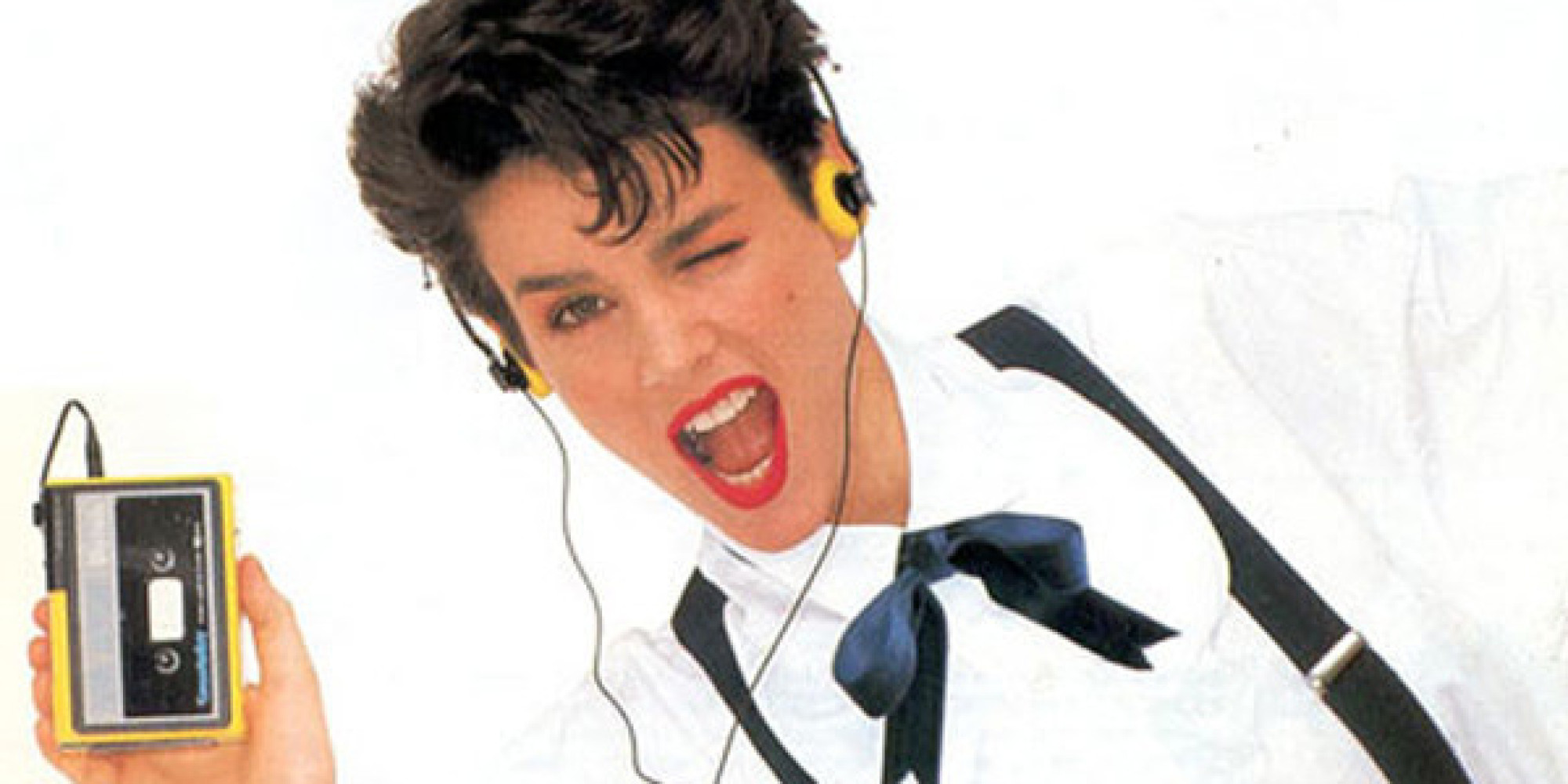
As you can see, people thought they were real cool when they had one of these.

In the 1990’s, the noise cancelling headphone came about, allowing people to have a new experience while listening to music. Instead of dealing with extra outside noise, people were now able to experience music where they did not have to deal with distractions other than the music itself. Originally, these headphones were designed for aviators as flights are very loud with out any sound reduction, however they soon began to produce them for the average person [4]. 

As headphones began to advance, out came the iPod and so began the era of portable music (in a much broader sense). In October of 2001, the iPod Classic was released, and depending on the number of gigabytes bought, could hold around 2,000 songs [5]. This was revolutionary as no other device had been able to store so many songs in such a small place. With this device, Apple also released small, in ear “earbuds” [5]. After this, the trend became for people to use smaller, in ear headphones that made it less obvious they were listening to music compared to the larger and clunkier over ear headphones [1]. Through out the years, this trend continued, and soon, even smaller headphones were created, such as wireless in-ear earbuds, which are so small that no one would be able to tell someone was listening to music with out getting a close look at their ear.

Apple’s new “Airpods” which are wireless in-ear earbuds.

For about the past hundred years, how people listen to music has changed drastically, and the ability for people to customize their playlists has improved drastically. Now, people have the option of playing music whenever and wherever they like without disrupting anyone else in the process. So, because of all of these innovations, hundreds of people are able to walk down the same street, not distract each other, and listen to completely different music while to someone just watching everyone, it would appear as if everything were silent.

  1. Newman, Mike. “The History of Headphones.” Cool Material. Accessed September 18, 2017. http://coolmaterial.com/roundup/history-of-headphones/.

2. “The History of Headphones.” Visual.ly. Accessed September 18, 2017. https://visual.ly/community/infographic/technology/history-headphones.

3. “Headphones: The Complete History.” Stuff. Accessed September 15, 2017. https://www.stuff.tv/features/headphones-complete-history/rise-walkman-1979-1990.

4. Denison, Caleb. “From Pilot to Passenger: A history of the noise-cancelling headphone.” Digital Trends. October 3, 2014. Accessed September 16, 2017. https://www.digitaltrends.com/home-theater/a-history-of-the-noise-cancelling-headphone-as-told-by-bose/.

5. Costello, Sam. “History of the iPod: From the first iPod to the iPod Classic.” Lifewire. September 22, 2016. Accessed September 16, 2017. https://www.lifewire.com/history-ipod-classic-original-2000732.
From Phonograph to the Digital Age of Music

Imagine walking through Times Square during rush hour and hearing not a single ounce of music around you. The electronic billboards are silent, the cars passing by are nothing but lifeless metal husks, stores feel drab with not a single catchy jingle, and people are agitatedly pacing the streets. Music does not exist in this bleak world with no way for it to stimulate the people who desperately need it. Dr. Syrigos, a historian, wrote, “Music coordinates emotions, helps important messages to be communicated, motivates people to identify with a group, and motivates individuals to support other group members.”[1] As humans, music occupies our everyday life and is transmitted to us whether we like it or not, and we have playback devices to thank for that. Everywhere you venture, there is some variety of music heard from a known or unknown source, acting as a stimulus. Times Square, as mentioned above, is a location of stimulus overload with billboards advertising products with vivid visuals and all too familiar jingles, and the bustling stores, playing your favorite tunes over the radio. Music players, like phones or MP3 players, are unconsciously used everyday to relay our favorite artists and groups to us, but have we ever thought of how these devices came to be?

Living in the modern age, listening to music is as easy as walking to the bathroom or looking up the latest and spiciest celebrity breakup on the internet. Modern playback devices are portable and are able to store a vast amount of music, all in pristine high quality. However, rewind to 1877 where music playback was in its infancy. Thomas Edison, a fledgling inventor, had just invented the phonograph, the first invention of its kind to record and playback music in one bulky package. To even record a sound on the phonograph required a weird amalgamation of items such as tin foil, a needle, a cylinder, and of course the mouth of the phonograph.

By shouting into the mouth of the phonograph, the needle inside of the cylinder would scribble the sound waves onto the tin foil and would allow for playback, albeit limited as the tin foil would eventually crumple.[2] The phonograph would evolve with time and reinvent itself as the turntable with records serving as the substitute of the cylinder and tin foil. However, the method of needles and grooves would remain. However, it stands that the phonograph allowed the common person to listen to music from the comfort of their own home.

Now, fast forward to 1979 where record players and radio were standard and were the primary sources of listening to music. Tapes were present at the time but were primarily for use in the car as it was more convenient and portable. Now, portable is a word many of us have blissfully experienced before but in 1979, music portability was scarce and almost nonexistent, that is until Sony released The Walkman. The Walkman is a playback device relying on cassette with several buttons functioning as start/stop, fast forward/rewind, and eject. Simple enough right? In actuality, The Walkman’s ability to play music from a cassette was not entirely special as it had been done before for use in journalism. However, the revolutionary addition of The Walkman stemmed from its portability and accessibility which had never been seen before: “Portability and privacy made it the ideal product for thousands of consumers looking for a compact portable stereo that they could take with them anywhere.”[3]

https://www.youtube.com/watch?v=lBqseObEt54

The only glaring weakness of The Walkman was its single capacity limit, which only allowed for one cassette to be inserted at a time. Flash forward to 2001 and this problem would be amended by a device which would revolutionize how we would listen to music for the last time in current history.

“Music is a part of everyone’s life, and because it’s a part of everyone’s life, it’s a very large target market all around the world. It knows no boundaries.”[4] In this quote, entrepreneur Steve Jobs understands the impact of music quite well, and would soon become a technological figurehead only few in history would achieve. Upon returning to Apple in 1997 after resigning in 1985, Jobs envisioned of a product which would forward the digital evolution of music in big strides. In 2001, the first generation of the iPod was released to the public and while it was highly criticized for its price, the innovation of having a device store thousands of songs was unparalleled.

The easy to use interface of the scroll wheel possessing basic functions also made the iPod more accessible than its competitors. Now, why is the iPod such a huge deal in digital music? When Apple had released the iPod in 2001, there were other digital MP3 players on the market previously. However, Apple’s flagship device was the first to usher in a sleek design as well as a simplistic structure and function, making it more appealing than its competitors. Through the years, the iPod would gradually evolve, introducing more internal space, features, designs, and would eventually cement its place in history as one of the most influential digital products to grace the 21st century.[5]

Looking back in history, it’s amazing to look at the progress playback devices have made. From the lack of portability and clunkiness of the Edison phonograph, to the portable yet limited Walkman, to the age of digital music with portability and ultimate accessibility. The strides made in music playback technology is a great technological marvel and thanks to those who made their contributions, music can be heard from the most bustling of cities to the silent confines of the country: music can be heard anywhere.

[1] http://www.ancient-origins.net/ancient-places-europe/origin-music-00972

[2] https://www.nps.gov/edis/learn/kidsyouth/the-phonograph.htm

[3] http://content.time.com/time/nation/article/0,8599,1907884,00.html

[4] https://www.cultofmac.com/124565/an-illustrated-history-of-the-ipod-and-its-massive-impact-ipod-10th-anniversary/

[5] https://www.lifewire.com/history-ipod-classic-original-2000732

Theremin: The World’s Spookiest Instrument

It is astonishing to think how interesting and perplexingly cool the theremin is and how very few people in the world know about its existence even when they have probably heard it somewhere. “In my experience, there are two kinds of people: those who are beguiled by the theremin and those who just haven’t heard of it yet. Because of the way it’s played – gestures, space – it fascinates instantly”  https://www.theguardian.com/music/2015/aug/22/invisible-instrument-theremin. 

To be honest, I didn’t know about it until a few years ago, when I stumbled upon this video of Clara Rockmore playing Saint-Saëns’s “The Swan” which literally looked like she was playing an invisible violin. The string-like sound is there, but it looks like she isn’t playing a particular instrument or even touching anything to that matter; she is playing air.

Leon Theremin (yes, that’s why the Theremin is called that) was a young Russian scientist who was working on a gas meter to measure densities. “‘Leon Theremin was an[n] . . . inventor of what is probably the most unusual musical instrument ever invented. You’re actually moving your two hands through two electromagnetic fields that are around two antennas. . . He was working in a laboratory in Russia as a young scientist, he was actually working on a gas meter to measure the density of gases,’ Glinsky said. ‘So as he brought his hand closer to the gas meter, he heard kind of a higher squeal. And as he brought his hand back to his body and away from the machine, it was a slower squeal’” https://www.cbsnews.com/news/the-theremin-a-strange-instrument-with-a-strange-history/ 

Then Leon started playing melodies on the device while his colleagues at the laboratory stared with amazement. This was the birth of one of the world’s first electronic instruments. The first model of the theremin used a foot pedal to control the volume and a switch to modify pitch. Later, in 1920, it became the mind-boggling instrument which requires zero contact of the performer with the instrument.

You are probably wondering how this thing even works, right? Basically, the first theremins were made up by circuits of vacuum tubes, coils, and wires which created electromagnetic fields around two antennae. By vibrating their fingers, players would raise or lower the pitch and volume. You can see why it is considered by many the world’s most difficult instrument. “A real theremin master can make an instrument soar with the fortissimo of Pavarotti or fade to the most delicate of whispers” http://electronics.howstuffworks.com/gadgets/audio-music/theremin3.htm 

It is really easy to merely produce gross squeaks and cries because only masters can produce the beautiful violin-like sound, like Clara Rockmore, who was actually one of Professor Theremin’s original students. She was an accomplished violinist who was forced to stop playing violin because of injury and therefore picked up the theremin and went on to become the world’s best thereminist. What a great example of how good things can come out of bad situations!

The 1920 theremin was shown at the Moscow Industrial Fair and picked up the interest from Vladimir Lenin, who actually took some lessons on it and commissioned 600 models to be toured around the Soviet Union. Later on, Leon Theremin left for the United States, where he performed at the Metropolitan Opera House as well as Carnegie Hall. He patented his invention in 1928 and its rights were quickly seized by RCA who distributed it during the 30’s. “The Theremin became known in the USA as a home ‘novelty instrument’ and featured in many film soundtracks of the 1940-50’s, it also appeared in several pop records of the 1960’s but never overcame its novelty appeal; used for effect rather than as a ‘serious instrument’, most recordings employ the Theremin as a substitute string instrument rather than exploiting the microtonal and pitch characteristics of the instrument” http://120years.net/the-thereminleon-termensoviet-union1922/ 

Some examples of media were it was used are: “The Green Hornet Radio Show” (1936), “The Day the Earth Stood Still” (1951), “The Flintstones,” “Batman,” and 2004’s “Hellboy.” You can hear it from yourself in the next video clip. The theremin comes in at 1:14.

Leon Theremin went on creating and invented other instruments, such as the “Terpsitone,” the “Rhythmicon,” and the “keyboard Theremin,” and even the “Electronic cello.” He later ended up eventually “disappearing” and returning to his home country. However, in 1954 in a basement in Queens, NY, a young Robert Moog was obsessed with theremins and began building them with his father. “It’s hard to imagine what the evolution of the synthesizer would have been without Leon Theremin. For one, it was Theremin’s invention that first captivated Robert Moog. Theremin kits were Dr. Moog’s first product and many would say, his first electronic instrumental love. That impact was significant, too, on a whole generation” (http://cdm.link/2015/09/read-article-bob-moog-wrote-met-leon-theremin/  Moog’s theremins went on to become the leading company for the instrument and they have sold more theremins than any other company in the last 57 years. What’s marvelous about all this is that Bob Moog is the man behind the Moog synthesizers, and there is no denying that the theremin was a great influence for this development. “Electronic music pioneer Robert Moog built theremins long before he built synthesizers. In the 1960’s, he produced such models as the wedge-shaped Vanguard theremin and the shoebox shaped Moog Melodia theremin. Today, Moog Music Inc. produces the popular Etherwave and Etherwave Plus theremins and kits as well as the new MIDI-enabled Theremini theremin.

Now that we have travelled through a brief history of the Theremin, we can see that is it actually a brief history of the technological advancements in electronic music over the last century. The discovery of the theremin and its technological innovation ended up being an inspiration for the creation of synthesizers, which are nowadays are incredibly popular and key for music production.


Carving out a Path for the Viola

When I first decided I wanted to play an instrument, I went to an instrument “try-out” day at my town’s local music store. I first tried out a flute, then a trumpet. Then I moved on to strings and picked up the violin. I remember that the sound of the bow against the strings was painful to my ears. A few minutes later, I walked over to my identical twin sister, who was smiling at what looked like a big violin. “Let me try!!!” I said, and I put the viola on my shoulder. I drew two bows on the D string, then two on the A string. Thinking, “OMG, I can already play Twinkle Twinkle Little Star”, I told my mom and sister that I wanted to play viola. My twin sister did too! As you can imagine we played a lot of viola duets over the next several years.

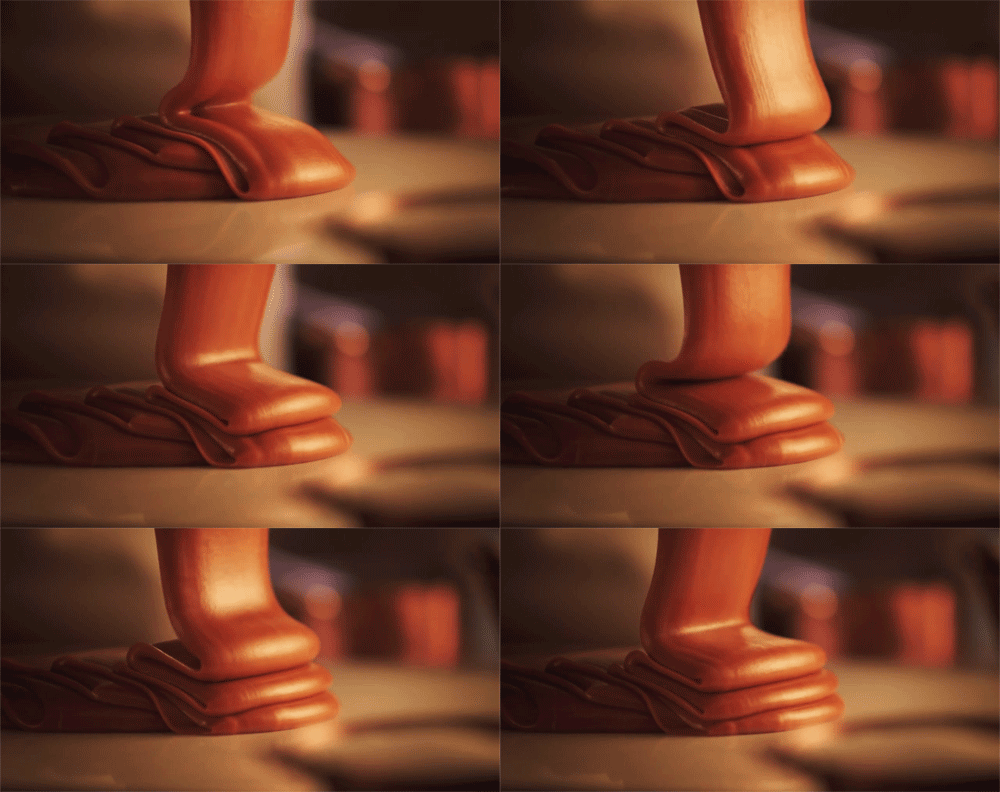
As a violist, I am used to the reputation this instrument has in the music world. In an orchestra, the viola plays a supportive role. Seldom receiving the melody, violists learn how to play harmony very well. When we received this blog post assignment, I knew I wanted to discuss the history of this instrument because there is a lot that goes untold (and unknown). Though, I am biased, I feel the viola’s importance should be projected. What other instrument sounds like caramel and chocolate when it’s played well?!

 Click to play

To emphasize this gif, here is a recording of one of my favorite pieces (and one that shows off that caramel sound of the viola). Just listen to the first 30 seconds- that’s all you’ll need.

Let us go back to sixteenth century Italy. The viola is a member of the violin family, but there is no clear answer to exactly when this instrument came to be. According to the Vienna Symphonic Library the role of the viola came defined when demands for instruments that would fill out a room with sound for Baroque Opera became necessary. String instruments were often made in different sizes with the same tuning, so when a need had to be met to split the registers and have another instrument played “da braccio”  or played on the arm, the viola was born.

Composers soon composed for sections to mimic the human voice (parts separated by bass, tenor, alto, and soprano registers). Naturally the viola falls into the alto category, and makers had to continually experiment to “find the optimal combination of tone, size, shape, and range to compliment the current trends in orchestra and court music” .

The viola is often misunderstood in terms of size because there is no standardized system for measurement. This makes the viola imperfect acoustically, because in order for the most amazing sound to be achieved, the body of the instrument would have to be huge (and therefore unplayable). Today there are many makers who experiment with string length and the size of the body to achieve the optimal effect. Usually, people with longer limbs and fingers play larger violas and vice versa.

A huge advance in the viola-making world came with the modern bow. Francois Tourte , a Frenchman, is often credited with many string instrument advances but the modern bow is especially important to violists. Because a viola responds less quickly because of the thicker strings, a modern bow allows for more tension between that hair and the strings. This means violists could actually project(!). Soon, the role of the viola became increasingly important in chamber music and the first solo pieces were composed for the instrument.

I encourage you to watch this TEDx talk specifically about the viola. This talk is great because there are frequent playing examples as well as great facts.

Today, there are many amazing solo violists who have created a beautiful new reputation for this instrument. Some of my favorites, including Kim Kashkashian, Nobuko Imai, Yuri Bashmet, etc. have inspired not only violists around the world, but also composers to write new and challenging works for this instrument. In the last decade new commissions and transcriptions have taken off, carving out a new path for this instrument. In this article by TimeOut New York, Steve Smith writes of new CD releases that deserve attention, honing in on many new contemporary works.

Past the viola jokes, I believe we gain a lot from understanding the technology of this instrument, and how it came to fruition. It is important to consider that instrument makers in the 16th century may have had some of the same musical concerns that instrument makers and composers have today, and that the means of creating music are constantly being improved upon.