
Always known to have a flair for the dramatic, Jaco Pastorius’ 1962 Fender Jazz bass was aptly named the Bass of Doom. Although no one except Jaco knows the origin of the name, as a fellow bassist, one theory I have is simply the awe and terror (of inferiority) instilled in other musicians who witnessed the combination of Jaco and the instrument while on stage.
EXHIBIT A (feat. The Bass of Doom):
Besides the ridiculous chops and musicality displayed in this performance (he flips the notion of people talking during a bass solo on its head), one of the most striking aspects of this video is the warm, fuzzy tone that Jaco produces. Electric basses typically have a defined low-end with precise pitches, such as all fretted instruments, but the distinguishing feature of the Bass of Doom is its’ fretless nature, allowing fluidity between pitches and Jaco’s ability to make the bass sing via vibrato. Legend goes that Jaco found the Jazz Bass for $90 at a pawnshop sometime around 1970 and decided to take out the frets with a butter knife and replace them with polished pieces of “plastic wood”, then finishing the fret(less)board with a few coatings of boat epoxy, thus creating the first fretless bass.
As is the case with many folk-heroes and tales though, these facts are widely disputed, with the possibility that Jaco’s bass may have already been fretless when he purchased the instrument. Not only is the origin story possibly fabricated, but there are also contradictions over the origin of the fretless bass that all come down to a person’s opinion on what defines a fretless bass rather than who was the first to invent the instrument. The following image is of Ampeg AUB and AEB basses made circa 1968, at least two years before Jaco’s “discovery”,and it is apparent that the inspiration for the bass’ design comes from the electric bass’ ancestor, the contrabass (which could be argued is THE original fretless).
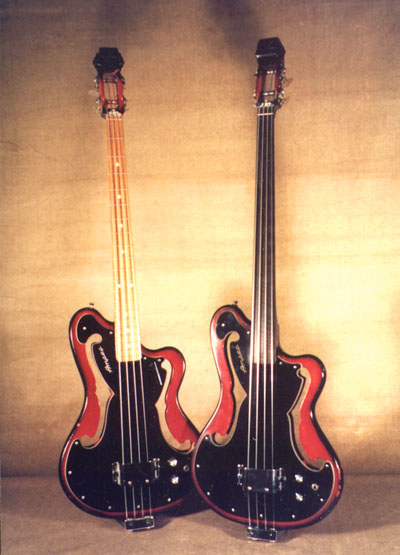
From the scroll-like headstock to the ebony fingerboard, both instruments look like and sound like a miniaturized version of an upright. Not only was Ampeg producing them around 1966, but according to Billy Wyman of Rolling Stones fame, “… I made a bass in 1961, before I joined the Stones, and it was a fretless bass. It was the first fretless bass ever made. I didn’t know that at the time, and I didn’t know that until 10 years ago. It predated fretless basses by about five or six years”. Rumor has it that the bass he had purchased was buzzing due to the frets so he decided to take them off. The issue here is that all we have to take for the validity of the claim is his word rather than recorded performances or videos of him with said makeshift bass. These differing origin points are where some debate comes in, as the Ampeg AUB and AEB are obviously derivative of upright basses, while Wyman’s choice was pragmatic in response to a functional issue but had no lasting impact. Jaco’s decision may have been a mixture of both due to his jazz background and influences and the questionable quality of pawnshop purchases, or it may have just been a stylistic quirk, the kinds of which he exhibited so often throughout his career. The main distinguishing factor when discussing any type of bass though is the tone, and any modern-day listener will instantly point to Jaco’s warbling, growling sonorities as the definitive fretless tone, even if it was not necessarily the “first” fretless, or a traditional fretless instrument.
As with so much of rock lore and history, stories are passed down via word of mouth for decades, resulting in tales that are irresistible but also sometimes easily refuted by the internet. While the anecdote about Jaco’s Bass of Doom being the original fretless may not be wholly true, it speaks volumes to how history is written, with the age-old adage of how the “victors” are the ones who write history. These conflicting origin stories pose some interesting questions about how the history of certain innovations is recorded. Does it matter who officially invented a technology if that person is hardly relevant to the cultural impact of said technology? Or, is it wrong to mythologize the origins of certain innovations if there’s an educational purpose behind it? While Jaco in many cases was no victor, in a sense, the history of the fretless electric bass begins and ends with him. Any person who performs on a fretless bass is instantly compared and contrasted with Jaco, similar to Michael Jordan’s shadow hanging over every single NBA superstar. The role of the fretless electric bass in any musical context is so entwined with Jaco’s legacy that even though the fretless had a precedent before the 70’s, it was Jaco and his eponymous debut album in 1976 that led instrument producers to market and produce these fretless instruments while also inspiring legions of bassists to pick them up in efforts to imitate him.
Further exploration:
Jaco Pastorius (Eponymous Debut Album)
Rick Danko (bassist for the Band, on left in yellow jacket) utilizing an Ampeg AMUB-1 Bass
Being a very classically oriented musician, this style of music is rather foreign to me, and the idea of a bass solo in a jazz chart gives me the urge to skip ahead forty five seconds or so… But this is super cool and totally present in the music which really makes it so much more interesting! As a trombonist I’m much more comfortable listening to the lower register of pitches, and hearing the fluidity of the sound Jaco gets out of the fretless bass is really striking to my ear. I recently heard Christian McBride at the Village Vanguard in NYC and he got a similar sound on his upright bass. Now I don’t really know anything about basses or bass pedagogy, but I can really see the appeal of the fretless bass. Also the idea of a fretless instrument resonates well with me as the trombone could in a sense be considered fretless. The slide has different harmonic series’ acting like strings, and each pitch is somewhere different on the slide. This is what helps the trombone achieve such effortless glissando and smoothness between natural slurs, something the fretless bass is also very good at. Overall really cool! I didn’t know that being fretless was such a big deal, but the differences do make a lot of sense to me know.