Round of Applause for Lady Gaga

There is no arguing that Lady Gaga takes her artistic ideas to the next level. Whether it be her fashion decisions, or her music videos, she is not easily missed. She showed up to an award show in a dress made entirely of meat cold cuts. She wears shoes that put her 12 inches above her normal height of 5’2’’, wigs of every color from platinum blonde,  jet black, and all the colors in between. Lady Gaga’s confidence to be a nonconformist and stay true to her views of art is what I believe makes her thrive in the industry. I cannot imagine what being a part of that pop music industry must be like, but there are certain trends within it that come and go but, I believe, that in some cases society adheres to. Lady Gaga introduced artistic ideas, both in her appearance and music videos and music which were new at the point that she entered and began to rise in the field. When given this assignment and reading through the prompt, Lady Gaga was the first to pop into my head. Honestly, it has been a while since I have listened to her music, as I find myself drawn to music that is of more a laid back feel. I wanted to write “calming” but I figured there are people out there who find upbeat music something that can calm them down.

After watching a few of her videos, I found that each one I watched were, obviously, very different. However, with all of the ones I watched, I thought: dark colors with pops of bright colors, scantily clad dancers and Lady Gaga, music video does not distract from the music itself, it just adds to it. I have seen some music videos in the past where the video content does not add to the music, but is just what I would have expected with a song. For example, videos which are just the song but in movie form, Taylor Swift’s videos from 2010 or so come to mind.

Lady Gaga’s video for “Applause” stuck out to me the most. I enjoyed the pops of colors that she incorporated in the video. Also, before she even starts singing, we already see eight shots of her, in four different outfits already. That’s 15 seconds, 8 shots, 4 outfits. You can tell the detail in which she and her producers/directors think through the video, second by second. She stays active throughout the video, dancing, or being suspended from the ceiling. Also, even when she is wearing very little clothing, the bra she is wearing is designed as a pair of hands, which makes sense as the song is called “Applause” but still, I think it is pretty creative. I think shots such as 1:13 are really cool when the background is black out and but she is wearing bright blush and yellow eyeshadow, which must have been enhanced digitally. But that goes to show how detailed this video is and how the editing process must have taken a lot of thought and precise work. Her choreography is very angular which fits well together with the beat and the abrupt cutting from one shot to another. One of the lines in the song is “art and pop culture and me”. I think this line really ties together Lady Gaga and her presence in this industry. And it goes beyond that as well, as she voices her opinions on political and societal issues.

It is clear that she has a strong influence on her fans as I could not find a single critique in the comments. And that was after scrolling for 5 or so minutes and I did not even get through all the comments. A few of the comments stood out to me, as many of them were about how she had reached 300 million views.

7 months ago, semar R wrote: “she’s definitely underrated. so authentic and beautiful. she’s a living work of art”.

Around the same time, Hanna D wrote: “this is ART.”

This came from Avatar Wan TV: “This music video is a masterpiece. It’s SO trippy, colorful, fresh, creative, original, artistic, etc. the list goes on. I just love how daring and experimental Lady Gaga is, not only in pop music, but in pop culture as well. I respect her dedication. I also heard she’s back in the studio working with RedOne again. She’s returning and I can’t wait.

claps claps claps”


I liked all of these comments because in an article about her in Rolling Stone Magazine, the author wrote, “The former Stefani Joanne Angelina Germanotta is on a mission: to prove that Lady Gaga is art and that her art is not a mask. It is her life,” (http://www.rollingstone.com/music/news/the-broken-heart-and-violent-fantasies-of-lady-gaga-20100708).


All in all, Lady Gaga has made and is making her mark in pop culture and this industry. She is going above and beyond and does not back down in using her voice and showing her artistic ideas.

https://www.google.com/search?biw=1279&bih=619&tbm=isch&sa=1&ei=asUdWtiDCqWXjwTs7Lm4AQ&q=lady+gaga+meat+dress&oq=lady+gaga+meat+dress&gs_l=psy-ab.3..0l10.3360.4646.0.4802.11.7.0.4.4.0.251.823.2j3j1.6.0….0…1c.1.64.psy-ab..1.10.835…0i67k1.0.NycdZPpUNnE#imgrc=4xyLyBHxOUdBYM:

LOS ANGELES, CA – SEPTEMBER 12: Singer Lady Gaga accepts the Video of the Year award onstage during the 2010 MTV Video Music Awards at NOKIA Theatre L.A. LIVE on September 12, 2010 in Los Angeles, California. (Photo by Kevin Winter/Getty Images)

Source List:

http://www.rollingstone.com/music/news/the-broken-heart-and-violent-fantasies-of-lady-gaga-20100708

http://mashable.com/2010/01/31/lady-gaga-social-fame/#2lSALztS9aqN

https://en.wikipedia.org/wiki/Lady_Gaga

https://www.ladygaga.com/


Bartoli’s Mission: A Modern Woman and Baroque Music

Cecilia Bartoli’s album, Mission, released in 2012, profiles the works of Agostino Steffani, a long forgotten baroque composer. This recording features some world premiere recordings of baroque fireworks by a woman who has referred to herself as, “the Indiana Jones of classical,  in an interview with All Things Considered host, Robert Siegel. In collaboration with EuroArts, a film was produced to follow this music and the life of the composer. This film acts as an extended music video, following a light plot but focusing mostly on the music and especially the period of the music. The opening aria, “Pìu non v’ascondo” from the opera Tassilone employs vocal fireworks while being set in Versailles, promoting a staunch take on the status of baroque music.

The film, Mission, was co-produced by Idéale Audience & ARTE France. The film opens following a priest-composer, a parallel to Steffani. Ms. Bartoli uses this imagery of the priest-composer as well on her album cover where she portrays the image of a bald man of the cloth holding a cross.

The film is  set at the Palace of Versailles, a strange choice for a film of the works of a composer who was strongly based in Italy. Additionally, there are no overt connections between Steffani and France, much less Versailles; he died soon after the second phase of expansion. Setting Mission in Versailles does not demonstrate an element of the composer’s life, but rather portrays the elaborate nature of baroque chamber music. Just as the ornate, almost gaudy stylings of the Palace of Versailles, baroque music is equally ornate and come with a hefty price tag. Most chamber pieces were written by court composers; Steffani was the court composer in Düsseldorf, which is where Tassilone premiered. This also demonstrates the elite nature of baroque chamber music; it was written for the royal court. This feeling of an ornateness and social elite is evident within Mission through its setting and design elements, but also parallels Steffani’s life through the inclusion of the priest-composer.

“Pìu non v’ascondo” comes from Steffani’s opera,Tassilone, a court opera following the life of the Bavarian prince, Tassilo III who opposed the Emperor Charlemagne. The aria translates to “I no longer miss it” and features flighty melismas. The original score calls for 2 oboes, bassoon, trumpet, strings, and basso continuo. Bartoli’s recording adds some percussion in the form of a tambourine and a recorder that add an extra light-heartedness to the recording. Cecilia Bartoli’s recording and filming of this aria mimics the bouncy nature of the piece through the cinematography and demeanor of the musicians. Bartoli captures the essence of a baroque royal in both her appearance in a silken green gown and her demeanor with proud smile and joyous, hopeful movement. The instrumentalists, I Barocchisti, mimic this demeanor as well, though they are not wearing courtly attire. The joyful nature of the piece is further cemented by the camera angles which mimic the movement of the piece in an almost dizzying effect. Midway through the aria, the camera switches from a pan to a pivot point movement which is very disconcerting to watch full screen but also captures the excitement of the musicians and the grandeur of the setting at the same time. Additionally, NPR argues that the piece ends with a “vocal wink” which Ms. Bartoli physicalizes in the filming. The camera angles and setting further demonstrate the joy and grandeur of baroque music which drew Ms. Bartoli to the Steffani project initially.

Mission was covered extensively by NPR and other broadcasting outlets, lauding the virtuosity of Ms. Bartoli and the originality of the project. The film similarly received very positive comments on YouTube shown by Mirtika Schultz’s comment, “This woman makes my ears so happy. Glorious talents. She’s been a fave of mine for many years….she’s not so young anymore, but she still makes the air dance.” For Mirtika, Bartoli’s talents transcend the video and makes the environment move with the music. Sólveig Sigmarsdóttir agrees, writing, “Cecilia proofs [sic] it once again, that  she is magnificence and inspire her fans with joyful and gorgeous performance. Bellissimo :).” The only negative comment I found was from MandO Marc and applies to the uploading of the video rather than the video or Ms. Bartoli’s performance, brilliantly penning the comment, “Thanks for putting video ads throughout the video so I can’t listen to songs uninterrupted. Reminds me of this time I took a shit in a mailbox.” Cecilia Bartoli’s performance and production of Mission reflect the music and aesthetic of Steffani’s time period through the setting, wardrobe, and cinematography.

Choreographing Classical Music: Ligeti’s 6 Bagatelles

When searching Google for György Ligeti’s 6 Bagatelles, the first video to pop up is the Carion Wind quintet playing the piece in an unusual music-video type setting. This performance includes heavy choreography, extensive use of camera angles, and almost comical interactions among the performers.

I think that this music video enhances the music itself, as the choreography attached to the performance matches the character of the music. In general, the interactions of the performers reflect and clarify the interactions of musical lines within the piece. For example, in the second movement of the piece, the performers file into a single line so that only the oboist is seen from the camera angle. The oboe begins the piece solo, and as other instruments enter, they step sideway into view of the camera. In the beginning of the third movement, the bassoon and clarinet have a quintuplet ostinato that is meant to sound independent of the free-flowing flute solo. In the video, the clarinetist and bassoonist stand in the back of the ensemble and make intense eye contact with each other while the flautist faces the camera. Likewise in the fourth movement, the flute soloist stands out in front to begin the piece, while the other four instruments form a separate quartet on the other side of the room. This adds something that a normal performance setting might lack; the choreography brings forth voice pairings and melodic conversations that may be missed, especially by a person new to this work. The camera angles and video editing also play a large role in this video. In the first movement alone, the frame changes on average once every five seconds. Its purpose is either to show the entire ensemble, or focus on a soloist or the interaction between a pair of performers.

As a comparison, here is a video of the same work performed in a traditional setting: five musician sitting in a semicircle with music stands.

In the comment section of this video, it was not hard to find contrasting opinions about the choreography. In fairness, the video demonstrates a blatantly planned combination of footwork and camera angles. There are only extremes in the choreography, not just conservatively memorized music. Two very simple yet contrasting comments are, “Amazingly done. The visual aspect of this video really helps represent their interpretation of [Ligeti’s] work. A great piece, with great players,” and, “Am I the only one who thinks the clowning distracts from the music? If I see someone goofing off, I’m going to assume the music is a joke as well.” While one user finds that the choreography is helpful in understanding the piece, another user labels it distracting. The solution in this particular case reveals itself in the fact that the quality of playing is extremely high, and thus the performance is extremely valuable. If one finds it distracting, they can simply not look at it. However, this video, in addition to providing a great performance of the work, provides an interesting and useful tool for understanding the music in a new way.

My favorite comment comes from one of the foremost authorities on 20th century classical music, the YouTube user “New Music Kitties.” This user states, “Unfortunately, by [supporting] this tasteless choreographic stunt… you are helping the worldwide loss of class metastasize in our society.  We are losing touch with basic aesthetic values of classical music… To the ensemble: don’t sell your talent and playing quality to banalities that will draw attention to your ensemble.  To the public: don’t buy into banalities and circus tricks!! In shorter terms: these are clowns.  Extremely talented, but nevertheless, clowns.  And in general, that makes this performance utter nauseating crap.”

Comments that decry choreography are based on a missed conception of the piece, composer, and probably classical music as a whole. Also some music lends itself more to these kind of performance options. Ligeti’s 6 Bagatelles, fitting into his generally quirky style of composition, is a relatively comical piece to begin with; its sharp contrast of voices and harmonies paint many sections as humorous. After all, according to the Grove Online Music Dictionary, a Bagatelle is “a trifle, a short piece of music in light vein.” Thus, I think this video and its extreme choreography do no disservice to the piece itself. I would even imagine that Ligeti would have liked this video.

As a testament to this ensembles sensitivity to the music in terms of their choice of choreograph and music video making, here is a performance of a different work, the Nielsen quintet. While they still interact with each other, they preserve the more serious and reserved nature of the music.

On a larger scale, this video and the reaction in the comments reveal a larger question: Is classical music suited for such interactive performances, specifically “music videos”? I think the utmost determining factor of any performance is the quality of music making. After that, I believe performers should feel free to perform in any manner as long as the intent is to clarify the music itself. The “seriousness” of classical music performance is something that was constructed in the first place; it is not inherently part of the music. Though there may be critics, untraditional performance videos like this appeal to a wider audience.


Smells Like Success: ‘Weird Al Yankovic’ and Musical Parody in the Age of MTV

Parody has long been an important device in music composition and production. Its form and purpose have changed drastically over the years from the parody masses of the late sixteenth century to the more humorous musical embellishments of Spike Jones and the silly lyrics of “Weird Al” Yankovic. In the last thirty years Yankovic has found unprecedented commercial success in parodying iconic pop and rock songs as well as their associated music videos. These multimedia masterpieces have held the public’s attention through fourteen studio albums, the latest of which reached the top spot on the U.S. charts. Yankovic’s success can in large part be attributed to his music’s accompanying fifty-four music videos, many of which mimic the music video of the original song.

One of his earlier parodies in particular, “Smells Like Nirvana”, effectively incorporates the music video as an additional element of parody. It closely copies the original Nirvana video to simultaneously provide additional continuity as well as make fun of some aspects of the alternative rock movement. The song, which parodies Nirvana’s “Smells Like Teen Spirit”, is also exceptionally effective. Rather than using the original tune as a vehicle to sing about an unrelated topic (as in his Michael Jackson parody, “Eat It”, or the Madonna rip-off, “Like A Surgeon”), Yankovic uses “Smells Like Nirvana” to playfully poke fun at the lack of clarity in Kurt Cobain’s diction. The overall effect results in some of Yankovic’s most compelling work.

The original Nirvana song, as described by Chuck Crisafulli in his book, is “a typically murky Cobain exploration of meaning and meaninglessness.” The song seems to be about some kind of cultural revolution but many of the lyrics are inherently contradictory and Kurt himself has indicated the song actually makes fun of the idea of having a revolution. The music video certainly supports the revolution hypothesis as it depicts an originally dispassionate crowd at a high school pep rally rise up into a frenzy and destroy the stage. Cobain’s incoherent vocal delivery coupled with the fact that the lyrics were not released in the original liner notes meant the the song grew to be very popular without anyone really being sure of the words. It’s not surprising then that it has been widely documented that Cobain often scribbled down the lyrics for a song in the studio just before the band would record. This, of course, provides the basis for “Weird Al’s” parody.


Yankovic’s video is almost a shot for shot recreation of Nirvana’s and he takes the lead role of playing Kurt. “Weird Al” even went so far as shoot the video on the same set and with many of the same actors! The song doesn’t mess around, making fun of Cobain’s vocal delivery from the start (lyrics). The first verse begins, “What is this song all about/Can’t figure any lyrics out” and it doesn’t let up with “Now I’m mumblin’, and I’m screamin’/And I don’t know what I’m singin’”. The video also embraces the silliness from the outset with the janitor (the same guy from the original Nirvana video) pulling a donut out of his mop bucket. This could be a reference to some of Yankovic’s earlier successful food related parodies (in fact when originally asked for permission to make the parody, Cobain asked if it would be about food). The video reaches a climax at about 2:12 when Yankovic imitates the guitar solo by gargling water in his mouth. This is followed by the audience of high schoolers continuing the solo in unison kazoo before the final phrase is played by the janitor on the tuba. “Weird Al” doesn’t let up in third verse with the lyrics, “And I forgot the next verse/Oh, well, I guess it pays to rehearse” and he takes one final shot at the screaming alternative rock style by finishing the song in a coughing fit.

Cover for “Weird Al’s” single “Smells Like Nirvana”

Yankovic’s silly lyrics and skillfully accurate musical recreations of popular songs have guided him into the public eye. The combination of parody in both lyrics and music video is what has allowed him to stay for decades. This much can be seen in the Youtube comments: “Tony R” comments on all the things they find “hilarious” in the video including the “Guy with ‘This space for rent’ written on the back of his head” and the “Man on fire during gargling solo”.  While I’m sure Tony likes the song too, what keeps them coming back for more is the video. Another commenter, “Super Nintendo Chalmers”, fondly remembers “ALtv”, a show on MTV in which “Weird Al” himself hosted a “3 hour block”of his parody videos. Yet another commenter sums it all up in their fierce defense of Yankovic’s talent in raving, “Heck just LOOK at this video.” It is clear “Weird Al’s” immense success is owed at least in part to his ability to produce and distribute equally wacky parody videos with his songs.

The ubiquity of music videos in today’s music industry and their accessibility through Youtube sometimes concerns me. These days it often seems that artists put more time into their music videos than into the songs that accompany them! One would think this is contributing to the decline in quality of popular music. “Weird Al”, however, gives me hope that music videos can be used effectively to compliment the music. His ability to incorporate parody into both the lyrics and video, especially as seen in “Smells Like Nirvana”, is inspiring.


Sia’s Controversial Music Video

Music videos can serve as one of the many platforms where artists can further express their passion. They can give music more meaning and depth and create a more clear image for their listeners.

One perfect example of this would be Sia’s “Elastic Heart” Music Video.

This music video features dancer, Maddie Ziegler, and actor Shia Labeouf, interpretive dancing throughout the music video, as opposing characters. These two characters represent the fight between past and present personalities and maturity. The past represented by Maddie Ziegler and the present by Shia Labeouf.


This is also not the first time Sia fans have seen Maddie Ziegler. The reason the image of Maddie fighting Shia Labeouf was so strong was because prior to “Elastic Heart,” Maddie was in the music video for “Chandelier,” another Sia song. Again, she represented a part of Sia’s personality or alter ego in that she was messy, and out of control.

In “Elastic Heart,” Sia faced controversy, where many people felt a sense of pedophilia from the music video.


Sia promptly answers these feelings in a tweet, where her art was mistaken and that her intentions were not to offend anyone.

Sia even gets negative responses from websites where she is questioned for ignoring the pedophiliac nuances in the video and is seen as having disturbing music videos.

Because Sia added interpretive dance in her music video, a different form of art was in use while also expressing her own. She was able to capture us with our ears, eyes and emotions. Aurally, “Elastic Heart” embraces an electropop beat with an impressive vocal line. Visually, Shia Labeouf and Maddie Ziegler’s dirty, disheveled look with nude leotards is striking to the eye as unique and bold, not to mention the animalistic interpretive dancing that adds to the intensity. At first listen, one would not think of such a vulgar interpretive dance to go with this electropop song, but in conjunction with the lyrics, it makes perfect sense. Emotionally, the music video tugs at your heartstrings because of the contrast of child to adult. The difference in age difference shows a clear difference in maturity. Maddie represents a naive, young self while Shia represents thicker skin, and a stronger self.

While browsing through the comment section, I was able to find a few very interesting comments.

First, Elaine Walton says, “There is nothing wrong with the video, however, there is something very much wrong with the world. Because pedophilia is so ramped, a 28-year-old man and a 12-year-old girl can’t do an interpretive dance together without eyebrows being raised. That’s pretty sad. There is nothing sexual about this.”

In general, many of the commenters were having a hard time seeing the art when all they saw was pedophilia, simply because a man danced with a young girl. This seemed to create an uproar among the music video, creating less conversation about the music video itself.

Another interesting comment would be by Jolie Hoffield. “This video never fails to bring tears to my eyes. I symbolise the cage as alcoholism and Maddie and Shia are daughter and father. Their relationship began rocky, but slowly mended itself. She managed to escape the addiction, he didn’t.
As a daughter of a recovering alcoholic, this video hits me hard. Might be silly to some, but meaningful to others.” Although many comments joked about Labeouf’s muscles, other commenters talked about how they were personally touched by this video. Because of how open ended this video was, the audience was able to take it in whatever way they wanted, making it personal for many different people.

Lastly, Colourishous MSP, commented, “good song, weird video <3.” It often enhanced the music for people who understood the artistry in the video while it distracted from the people who did not.

Bibliography:

http://www.elle.com/culture/celebrities/interviews/a25311/maddie-ziegler-shia-labeouf-warned-me/

https://vigilantcitizen.com/musicbusiness/disturbing-message-behind-sias-videos-chandelier-elastic-heart-big-girls-cry/

http://www.rollingstone.com/music/news/sia-apologizes-for-controversial-elastic-heart-video-with-shia-labeouf-20150108


The performance of silence

My friends and I always make fun about playing John Cage’s 4’ 33” for the recitals, but unfortunately, none of us have done it so far. It seems that 4’ 33” is the easiest piece to play, and the musicians do not have to practice before the performance since the whole piece is filled with tacet. Also somehow, we do not hear 4’ 33” very often in the concerts, even though it is a very well-known music repertoire by John Cage. At least, I haven’t heard any live performance for this piece.

John Cage is a leading American composer in “chance” music area/music in indeterminacy, and he composed his famous “silent” piece 4’ 33” in 1952. David Tudor played the world premiere of the piece on the piano, and he sat in front of the piano, closed the lid during the movements and set the timing for each movement—the first movement is 33’’, the second movement is 2’ 40’’ and the third movement is 1’ 20’’. After the last movement, David Tudor closed the lid and walked off the stage. Overall, it was a very formal and serious performance.

Many years ago, I also imagined how I would perform John Cage’s 4’ 33” on the piano, and I thought the only thing I needed to do is to not play any note. However, after I watched a lot of videos of this piece, I got shocked by different interpretations from various musicians besides just being silent for four minutes and thirty three seconds. The video performed by Japanese Orchestra—K2Orch—is one of the greatest performance on Youtube, and I think it is an amazing live performance with a violin soloist that I can find online for 4’ 33”. As we know, the performance can’t be totally silent since every sound and noise from the audience and the natural environment is enlarged at the moment. Thus, what happened to the performance of 4’ 33” by K2Orch?

The soloist started to walk on the stage first and the conductor—Yusuke Ichihara—walked after her, and the audiences were keeping clapping when they were walking. I am not sure if the audiences already had the background knowledge of the piece or they already heard the piece before, but I can tell the applause showed their generous welcome. After all the greetings between the conductor and the concertmaster, the conductor and the soloist and so on, the orchestra sat down and the soloist began to tune the violin. Until now, all the processes were same as other music repertoires. After the soloist tuned her instrument, she gave the nod to the conductor to inform him that she was ready. The conductor gave the prep and the down beat, and then the “silent” music started. Thirty three seconds later, the conductor gave the cutoff, and it showed the end of the first movement. Then, the instrumentalists and the conductor took a few seconds break before the second movement started. No one clapped during this time, and it just seems that all the audiences knew 4’ 33” is a three movements piece.

After the conductor gave the prep and the down beat again, the second movement began formally. However, it is very clear that the second movement is a slow movement and it might be adagio because the conductor gave the softer, slower and more smooth prep than the first movement. Two minutes and forty seconds later, the conductor gave a very beautiful cutoff and the release—the second movement was done. Same as taking few seconds break between the first movement and the second movement, after the very short break, the third movement began. I know the last movement is allegro and the dynamic probably should be forte, since the prep from the conductor was more powerful, faster and stronger. After a minute and twenty seconds and the cutoff from the conductor, the whole piece was over. The audiences clapped loudly, and the applause presented that they really enjoyed the performance.

I had to say K2Orch did a fantastic job on this piece. I timed the durations for each movement when they were performing, and all three movements are finished perfectly on time. Actually, stoping on time is not easy to do, even though the players use the watch to keep the time. For example, the performance of William Marx,

he played the first movement as 30’’, instead of 33’’, the second movement was 2’ 23’’, rather than 2’ 40’’, and the last movement was 1’ 40’’, though John Cage wrote 1’ 20’’. Also, the Japanese audiences showed their high respectful for the performers in the video. It is very obvious that they were trying to be very quiet and to not make any noise until the short breaks between the movements—the audiences coughed and moved, even though there was a baby kept crying during the movements. But, since it is a recording of the live, I also can clearly hear the frequency/noise from the recording equipments. Therefore, the “silent” music is not absolutely silent.

If I have to give one suggestion to the performance, I would say maybe the players can be in the performing positions, such as putting or holding their instruments up. So the conductor would not be the only person showing the status of the performance, but also the instrumentalists. Interestingly, this is how the EBU Euroradio Orchestra performed John Cage’s 4’ 33”. 

Reading through the comments of the video by K2Orch, many of them are funny, ironic and casual, even though the performance is formal and fabulous. For example, “The second violin sounded a little out of tune to me”, “I’m 18 and it took 30 years for me to master this song”, “and people pay to hear this”, “Do you think they rehearsed the piece!”, “Excellent performance, though I still prefer the Berliner philharmoniker one with Claudio Abaddo. If anyone has it, please post.”

In my opinion, there are three reasons caused these comments and reactions from the most audiences. Firstly, during the real performance, the ideal meaning of being silent always conflicts with the inevitable noise, and a lot of time people think 4’ 33” is a joke because of those unexpected noise, though it is not. Secondly, the function of the composer being more vague in “chance” music, and unusually, the audiences get involved in the compositional process. Finally, the lack of programme-notes or background stories make the audiences hardly to understand the music. For instance, in John Cage’s book Silence (cited from Music imagination and culture by Nicholas Cook, page 11), he explained his imagination of 4’ 33” and the third movement is in A-B-A form.

John Cage said, “The most important piece is my silent piece.” And it is true that we can hear his philosophic thinking in 4’ 33”—music as indeterminacy. Being one of the wonderful recording, K2Orch presents high quality of the performance and the real and live reactions from the audiences. Since John Cage believes Zen Buddhism and uses I Ching (Taoism), I believe that he might also want to explain the idea of “nothing means something/silence is not silent” in his music, besides “everything is natural and random”.

Andra Day’s “Strange Fruit”

The combination of a beautiful sunset and a Mozart string quartet can bring out emotions we feel in the depths of our soul. A sappy love scene combined with a cheesy romantic melody can make us cry. When moving images are connected with meaningful music, the two have an incredibly powerful effect on the listener and leave a deep impact. What happens when video is combined with a song that is almost too painful to listen to?

Andra Day recently covered and recorded Billie Holiday’s Strange Fruit. The song was originally released in 1939 in response to a photo of three black men unfairly lynched in Indiana. The powerful lyrics reached millions of people at the time and played an important role in the development of the Civil Rights Movement. In 1999 the song was named song of the century by Time magazine and has been incorporated in many popular songs.

Strange Fruit has been performed in honor and remembrance of lynched victims, but few music videos have been made. Putting a video to such an emotionally heavy song is not something many decide to take on. The lyrics are as follows: 

Southern trees bear a strange fruit,
Blood on the leaves and blood at the root,
Black body swinging in the Southern breeze,
Strange fruit hanging from the poplar trees.

Pastoral scene of the gallant South,
The bulging eyes and the twisted mouth,
Scent of magnolia sweet and fresh,
And the sudden smell of burning flesh!

Here is a fruit for the crows to pluck,
For the rain to gather, for the wind to suck,
For the sun to rot, for a tree to drop,
Here is a strange and bitter crop.

What makes Andra Day’s video special is the the video combined with sound effects and music. The opening scene of the music video gives a brief history of the lynchings in America and includes a sunset with the outdoor sounds of bugs and wind. This creates a chilling atmosphere and is enhanced by the sound of wood cracking due to the swinging of a rope. It’s almost as if the listener is taken to the night of the Indiana lynchings. As the music starts, the swinging rope effect continues and the sound of gasped breathing is added. Before Andra Day even appears or starts singing the dark lyrics, the listener is able to understand that this is not a light song.

As Andra Day starts singing, the sunset turns into a spotlight and the viewer almost feels as if they are in the vocalist’s shoes.


This spotlight may reference Billie Holiday’s performances of this song in the 1940s, as a single spotlight always shown or her face throughout each performance of Strange Fruit. One source stated the following, Because of the poignancy of the song, Josephson drew up some rules: Holiday would close with it; the waiters would stop all service in advance; the room would be in darkness except for a spotlight on Holiday’s face; and there would be no encore. During the musical introduction, Holiday would stand with her eyes closed, as if she were evoking a prayer.” 

The constant change between the spotlight on Andra and the sun shining through the leaves gives tribute not only to the lynching victims but also to Billie Holiday and the difficulties she faced as an African American throughout the Civil Rights Movement. 

As the video continues the listener is able to see that Andra Day is wearing broken handcuffs. This is significant as we see a symbol of the injustice African Americans faced and are reminded that racism in America is still an issue.

Finally, the viewer is able to see images of the camera angle pointed up at branches and Andra Day looking into the air, almost as if she is painfully looking up as she is remembering the victims of the lynching.

This video has the ability to speak to anyone that watches it. The comments listed below show that the filming and performance of this song have an emotional depth that cannot be felt with video or music alone.

When music and video are put together, both create a visual and emotional experience that is essential to the understanding of this song. Because of the heart-wrenching shots combined with Andra Day’s chilling voice, this music video gave “Strange Fruit” the depth and meaning it deserves.

https://www.npr.org/2012/09/05/158933012/the-strange-story-of-the-man-behind-strange-fruit

http://www.billieholiday.com/portfolio/strange-fruit/

Banking on Taboo

Content Warning: Blackface, explicit language and images


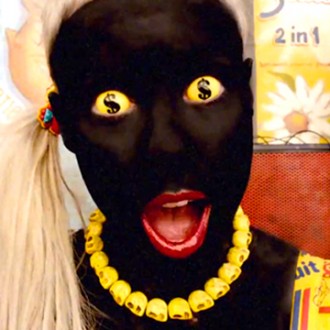
Die Antwoord is a South African rap-rave group that has garnered fame for their provocative, aggressive style and unique vocal sound. In 2012, their music video “Fatty Boom Boom” inspired controversy because of their use of blackface bodypaint and shocking content. The reception of the video, and of the group in general, has been bitterly divided.

This article by Aisha Harris directly condemns Die Antwoord’s use of blackface in their music video and raises other concerns about their video. Since blackface minstrelsy is a cultural vestige of slavery in both America and South Africa, this video’s flippant use of blackface imagery is totally unjustified. On the other hand, Harris also mentions that minstrelsy has become a cultural symbol of progress for black people in South Africa after Apartheid. Annually there is a giant festival called “Tweede nuwe jaar” where a multitude of minstrel troupes celebrate together in a colorful display of costumes, body paint, and music.

An article on South African History Online says that: “as one of the longest surviving traditions it has become very evident that the minstrel festival is an important aspect of South Africa’s history and cultural heritage… It is therefore important to maintain the tradition, which has become so deeply entrenched within the popular culture of Cape Town.”

This almost seems like a cogent argument as to why it’s normal that Yo-landi Vi$$er donned a full-body outfit of black paint, until we remember that a group of black South Africans wearing pink and purple, etc, from head to toe and celebrating overcoming slavery and Apartheid is a lot different than a white person dressing in blackface in a music video.

What you-tuber Mayfinder might not realize is that “African” is not homogeneous. In contrast, Adam Haupt argues that Die Antwoord is doing nothing short of culturally appropriating black South African culture. In this article he says: “It is ironic that Jones, the crew’s founding member, is neither coloured nor white Afrikaans working class; rather, he is a well-resourced white, English-speaking South African.” To clarify, the Afrikaans language is associated with poor, uneducated people, while English is the more official and elite language in South Africa. So, we can conclude that their performing persona is not genuine and it is built off an existing culture that they will never be part of.

Okay, now that you’re primed on the racially exploitive elements of the video, let’s take a look and see what you think! Are these artists just being sensationalist and intentionally treading on open wounds? or is there a compelling artistic vision or critique that makes these images powerful and meaningful?

The first minute of the video actually strikes me as a commentary against the mainstream stereotypes and voyeuristic attitudes towards Africa. The tour guide’s monologue and the inclusion of docile safari animals presents an absurd image of an unrealistic place, which is perhaps part of their attack against Lady Gaga, who also embraces sensationalism.

The next three minutes is a fast-paced visual spectacle that enhances the intensity of the music with its quick camera cuts that change the size of the frame and its high energy dance moves. These scenes also rapidly move between color blocks – basically alternating between high contrast bright colors and white body paint to the “voo-doo room” (as they call it in an interview) that is all black and features semi-reflective costumes made of human hair.

Their diss of Gaga in this video – both with the prawn in her vagina and her tragic encounter with the king of the concrete jungle – seems to be a major media-grab. And it bolsters their position as “radically unique” and as a more niche and interesting music than most pop, which they continually drag through the mud in the lyrics of this song.

This video shows a different side of the creative process and explains how they got to the finished product.

While this video succeeds in making the members of Die Antwoord seem more human, engaged, and less sensationalist, I am still skeptical about whether or not this is a continued marketing ploy. Elements of satire in their videos make me question to what extent they are playing an artificial persona or wether their goal is just to embrace the child-like absurdity and freedom that their irregular dancing and graffiti suggests. Whatever cultural impact Die Antwoord’s complicated, racialized, sensational music videos have on the US and South Africa, they’re a hit and here to stay. 

KENZO World- The Ultimate Collaboration

“The eye is both feminine and powerful”


When creating a fragrance, many marketers will brand it with a certain celebrity or word, so the person buying it can feel associated with that in order to empower themselves to feel like they are one in the same as their new and powerful scent. A combination of a single word with a gorgeous celebrity and the scent of sandalwood lilac can cause mass amounts of people to flock to their nearest mall and go crazy. The smell of David Beckham is one thing, but what happens when you add the talents of fashion (Carol Lim and Humberto Leon), choreography (Ryan Huffington– choreographer of the Chandelier music video & Margaret Qualley), Spike Jones, and the song ‘Mutant Brain (ft Assassin)’?  All while referencing the earlier posted video by Fatboy Slim?????

You get KENZO World- The New Fragrance.

https://www.youtube.com/watch?v=ABz2m0olmPg

This video itself is a modern day musical text painting that reflects the description of the perfume itself.

“KENZO WORLD reveals a new definition of femininity with its new perfume. This intense eau de parfum reveals the essence of a strong, bold, determined woman. In her image, Francis Kurkdjian and Maïa Lernout revisit the KENZO WORLD floral bouquet with addictively velvety black plum, sparkling peony and jasmine, and indulgent vanilla. A gourmet fragrance for any woman who dares to be herself. KENZO WORLD, an intense eau de parfum, reveals your power.”

This entire video is a redefinition of femininity. It begins with a woman leaving a fancy social event to grab a breath of fresh air, only to be able to let herself go from her mental societal constructs of who she is supposed to be and allow herself to have an explosion of expression in an unconventional way. This immediate change in mentality is shown in the introduction of the music, which itself has intense beat from the music of Ape Drums (an American DJ known for combining electro-dance music with Caribbean sounds/music). As she begins to let go, you see a sense of freedom on her face that shows her beginning to define herself. The idea of a constructed society is then shown with her interaction with the statue head. As she is moving around, she goes to the statue head and yells at it, which would have been considered absolutely improper of a scene like the one she was in a little while ago.

Spike Jones continues to show this idea of releasing your inner self beautifully throughout the rest of the video, showing the woman go between trying to keep herself bound to what she believes to be the “proper way” (for instance when she is trying to control her arm from moving about spastically) and allowing her to feel the freedom of breaking away from it (when she jumps through the eye and beats her chest while shouting).


This whole work of art greatly relates to the discussion of music and politics in the 20th C. The work is showing the breaking away from typical society in a setting that is totally unexpected, and does so so beautifully that it leaves a lasting impression on the viewer.

“I love this publicity cause it shows the woman by a really different way than the others publicities of fragrance. It shows the liberty and the power of women”

-Saku123 (youtube user)

In class we have talked a lot about collaborations of works, and works that are related to/make us think of real world experiences (like music for airports), but present them in a way in which they force the observer/listener to question the meaning of the work itself and the motives behind that. KENZO World does that above and beyond any other modern collaboration I have seen, and I believe works like this set a huge influence on the future of art and politics.


The Last of Us: Blend between Music and Screen

When I was younger, I remember the thrill of playing video games with my brother to see who would get the highest score, who could get the farthest, or who was just overall better at the game. Today, while these elements of competitive drive still resides within the medium, the evolution of the video game is astounding. Just a decade or more ago, video games used to be viewed through a very specific lens by the general public as being a type of “nerd culture” that possessed no grounded place in the entertainment market. However, much like the Marvel Cinematic Universe, video games have become accepted by the public and has transformed into a mainstream form of entertainment. Now, why is this?

The evolution and growing success of video games can be attributed to the sense of immersion one can receive. Image, sound, and most importantly music, come together to create a multisensory experience not easily attainable in other forms of entertainment. In 2013, American video game company Naughty Dog released the PlayStation 4 exclusive title, The Last of Us, which has been regarded by critics to be a masterpiece in the medium. The title’s intense action and survival horror elements created a beautifully executed atmosphere not seen in other titles but what elevated it further was the incredible compositional works by Gustavo Santaolalla.

One of the most incredible aspects of Santaolalla’s compositions is that even though they are categorized as “minimalist”, there’s an incredible amount of meaning put into each texture and note. During the production of the soundtrack, Santaolalla experimented with an incredible amount of different instruments to see which ones captured the atmosphere of the game and then recorded them to see how they blended with one another. Also by collaborating with Neil Druckmann, the game’s creative director, Santaolalla was able to create music with a great deal of creative freedom, allowing for a soundtrack that helped to further strengthen the connection between the player and game.

Santaolalla’s compositional style not only reflects the atmosphere present within the game, but is also able to invoke an incredible amount of emotion without any context but with it, a whole new level of immersion is introduced. In a documentary with Santaolalla concerning the game’s soundtrack he says,

“The most important thing that makes The Last of Us what it is, is that it’s a very different project than other projects with more emotional content, with more emotional connection between the players and the characters.”(3:22)


One scene to further strengthen Santaolalla’s point is the reaction of Druckmann, during a very particular moment in the prologue (47:26 in this documentary). In the scene, linked here, the player narrowly avoids the chaos of a viral outbreak all the while protecting the protagonist’s daughter from danger throughout the entire prologue. The player’s actions are for naught however and the daughter is shot, resulting in her death. It is important to note that the first connection the player receives in the game is the father-daughter bond that is established within the first few minutes of the prologue. Due to the authentic relationship between the two, the player has the desire to make sure that not only the protagonist survives but the daughter as well.  These string of events culminated an extremely powerful and effective emotional impact and with the soundtrack at the forefront, not even Druckmann himself was able to leave unscathed from the balance between scene and music. During the father’s lament at his daughter’s passing, the use of strings and solo cello was an excellent way for Santaolalla to convey the despair to the player and the transition to the main theme was a fantastic way to dense the texture to reflect the chaotic nature of the plot.

The Last of Us is a masterpiece of a game, telling a story through visceral gameplay and immersive soundtrack. The passion Naughty Dog placed into the game can be wholeheartedly felt and the care Gustavo Santaolalla placed into the music is astounding, even more so after learning his history in music. The combined efforts of creating an unforgettable piece of entertainment are certainly present and showcases just how far video games have come since the late 1900’s. To end, here are the words of Bruce Straley, the game’s director:

“We feel that the interactive medium has an untapped potential to touch the feelings of the player. You have that connectivity, the fact that I am actually in the world and participating in what’s happening on the screen in front of me gives us some sort of advantage to make you feel connected with what’s actually happening.”

                                             –Grounded: The making of The Last of Us (6:34)


[1] https://en.wikipedia.org/wiki/Marvel_Cinematic_Universe

[2] https://www.naughtydog.com/company

[3] https://en.wikipedia.org/wiki/Gustavo_Santaolalla

[4] https://www.youtube.com/watch?v=Ejdjcun2Jo4

[5] https://youtu.be/R0l7LzC_h8I?t=2846

[6] https://youtu.be/s3_cP_jJ-9w?t=725