Just Play Along!

Every living jazz musician has had to contend at some point or another with the idea of using a play-along track. For those who aren’t familiar, this is an audio track consisting of rhythm section instruments (most commonly drum set, string bass and either piano or guitar) playing behind an imaginary soloist. Jazz musicians use them to practice when they have no live rhythm section of their own to play with. The musicians who record the track (except in cases where the track is computer-generated) simply play the chord progression of a familiar tune together for anywhere from two to ten minutes, and the consumer at home can use it to pretend they’re playing with real people while they practice this tune. Here is what one of these tracks sounds like:

Perhaps to the untrained ear this just sounds like normal jazz music, but to a jazz musician it sounds like something is missing – what’s missing is you, the soloist who needs to practice Giant Steps. So how did this strange, anonymous musical collaboration come to be? How did this sort of virtual reality become the norm for aspiring students of jazz music?

50 years ago (roughly half the amount of time jazz as we know it has existed) a young saxophonist named Jamey Aebersold stumbled into one of the most prominent tools in jazz education (an educational field virtually nonexistent at this time). Seemingly without realizing it, he launched the Jamey Aebersold Play-Along Series after students at a summer camp requested that he make them a recording of piano accompaniment for a few standard jazz tunes. You can read about how this series took off unexpectedly and became one of the most recognizable volumes in jazz music here.  For more from Aebersold himself on jazz education, which itself as a technology has only been around for half a century, you can check out his article “Music is for Life“.

Fast forward to today: Learn Jazz Standards is a free online resource with literally hundreds of videos including backing tracks and podcasts about common jazz education topics like tune-learning and improvisation techniques. This page gives you a good idea of the sheer volume of content they have available.  Apps like iReal and Drumgenius offer a seemingly endless array of customizable backing tracks for anyone with a mobile device.  This is a remarkable difference from Aebersold’s earliest tracks, which were recorded in his basement studio and sold in an LP format with an attached book of lead sheets. (For reference, this is a lead sheet, or simple statement of the main theme of a tune with the basic underlying harmony, to be expanded upon by improvising jazz musicians. This is the sheet music the players from the above video would be looking at. Giant Steps) 

Of course, there is disagreement among jazz players and educators over the merit of playing with pre-recorded tracks. Some say this detracts from the spontaneous and improvisational spirit of the music, training the student to treat rhythm section players like a static background drone instead of living, constantly improvising musicians. Kelly Rossum, professor of trumpet and jazz studies and Christopher Newport University insists that his students play with real jazz recordings with interacting musicians instead of backing tracks, even if it means the student plays over John Coltrane’s saxophone solo. On the other hand, many insist that playing with tracks is the only way to develop one’s aural skills as an improviser, as practicing alone or with a metronome doesn’t give one a sense of the form and harmony of a jazz standard, and playing over another soloist is not indicative of real playing situations. Others see the tracks as a sort of unique challenge: Bill Dobbins, professor of jazz composition and arranging at Eastman says of the tracks’ repetitive nature: “Some people complain that when they’ve played with a track a few times, they know exactly what’s coming. Well, you should use that to your advantage. Get creative with it!”

Play-along tracks have undoubtedly made great strides since they first came about in the 1960’s. As a technology they have clearly made a seamless transition into the digital age through the internet and mobile technology, and as a tool of jazz education they have at the very least become ubiquitous enough to warrant specific opinions from jazz pedagogues. In any case, backing tracks are out their for students of all ages to use, for better or for worse…

Violin and Technology

Last week I sat in Kodak Hall as one of my childhood violin heroes played on stage. I couldn’t understand how he was able to produce such a large and beautiful sound that seemed to rip the heart out of my chest. I began to think about how this violinist produced such a large sound and the reason for it. What kind of violin did he have, and what was particularly special about his violin? What went into making it? How did a piece of wood from a tree became a small box that creates beautiful sounds?

There is a belief that orchestral musical instruments are far from any type of technology, but instruments and the process of making them requires more technology than one may think. For example, a tree must be cut down, the wood dried, and then imported to whichever part of the world the violin maker is in. If not already aged, the wood must then be seasoned before luthiers begin their work. Some violin makers require their wood to be seasoned for a minimum of fifteen years. Below is a violin maker with a piece of wood he has been naturally drying and aging for many years.

Once the wood is aged, luthiers are able to begin their work. The first step is the bending of the ribs or outer frame. This requires a bending iron and water in order to bend the wood efficiently. The bending iron temperature should range between 200 and 250 degrees Celsius but other factors apply. These include the type of wood being used and the exact temperature it needs in order to be bent correctly.

http://https://www.google.com/search?q=bending+iron+and+water+violin+making&rlz=1C5CHFA_enUS728US729&source=lnms&tbm=isch&sa=X&ved=0ahUKEwjm46DQgbDWAhXG6iYKHcX3CwgQ_AUIDCgD&biw=1082&bih=638#imgrc=3aZYxrBWJiQSEM:

The top and back of the violin must be carved next in a process called arching. Modern violin makers still copy Strad and Guarneri models while doing this, as an improved combination of dimensions has still not been discovered. This process is the removing of wood using gouges. Luthiers start with a large gouge and work their way down to smaller gouges in order to achieve desired thickness. When finished, the top must be scraped rather than sanded to provide a crisp and beautiful appearance of the wood. At the end of this process, only twenty percent of the actual wood block ends up being used.

Following gouging, the F-holes are cut in order for air to enter and escape. F-holes give the violin character and can even make the violin look happy, sad, or interesting. One technology that aids in the cutting process is an electric saw shown below.

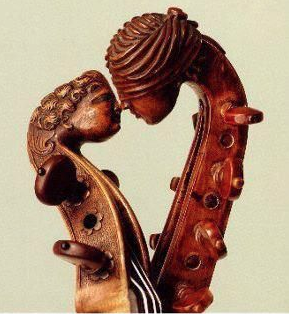
One of the final steps in violin making is creating the scroll and neck. The scroll is cut out using a saw and hand carved by the maker. This is often when the luthier is able to express his or her individuality and creativity. Scroll carving is usually the only time in the violin making process that a maker can carve freely.  

Once the instrument is glued and put together, the final step of varnishing must be completed. Varnish has been known to enhance the tone of the violin while also protecting and giving the wood a beautiful finish. When completed, the varnish must be aged and exposed to sunlight before it can be put into the hands of a performer.

When considering all of the technology and time that goes into making a violin, it’s easy to see why fine handmade instruments are so admired and prized. Even instruments that were made in the last twenty years have had to come from a tree that started growing at least 100 years ago. How did that tree get there and what technologies may have gone into getting it there? Did it grow naturally or did someone plant it? The time it takes to cut, dry, season, and varnish a violin’s wood means that most violins are a lot older than one may think.

One violin maker said that “the violin does not have its beginnings with a musician, but rather with its maker. It can only be used by skillful hands to bring a person into the very presence of God.” With that being said, a violin is a technology musicians can use to communicate whatever they want to be said, using the gift of music which is beyond this world.


Evolution of The Trumpet

The Modern Trumpet

The metal Trumpet has been around for thousands of years, dating back to around 1500 B.CA basic trumpet is not difficult at all to make, believe it or not. When I was about 4 years old, I would buzz my lips into a plastic funnel and was able to get a sound out of it. This is not that much different from the earliest versions of trumpets. All you need is a tube, theoretically. Here is a video of a man demonstrating this:


So how do we get from simple tubes to the shiny triumphant metal beasts that we are so familiar with today? Before the 1800’s, the trumpet had very limited facility. Since there were no valves or holes, the person playing it would have to use air, embouchure, and tongue position to change the note. These notes are referred to as partials, and are limited to the harmonic series.  Since they were limited to the harmonic series, the trumpet’s role in music was focused around military events and bugle calls. However, when the valve system was invented in the 1800’s they were then able to play in chromatic musical contexts. The valves reroute the air blowing through the trumpet to change the distance your air travels from mouthpiece to the bell , which ends up changing the note. There are 7 different valve combinations, each one having its own harmonic series.


Since then there have been minor innovations to the trumpet, yet it has remained a relatively consistent design for the past 100 years or so. Nowadays trumpets are very customizable in regards to metal type, bore size, mouthpiece type/size, key (C/Bb/Eb/etc), and finish, yet they all stick to the same basic formula.


Technical Advancements in Player Ability/Extended Technique

Since the trumpet has gotten more advanced, the playing ability has also increased. Many technical advancements in the player have occurred recently in the 20th and 21st Century. A few noteable players are Rafael Mendez, Allen Vizzutti, Louis Armstrong, Laurie Frink, Woody Shaw, Peter Evans, and Ambrose Akinmusire. All of these people have pushed trumpet to technical limits that were thought to be unreachable.


Many technical innovations of trumpet players have happened in the Jazz idiom. This makes sense since jazz music is constantly exploring boundaries. One of the greatest innovators was Woody Shaw , who explored large interval improvisation, especially with 4ths and 5ths. Intervals are very difficult on the trumpet. They require a relaxed embouchure and air flow, which is counter intuitive when you try to perform them. Ambrose Akinmusire is a modern trumpet player who also has a very intervallic style of improvising, taking it even further than Woody Shaw. Ambrose also tends to emulate the human voice frequently by pushing the valves halfway down to get a muffled and slippery timbre.


Peter Evans is perhaps one of the greatest technical trumpet players to ever live, and has taken trumpet to its limits. He plays high, fast, slow, intervallically, and melodically, all with ease. Evans’ music is also highly experimental and crosses over into the avante garde umbrella. He uses what we call “extended techniques” to create sounds on the trumpet that are totally unique to him, and require masterful technique. This makes Peter Evans a great innovator of the trumpet.


The Electronic Trumpet

The EVI (Electronic Valve Instrument) is an electronic wind instrument created by Nyle Steiner. It uses the bottom half of the octave fingerings for trumpet, and the rest is controlled by the octave dial and partial key. This is a wind powered instrument that uses MIDI technology to create sounds. This means that the entire soundscape for trumpet players has opened widely since this was created. It also allows the person to play in 8 octaves, instead of 2 or 3. This is a major innovation that was conceptualized with a trumpet in mind, and a ton of beautiful music has come out of its creation. A couple notable EVI players are John Daversa and John Swana.


There have been many major innovations of the trumpet since its creation, but many of those innovations have happened in the last 200-300 years. I’m excited to see what the next “big thing” is.

Bones?

The trombone is an instrument that is full of misconceptions from those who don’t play it. It is most commonly associated with silly noises, the parents talking sounds from the Charlie Brown series, and sheer loudness, among others. However, just because the trombone is capable of making silly, sound effect-esque glissandi if called upon, the trombone is also more than capable of creating beautiful, rich sounds in a wide variety of contexts.

The modern trombone originates from an instrument called the sacbut, or sackbut. The true date of origin of the sacbut is not known, but “ by 1500 it is illustrated and mentioned regularly.” https://www.music.iastate.edu/antiqua/sacbut.htm

The sacbut had four main sizes, being alto, tenor, bass and great or contrabass. The tenor sacbut eventually evolved into what is known as the modern tenor trombone. This instrument is however very different from trombones as they are known today. Sacbuts are generally smaller, but particularly so in the bell. Thus, the sound quality of the sacbut is less full, due to the actual lack of overtones being produced. The sacbut also does not have much of the tubing present on modern trombones, as the intonation was primarily fixed from the main slide, unlike the extra tuning slides that modern trombonists are able to work with. An example of the sacbut’s sonority: https://www.music.iastate.edu/antiqua/mp3/Musica_Antiqua_hymn_to_st_john.mp3

These instruments were primarily used in church settings to accompany the choir, as the timbre of the sacbut and trombone are both very similar to that of the human voice, especially a tenor. “For outdoor music the top part of a sackbut ensemble was usually taken by a shawm, and for church music, by a cornett. The sackbut player should imitate the sound of the cornett, not the trumpet. Thus today’s marching band trombone blasts have no place in the performance of early music.”https://www.music.iastate.edu/antiqua/sacbut.htm
This statement is a very accurate depiction of the sound concept of a sacbut versus the modern trombone. While “marching band trombone blasts” are of course not the only sound that trombonists are capable of creating, although some do unfortunately favor it, the sacbut was an instrument intended to blend into the sound of the lead voice of a shawm or cornet.

Many players very much enjoy abusing the trombone’s capabilities in terms of volume, rather than exploring the trombone’s capabilities in terms of beautiful sound quality. While the sacbut was intended to blend into the top voice of its ensemble, so too is the trombone meant to blend into the sound of the lead trumpet (or other instrument) in its many contexts today, such as the orchestra, wind band or various jazz settings. http://www.blackdiamondbrass.com/trbhist/tbonehist.htm The trombone was used by the great, extravagant composers of Richard Strauss and Wagner in moments of triumph and great energy, in order to ‘properly’ utilize the trombone’s unique capability for great volume.

See this thoughtful article on the development of trombone playing in terms of equipment and mindset: http://www.dansr.com/wick/resources/me-myself-and-i-are-orchestral-brass-players-losing-the-concept-of-being-team-players

This article touches on the fact that trombone equipment has been continually getting larger, typically to help players produce bigger sounds within the orchestra. Famous trombone pedagogue Doug Yeo touches on the fact that in modern orchestral settings, you will notice plexiglass shields protecting the string players positioned in front of the brass players. The fact alone that players need plexiglass shields and/or earplugs to protect their hearing speaks a lot about the sheer volume being produced from brass players today. This illuminates the great deal of change that has accompanied the development of the sacbut into the modern trombone in terms of instrumental design and adding of tubes as well as increasing size of almost every aspect of the instrument, specifically the tenor and bass ranges. For example, here is a trombone ensemble playing music from Game of Thrones, extremely loudly: https://www.youtube.com/watch?v=vTDEVUlCClk

Modern trombonists would surely benefit from thinking more about the blend of an ensemble and fitting into the top voice being played. While outputting great amounts of volume and energy is very exciting and fun as a player, sometimes it can simply be overpowering, or just overbearing and not enjoyable to listen to. As quoted in Doug Yeo’s article speaking of the great Chicago Symphony brass, “The performance was electric because I (Ed Kleinhammer, former bass trombonist of the CSO) was part of a great unified orchestra doing their thing.”

While the tone of this article was generally disapproving of modern trombonists’ habits, this article does not intend to encompass the intentions of every modern trombonist. There is a large community of sensitive and actively listening players that are promoting these good habits into the orchestral and jazz settings of trombonists everywhere, like my good friend Jack Courtright. Here is an example of beautiful trombone playing that blends beautifully with an ensemble, while also playing solo lines that soar over and project with a beautiful tone. https://www.youtube.com/watch?v=79-EDLi8KRw

The future of brass playing could surely benefit from increased sensitivity, and forgetting about the ego that comes from being the loudest player in the orchestra. The increase in musical technology from the beginning of the sacbut to the modern trombone certainly had its flaws, primarily due to players trying to abuse the trombone’s capabilities. However, if played right, the trombone can be the most beautiful sound you’ll ever hear.

Why do we ‘mute’ our instruments?

In one of Prokofiev’s most famous pieces, Romeo and Juliet, the horns begin Montagues and Capulets with sustained notes, becoming more and more dissonant as voices are added, leading up to a fortissimo chord with the entire orchestra. The one exception and peculiarity to this chord, is the pianissimo ‘con sordino’ (with mute) string section. Once the blaring brass and woodwinds’ chord dissipates, the strings continue their sustained pianissimo, which is made even quieter because of Prokofiev’s usage of mutes. Prokofiev’s Romeo and Juliet is famously known for the beginning and its muted string section which not only dampens the sound, but also adds a unique timbre to the string section.


Mutes were first notated in music as early as 1607 in The Toccata from Claudio Monteverdi’s opera L’Orfeo in the trumpets and were first notated in the string section of Jean-Baptiste Lully’s Act II of Armide in 1686. However, mutes did not become as commonly used until the 19th century and by the 20th century, mutes were used very often.

There are a few different kinds of mutes for the string family. The most commonly used and referred to in music is a simple rubber device that is attached to the top of the bridge. There is also a practice mute which is usually used to practice in the late hours of the night when one is procrastinating for a lesson. This mute is more dense and dampens the sound even more and is not usually used in performance. When the mute is used, it dampens the vibrations of the instrument and also suppresses certain harmonics of the instrument and creates higher harmonic sounds. This shows that not only does it ‘mute’ the sound in volume but also changes the timbre and tone color of the instrument.

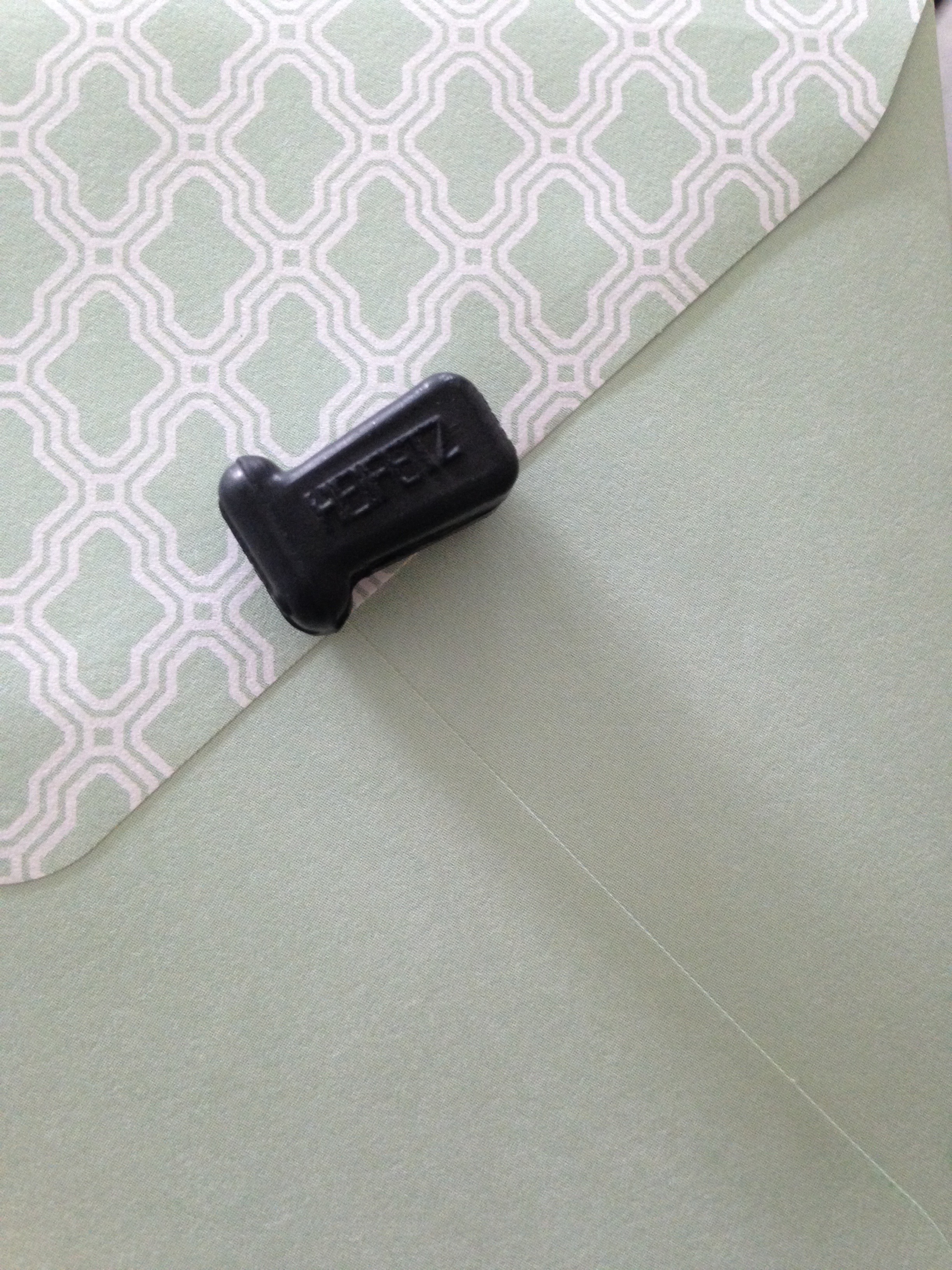
Originally, string mutes were wooden and could not be left on the instrument during ‘senza sordino’ passages. In 1947, Jascha Heifetz and Henryk Kaston created a new model of the mute which was carefully designed with a metal clamp inside the rubber casing which let the musician decide how ‘muted’ to make his/her sound. The farther down the bridge you pushed the mute, the more muted it became. It was also designed to allow the musician to choose what strings to mute. One could put them between the two higher strings to dampen the higher register, between the lower for the lower register, or in the middle for a balanced sound. This ‘Heifetz mute’ became extremely popular especially because of its name, under the great violinist Jascha Heifetz. This model is no longer manufactured but a different, less expensive and modified version is still sold. The original Heifetz mutes now sell for $500 and are extremely limited. You can buy the original model or buy a Heifetz mute that he used himself for $25,000 here!

I do not mean to brag, but this is a picture I took of an original model Heifetz mute that my previous professor (Toby Appel) let me use for my senior recital two years ago. He had purchased this when the original models first came out and were not $500.

In the Romantic era, composers were searching for a new sound in the orchestra and started to implement the mute. The mute is often seen simply as a tool to make a softer sound. If this were the case, composers could have easily reduced the orchestra or notated a softer dynamic. Instead, the mute creates a darker tone that creates a very particular somber sound. This ‘new technique’ for Romantic composers was, what it seems to be, the beginning of extended technique. Using tools and different technologies to produce different sounds and playing instruments even beyond what it was originally intended to, was and is still currently intriguing musicians and pushing heir creative capabilities. 

Sources:

https://www.sweetwater.com/insync/mute-musical-instrument/

http://www.theheifetzmute.com

https://books.google.com/books?id=_tkPAAAAYAAJ&pg=PA190&lpg=PA190&dq=mute+timbre&source=bl&ots=jjv4nbaS9Y&sig=V62CNNqmMsiWeH2Cg3SZ5WXlVH4&hl=en&sa=X&ved=0ahUKEwiA7seE9K_WAhUG5iYKHT8KDQU4ChDoAQg3MAM#v=onepage&q=mute%20timbre&f=false 


Theremin: The World’s Spookiest Instrument

It is astonishing to think how interesting and perplexingly cool the theremin is and how very few people in the world know about its existence even when they have probably heard it somewhere. “In my experience, there are two kinds of people: those who are beguiled by the theremin and those who just haven’t heard of it yet. Because of the way it’s played – gestures, space – it fascinates instantly”  https://www.theguardian.com/music/2015/aug/22/invisible-instrument-theremin. 

To be honest, I didn’t know about it until a few years ago, when I stumbled upon this video of Clara Rockmore playing Saint-Saëns’s “The Swan” which literally looked like she was playing an invisible violin. The string-like sound is there, but it looks like she isn’t playing a particular instrument or even touching anything to that matter; she is playing air.

Leon Theremin (yes, that’s why the Theremin is called that) was a young Russian scientist who was working on a gas meter to measure densities. “‘Leon Theremin was an[n] . . . inventor of what is probably the most unusual musical instrument ever invented. You’re actually moving your two hands through two electromagnetic fields that are around two antennas. . . He was working in a laboratory in Russia as a young scientist, he was actually working on a gas meter to measure the density of gases,’ Glinsky said. ‘So as he brought his hand closer to the gas meter, he heard kind of a higher squeal. And as he brought his hand back to his body and away from the machine, it was a slower squeal’” https://www.cbsnews.com/news/the-theremin-a-strange-instrument-with-a-strange-history/ 

Then Leon started playing melodies on the device while his colleagues at the laboratory stared with amazement. This was the birth of one of the world’s first electronic instruments. The first model of the theremin used a foot pedal to control the volume and a switch to modify pitch. Later, in 1920, it became the mind-boggling instrument which requires zero contact of the performer with the instrument.

You are probably wondering how this thing even works, right? Basically, the first theremins were made up by circuits of vacuum tubes, coils, and wires which created electromagnetic fields around two antennae. By vibrating their fingers, players would raise or lower the pitch and volume. You can see why it is considered by many the world’s most difficult instrument. “A real theremin master can make an instrument soar with the fortissimo of Pavarotti or fade to the most delicate of whispers” http://electronics.howstuffworks.com/gadgets/audio-music/theremin3.htm 

It is really easy to merely produce gross squeaks and cries because only masters can produce the beautiful violin-like sound, like Clara Rockmore, who was actually one of Professor Theremin’s original students. She was an accomplished violinist who was forced to stop playing violin because of injury and therefore picked up the theremin and went on to become the world’s best thereminist. What a great example of how good things can come out of bad situations!

The 1920 theremin was shown at the Moscow Industrial Fair and picked up the interest from Vladimir Lenin, who actually took some lessons on it and commissioned 600 models to be toured around the Soviet Union. Later on, Leon Theremin left for the United States, where he performed at the Metropolitan Opera House as well as Carnegie Hall. He patented his invention in 1928 and its rights were quickly seized by RCA who distributed it during the 30’s. “The Theremin became known in the USA as a home ‘novelty instrument’ and featured in many film soundtracks of the 1940-50’s, it also appeared in several pop records of the 1960’s but never overcame its novelty appeal; used for effect rather than as a ‘serious instrument’, most recordings employ the Theremin as a substitute string instrument rather than exploiting the microtonal and pitch characteristics of the instrument” http://120years.net/the-thereminleon-termensoviet-union1922/ 

Some examples of media were it was used are: “The Green Hornet Radio Show” (1936), “The Day the Earth Stood Still” (1951), “The Flintstones,” “Batman,” and 2004’s “Hellboy.” You can hear it from yourself in the next video clip. The theremin comes in at 1:14.

Leon Theremin went on creating and invented other instruments, such as the “Terpsitone,” the “Rhythmicon,” and the “keyboard Theremin,” and even the “Electronic cello.” He later ended up eventually “disappearing” and returning to his home country. However, in 1954 in a basement in Queens, NY, a young Robert Moog was obsessed with theremins and began building them with his father. “It’s hard to imagine what the evolution of the synthesizer would have been without Leon Theremin. For one, it was Theremin’s invention that first captivated Robert Moog. Theremin kits were Dr. Moog’s first product and many would say, his first electronic instrumental love. That impact was significant, too, on a whole generation” (http://cdm.link/2015/09/read-article-bob-moog-wrote-met-leon-theremin/  Moog’s theremins went on to become the leading company for the instrument and they have sold more theremins than any other company in the last 57 years. What’s marvelous about all this is that Bob Moog is the man behind the Moog synthesizers, and there is no denying that the theremin was a great influence for this development. “Electronic music pioneer Robert Moog built theremins long before he built synthesizers. In the 1960’s, he produced such models as the wedge-shaped Vanguard theremin and the shoebox shaped Moog Melodia theremin. Today, Moog Music Inc. produces the popular Etherwave and Etherwave Plus theremins and kits as well as the new MIDI-enabled Theremini theremin.

Now that we have travelled through a brief history of the Theremin, we can see that is it actually a brief history of the technological advancements in electronic music over the last century. The discovery of the theremin and its technological innovation ended up being an inspiration for the creation of synthesizers, which are nowadays are incredibly popular and key for music production.


Carving out a Path for the Viola

When I first decided I wanted to play an instrument, I went to an instrument “try-out” day at my town’s local music store. I first tried out a flute, then a trumpet. Then I moved on to strings and picked up the violin. I remember that the sound of the bow against the strings was painful to my ears. A few minutes later, I walked over to my identical twin sister, who was smiling at what looked like a big violin. “Let me try!!!” I said, and I put the viola on my shoulder. I drew two bows on the D string, then two on the A string. Thinking, “OMG, I can already play Twinkle Twinkle Little Star”, I told my mom and sister that I wanted to play viola. My twin sister did too! As you can imagine we played a lot of viola duets over the next several years.

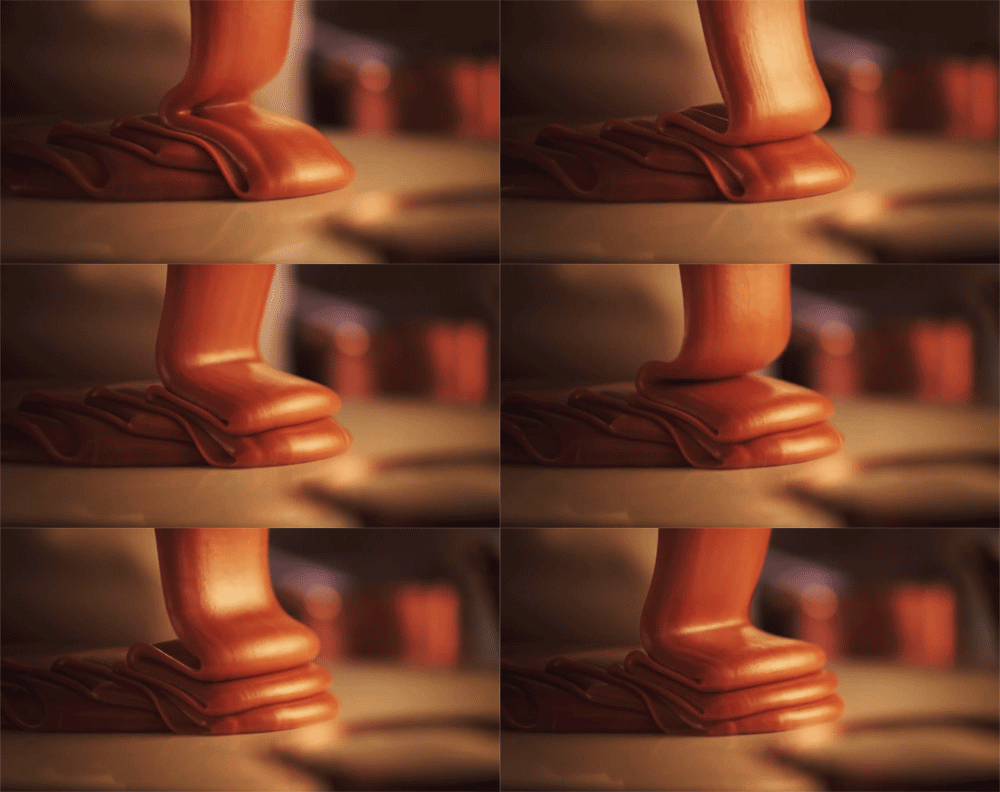
As a violist, I am used to the reputation this instrument has in the music world. In an orchestra, the viola plays a supportive role. Seldom receiving the melody, violists learn how to play harmony very well. When we received this blog post assignment, I knew I wanted to discuss the history of this instrument because there is a lot that goes untold (and unknown). Though, I am biased, I feel the viola’s importance should be projected. What other instrument sounds like caramel and chocolate when it’s played well?!

 Click to play

To emphasize this gif, here is a recording of one of my favorite pieces (and one that shows off that caramel sound of the viola). Just listen to the first 30 seconds- that’s all you’ll need.

Let us go back to sixteenth century Italy. The viola is a member of the violin family, but there is no clear answer to exactly when this instrument came to be. According to the Vienna Symphonic Library the role of the viola came defined when demands for instruments that would fill out a room with sound for Baroque Opera became necessary. String instruments were often made in different sizes with the same tuning, so when a need had to be met to split the registers and have another instrument played “da braccio”  or played on the arm, the viola was born.

Composers soon composed for sections to mimic the human voice (parts separated by bass, tenor, alto, and soprano registers). Naturally the viola falls into the alto category, and makers had to continually experiment to “find the optimal combination of tone, size, shape, and range to compliment the current trends in orchestra and court music” .

The viola is often misunderstood in terms of size because there is no standardized system for measurement. This makes the viola imperfect acoustically, because in order for the most amazing sound to be achieved, the body of the instrument would have to be huge (and therefore unplayable). Today there are many makers who experiment with string length and the size of the body to achieve the optimal effect. Usually, people with longer limbs and fingers play larger violas and vice versa.

A huge advance in the viola-making world came with the modern bow. Francois Tourte , a Frenchman, is often credited with many string instrument advances but the modern bow is especially important to violists. Because a viola responds less quickly because of the thicker strings, a modern bow allows for more tension between that hair and the strings. This means violists could actually project(!). Soon, the role of the viola became increasingly important in chamber music and the first solo pieces were composed for the instrument.

I encourage you to watch this TEDx talk specifically about the viola. This talk is great because there are frequent playing examples as well as great facts.

Today, there are many amazing solo violists who have created a beautiful new reputation for this instrument. Some of my favorites, including Kim Kashkashian, Nobuko Imai, Yuri Bashmet, etc. have inspired not only violists around the world, but also composers to write new and challenging works for this instrument. In the last decade new commissions and transcriptions have taken off, carving out a new path for this instrument. In this article by TimeOut New York, Steve Smith writes of new CD releases that deserve attention, honing in on many new contemporary works.

Past the viola jokes, I believe we gain a lot from understanding the technology of this instrument, and how it came to fruition. It is important to consider that instrument makers in the 16th century may have had some of the same musical concerns that instrument makers and composers have today, and that the means of creating music are constantly being improved upon.

Fretting over the past

Always known to have a flair for the dramatic, Jaco Pastorius’ 1962 Fender Jazz bass was aptly named the Bass of Doom. Although no one except Jaco knows the origin of the name, as a fellow bassist, one theory I have is simply the awe and terror (of inferiority) instilled in other musicians who witnessed the combination of Jaco and the instrument while on stage.

EXHIBIT A (feat. The Bass of Doom):


Besides the ridiculous chops and musicality displayed in this performance (he flips the notion of people talking during a bass solo on its head), one of the most striking aspects of this video is the warm, fuzzy tone that Jaco produces. Electric basses typically have a defined low-end with precise pitches, such as all fretted instruments, but the distinguishing feature of the Bass of Doom is its’ fretless nature, allowing fluidity between pitches and Jaco’s ability to make the bass sing via vibrato. Legend goes that Jaco found the Jazz Bass for $90 at a pawnshop sometime around 1970 and decided to take out the frets with a butter knife and replace them with polished pieces of “plastic wood”, then finishing the fret(less)board with a few coatings of boat epoxy, thus creating the first fretless bass.


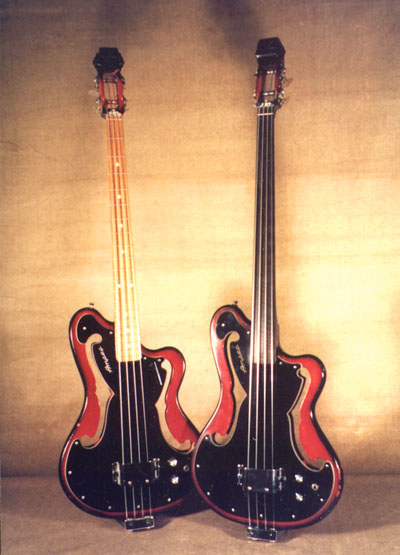
As is the case with many folk-heroes and tales though, these facts are widely disputed, with the possibility that Jaco’s bass may have already been fretless when he purchased the instrument. Not only is the origin story possibly fabricated, but there are also contradictions over the origin of the fretless bass that all come down to a person’s opinion on what defines a fretless bass rather than who was the first to invent the instrument. The following image is of Ampeg AUB and AEB basses made circa 1968, at least two years before Jaco’s “discovery”,and it is apparent that the inspiration for the bass’ design comes from the electric bass’ ancestor, the contrabass (which could be argued is THE original fretless).

From the scroll-like headstock to the ebony fingerboard, both instruments look like and sound like a miniaturized version of an upright. Not only was Ampeg producing them around 1966, but according to Billy Wyman of Rolling Stones fame, “… I made a bass in 1961, before I joined the Stones, and it was a fretless bass. It was the first fretless bass ever made. I didn’t know that at the time, and I didn’t know that until 10 years ago. It predated fretless basses by about five or six years”. Rumor has it that the bass he had purchased was buzzing due to the frets so he decided to take them off. The issue here is that all we have to take for the validity of the claim is his word rather than recorded performances or videos of him with said makeshift bass. These differing origin points are where some debate comes in, as the Ampeg AUB and AEB are obviously derivative of upright basses, while Wyman’s choice was pragmatic in response to a functional issue but had no lasting impact. Jaco’s decision may have been a mixture of both due to his jazz background and influences and the questionable quality of pawnshop purchases, or it may have just been a stylistic quirk, the kinds of which he exhibited so often throughout his career. The main distinguishing factor when discussing any type of bass though is the tone, and any modern-day listener will instantly point to Jaco’s warbling, growling sonorities as the definitive fretless tone, even if it was not necessarily the “first” fretless, or a traditional fretless instrument.

As with so much of rock lore and history, stories are passed down via word of mouth for decades, resulting in tales that are irresistible but also sometimes easily refuted by the internet. While the anecdote about Jaco’s Bass of Doom being the original fretless may not be wholly true, it speaks volumes to how history is written, with the age-old adage of how the “victors” are the ones who write history. These conflicting origin stories pose some interesting questions about how the history of certain innovations is recorded. Does it matter who officially invented a technology if that person is hardly relevant to the cultural impact of said technology? Or, is it wrong to mythologize the origins of certain innovations if there’s an educational purpose behind it? While Jaco in many cases was no victor, in a sense, the history of the fretless electric bass begins and ends with him. Any person who performs on a fretless bass is instantly compared and contrasted with Jaco, similar to Michael Jordan’s shadow hanging over every single NBA superstar. The role of the fretless electric bass in any musical context is so entwined with Jaco’s legacy that even though the fretless had a precedent before the 70’s, it was Jaco and his eponymous debut album in 1976 that led instrument producers to market and produce these fretless instruments while also inspiring legions of bassists to pick them up in efforts to imitate him.


Further exploration:

Jaco Pastorius (Eponymous Debut Album)

Rick Danko (bassist for the Band, on left in yellow jacket) utilizing an Ampeg AMUB-1 Bass


Why F Holes?

One the most notable features of the modern bowed string instrument family is that of the so called “f holes” located centrally on either side of the instruments’ main bodies.  These in particular contrast with the single circular shaped sound hole located in the center of an acoustic guitar.  In the guitar’s case, the single circular hole has been a staple of the instrument’s design for centuries.  In the case of the violin and other bowed string instrument, the f hole is a product of years of development through trial and error.

Image source: http://digitalcommons.usu.edu/cgi/viewcontent.cgi?article=1741&context=gradreports

The earliest bowed string instruments actually had the same circular hole design as the guitar.  This probably occurred as some of the first instruments to be played with bows were simply lutes, whose main performance technique remained plucking.  However, as bowing took off as a genuine technique in its own right, the makers of such stringed instruments found that the circular sound holes did not produce the desired results.  And so, they began experimenting with other designs.

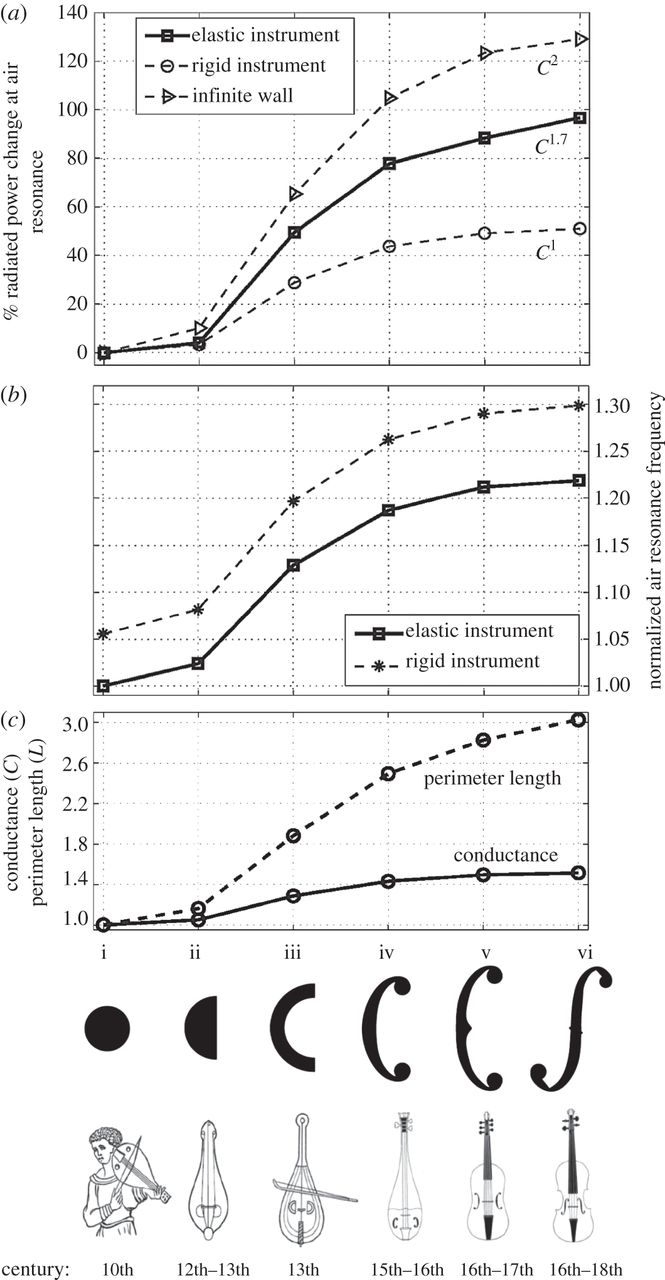
In the 10th and 11th centuries, the single circular hole was replaced by two separate circular holes on opposite sides of the instrument’s body, much as the modern f holes are located today.  This double design produced a greater acoustic clarity for bowed instruments than the single holes did, but it was still far from perfect.  And so, the experimenting continued.

By the 12th and 13th centuries, the circular holes were replaced with half moon shaped holes, followed quickly by C shaped holes.  These, combined with improvements in the technology of the bow itself contributed to a new era in the evolution of the bowed string instruments.  These C holes were so successful, that while they went through many phases of stylization through the centuries to come, they remained a staple through the early baroque.  In fact, many baroque string instruments retain the C shaped sound holes.  However, by the high baroque, influential luthiers – most notably Nicolo Amati – began creating instruments whose sound holes were shaped like an f.  This new design caught on rapidly, and remains in use today, with slight variations between different makers.  Guarnieri, for example, favored a longer and narrower design, while Stradivarius’s design was wider and shorter.

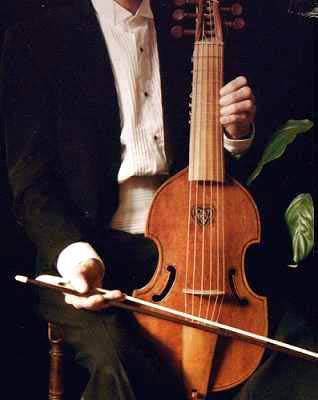
Viola Da Gamba with C shaped sound hole

Image Source: http://www.orpheon.org/OldSite/Seiten/education/ShapeUpEnglish.htm

The reason for the adoption of the f shape is not entirely clear.  However, a separate blog I found poses an interesting theory: namely, that the holes are not intended to be f – shaped.  Rather, the shape is intended as a stylized s, which in turn stood for “sound” in various languages.  Whether this theory is accurate is up to debate, but in either case, the f hole (or s hole), is now an integral part of the design of any modern bowed string instrument.  (side note, the f hole is also shaped like the symbol for integral: )

Interestingly enough, an MIT study from 2015 (in sources) has discovered that the f-hole is actually the ideal shape for sound production.  The vibrations from the f-holes carry longer and louder than that of any other shape on the bowed string instruments, as it is most suited to the sonic vibrations and air flow that bowing the strings produces.

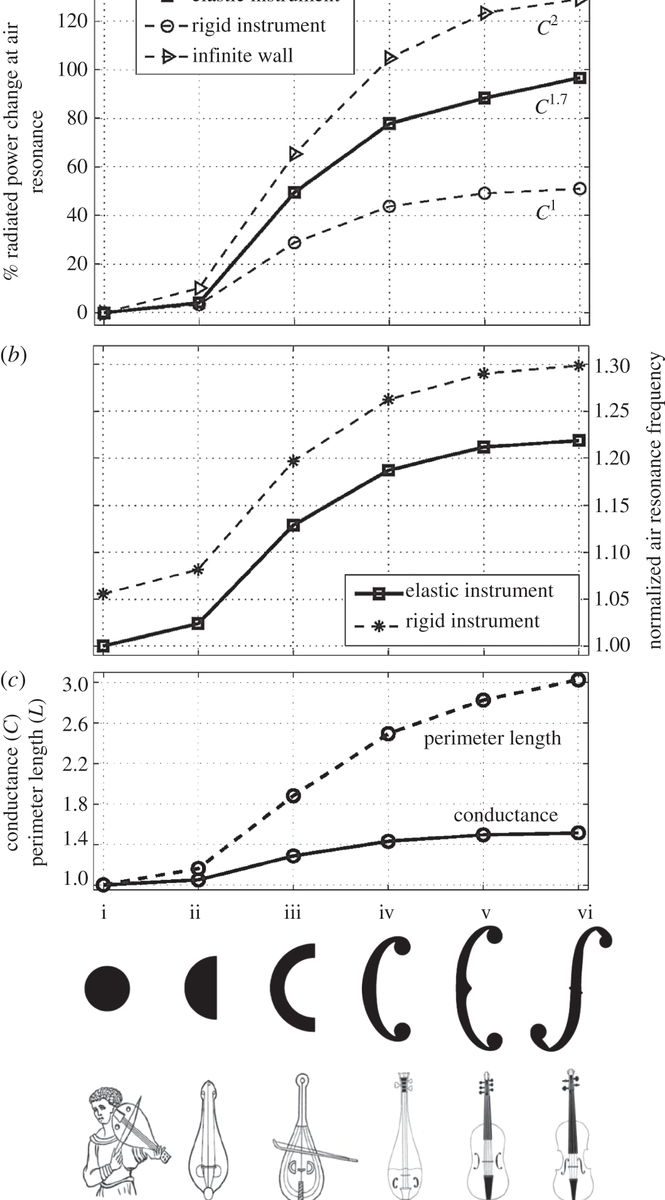
Image source: http://rspa.royalsocietypublishing.org/content/471/2175/20140905#sec-4

It is a curious coincidence that this ideal shape was stumbled upon by what amounts to accident.  While I am certain that the early luthiers could empirically ascertain the superiority of the f-holes, they undoubtedly were unable to replicate the detailed acoustic physics calculations of the MIT researchers.

As a violinist, I am actually rather pleased with the concept of a chance occurrence driving the evolution of an important part of my instrument.  After all, so much of what goes into a good performance is created by chance – the atmosphere of the hall, the artist’s current mood, avoiding an unfortunate mistake – that having the creation of your instrument be coincidental is rather comforting.


Sources:

http://digitalcommons.usu.edu/cgi/viewcontent.cgi?article=1741&context=gradreports

https://newt.phys.unsw.edu.au/music/publications/mclennan/fholes.pdf

http://blog.feinviolins.com/2013/04/why-f-holes.html

https://www.thestrad.com/new-research-into-the-development-of-violin-f-holes-is-simplistic-at-best/4073.article

http://rspa.royalsocietypublishing.org/content/471/2175/20140905#sec-4

http://www.orpheon.org/OldSite/Seiten/education/ShapeUpEnglish.htm

Sampling and why it should be respected in the artistic community

“Sampling: the technique of digitally encoding music or sound and reusing it as part of a composition or recording.” – Google. This is the definition but it has received so many other societal implications depending on your social circle. For conservatory musicians it can be met with distain for people who have so little creativity that they are forced to rip off other’s ideas. For producers of hip hop it is the very essence of their music; a corner stone to their art form and creative process that forces them to hear music a fundamentally different way. Conservatory musicians might here a piece of music and think about the harmony or virtuosity of the musicians playing, while a sampling musician is listening for the timbres, the rhythms, and instrumental breaks with one question in mind: “can I sample this?”

Sampling as an art form many would say started in the 1980s with the MPC 60; a machine that could record audio onto 12 preset, touch-sensitive pads, that revolutionized beat production in hip hop. (See

for more info) While I would agree that for hip hop this is certainly true, I would disagree with it being the beginning of sampling. Since the beginning of recorded history there has always been an element of sampling and recycling material. How else would we develop our theories if there was not some level of commonality between pieces of music. This might seem like I’m thinking to macro in my take on sampling. A more concrete example of sampling in classical music would be Bela Bartok, who literally had a recording devise which he used to record different folk musics from around the world to later use for inspiration for his own works. (If your curious about Bartok field recordings check this out!)

 How is this not sampling? When talking about sampling, Mark Ronson (Producer of Uptown Funk) said that “In music, we take something we love and we build on it.” Does this quote not apply to all music, not just sampled music? So why then is sampling prerecorded music bad?

I think many would argue that it is one thing to play the notes someone else played, it is another to claim someone else’s work is your own. While that argument does have merit it is assuming that by sampling you mean taking someone’s complete work and projecting it as your own, which is not the case with sampling of hip hop music generally speaking. It is actually a highly creative process, which takes parts of a musical excerpt and reinterprets them into a new piece of music that is separate from yet related to the piece that was sampled. Mark Ronson put’s it like this “You have to take an element of those things and bring something fresh and new to it.” Most sampling is viewed as a way of paying homage to the music that you like best, similar to a jazz musician quoting lines from his favorite soloist to show respect for the tradition. In jazz this is viewed as a cornerstone for being steeped in the tradition, improvisors spend hours transcribing their favorite soloist with the goal of sounding like them. And yet many, esp. older, jazz musicians don’t see how J Dilla sampling his favorite soul records and reinventing them, is the same thing with a different instrument. (If you’re asking yourself, who is J Dilla? How did he sample soul music? check this out! )

To sum up, sampling exist, it has been around for decades and should be respected in the art community. It is ridiculous to me that the Grammy’s won’t let a song that has prerecorded samples in it even be considered for song of the year. To my musician friends, take a look in the mirror, it’s not that your bad too, it’s that sampling is always good*. *Granted the original artist receives credit and compensation for their work.

Lastly I will say, if you are interested in sampling, check out whosampled.com it has great resources to see what your favorite artist sampled to create your favorite beats!

Sources in text: How Sampling Transformed Music – Mark Ronson

https://www.youtube.com/watch?v=H3TF-hI7zK

http://www.whosampled.com/sample/4051/Madvillain-M.E.D.-Raid-Bill-Evans-Nardis-(At-the-Montreux-Jazz-Festival)/

Netflix – Hip-Hop Evolution

Ross- The Rest is Just Noise, Chapter 3.

Suggested Listening: Deltron 3030 (self titled)https://www.youtube.com/watch?v=v6YJjkO7F5A

Madvillain- Madvillainy https://www.youtube.com/watch?v=DWY22Blwouc

J Dilla – Donuts https://www.youtube.com/watch?v=5nO7IA1DeeI&list=PL9dk_xtWpAkKXxzv_TfLWmlJj6G3quWQ2