Reed All About It

The bane of every saxophonist, such as myself, is a small, tan piece of wood—  the reed. According to esteemed saxophone pedagogue Larry Teal, “the principle task of the reed is its function as an air valve, which opens and closes on the mouthpiece at various speeds, [thus creating a tone].”1 Reeds are a technology I take for granted every day. My daily view of a reed begins with opening a blue, vacuum-sealed package, wetting the reed in my mouth, slapping it on my mouthpiece, and jumping right in to my practice session. Yet, reeds, in addition to being finicky at all the wrong times, possess a much more complex back story, and carry relatively unmentioned environmental implications.

The modern reed came about with the standardization of the clarinet in the late 17th century, 2 but the plant itself has been used for much longer. The reed species Arundo donax “has played an important role in the culture of the western world through its influence on the development of music, which can be traced back 5000 years.”3 The first musical use of Arundo donax was for making flutes, and only later was it used a reed. Nowadays, it is this species, grown in the Var region of France, that reed manufactures harvest, cut, and sell to customers.5

As simple as a reed may seem, the manufacturing process of cane is surprisingly complex, and the transformation to its use for musical instruments is a lengthy journey. As this video from the Rico reed company shows, the reed-making process takes many months to several years from planting the cane to harvesting and finishing the final product.

When I open a reed, I am actually opening up to two years worth of production time. The harvested plants must spend varying lengths of time drying naturally in the sun, depending on the manufacturer. The finished product is also a result of precise manufacturing tools and close inspection for reed imperfections. Yet, even the best reed will last no longer than a month of heavy use.

I have rarely heard anyone talk about the environmental impact of this technology, but, being a natural resource, reeds production does indeed carry environmental implications. Upon close inspection of the history and process of reed making, I found that there are significant environmental drawbacks, as there too often are with even the simplest of technologies. The first concern involves the plant itself; Arundo donax is considered in many regions, including the United States, an invasive species. Due to its musical and nonmusical uses alike, people have taken the plant out of its native region in the Mediterranean and cultivated it across the globe. Its ability to survive in many different conditions makes it a serious threat to indigenous plant species.4

Another negative environmental impact of this technology is its wasteful production. In a magazine published by one of the largest reed manufacturers, Vandoren, the company describes the complete process of making a reed. According to the company, up to 90% of cultivate plant material is discarded before it even enter the reed-making process, as high-quality reeds require very specific physical features of the original cane. Plants that are deemed usable also create significant waste products; out of the six-meter long stalk, only 20-30% is made into reeds.5

Due to more precise cutting and measuring equipment, reeds have become increasingly consistent over the last several decades. Some of the most dramatic developments have been in synthetic reeds, which have the same shape and function as traditional reeds, but are made from plastics.

Now, more than ever, synthetic reeds are reaching the ability to offer as great tone quality as cane reeds. Perhaps continuing to pursue the development of quality synthetic reeds will offer a better alternative to the wasteful use of cane.

The small piece of wood I use every single day is both a modern and ancient technology. Reeds have been used for thousands of years, but the last several decades have seen bounding progress in reed making and innovation. Yet, the complexity of the reed and its back story never fail to slip my mind, even though my ability to play the saxophone depends on a high quality piece of cane. This shows that the seemingly simple technology we use every day can have an immense, unseen history as well as a global impact.

  1. Teal, Larry. The Art of Saxophone Playing. U.S.: Summy-Birchard, 2000. p. 21
  2. Editors of Encyclopædia Britannica. “Reed instrument.” Encyclopædia Britannica. July 20, 1998. Accessed September 18, 2017. https://www.britannica.com/art/reed-instrument.
  3. Rojas-Sandoval, Julissa, and Pedro Acevedo-Rodríguez. “Arundo donax (giant reed).” Invasive Species Compendium. Accessed September 18, 2017. http://www.cabi.org/isc/datasheet/1940.
  4. Perdue, Robert E., Jr. “Arundo donax-Source of Musical Reeds and Industrial Cellulose .” Economic Botany 12, no. 4 (December 1958): 368-404. Accessed September 18, 2017. http://www.jstor.org/stable/4287997.
  5. Van Doren, Bernard. “SELECTION OF THE REED : FROM THE PLANT TO THE INSTRUMENT.” Edited by Jean-Marie Paul. Vandoren Magazine, 4-7.

Media:

https://www.reidys.com/images/products.large/vandoren_tenor_reed.jpg


https://www.google.com/search?hl=en&tbm=isch&q=parts+of+a+reed&oq=&gs_l=#imgrc=Tjj1rKWa0cnOxM:

http://www.bettermusic.com.au/media/catalog/product/cache/1/image/9df78eab33525d08d6e5fb8d27136e95/l/e/legerereed_1_7_1.jpg

 

Evolution of The Trumpet

The Modern Trumpet

The metal Trumpet has been around for thousands of years, dating back to around 1500 B.CA basic trumpet is not difficult at all to make, believe it or not. When I was about 4 years old, I would buzz my lips into a plastic funnel and was able to get a sound out of it. This is not that much different from the earliest versions of trumpets. All you need is a tube, theoretically. Here is a video of a man demonstrating this:


So how do we get from simple tubes to the shiny triumphant metal beasts that we are so familiar with today? Before the 1800’s, the trumpet had very limited facility. Since there were no valves or holes, the person playing it would have to use air, embouchure, and tongue position to change the note. These notes are referred to as partials, and are limited to the harmonic series.  Since they were limited to the harmonic series, the trumpet’s role in music was focused around military events and bugle calls. However, when the valve system was invented in the 1800’s they were then able to play in chromatic musical contexts. The valves reroute the air blowing through the trumpet to change the distance your air travels from mouthpiece to the bell , which ends up changing the note. There are 7 different valve combinations, each one having its own harmonic series.


Since then there have been minor innovations to the trumpet, yet it has remained a relatively consistent design for the past 100 years or so. Nowadays trumpets are very customizable in regards to metal type, bore size, mouthpiece type/size, key (C/Bb/Eb/etc), and finish, yet they all stick to the same basic formula.


Technical Advancements in Player Ability/Extended Technique

Since the trumpet has gotten more advanced, the playing ability has also increased. Many technical advancements in the player have occurred recently in the 20th and 21st Century. A few noteable players are Rafael Mendez, Allen Vizzutti, Louis Armstrong, Laurie Frink, Woody Shaw, Peter Evans, and Ambrose Akinmusire. All of these people have pushed trumpet to technical limits that were thought to be unreachable.


Many technical innovations of trumpet players have happened in the Jazz idiom. This makes sense since jazz music is constantly exploring boundaries. One of the greatest innovators was Woody Shaw , who explored large interval improvisation, especially with 4ths and 5ths. Intervals are very difficult on the trumpet. They require a relaxed embouchure and air flow, which is counter intuitive when you try to perform them. Ambrose Akinmusire is a modern trumpet player who also has a very intervallic style of improvising, taking it even further than Woody Shaw. Ambrose also tends to emulate the human voice frequently by pushing the valves halfway down to get a muffled and slippery timbre.


Peter Evans is perhaps one of the greatest technical trumpet players to ever live, and has taken trumpet to its limits. He plays high, fast, slow, intervallically, and melodically, all with ease. Evans’ music is also highly experimental and crosses over into the avante garde umbrella. He uses what we call “extended techniques” to create sounds on the trumpet that are totally unique to him, and require masterful technique. This makes Peter Evans a great innovator of the trumpet.


The Electronic Trumpet

The EVI (Electronic Valve Instrument) is an electronic wind instrument created by Nyle Steiner. It uses the bottom half of the octave fingerings for trumpet, and the rest is controlled by the octave dial and partial key. This is a wind powered instrument that uses MIDI technology to create sounds. This means that the entire soundscape for trumpet players has opened widely since this was created. It also allows the person to play in 8 octaves, instead of 2 or 3. This is a major innovation that was conceptualized with a trumpet in mind, and a ton of beautiful music has come out of its creation. A couple notable EVI players are John Daversa and John Swana.


There have been many major innovations of the trumpet since its creation, but many of those innovations have happened in the last 200-300 years. I’m excited to see what the next “big thing” is.

Boing Boing Boing!

Have you ever wondered what that mysterious “boinging” sound is that randomly pops up in songs? Or what instrument is being played when a character stumbles and falls in a cartoon? Well stop your worrying today folks because Danielle has all of the answers to your questions! BEHOLD…the jaw harp, also commonly known as the jew harp. I first discovered this quirky instrument during the summer of 2017 when I was browsing through Bernunzio’s, located right here in Rochester! I made an impulsive purchase and VOILA, a jaw harpist was born. Grab a seat and enjoy this short video of snoopy playing a spectacular little tune!        

 https://www.youtube.com/watch?v=QkldkfoeVQc

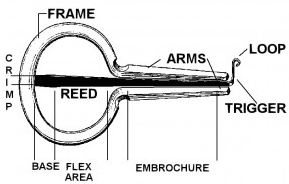
The jaw harp is small metal instrument that is played by using one’s mouth and right hand index finger. To get started simply rest the instrument between your lips, while holding the left side of the instrument with your left hand. There are many different models of a jaw harp, and some may require you to press the frame onto your lips against your teeth. The right hand is used for plucking the loop of the instrument, which then vibrates the reed. The “boing” sound is created by simultaneously plucking the loop, and moving your tongue. The faster you move your tongue, the more vibrant the “boing” sound will be. The lower your tongue sits in your mouth, the lower the pitch will be. If you move your tongue to the roof of your mouth, the pitch will sound higher. You can also change the pitch by making  “oo-ee” shapes with your mouth. This sounds like a relatively simple concept, but I struggled a lot with understanding how the instrument works. I guess since I’m so used to focusing on my breath because of singing, I thought in order to play the jaw harp I would need to blow air through the reed. I quickly learned that no air is required to produce a sound on the instrument. However, the process of breathing into a jaw harp is a common practice used for some genres of music. It’s surprisingly a pretty popular skill in the techno music world. In this video, Mirko Muni shows off his techno jaw harp skills by experimenting with breathing in and out while playing the jaw harp. 

A little known fact, is that the jaw harp is also associated with the invention of other well-known instruments. In this TED talk, guest speaker Valentinas tells his audience that the invention of the harmonica “is based on several little jaw harps connected together.” He also mentions that the accordion was made in a similar way. This explains why the jaw harp blends so well with these two instruments. You’ll often hear the jaw harp being played with harmonica, accordion, or banjo in bluegrass! It’s interesting to think that two well-known instruments were made possible by one simple instrument few people have heard of. It makes me wonder if other instruments were originated in a similar way. If so what are they?

TED talk speaker Valentinas also touches on the origin of it’s name. “It has nothing in common with Jews, Jewish, or Judaism. Very simple, this name ‘jews’ came from English word ‘jaws’, mouth, so sometimes it’s called jaw harp or mouth guard.” He mentions that it has around 900 different names, and is known as one of the oldest instruments in the world. Michael Wright, author of  The Search for the Origins of the Jew’s Harp states that “the beginnings of the instrument suggests an Asian origin…Bamboo examples are played throughout Asia and Polynesia, but because of the basic structure of the single reed concept, it is possible that the instruments evolved in various ways independently rather than from one single source.” The picture to the right shows four jaw harps carved out of bamboo instead of metal. 

Jaw harps also make fun cameos in cinema. They’re most popular in western movies, and actors often actually learn how to play them! Here is a little montage of the jaw harp in cinema!

Sources:

http://www.silkroadfoundation.org/newsletter/vol2num2/Harp.htm

https://www.youtube.com/watch?v=4SpWuseQGys

https://www.youtube.com/watch?v=RKHgIERB5rQ

https://www.youtube.com/watch?v=CkPlk4BSSMY

https://www.youtube.com/watch?v=QkldkfoeVQc

http://www.jewsharpguild.org/history.html

https://bernunzio.com/


The Trombone and It’s History

What is the first thing you think about when you hear the word trombone or see someone playing one? Is it a marching band going down the street in bright red uniforms? Is it a long glissando in an old cartoon when a character does something silly or falls down? I bet it’s not a 15th century brass instrument most commonly found alongside two schawms. One of the things I find so interesting about the trombone is it’s versatility. Today, one can find trombonists playing all kinds of styles and genres ranging from jazz combo to symphony orchestra. Trombone plays a vital part in brass quintet, as well as big band. There are usually at least three of them in any wind ensemble, and even more in a larger symphonic band! New music in the 21st century loves the trombone because of it’s uniqueness in being the only brass to legitimately get a long and very crass glissando. I personally think it’s very annoying when I come across a piece of music written in the last one hundred years and my part is primarily whole notes at a loud dynamic, followed by a bunch of glissandi (that are sometimes physically impossible due to a composer’s lack of knowledge regarding the physics of the trombone). The reason for this being the fact that trombone is also extremely capable, like most all other instruments, of playing a beautiful melody or complimenting a melodic line in other ways than extended technique.

Encyclopedia Britannica describes the trombone as such: “Trombone, French trombone, German Posaune, brass wind musical instrument sounded by lip vibration against a cup mouthpiece. It has an extendable slide that can increase the length of the instrument’s tubing. The slide thus performs the function of the valves on other brass instruments.”

I like this description a lot, but the one thing it leaves out is the sackbut. Saqueboute in French, translates nicely to describe the modern trombone in the words “push-pull”. The first sackbuts appear in the year 1400 in Southern France (Eliason), and by 1420 had become while not universal, an accepted fact of the musical scene. The Sackbut was a development of the trumpet with an extendable slide instead of valves that increased the length of tubing, changing the pitch like the modern trombone. Like the trumpet, it had cylindrical bore flared to a bell, but a larger mouthpiece and cross section resembling a coronet. The bell of the sackbut had a five inch diameter and no finish on the rim, and also crooks that made the pitch of the instrument higher or lower depending on their material and size. These were considered tenor sackbuts, but by the beginning of the 17th century there were different sized instruments for alto, bass, and contrabass. 

The early trombone, or sackbut, had a multitude of different functions when it was introduced to the musical world. In the early 16th century, vocal groups were commonly alternating with organs or instrumental groups, but eventually the instruments would accompany and often times double the vocal parts.  The trombone has been described as the closest instrument to the human voice, so this feature of doubling is not surprising. This tradition carried on into the mid 19th century, as the trombone became less of a novelty and more respected in the orchestral setting.

By the mid 1800’s, sackbuts had become trombones in a much more modern sense. The bells became much larger and thicker to create the intended larger sound of composers such as Wagner and Berlioz of the time. Wagner used trombones heavily to portray feelings of heroism, might, and barbarism. But also by that time and into the early 20th century with people like Tommy Dorsey and Emory Remington, the trombone started to develop its lyrical singing side, putting aside the loud and pompous ideals that Wagner and earlier composers thought so important, creating a new and much more versatile personality for an instrument with an unfortunate first name.

The Metal Air Tube Through History

6:30am my alarm goes off and I start my day. I throw on whatever clothes I can find and I grab my case packing 4 incredibly unique instruments. Instruments with a history I can only attempt to comprehend. I play the trumpet, an instrument that dates back as early as 1500BC, with the first metal trumpets being found at King Tut’s tomb in ancient Egypt along with similar instruments scattered through Asia (1). Inspiration for the instrument stemmed from the use of conch shells, the trumpet recreated the original sound of blowing wind through the shell. What we now use for music, was once used as a tool in militaries and religious purposes. Through its evolution, the trumpet was first made of bronze, and through time we now have trumpets made up of brass with coatings of silver and gold.

The earliest of valves for the trumpet wouldn’t come around until 1814, with the first form of valve invented by Heinrich Stolzel (2). Until this time, trumpets were as simple as one elongated tube, wrapped around itself until the desired length/tuning was achieved. The newly made keyed trumpets would make its debut in Haydn and Hummel’s trumpet concerti, and would serve a big role in Hector Berlioz’s Symphonie Fantastique with his use of the cornet. The newly developed cornet featured a new piston valve system developed by Francois Perinet in 1839 (3). With the development of the cornet and modern trumpet, the presence of the trumpet dramatically increased. More solo works came to life and music for brass become much more complex and prominent, achieving new pitches and gaining access to quarter tonal musical abilities. Fast forwarding to present time, my horns are made from a yellow brass foundation and are plated with silver and/or gold. Two of them were built here in the United States, one from Elkhart Indiana, and the other from Anaheim, California. I’ve had some customization with my trumpets, and some of the parts come from Japan.The US has a rich history of modern piston trumpet making, with famous techniques and formulas originating in the 1920s. Below I’ve included a link with a video showing the creation of a modern trumpet. Although most trumpets are factory made, there is still a significant hand-crafted element to every instrument, so every trumpet is different from another, even if they came from the same designs.

The other two trumpets in my case originated from Spain, a manufacturer that has a history for creating beautiful “small horns”. These small horns are higher pitched than the standard trumpets we typically see, and their origins come from the smaller cornets used in early British Brass Bands. These trumpets are typically used for early music, and for recreating sounds of the past. One is gold plated and the other silver. These materials serve to create different timbres in sound, the silver being more brilliant and the gold having a richer quality. These finishes on trumpets weren’t seen until the early 20th century.

Aside from the physical trumpet itself, the mouthpiece is an essential partner. There is almost more science to creating a mouthpiece than the trumpet. There are infinite possibilities when pairing a mouthpiece to a trumpet, because there are an infinite number of trumpet players all with different facial structures. John Storck’s “Understanding the Mouthpiece” describes the various shapes a mouthpiece can have, and has worked with world class trumpeters to create mouthpieces that can best suite every player (5). I play on a mouthpiece that was influenced by former New York Philharmonic Principal Trumpeter William Vacchiano.

Each time I go to practice, I’m playing the result of thousands of years of musical and mechanical evolution, each piece is the culmination of ideas of inventors across history, and it’s incredible that I can enjoy the fruits of their labor and utilize these tools to create beuatiful art.


Sources:


  1. “A short history on the trumpet”, Tony Guerrero. http://www.wwbw.com/the-music-room/a-brief-history-of-the-trumpet
  2. “The evelution of Brass Instruments and Orchestral Brass Writing From the Late Classical Period to the End of the Romantic Period”, Ken Jimenez. December 19, 2011. http://www.d.umn.edu/~rperraul/MU5204-EnsembleLit/KJimenez.pdf.pdf
  3. “The History of the Cornet, from pre-history to the present”, Greg Monks. http://www.blackdiamondbrass.com/tpthist/trpthist.htm
  4. “Bach Trumpet Tour”, Feb 24, 2015.  https://www.youtube.com/watch?v=y9XYQHBBp9I
  5. “Understanding the Mouthpiece”, John Storck, 1989.

Welcome!

Welcome to the class blog for MHS 123/223: Music and Technology in the Twentieth Century! We’ll be building a repository of shared knowledge, opinions, and thoughts based on what we learn in class. The more you’re able to comment on posts by your peers, the better!