Victor Jara

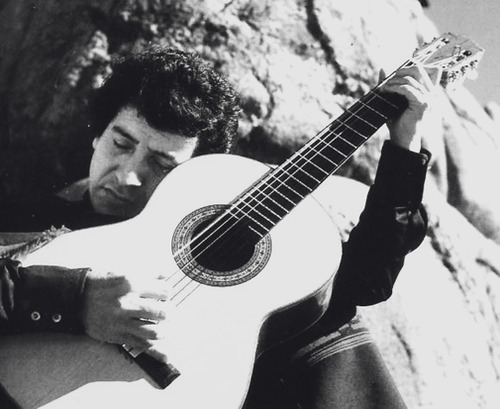
As musicians, sometimes we get to experience our art, but other times we sacrifice ourselves for it. Victor Jara, a Chilean musician, teacher, and strong political activist “used to play guitar and write folk songs. But a soldier chopped his hands with an axe and machine gunned him to death so he couldn’t play guitar anymore. When I first read this sentence from Andrew Tyler’s article I was in shock. It’s heartbreaking when politics get violent, and innocent people lose their lives. Victor Jara’s death stands for democratic social change in Chile. Even though he died for what he believed in, his music and spirit both still live on today. 


Victor Jara started out singing in the neighborhoods of Chile as a 1960’s protest folk singer for human rights. He was a member of the New Chilean Song Movement, and was a supporter of the socialist Salvador Allende. Salvador Allende was the president elected in 1970 who initiated many social programs. During the election season, Jara wrote a song for Allende’s movement titled Venceremos, which translates to We Shall Triumph.

Prior to the election in 1970 the United States CIA ran propaganda campaigns to discredit Allende, showing the United States dissatisfaction with his new government.  According to interviews with Amy Goodman of Democracy Now, Allende planned to nationalize private United States corporations. The Allende government of Chile wanted to negotiate how

to compensate the United States corporations so they would finally leave Chile. In particular, the main telephone company of Chile, and the owner of Sheraton Hotels ,  ITT Corporation.  Henry Kissinger and Nixon refused these negotiations and planned a violent “coup” in 1973.  Bill Clinton declassified the CIA documents showing that the CIA trained DINA (secret police) invaded a helicopter, and murdered the Commander in chief of the Chilean armed forces. Allende eventually committed suicide and the brutal dictator Augusto Pinochet, took control of Chile.  

Chile was not in great shape during this time in history. More interviews with Democracy Now tell the story of Victor Jara’s death. He was arrested along with thousands.  (30,000 had been referred to as “the disappeared”) He was singing to the people in the Santiago soccer stadium where the executions were taking place. According to Democracy Now, as his wife described what happened, he was well  recognized and one soldiers said “that one is for me. He was tortured, in particular his hands smashed so he couldn’t play guitar. He was shot and his body was recognized after being dragged on the streets and claimed by his wife when a friend informed her a week after the coup that his body was at the morgue. He wrote one last poem that night in the stadium to document what happened.  It was somehow smuggled out of the stadium and eventually put to music by Pete Seeger
Victor Jara, saw what was happening politically in Chile and decided to take action by sharing his art. He incorporated his beliefs through his musical creations to promote peace, but the government silenced him. If I’ve learned anything from Victor Jara’s story, it’s that he has inspired many other artists to stand up for what they believe in. Politics always try to control what we do, but in the end music continued to fight back with creativity and truth.

http://www.vjvive.com/?page_id=14

https://www.theguardian.com/music/2013/sep/18/victor-jara-pinochet-chile- rocks-backpages

https://www.democracynow.org/2016/6/29/former_chilean_army_officer_found_liable

https://www.democracynow.org/1999/10/8/documentary_on_legendary_chilean_protest_singer

http://www.angelfire.com/ca3/jphuck/BOOK3Ch3Part5.html


Strange Fruit

Music has always been a powerful emotive force that is able to explain events that words alone cannot. Because of this, it has the ability to shed light on some of the darkest and most feared issues in the world. “Strange Fruit,” sung by Billie Holiday in 1939, brought attention to one of the most horrendous moments of American history: racism and the unfair discrimination towards African Americans.  

As an African American artist in the 1930s, Holiday had experienced racism throughout her career. She had performed in mostly “high-society,” white venues but wasn’t allowed to even enter the front of the house. She had to take a freight elevator up to the stage because she was not allowed to share the elevator with white patrons. Although she was one of the best jazz vocalists of all time, she truly understood and experienced the heartbreaking reality of racism in America.

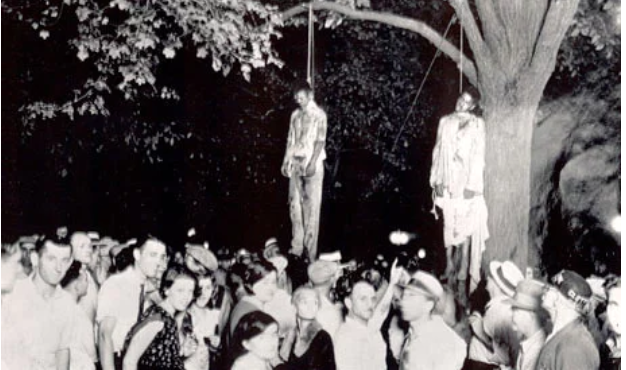
The birth of “Strange Fruit” occurred after a Jewish white school teacher, Abel Meeropol, saw a horrific photograph of a lynching of two black men in Indiana.

Outraged and upset, he wrote a protest poem that was later used as lyrics for Holiday’s song. The lyrics depict the lynched black men as “strange fruit” hanging from trees as they rot in the sun for birds to eat. The song uses physical imagery and strong metaphors, making the scene come to life in the listener’s mind.  

Southern trees bear a strange fruit

Blood on the leaves and blood at the root

Black bodies swinging in the southern breeze

Strange fruit hanging from the poplar trees

[Verse 2]

Pastoral scene of the gallant south

The bulging eyes and the twisted mouth

Scent of magnolias, sweet and fresh

Then the sudden smell of burning flesh

[Verse 3]

Here is fruit for the crows to pluck

For the rain to gather, for the wind to suck

For the sun to rot, for the trees to drop

Here is a strange and bitter crop

The song debuted in New York’s first integrated club. Holiday’s manager knew it was extremely heavy and programmed it at the very end of her performance. Waiters stopped serving before the performance of the song, and no encore was performed. Holiday’s dramatic and heart wrenching interpretation continuously left all of her audiences stunned, and most responses included silence followed by a tremendous applause of approval. 

The song was extremely controversial, and Holiday’s regular recording label refused to record it.  She was released from her contract and forced to find an alternative record company to complete her recording. It was eventually produced and sold over 1 million copies, making it Holiday’s most sold record.

The recording of “Strange Fruit” was the first time a black artist had ever released something so controversial, and some consider it a contributing factor to the beginning of the Civil Rights Movement.  Artists such as Nina Simone and John Martin went on to record it, and Time Magazine named it the Song of the Century in 1999. It has continued to impact people today and has been inspiration for a novel by Lillian Smith, an opera  by Chandler Carter, and a song released in 2014 by Kanye West, “Blood on the Leaves (Strange Fruit)

https://www.youtube.com/watch?v=SPhsSzfAoBA

Every musical creation has a history and story behind it, and it is an integral piece that must not be forgotten. Even if a work has a strong political message, it should not be overlooked or hidden from its audience. If no one had paid attention to the political issues in “Strange Fruit,” the Civil Rights Movement may not have developed as soon as it did. Billie Holiday’s song changed history, and all artists should have the desire to change the world the way she did. 


https://en.wikipedia.org/wiki/Strange_Fruit_(novel 

Politics/Community of Jazz

Jazz music has historically been a part of a much broader culture, specifically with African Americans. The music has unified communities, protested injustice, and most importantly been a vehicle for self expression.

Integration in Jazz Bands

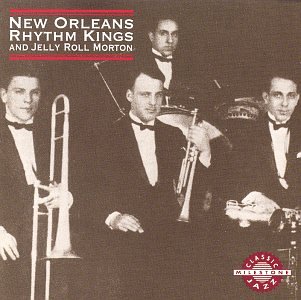
While jazz has influences of spirituals and work songs, it also has a heavy influence of western European harmonies. However, it started as mainly an African American art form. As technology prevailed in the early 20th century, the recording studio and invention of the radio became a significant way for black musicians to be heard. “Opportunities were given to black musicians by the radio and recording industry and popular black bands were promoted as long as there was a demand for jazz music by white Americans.” This was an important leap forward socially for black Americans, as the demand for jazz music was high. Another thing that occurred in the realm of jazz was the integration of orchestras and bands. Back then, it was common to have all white or all black jazz bands. However, these bands started to become integrated around the 1920’s. Black musicians would play in white bands and vise versa. One of the earliest examples of this integration was when Jelly Roll Morton, a famous creole. pianist, recorded with the Rhythm Kings, a white jazz band. This was an extremely unusual since people of any color in America were harshly discriminated against. Jazz culture was a beautiful thing because in a world where there was crude social injustice against the underrepresented minority Americans, jazz culture began to promote unity in some ways.

Jazz and the Civil Rights Movement

In the 1960’s Jazz had collided with the civil rights movement. Jazz had gone through many transformations by this point since the beginning of the 20th century. The evolution started mainly with New Orleans  jazz, then evolved into swing/dance bands, and then bebop, cool jazz, and hard bop. In the 1950/60’s, an emergence of free and avant garde jazz occurred. (This is a generalization). One of the main leaders of this new music was Ornette Coleman. Free jazz was all about the individual, and the freedom of expression as it delineated from traditional forms of jazz and music in general. In the 1960’s the civil rights movement came into place. There was a huge reaction to this movement in the jazz community, as many black musicians made their voices heard through their music.


An example of a musician reacting to this was John Coltrane’s “Alabama,” which he wrote about the Birmingham church bombing in 1963. 

In 1959 bassist/composer Charles Mingus recorded an album entitled “Ah Um.” This album had a track on it called Fables of Faubus, which was a response to Orval Faubus’ prevention of nine African American students’ attendance of a school in Arkansas, even after Eisenhower integrated schools in America. Fables of Faubus was a part of the civil rights movement, and here are the Lyrics:

Fables of Faubus:

Oh, Lord, don’t let ’em shoot us!

Oh, Lord, don’t let ’em stab us!

Oh, Lord, no more swastikas!

Oh, Lord, no more Ku Klux Klan!


Name me someone who’s ridiculous, Dannie

Governor Faubus!

Why is he so sick and ridiculous?

He won’t permit integrated schools

Then he’s a fool!


Boo! Nazi Fascist supremists!

Boo! Ku Klux Klan (with your Jim Crow plan)


Name me a handful that’s ridiculous, Dannie Richmond

Faubus, Rockefeller, Eisenhower

Why are they so sick and ridiculous?

Two, four, six, eight:

They brainwash and teach you hate

H-E-L-L-O, Hello

Musicians like Charles Mingus, John Coltrane, Nina Simone, and more made their voices heard through powerful music that was written in response to the civil rights movement of the 1960’s.

Unfortunately, there is still a great deal of social injustice against African Americans today, and we keep seeing responses to this all over the place. Recently, the quarterback of the San Francisco 49ers ,Colin Kaepernick, sat while the national anthem was played. He said that “I am not going to stand up to show pride in a flag for a country that oppresses black people and people of color.” This is an example of a modern day response to the injustice at hand. Kaepernick wanted to make a statement, so he refused to stand during the national anthem. This is not unlike how certain people reacted through music during the civil rights movement. “To me, this is bigger than football, and it would be selfish on my part to look the other way. There are bodies in the street and people getting paid leave and getting away with murder,” Kaepernick said. Whether it is through sports or through music, it is important that underrepresented Americans of color have their voices heard. We have seen this been done through music during the civil rights movement, and in protests worldwide. Through media, more and more people are being informed of the problem at hand every day.

Why Jimi Hendrix’s Rendition of “The Star Spangled Banner” is More Relevant Than Ever

It’s well known that the 1960’s were a unique and crazy time in United States history. The civil right’s movement, the assassination of President Kennedy, the controversial policies of President Nixon, the Vietnam war, the space race/moon landing, the complete overhaul of the popular music world as Rock and Roll swept in from England, and many other phenomena set a political stage where controversy roared. It seemed impossible to make a meaningful statement that people would listen to.

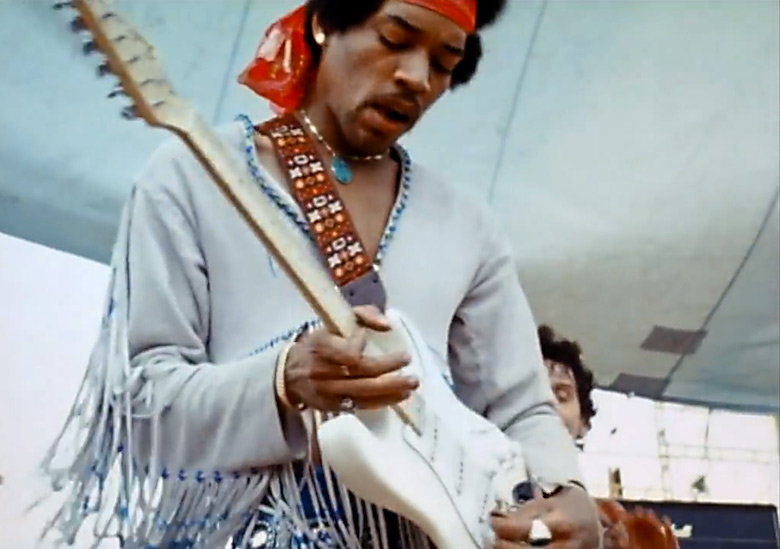
Amidst all of this, on August 18th, 1969, Jimi Hendrix did just that. On the final day of Woodstock, towards the end of his set, he played a distorted, extended, somewhat mangled version of the star spangled banner. If you haven’t seen and heard it before, check it out before you read any further.

https://www.youtube.com/watch?v=MwIymq0iTsw


Jimi Hendrix at Woodstock, 1969                            http://www.guitarhive.com/images/Hendrix-Woodstock_small.jpg


Hendrix plays the melody painfully slowly, lingering on every moment and letting his guitar feedback into his wall of amps. He is accompanied only by drummer Mitch Mitchell-http://www.drummerworld.com/drummers/Mitch_Mitchell.html. Throughout the entire song he lets his vibrato pedal create a churning effect on his sound, almost like the whirring off helicopter propellers starting up-http://www.rockprophecy.com/shop.html. Following the lyrics-”rocket’s red glare” he uses his tremolo bar and string-bending to morph his guitar’s feedback into a violent visual. After “bomb’s bursting in air” Hendrix uses his guitar’s whammy-bar to drop the high note down over two octaves, crashing into harsh noise as bombs dropped in Vietnam across the world. He even quotes “Taps”, the bugle call played at military funerals, so as to lament the military lives being lost in that same conflict http://www.music.army.mil/music/buglecalls/taps.asp. Regardless of one’s opinion on it as a piece of history or a political statement, I don’t think anyone can deny that the performance is encapturing.

New York Times writer William Robins points out that the Star Spangled Banner has a “long, polarizing history” in which Hendrix’s performance is only a chapter. There was a harsh parody of the song made in 1844 criticizing the lingering institution of slavery in which the last line is “O’er the death-bed of freedom/ the home of the slave. –https://www.newyorker.com/culture/culture-desk/colin-kaepernick-and-the-radical-uses-of-the-star-spangled-banner. Since then it has long been a target vehicle for critiquing the state of the nation, as is true today with the Colin Kaepernick/NFL protests.

And it’s in light of the recent political climate that I believe that Hendrix’s interpretation of the anthem is as meaningful as it has ever been. Instead of bombs dropping on Vietnam it’s on the middle east. Instead of Nixon’s hardline republican policies it’s Trump’s heartless and insane policies. The anger in the performance could just as well be directed at the killings of Trayvon Martin or Philando Castile as it could that of Martin Luther King Jr. The patriotism in Hendrix’s beautifully powerful sound as he screams the melody still applies to those who are able to look past the numerous deep problems the U.S has and appreciate the beauty of the nation. Woodstock attendee said that Hendrix’s performance “was the most electrifying moment of Woodstock, and it was probably the single greatest moment of the sixties. You finally heard what that song was about, that you can love your country, but hate the government”-https://hooksanalysis.wordpress.com/2014/06/14/improvised-jimi-hendrix-star-spangled-banner-1969-and-john-bonham-moby-dick-1970/. I believe that in current times, as a misogynistic narcissist runs the country, and every American lives with the knowledge that our private information is legally sold from corporation to corporation through questionable means, that message holds up powerfully. 

On the Dick Cavett show  in 1970, Cavett remarked that Hendrix was bound to recieve some “nasty letters” about his performance of the anthem, which Hendrix quickly shrugged off saying “I thought it was beautiful.” And to me that inner confidence that Hendrix had about his work is part of what makes it so great. I personally hear it every time I listen to the Woodstock national anthem performance, and I hope it inspires any listener to have that confidence in the beauty of the USA, while acknowledging it’s flaws and struggles.

.

Carmina Burana and It’s Ambiguous Origin

Considering it’s morally ambiguous past, Carl Orff’s Scenic Cantata Carmina Burana, can be heard by the general public everywhere from Ozzy Osbourne, Old Spice ads, and even Domino’s Pizza Commercials. Premiered in 1937 by the Frankfurt Opera and Bertil Wetzelberger and supercharged with conflicting undertones, Orff’s explanation of Carmina Burana created lots of conflict between the Axis and Allied powers of the second world war regarding Orff’ political standings.

Part of the reason Carmina Burana was such a success was because of it’s accessibility. Orff utilized a large modern orchestra, full chorus, and solo voices. The music has been shown to emulate and be derived from Stravinsky with maximalist Wagnerian features. Originally Orff was accused of using undesirable jazz-like rhythms in a Stravinsky-esque style, but Nazi Officials overlooked this fact once they realized the piece’s potential for propaganda. Another reason this was overlooked was by the common folk and dance elements also found in the piece.

One interesting tidbit of this history is that Orff was supposedly one quarter Jewish, making his political stance in the Nazi party particularly interesting. He was known to be friends with prolific Jews such as Kurt Weill and Franz Werfel while living in German. The most common explanation is that Orff simply took advantage of his popularity among both sides and used it to make money, and an interesting example of this can be seen in Frankfurt when Orff was documented in taking a commission to rewrite Mendelssohn’s A Midsummer Night’s Dream score. He later denied this when the Allied powers were determining his employment status after the war ended. By believing his lies, his status was made “Gray-Acceptable”, and made him eligible for work in the Allied military government. Another way Orff’s employment status was hazy during the war was his actual employment in the Nazi regime. For multiple years, he was awarded a job composing music for the Hitler Youth and teaching music. He tailored the curriculum and music to align with the Nazi ideals, stressing folk music and emphasizing the negative impacts of jazz and atonality.

Finally, the most ambiguous part of Carmina Burana is the music itself and the undertones presented within the score and text. The title translates to Songs of Beuren (a Benedictine Monastery in Bavaria). The entire scenic cantata contains a total of 24 songs set to music, the text itself came mainly from the Burana Codex, a compilation of medieval poetry, speaking of sin, passion, lust, and even gambling and drinking. This is the first layer of of confusion as to why the Nazi’s used it as propaganda. The reason ties into a deeper meaning below the surface. The music contains many folk melodies and dance rhythms making it very easy to listen to. It also describes pastoral images of the forest and the Earth in a Wagnerian manner similar to that of the Ring Cycle. Hitler was a supporter and fan of Wagner’s music because it appealed to his ideology of the ancient forest and timeless German landscape for the perfect Aryan soldiers. While this was obvious to Hitler and the Nazi’s, it was not obvious to everyone, and Orff never clarified what his intent behind the piece was. In the end it seems like Orff was just an opportunist who slyly got away with appeasing both sides of the war depending on who was in power.

In quite a different situation and a different time, Colin Kaepernick has been doing quite the opposite of Orff in his stand against standing for the anthem. While Orff shied away from the fact that he was potentially part Jewish and still made money off of the Nazi’s when he might not have believed in their ideas, Kaepernick has taken a stand against the ideas he disagrees with and openly risks his career and public image for it. Perhaps Orff had a little more on the line, but racism in America now has become violent, so perhaps Kaepernick is risking more now than ever.

The History of the Sample

With the vast quantity of recorded music, now in an ever more accelerated pace of expansion with the music sharing sites such as Bandcamp and Soundcloud, and technology (logic, ableton, pro tools) in place to quickly download, move, and tamper with audio files, the question arises, is there any point to creating new sounds or composing new pieces, of utilizing analog sources to create familiar sounds and songs of all too familiar character? The catalog of recorded material is already so great that it would take thousands of lifetimes to listen to it in its entirety, but perhaps even more exciting or intimidating are the countless ways in which to alter and create entirely new purely from this great catalog.


While the radical idea of all modern music being entirely created from past records hasn’t taken hold, sampling in fact entered into the mainstream years ago and has remained there today. For example the music of artists like Kendrick Lamar includes samples, and his new album is on the billboard top 200. I wouldn’t be surprised if most of the music on the billboard 200 includes samples, as samples are ingrained into the way a lot of pop music (primarily black music) is produced. While the process and utilization of sampling has changed, its popularity has remained constant in changing populations for roughly 40 years.


This idea to create music purely or partially from previously recorded material began in the late 1940s with a man named Pierre Schaeffer. He spliced together and looped different tapes together to create music. Schaeffer’s believed that classical music began as an abstraction that was later produced as audible music. He strove to start with “concrete” sounds and late abstract them into music. This began the term “musique concrete”.

This process of tape loop sampling was taken up by a wide range of artists from minimalists like Terry Riley to people like John Cage to jamaican dub producers like King Tubby and Lee “Scratch” Perry. All of whom utilized tape recordings in their own unique and preconditioned musical language.


In the 1960s a new process of sampling emerged, this was digital sampling. The most notable early samplers were the Mellotron, the Fairlight CMI, and later the Akai MPCs. The digital samplers took pre recorded sounds into an interface which could be played with ease; the musician could play and sample he or she want to with the push of a button. The earliest innovators with this new technology were bands like Yellow Magic Orchestra and Big Audio Dynamite.https://www.dawsons.co.uk/blog/the-sampler-a-history-in-5-landmarks

Sampling however became most widespread and popular not in synth based pop music but in hip hop. In fact, sampling has been engrained in hip hop from the beginning, hip hop has a history not of analog or digital instruments, but of utilizing turntables and samplers to create music from pre-recorded sounds. The beats in popular hip hop from the 70s to around the mid 200s centered around break beatsl; beats taken from isolated drum sections of funk songs and looped. For example, the isolated drum beat from the James Brown song “Funky Drummer” has been sampled countless times in both hip hop and jamaican drum and bass and jungle music.

Not only were break beats sampled though, hip hop producers looking for melody and harmony as well as good bass lines turned to whatever they had in their record collection in order to create good music derived from a patchwork of previously recorded material.   

Today sampling is more fluid and there are mountains sampling software. Altering the sample is also very easy- there is software for it. At this point one finds that as a composer it’s equally acceptable to be fluent in the language of theory as it is to be fluent in the language of the sample.


http://singletrackworld.com/forum/topic/albumsbands-who-use-lots-of-samples

https://en.wikipedia.org/wiki/Sampling_(music)

http://120years.net/musys-and-mouse-audio-synthesis-language-peter-grogono-untied-kingdom-1965/

Mass Production

The birth of the first cellos were made almost 500 years ago in Italy by Andrea Amati. They were hand carved pieces of art, and all of the decisions were very deliberately made. The craftsman needed to know exactly which wood to use for each part of the cello, and how to fit it with strings and bridges that would resonate the most on that particular cello. Now in the 21st century, professionals strive to play on those old beautiful instruments especially by the widely popular Stradivarius and Guarneri, which have rich tones and can produce many different qualities of sound. However their prices can become rather high; from hundreds of thousands to millions of dollars. Is it worth spending all that money for a handcrafted, old instrument? Many of the strings and bridges string players use on their instruments cost a fortune on their own, cello string sets costing around $300 and lasting for only a few months. To get a full set of one of the most popular strings for cello, “Larsen”, it costs $227 on Amazon. To get your bow rehaired at Sullivan Violins in Rochester it costs $70, and to get a new bridge could be in the hundreds. Repairing your instrument will always be expensive, so why not buy a mass produced computer-perfected instrument?

Recently, the Chinese have started to sell instruments in the violin family that are under $5,000 (I’m playing on one right now). These instruments, although not as brilliant as a Strad, are not too shabby. They can have beautiful sounds, and can be fixed up with proper strings and a better bridge if needed. The reason these instruments are so cheap, is because they are partially (if not fully) factory made. Yes, instruments are becoming mass produced products, rather than finely crafted pieces of art. Some will be painted with spots trying to look old and used, to appeal to an audience or buyer that appreciates antique instruments (kind of the equivalent to pre-ripped jeans).

Although this baffles the mind of most classical string players, these cellos and violins are not the first factory made and mass produced instruments. Super-stores are selling guitars for very cheap. “Huge U.S. chain stores, such as Costco, Wal-Mart and Sam’s Club, are beginning to sell low-cost instruments, appealing to spontaneous buyers. Those stores have been partly behind a fivefold increase in the sales of electric and acoustic guitars in the U.S. market since 2000. ‘The average selling price (of a guitar) has gone down from $630 or $640 to somewhere in the $300s. That is almost a direct result of Chinese manufacturing,’ Lamond said”. These mass produced instruments are changing the way we think about music and craftsmanship. Is it important to always require authenticity and individuality as artists? Even for poor college students who just want to learn how to play guitar in an elective class during their first semester sophomore year?

This applies to all forms of art, not just music. Just the other day I was shopping in my favorite store, Target, and I saw many pieces of art for sale. It was very obvious that a computer had created it, my good friend Raina pointed out the straight lines on the canvas that suggested an automatic machine painting in a factory setting.

There were many upsetting aspects to this “wall art”, but there were also some nice things to consider. The price is always fairly cheap at Target, the symmetry can be very pleasing to the eye, and the colors in the painting are very real and don’t have anything to do with the artists themselves. If the buyer is not an art expert and wants something that will brighten up the room rather than something to really sit and think about, this should be perfect for them.

So is it really important that someone is handcrafting your instrument? Aren’t machines made to perfect what the human body cannot do on its own? For some it isn’t important, and that is okay. Not everyone needs to be an expert on what the latest painter likes, or all the latest fashion trends, or have the most beautiful sounding cello. Some buyers really want to experience something raw and human; to notice a connection between themselves and the artist. It is obviously not essential to use machines, as the best instruments we have are made by craftsmen in the 17th and 18th centuries who made glorious instruments all on their own.

But do these instruments really sound different? In a blind test where a violinist played the same piece on a Stradivarius and a modern instrument, the results were never actually what we would expect. Some of the time performers and listeners would like the Strad the least!

https://www.youtube.com/watch?v=ZtlTJkbUqkA

Does this mean that mass produced instruments can sound the same as a Strad? Is there actually a difference in the instrument’s sound, or are we just pretentious? Maybe spending thousands or millions on a fancy instrument is just a waste of money, and buying mass produced instruments is the way to go.

On V-Picks and Why They’re overrated

On V-Picks and Why They Are Overrated 

By Garrett Mader 


A collection of standard celluloid guitar picks

The pick, or more formally plectrum, is a small, generally triangular object that a guitarist, banjoist, or mandolinist holds in/attaches to their dominant-hand to strike their guitars’ strings and create sound from the instrument. Picks date back to the start of recorded history, with writings about music from ancient greece recounting that Lyres had picks attached to them by a string(https://www.premierguitar.com/articles/25204-the-surprisingly-long-history-of-the-guitar-pick).Those picks were made of ivory, bone, or wood, while since approximately 1922 the most common material for picks has been celluloid (http://surfpick.com/history/). Today the market for picks is massive and varied from brand to brand. For the purpose of this blog, however, I would like to narrow in on V-Picks.

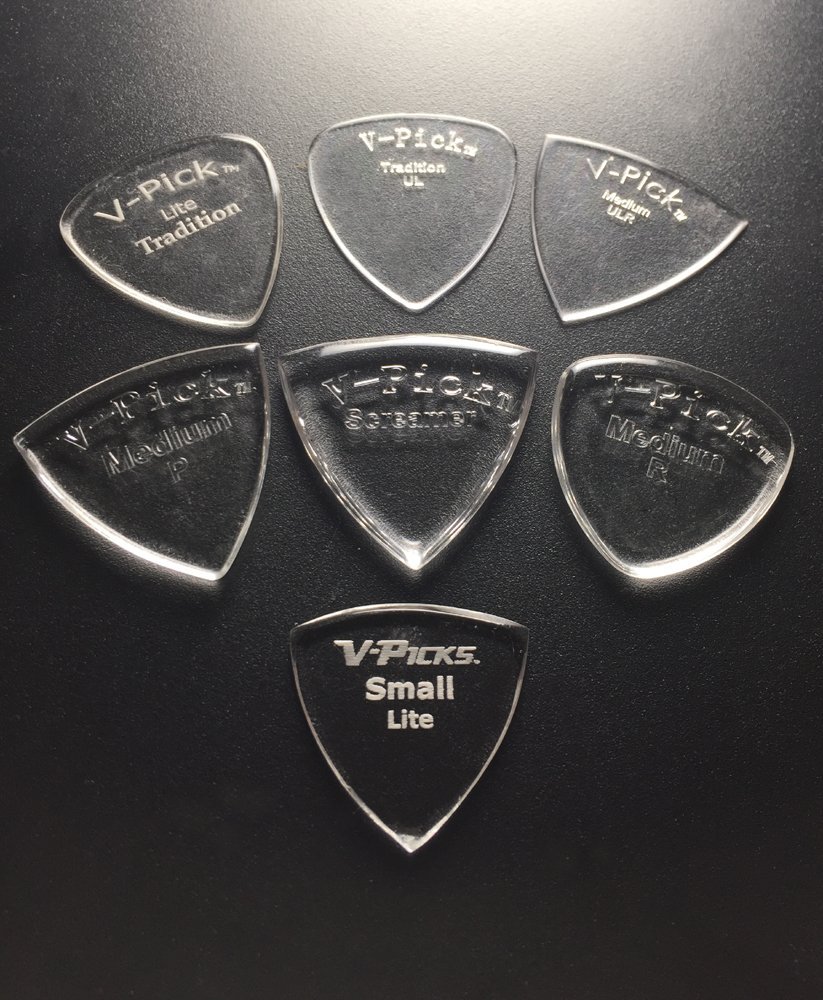
Some of the many varieties of V-Picks


V-picks are the creation of amatuer guitarist Vinni Smith (v-picks.com/v-picks-about-us/). They are produced in Nashville, TN and Modesto, CA. They’re made sheets of acrylic instead of celluloid, giving them a sleek, glossy look, and smooth feel. Acrylic is essentially a tough plastic used for windows, taillights, and bulletproof “glass”. For a brief chemistry lesson, Acrylic sheets are made by “reacting a monomer, such as methyl methacrylate, with a catalyst,” such as organic peroxide (madehow.com/Volume-2/Acrylic-P lastic.html). I discovered a video on Youtube called “How It’s Made-V-Picks”, in which some fans of these picks visited Vinni in his home and recorded him making a pick. The process is as follows; Vinni takes a sheet of acryllic covered with evenly-spaced V-Picks logos/labels into a laser cutting machine. The laser cutter cuts the acrylic into pick-shapes around the text. The rest of the process is done by hand-a point of pride in V-pick advertising. Vinni takes a pick cutout and puts it to a grindstone to craft the edges to be smoother. After this the pick is too hot to continue working with, so Vinni takes it to his backyard and leaves it in his dog’s water bowl to cool down for a few mins. Once its cooled he dries it on his shirt then puts a hydrogen flame, the clearest known combustible he says, to it to take away the roughness from the grindstone and the V-Pick is finished.  


A V-Pick is more than just the sum of it’s materials and processes though. Guitar-gear culture is a sprawling universe full of kingpin brands (fender stratocasters and telecasters are arguably as standard as TV sets in the American home) as well as niche corners, and V-picks are a relatively new phenomenon (the company started in 2004) that has quickly made itself a widely esteemed product (wikipedia.org/wiki/V-Picks_Guitar_Picks)*. There is a certain reverence for them in the guitar-iverse that doesn’t exist for most products. I believe this is derived from their unique, shiny look and the fact that most people believe they’re made of glass, which seems much classier than plastic. That last bit comes from my own experience; the first several people to mention V-Picks to me all told me they are made of glass. There is also some celebrity endorsement-Carlos Santana and Billy Gibbons have both officially endorsed V-Picks as their main pick brand. Not to downplay the contributions of those guys, who do you know who’s all-time favorite guitarist is Gibbons or Santana? V-Picks are also pricier than your average pick, with a single pick costing upwards of 5 dollars. I believe the elevated price, general esteem, and celebrity endorsement are as much parts of the product as the acrylic and the logo at this point. When a guitarist buys a V-Pick they aren’t just buying a pick but they are buying what hundreds of youtube/guitar forum commenters have told them, and buying the idea that because they are paying more for a pricy, celebrity-endorsed pick that they are buying a more high-end product that will make them a better player in record-time. In the aforementioned Youtube video Vinni himself says of one of his products “I guarantee you this pick will make you a better player”.


I personally think V-Picks are sorely overrated. To me they generally don’t give your sound much mid-range or warmth, and they got scratched up fairly quickly when I tried them which made them sound worse. I respect that some people swear by them, but I believe that they have fallen under the hype surrounding them in the guitar-world. I do respect V-Picks for the brand they’ve created for themselves and the esteem they’ve created for their product, but  when it comes to picks I think it’s always imperative to remember that some of the most iconic guitar solos in the world were recorded by Brian May of Queen using a sixpence, so sometimes simpler is better.


*I understand that generally Wikipedia is not a reliable source, but the V-Picks website explicitly refers those interested in their product to the wiki page, giving it legitimacy in my eyes.  


Links to Media


http://www.guitarmania.co.uk/ekmps/shops/guitarmania/images/assorted-medium-guitar-picks-plectrum-pk-of-12-for-acoustic-or-electric-210-p[ekm]300×229[ekm].jpg


https://www.youtube.com/watch?v=urywl-Jy4yo

https://images-na.ssl-images-amazon.com/images/I/71eysAIzVAL._SL1000_.jpg

History of the Saxophone

The History of the Saxophone


The saxophone is one of the most ubiquitous instruments in America and Europe today. From the jazz clubs to the concert hall to the band room, it seems as though the saxophone is and always has been a common fixture of the musical landscape in America. To the average american, the saxophone is much more familiar to their eyes and ears than say the oboe or viola. This certainly seemed to be the case for me growing up in New Jersey. In New Jersey most people have heard of Clarence Clemons of the East Street Band while almost no one has heard of Juilliard and Curtis educated Principal oboist of the Philadelphia Orchestra John Mack. This is despite the fact the John Mack is a New Jersey Native while The Big Man (Clemmons) is actually from Virginia. Yet, this has not always been the case. The saxophone is a relatively new addition to the woodwind family and did not find its way into american popular music until approximately 1915.


Most instruments in evolve over long periods of time from one more primitive version to a successively more refined version. One may point to C. H. Denner1 who modernized the Chalumeau in the 1740’s as an example of someone “inventing” an instrument. While he did radically improve the instrument by adding the second upper register and addressing intonation issues, he was still building upon centuries of previous designs and methods in order to create his clarinetto. In contrast, the saxophone was invented by Adolphe Sax in 1841 and officially patented in 19462. Sax was a born in Belgium in 1814 to master instrument maker Charles Joseph Sax. By the age of 16, Adolphe was an accomplished instrument maker in his own right3. He had made improvements on the clarinet and cornet and created high quality flutes and clarinets 3. He was also an accomplished musician and had studied at the Brussels conservatory. When Adolphe Sax was creating the saxophone, he was looking to create an instrument which would have the timbre of woodwind instrument but the power and volume of brass instrument. He originally intended for his creation to find its way into the orchestra. With elements from both brass and woodwind instrument families he envisioned it bridging the sonic gap between the two families. However this vision would never be realised.


The saxophone was largely rejected by most “serious” musicians and composers of the day with many regarding it as “unacceptable”. However, the Bb Tenor and Eb alto saxophones were officially adopted into the French military band and thus began the history of popular saxophone music. This is not to say the saxophone was totally out of the classical establishment. Sax himself was instructor of saxophone at the Paris Conservatory and romantic composers such as Jean-Baptiste Singelée5 wrote for the saxophone in the mid to late 1800’s. But most of the music played on the saxophone in the late 19th and early 20th century was military band music. However, around 1915 the saxophone was starting to show up in early recordings of jazz music6. In early jazz music the clarinet was the main woodwind instrument being utilized. However, with its superior projection and volume, the saxophone was a good replacement for the clarinet as jazz band began to play in loud dance halls. Given the saxophones gradual takeover of roles traditionally left to the clarinet, it isn’t surprising that the first jazz saxophone soloist was Sidney Bechet, originally a clarinetist. In the 1930’s the standard big bands grew to have five saxophones, two altos (Eb), two tenors (Bb) and a Baritone (Eb). As big band music matured, the role of the saxophonist as soloist did as well. These early luminaries include Johnny Hodges, Lester Young, Coleman Hawkins, Ben Webster and Don Byas just to name a few.  These early swing players really set the stage for the explosion of jazz saxophonists who revolutionised jazz and american music in the following decades. They inspired the likes of Charlie Parker, Dexter Gordon, John Coltrane, Ornette Coleman and many others who further explored the technical and expressive range of the saxophone.


The saxophone maybe be as important an instrument as the violin when it comes to western (particularly american) music. However, it had its beginnings in unusual circumstances and was nearly doomed to obscurity. Yet through chance and circumstance was propelled to the forefront of musical exploration in the 20th century.


  1. http://www.the-clarinets.net/english/clarinet-history.html
  2. https://www.thoughtco.com/history-of-the-saxophone-2456519
  3. http://www.madehow.com/Volume-6/Saxophone.html
  4. https://www.britannica.com/art/saxophone#ref138721
  5. http://www.dolmetsch.com/cdefss.htm
  6. http://teenjazz.com/the-development-of-the-saxophone/#sthash.HBgXPwhJ.dpbs

Metronomes on My Mind

I super-duper love my metronome. My metronome is one of the oldest musical friends I have, at least in this leg of my musical journey. I have had it since 8th grade and I’m pretty sure I prepared for one of my first All-state auditions with it. Its been with me since day one. Its also been paramount to my musical success as a percussionist and often its easy to forget the role that metronomes in general have taken as a part of my musical growth.
My metronome and the most popular other metronomes on the market today are a part of a line of metronomes called Doctor Beat that are made by Boss. Now the smallest member of this lineup is the DB-30 which is the cutest little clip on thing you’ve ever seen and it was actually the metronome I had before I bought my current one. Then there’s also the celebrity DB-90 which looks like this:

DB-90 Metronome

The DB-90 is best known for single-handedly keeping every single drumcorp or marching band in the country in time. The mere sound of it has been known to trigger traumatic episodes among former band members, causing them to relive the sights and sounds of getting screamed at by their psychotic band director whilst simultaneously getting roasted by the sun. Its clunky silver plastic casing weighs at least a couple of pounds and it quite literally eats 9 volt batteries. It comes with enough weird, useless grungy beat presets to run an underground Polish nightclub along with probably the most disturbing synthetic counting voice samples in existence that have never once helped anyone play in time better ever. And the worst part, at over $150 on most sites, the DB-90 is probably the stupidest piece of technology available. Yet in spite of the the supreme extra-ness of the DB-90, metronomes have come a long way through history to earn the prominence they enjoy in today’s musical culture.
The history of metronomes is actually not all that fascinating. It pretty much starts out in the same place as clocks, where Galileo observed and the described the properties of a pendulum. As time and discoveries progressed pendulums were able to be made with adjustable weights which affected how fast the period of the swing was. In 1814, a man by the name of Dietrich Nikolaus Winkel invented the metronome while studying pendulums. His design was the first truly successful metronome because it made sound and had a spring acting as as escapement that kept it ticking. Winkel was not successful at patenting his “chronometer” although, and in 1816 another fellow named Johann Maelzel took Winkels design, slapped a scale on it designating certain bpm’s, and called it his own.

Maezel Metronome

This type of metronome is the one we have all come to know and love as the “classic” metronome. With the advent of mass-produced electrical appliances in the 20th century, metronomes like the Franz electric metronome began gaining ground. Nowadays most metronomes are digital, but Maelzel’s classic style metronomes still appear and are even written for in pieces like Casey Cangelosi’s “Slight of And Evil Hand.” Their effect on the way we write, perform and interpret our music today is immense.

My personal metronome in particular has a special place in my heart, unlike the teeny DB-30 and the utterly awful DB-90, I have a DB-60 which is juuuust right. It has all of the basic functions that you actually need in a metronome plus a few other actually useful extra ones. Best of all its extremely durable, I’ve dropped it on hard floors all the time, and I’ve changed the batteries less than ten times in the 6+ years I’ve owned it. I recently misplaced it for a few weeks over the summer and I was pretty surprised by how upset I was, I mean this little guy has been with me this whole time and even though its just a metronome, I really appreciate all it can do for me everyday. Its amazing how much I end up using it and its so easy to take something simple like that for granted every day, so even though my heart doesn’t skip a beat every time I see it, this metronome definitely clicks for me ;D