Vietnam War Protests and Rock n’ Roll

The Vietnam War is one of the most controversial wars in all of history. This seemed to be the first time where the majority of people living in the United States were unhappy with the government’s decisions to go to war, and the first time that the government actively chose to ignore the complaints of the people. Protests broke out across the country- in the streets, in Washington, even on college campuses. These protests were very forward, but one way that many people used as a medium to express their unhappiness with the U.S’s involvement in the Vietnam War was through music, or more specifically, rock and roll.

Elvis, the father of rock and roll

Rock and roll first appeared in the United States in the 1950’s and was a fusion of electric blues, boogie, country and jazz. This music was created for the younger generation and explored risqué themes for the time (obviously these themes grew more vulgar as the years went on), but when these songs came out, they were targeted at the younger generation and almost always made the older ones scoff in disbelief. This transformed rock n’ roll into the rebellious and powerful genre it is now. Its music had such a wide fan base, especially in the younger generation, that it was able to serve as a fantastic medium to get thoughts and values of the bands to others, and also served as a way so that the rock and roll fan base could express their own values.

A photo from a Vietnam protest gone wrong

When the Vietnam War began, people already felt that the U.S did not need to be involved since they had already just spent nearly twenty years at war with their involvement in WWII and the Cold War. The Vietnam war also turned out to be expensive, much longer than predicted, and resulted in more than 58,000 american casualties. To state that people were not happy with these facts after not wanting to join the war would be an understatement. The majority of Americans were angry with their government, especially the younger generation since they were the ones forced to go fight in Vietnam: this began a surge of protests across the country, many of which ended up violent, however rock and roll artists were able to take their music and incorporate the emotions they were feeling at the time which began a whole new way people were able to express their opposition to the war.

Woodstock became one of the largest, most famous concerts in the world.
A Woodstock poster

Since musicians were now writing songs left and right urging for a change during this war, there was a greater chance for the people’s voice to be heard. One song that grew very famous and popular during the time of the Vietnam war war was Buffalo Springfield’s “For What It’s Worth.” This song delves into the horrors of the war, and urges people to look around and ask themselves what is really being fought. Springfield also urges everyone to look around and realize how many people are against the war, because if people, specifically those in the government, were to just look beyond their close-minded opinions, they would see how many are angry, hurt, and trying to show their leaders that they are not happy. With this song, it is very obvious that Springfield was trying to bring the war protests to an even greater level. With his ability to share his music with so many, he had the power to bring this issue to light. Although many other people were able to make a difference with their protests, many of the most notable protests were violent ones, and Springfield was able to share his anger and frustration through a peaceful means. These rock bands even began addressing their concerts as a way to protest peacefully: Woodstock was advertised as being “three days of peace and music.” This is very important to note, considering the riots that were occurring at colleges like University of Buffalo, Kent State, and many others. These musicians were able to change the ways people were protesting which resulted in much fewer injuries and deaths, and also showed the government that these people were willing to work out issues in a peaceful and reasonable manner, something they may not have seen through all of the violence in previous protests.

Seeing what all of these musicians did to speak out against war despite the controversy makes it difficult to get angry at the athletes who have begun to protest the National Anthem. Although many people see it as a sign of disrespect, this is a peaceful way to make it clear that they are in opposition to to obvious racism that lies within the anthem’s lyrics, as well as the racism that still exists in the country. Music has always been a way for people to peacefully protest while also getting their message out to hundreds of thousands of people and will continue to be a means for people to express their dissatisfaction. The music during the Vietnam War is only one small portion of music that was written to share frustration with political issues, but nonetheless, these seemingly simple rock and roll songs became a powerful way for people to express their anger with the government at the time. Of course the war did eventually end and rock and roll moved onto different, up to date topics, but these songs, especially “For What It’s Worth,” will remain in history as songs that allowed people to speak their mind and make a change in the world with out harming one another.

Politics in music

      There are many mediums in which we can express political opinion, whether it be marches, boycotts, the possibilities are endless. In every single case, each advocate expresses their motives through the medium that is most accessible way that will have the highest chance of making their voice heard. Politics in music has been the most literal way for a lot of composers and performing artists to get their views and beliefs across. With substantial followings and the eloquent skills in presentation often times these artists have been able to successful spread their message to millions of people across the globe. Composers throughout history have written grandiose works to express political thought, Dimitri Shostakovich was one of the most notable composers of them. To this day we have mainstream artists utilzing their music to deliver powerful messages, and in this blog I will discussing Macklemore and Ryan Lewis’ hit song, “Same Love”, and his message of support to the gay community.

      “Same Love” is an incredibly powerful song with extremely substantial lyrics. The song starts with sustained string chords and a simple piano progression, and Macklemore opens with a simple rap-monologue that contemplating what it means to be gay, and digs into the common misconceptions about homosexuality. Although Macklemore (Ben Haggerty) is straight, he felt pressure that he must’ve been gay since he was artistic, tidy, and that his uncle was. He doesn’t hold back any punches and calls out right-wing conservatives as well as the conservative christian community in his lyrics “The right-wing conservatives think it’s a decision” and “America the brave Still fears what we don’t know, and God loves all his children it’s somehow forgotten, but we paraphrase a book written 3,500 years ago”. He criticizes the people who refuse to open their minds, and who are still stuck in traditions while using specific religious interpretations to suit their needs. The chorus is especially chilling when Mary Lambert’s erie voice enters singing, “And I can’t change, even if I tried, even if I wanted to”. The lyrics lets us know that being homosexual is a natural part of someone’s identity, and it’s not just a lifestyle people choose. Macklemore’s second verse attacks the negative connotation that has unfortunately developed around the word “gay”. I’ve seen it in the world around me when you hear someone exclaim “that’s gay!” when describing something they think is dumb or disagree with. None of the other definitions of the word offer anything remotely close to being contextually correct with that statement. It is purely disrespectful and shaming of homosexuality, and it is saddening to hear it being used in modern dialogues. Macklemore states, “Our culture [was] founded on oppression”, which is scarily accurate. It started with the Native Americans, continued through the use of slavery and segregation of Non-Whites, and continues today with people of different orientations. Reading the article on Dennis Prager just shows that this hateful ideology is still alive today. He claims that same-sex marriage is detrimental to classical music and Western Culture. He also believes that “Heterosexual AIDS has been entirely manufactured by the Left”, and you can read all about this radical claim here. Of course I disagree with this claim, and I’m sure Georg Friedrich Handel, Pyotr Ilyich Tchaikovsky, Aaron Copland, Samuel Barber, Benjamin Britten, Leonard Bernstein… the list goes on and on. All the composers above have had a significant impact on the advancement of Western Culture, and have created some of the best musical works audiences have ever enjoyed. Dennis Prager is the definitive example of the type of hateful person Macklemore describes in his song. Macklemore’s lyrics open a curtain to the harsh reality of the depressing thoughts of the community and the hateful resistance that has been around since civilization began, his song prays for peace and urges people to hope and work for a better tomorrow.

Macklemore and Ryan Lewis masterfully created a piece of art that would make it to phones and music players to millions of people internationally. With 182,087,438 views on their YouTube music video, the song went insanely viral. The duo serve as modern day political activists by operating in the medium that gets their message the most attention and traction. The song supports the gay community and helps raise awareness to take down pre-existing oppressive power. Whether you believe politics should or shouldn’t be in music, there is no denying that it has found a place in it, and has been some of the most effective way to spread love and significant messages to millions of people.


Also it is fun to note that at the Grammy Award Ceremony, Macklemore and Ryan Lewis performed “Same Love” (Even though the song lost Song of the Year  to Lorde’s “Royals”, they still won best rap album and “Thrift Shop” won for best rap performance and rap song) with Mary Lambert, Trombone Shorty, Queen Latifah, and Madonna. At the end of the last verse, Latifah presided over a wedding ceremony where 33 audience members both gay and straight exchanged rings, where at the conclusion of “Same Love”, Madonna makes her appearance singing “Open Your Heart” over the same groove of “Same Love”. (http://www.songfacts.com/detail.php?id=28073)  

Marley’s Moving Music

From Bob Marley’s musical beginnings, he has always had an important message in his lyrics. The subject matter of many of his most famous songs regard the political unrest within his home of Kingston, Jamaica. However, as Marley’s musical fame grew and grew, he was able to address more worldly issues in his music.

Bob Marley was very passionate about political justice, especially in Jamaica. Thus, as his fame rose, it seems he began to speak out more and more of the issues and political unrest he was experiencing and trying to change. Marley’s political activism seems to be primarily rooted in his album releases between 1973-1979, although this of course does not cover the entirety of his politically charged music. In The Wailer’s 1973 album “Burnin'” there are several tracks that very directly discuss the issues of racial inequality, mistreatment of people from authoritative figures such as police, government figures, etc. This album in particular is noted to have a much more direct tone in discussing these issues, rather than the cryptic lyrics present in The Wailers earlier works. Off of “Burnin'”, Marley notably wrote the songs “Get Up, Stand Up”, “I Shot The Sheriff”,  and “Burnin’ and Lootin'”, among others.  https://en.wikipedia.org/wiki/Burnin%27_(The_Wailers_album)

“Get Up, Stand Up” has proven itself to be one of Marley’s most timeless songs. It very clearly discusses Marley’s displeasure with the treatment of African and Jamaican peoples in his homeland. In this song, the lyrics speak of encouragement and standing up for the worth of one’s life. Marley sings “If you know what life is worth, you would look for yours on earth.” https://www.youtube.com/watch?v=X2W3aG8uizA 

More specifically, this song deals with the socioeconomic and religious inspirations for the mistreatment of these African and Jamaican peoples in Jamaica. He discredits the cultural idea that unfortunately has been around for a very long time: the mistreatment of those who are not in good socioeconomic standing, as well as racial discrimination.  Marley also discredits the religious belief of waiting and settling for mistreatment in hopes of a substantially better afterlife, stemming from a typically Christian belief system. There was undoubtedly a great deal of religious conflict in Marley’s hometown of Kingston. Christian and Rastafarian beliefs often clashed, and were often bundled together with the mistreatment of poor and lesser-educated peoples. https://www.pastemagazine.com/blogs/crawdaddy/2011/08/the-origin-of-song-the-wailers-and-get-up-stand-up.html

Another massively popular Bob Marley song off of The Wailers’ album “Burnin'” is “I Shot The Sheriff”. https://www.youtube.com/watch?v=nrnZSLwfzVs . While there is clearly a conflict depicted here of government/authoritative officials versus the common people, there is a much more specific connotation for this song. Marley details Sheriff John Brown as those who are discriminating against Marley and his peers, presumably for similar reasons that were discussed above: social, economic and religious discrimination. This song is Marley stating that he will not stand for this unfair treatment, and will continue to try to spark an uprising against this long-lasting mistreatment of Marley and his people. information used from: https://everlivingroots.wordpress.com/2016/12/04/10-strongly-political-messages-in-the-music-of-bob-marley/

This song is also meant to be an anthem of sorts, an inspiring message for all people to be able to connect to and, as a result,  take action. Here is a video of Marley discussing his music and various inspirations, among other things: https://www.youtube.com/watch?v=pl0JpC7XO74

In reading Ted Gordon’s article on Dennis Prager, I found some stark differences between Prager’s approach in comparison to Bob Marley’s in both of their pursuits to spread music and it’s message. In Prager’s case, he argued that classical music must be integrated into culture in order to fortify Western supremacism and political “correctness”, in Prager’s case, being very far right.. Bob Marley is nearly the opposite of this, promoting the destruction of one’s ego and the support of one’s spiritual and compassionate beliefs. Marley promoted this positivity, peace and activism (not in any sort of violent way) in his music, whereas Prager promoted classical music’s integration into modern culture in a very destructive and hateful way; Marley’s integration of reggae into modern culture proved to be much more peaceful and universally accepted. http://musicologynow.ams-net.org/2017/09/does-music-trump-politics-dennis-prager.html

Ultimately, Marley proved to be a prominent political figure through his musical ideas and lyricism. He promoted equality, peace, and love in addition to highlighting political injustices such as racial discrimination and discrimination of people who are in lower economic and social standings. His music truly carries a powerful message for all.


*I’m sorry, I’m not really sure how to integrate hyperlinks so I just added the regular links..

Progression of Oppression and Technology

Doom. A Sigh

– Istvan Marta


I’ve always been interested in music that evokes an emotional response. As a performer and listener, having an emotional connection to a piece makes it feel significantly more satisfying. When looking for pieces to match the extreme amount of angst I was feeling at the time (also to put said angst into perspective by having my privilege checked) I began to search for music that was revolving around an intense political movement (something along the lines of Messiaen’s Quartet for the End of Time) and came across the piece “Doom. A Sigh” (https://open.spotify.com/track/1hCNaY6jPujUZjS13qK6bP).

The piece is easily one of the darkest pieces I have ever heard, as it combines the use of electronic sound effects with percussion and string quartet alongside “old sounding” recordings of two women speaking/singing. They appear to be talking/singing about something very that makes them very sad and/or angry. After reading the notes by Marta (https://www.youtube.com/watch?v=e-LQ7nBQcjA&t=0m00s), I understood the context; these women were from the remote village of Trunk, Romania, and were part of the group of around 400 people who lived there called the Csangos. These people had been uninfluenced by the progression of language in the 19th century due to their lack of connection to society and the progression of media. Their language was dying out due to the fact that people rarely left the village, and children would receive education in a language they were unfamiliar with. “…an encroaching government was wearing their sense of identity and family bonds”. Marta recorded these women and actually used one of Bartok’s 3 tiers of composition, in which he created an accompaniment to the exact melody recorded (with the melody being these two women). One of the women is talking about her deceased parents and the other is singing about a battle. Marta then talks about his circumstances with getting the recording and how the people were actually punished for him doing so. He accurately depicts these events happening through his music, and this is through being able to use technology of the recording, and electronics that create this scene of oppression.

Rarely before had a piece moved me so much that I looked up the situations surrounding the piece on my own. I had always been of the mindset that music is only relevant to the listener, but this piece had proven me wrong. I had heard such an intensity of emotion that motivated me to learn more about how this came together as a piece of music, and that was due to the bizarre nature of the musical instrumentation (ie, the recording of the women and the battlefield setting created with electronics)

I think that pieces like this was only really possible through the advances of technology in the 20th century, as the level of recording that had developed now can give rise to a new type of communication in a piece of music. For this, it was conveying the oppression of a society. Although the listener is unable to understand what exactly the speaker is saying, you are immediately able to grasp the emotion and power behind this work.  In the past, when a piece (like a symphony) uses a motive to represent a certain idea, and would incorporate politics into this by inserting the motive at a certain time, there is still a sort of “code” needed to decipher the meaning, whereas with this, you immediately are captivated by the emotion and are curious as to what the meaning is, even though this work is nowhere near anything standard of the previous century. This made me think of the article in which Trump brought up symphonies and somehow used them to convert this idea of elitism to prove whatever ridiculous point he was trying to make. This piece is definitely not a symphony, and in fact some people would maybe describe this more as performance art, as it does not have a standard form that we would be used to in Western music, however, I believe that the confusion itself adds to the meaning if the piece. The piece puts us in this uncomfortable state in which we question many things: what do they mean? how did something like this happen? what happened?. These questions allow for the growth as an individual both politically and musically due to the fact that we do not know, yet are still extremely captivated.(https://www.nytimes.com/2017/07/30/arts/music/trump-classical-music.html?smid=tw-%20nytimes&smtyp=cur&_r=0)

Victor Jara

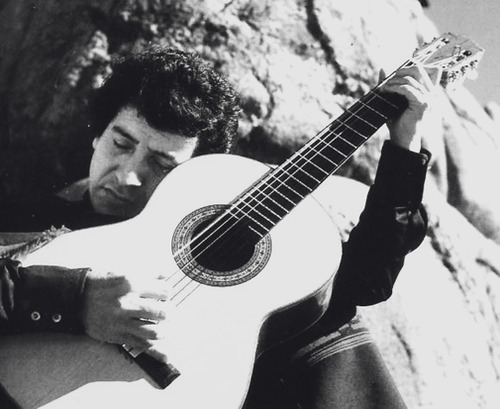
As musicians, sometimes we get to experience our art, but other times we sacrifice ourselves for it. Victor Jara, a Chilean musician, teacher, and strong political activist “used to play guitar and write folk songs. But a soldier chopped his hands with an axe and machine gunned him to death so he couldn’t play guitar anymore. When I first read this sentence from Andrew Tyler’s article I was in shock. It’s heartbreaking when politics get violent, and innocent people lose their lives. Victor Jara’s death stands for democratic social change in Chile. Even though he died for what he believed in, his music and spirit both still live on today. 


Victor Jara started out singing in the neighborhoods of Chile as a 1960’s protest folk singer for human rights. He was a member of the New Chilean Song Movement, and was a supporter of the socialist Salvador Allende. Salvador Allende was the president elected in 1970 who initiated many social programs. During the election season, Jara wrote a song for Allende’s movement titled Venceremos, which translates to We Shall Triumph.

Prior to the election in 1970 the United States CIA ran propaganda campaigns to discredit Allende, showing the United States dissatisfaction with his new government.  According to interviews with Amy Goodman of Democracy Now, Allende planned to nationalize private United States corporations. The Allende government of Chile wanted to negotiate how

to compensate the United States corporations so they would finally leave Chile. In particular, the main telephone company of Chile, and the owner of Sheraton Hotels ,  ITT Corporation.  Henry Kissinger and Nixon refused these negotiations and planned a violent “coup” in 1973.  Bill Clinton declassified the CIA documents showing that the CIA trained DINA (secret police) invaded a helicopter, and murdered the Commander in chief of the Chilean armed forces. Allende eventually committed suicide and the brutal dictator Augusto Pinochet, took control of Chile.  

Chile was not in great shape during this time in history. More interviews with Democracy Now tell the story of Victor Jara’s death. He was arrested along with thousands.  (30,000 had been referred to as “the disappeared”) He was singing to the people in the Santiago soccer stadium where the executions were taking place. According to Democracy Now, as his wife described what happened, he was well  recognized and one soldiers said “that one is for me. He was tortured, in particular his hands smashed so he couldn’t play guitar. He was shot and his body was recognized after being dragged on the streets and claimed by his wife when a friend informed her a week after the coup that his body was at the morgue. He wrote one last poem that night in the stadium to document what happened.  It was somehow smuggled out of the stadium and eventually put to music by Pete Seeger

Victor Jara, saw what was happening politically in Chile and decided to take action by sharing his art. He incorporated his beliefs through his musical creations to promote peace, but the government silenced him. If I’ve learned anything from Victor Jara’s story, it’s that he has inspired many other artists to stand up for what they believe in. Politics always try to control what we do, but in the end music continued to fight back with creativity and truth.

http://www.vjvive.com/?page_id=14

https://www.theguardian.com/music/2013/sep/18/victor-jara-pinochet-chile- rocks-backpages

https://www.democracynow.org/2016/6/29/former_chilean_army_officer_found_liable

https://www.democracynow.org/1999/10/8/documentary_on_legendary_chilean_protest_singer

http://www.angelfire.com/ca3/jphuck/BOOK3Ch3Part5.html


Rock Against Racism: Reaction to Far Right Politics and Eric Clapton in the United Kingdom

Rock Against Racism: Reaction to Far Right Politics and Eric Clapton in the       United Kingdom

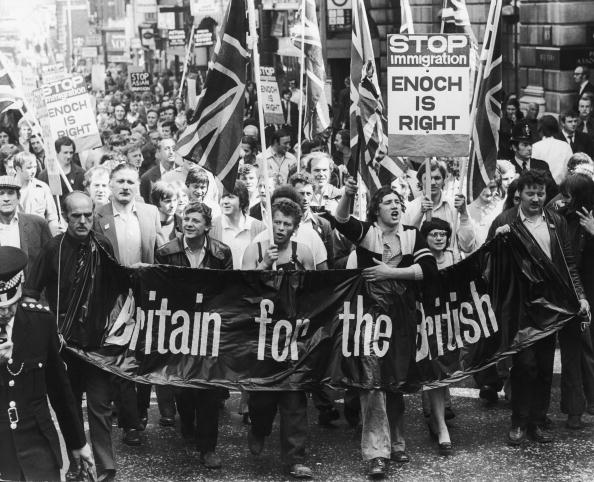
A large crowd gathered at London’s East End Victoria Park on April 30th 19781. They came from all over Britain to join forces and support a cause which had become a embroiled in the central struggle of British politics. This struggle was a race struggle thinly veiled as a immigration debate. Political agents such as Enoch Powell and his National Front had, in the years prior, created an atmosphere of xenophobia, hate and White/English supremacy. But there was a reaction to this rhetoric. Rock Against Racism, founded by Red Saunders, was a movement which fought hatred with music. They turned music from a medium of entertainment to a form of political activism. When one looks in retrospect, one might claim that they were central to reclaiming Britain’s youth from the jaws of neo-fascism.

The far right had always been lurking in the back waters of British politics. As far back as the 1920s, fascists such as Oswald Mosley had wielded varying degrees of power and influence2. But ever since the end of WWII support for the far right had dwindled. This was likely due to the increasing radical anti-semitic policy proposals ended Mosley’s Career, the traumatic war against the Nazis and the existence of a centre right party, the conservative party, which contested all elections as one of the two main political parties.  However, starting in the late 1960’s there was an unsettling resurgence of Ultra-Nationalist rhetoric entering the mainstream political debate. The main reasons for the resurgence of far right parties such as the National Front was the great influx of immigrants coming from former colonies/ commonwealth realms3. The Troubles, the civil rights movement turned insurgency/ fight for liberation in Northern Ireland, was also a cause for their surge in popularity. They believed in Ulster as an integral part of the UK and advocated for extreme Loyalism in NI. The culmination of this racist populism was a speech given by Enoch Powell (National Front Leader) in 1968. The “River of Blood” speech, as it is now known, voiced Powell’s paranoid concerns that within the century the white british people will become an underclass to the commonwealth immigrants3. While this paranoia is totally unjustified, it resonated with the white working class and lead to a atmosphere of racial intolerance and hatred.

Now with the political context set, we can look at the inciting incident which lead to the formation of Rock Against Racism. On august 5th1976, at a concert in at the Birmingham Odeon,Eric Clapton made remarks which will forever overshadow anything he played that night. Just blocks away from where Powell made his “Rivers of Blood” speech, Clapton went on an alcohol fueled diatribe against the immigrant community and people of colour in general. Below is an slightly censored quote from that night.


The black w*gs and c**ns and Arabs and f***ing Jamaicans don’t belong here, we don’t want them here”


Clapton then followed up this remark with.


“This is England, this is a white country, we don’t want any black w**s and c**ns living here… Enoch for Prime Minister! Throw the wogs out! Keep Britain white!”4


Drunkenness does not turn someone into a racist, and even if it did it would not matter. Clapton never apologised for his statement that night. This lead to a reaction by a rock photographer and future organizer of Rock Against Racism, Red Saunders . Saunders’ response included a swift denunciation of Clapton, a accurate accusation of appropriating black music and a call to action to support his new found cause1. But why was it Clapton’s comment that prompted such a large response from popular culture and not Enochs Speech? Similarly why didn’t this response come when David Bowie made similar albeit stranger remark a few months earlier?  I think what Saunders understood about music was that it had a profound ability to mold the thoughts and outlooks of a generation. It was not so much that Claptons music was overtly racist, but that people felt a deep connection to him due to his immense expressive power. We identify with the artists of our time more so than the politicians of our time. So when Clapton demonstrates his racist attitude openly, it encourages others who feel similarly to overtly convey their attitudes. Furthermore when Clapton does not apologize he vindicates the racists attitudes held by some of these younger fans. This, I think, is what separated Bowie from Clapton, who has since apologized many times and was admittedly under the influence of a lot of narcotics (and Nietzsche?) at the time5.

Western music has been creating cults of personality for many centuries. Since Beethoven, the musician as a demigod has been an unfortunate feature of our musical culture6. However what happens when this elitist attitude transforms from a dog-whistle of white supremacy6 ,suggesting western classical music is superior music written by a superior race, to the bull-horn for fascist ideologies? Luckily in the UK the reaction is the organization of sane people standing up for those who are marginalized. By rejecting the propagators of  fascism and reclaiming the idiom of rock the British scene was able to save a generation from shifting two giant steps to the right and played a part in the fall of the National Front.


  1. https://www.theguardian.com/music/2008/apr/20/popandrock.race
  2. https://depts.washington.edu/chid/intersections_Autumn_2010/Bret_Rubin_The_Death_of_British_Fascism.pdf
  3. http://www.telegraph.co.uk/comment/3643826/Enoch-Powells-Rivers-of-Blood-speech.html
  4. http://thequietus.com/articles/20701-eric-clapton-racism-morrissey
  5. http://www.playboy.com/articles/playboy-interview-david-bowie
  6. https://www.nytimes.com/2017/07/30/arts/music/trump-classical-music.html?smid=tw-


Strange Fruit

Music has always been a powerful emotive force that is able to explain events that words alone cannot. Because of this, it has the ability to shed light on some of the darkest and most feared issues in the world. “Strange Fruit,” sung by Billie Holiday in 1939, brought attention to one of the most horrendous moments of American history: racism and the unfair discrimination towards African Americans.  

As an African American artist in the 1930s, Holiday had experienced racism throughout her career. She had performed in mostly “high-society,” white venues but wasn’t allowed to even enter the front of the house. She had to take a freight elevator up to the stage because she was not allowed to share the elevator with white patrons. Although she was one of the best jazz vocalists of all time, she truly understood and experienced the heartbreaking reality of racism in America.

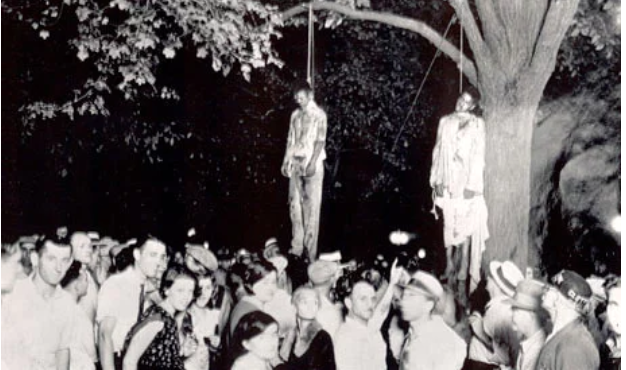
The birth of “Strange Fruit” occurred after a Jewish white school teacher, Abel Meeropol, saw a horrific photograph of a lynching of two black men in Indiana.

Outraged and upset, he wrote a protest poem that was later used as lyrics for Holiday’s song. The lyrics depict the lynched black men as “strange fruit” hanging from trees as they rot in the sun for birds to eat. The song uses physical imagery and strong metaphors, making the scene come to life in the listener’s mind.  

Southern trees bear a strange fruit

Blood on the leaves and blood at the root

Black bodies swinging in the southern breeze

Strange fruit hanging from the poplar trees

[Verse 2]

Pastoral scene of the gallant south

The bulging eyes and the twisted mouth

Scent of magnolias, sweet and fresh

Then the sudden smell of burning flesh

[Verse 3]

Here is fruit for the crows to pluck

For the rain to gather, for the wind to suck

For the sun to rot, for the trees to drop

Here is a strange and bitter crop

The song debuted in New York’s first integrated club. Holiday’s manager knew it was extremely heavy and programmed it at the very end of her performance. Waiters stopped serving before the performance of the song, and no encore was performed. Holiday’s dramatic and heart wrenching interpretation continuously left all of her audiences stunned, and most responses included silence followed by a tremendous applause of approval. 

The song was extremely controversial, and Holiday’s regular recording label refused to record it.  She was released from her contract and forced to find an alternative record company to complete her recording. It was eventually produced and sold over 1 million copies, making it Holiday’s most sold record.

The recording of “Strange Fruit” was the first time a black artist had ever released something so controversial, and some consider it a contributing factor to the beginning of the Civil Rights Movement.  Artists such as Nina Simone and John Martin went on to record it, and Time Magazine named it the Song of the Century in 1999. It has continued to impact people today and has been inspiration for a novel by Lillian Smith, an opera  by Chandler Carter, and a song released in 2014 by Kanye West, “Blood on the Leaves (Strange Fruit)

https://www.youtube.com/watch?v=SPhsSzfAoBA

Every musical creation has a history and story behind it, and it is an integral piece that must not be forgotten. Even if a work has a strong political message, it should not be overlooked or hidden from its audience. If no one had paid attention to the political issues in “Strange Fruit,” the Civil Rights Movement may not have developed as soon as it did. Billie Holiday’s song changed history, and all artists should have the desire to change the world the way she did. 


https://en.wikipedia.org/wiki/Strange_Fruit_(novel 

Politics/Community of Jazz

Jazz music has historically been a part of a much broader culture, specifically with African Americans. The music has unified communities, protested injustice, and most importantly been a vehicle for self expression.

Integration in Jazz Bands

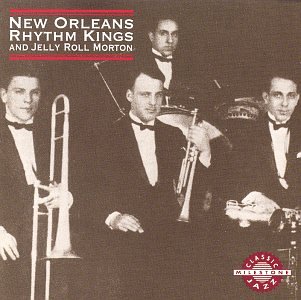
While jazz has influences of spirituals and work songs, it also has a heavy influence of western European harmonies. However, it started as mainly an African American art form. As technology prevailed in the early 20th century, the recording studio and invention of the radio became a significant way for black musicians to be heard. “Opportunities were given to black musicians by the radio and recording industry and popular black bands were promoted as long as there was a demand for jazz music by white Americans.” This was an important leap forward socially for black Americans, as the demand for jazz music was high. Another thing that occurred in the realm of jazz was the integration of orchestras and bands. Back then, it was common to have all white or all black jazz bands. However, these bands started to become integrated around the 1920’s. Black musicians would play in white bands and vise versa. One of the earliest examples of this integration was when Jelly Roll Morton, a famous creole. pianist, recorded with the Rhythm Kings, a white jazz band. This was an extremely unusual since people of any color in America were harshly discriminated against. Jazz culture was a beautiful thing because in a world where there was crude social injustice against the underrepresented minority Americans, jazz culture began to promote unity in some ways.

Jazz and the Civil Rights Movement

In the 1960’s Jazz had collided with the civil rights movement. Jazz had gone through many transformations by this point since the beginning of the 20th century. The evolution started mainly with New Orleans  jazz, then evolved into swing/dance bands, and then bebop, cool jazz, and hard bop. In the 1950/60’s, an emergence of free and avant garde jazz occurred. (This is a generalization). One of the main leaders of this new music was Ornette Coleman. Free jazz was all about the individual, and the freedom of expression as it delineated from traditional forms of jazz and music in general. In the 1960’s the civil rights movement came into place. There was a huge reaction to this movement in the jazz community, as many black musicians made their voices heard through their music.


An example of a musician reacting to this was John Coltrane’s “Alabama,” which he wrote about the Birmingham church bombing in 1963. 

In 1959 bassist/composer Charles Mingus recorded an album entitled “Ah Um.” This album had a track on it called Fables of Faubus, which was a response to Orval Faubus’ prevention of nine African American students’ attendance of a school in Arkansas, even after Eisenhower integrated schools in America. Fables of Faubus was a part of the civil rights movement, and here are the Lyrics:

Fables of Faubus:

Oh, Lord, don’t let ’em shoot us!

Oh, Lord, don’t let ’em stab us!

Oh, Lord, no more swastikas!

Oh, Lord, no more Ku Klux Klan!


Name me someone who’s ridiculous, Dannie

Governor Faubus!

Why is he so sick and ridiculous?

He won’t permit integrated schools

Then he’s a fool!


Boo! Nazi Fascist supremists!

Boo! Ku Klux Klan (with your Jim Crow plan)


Name me a handful that’s ridiculous, Dannie Richmond

Faubus, Rockefeller, Eisenhower

Why are they so sick and ridiculous?

Two, four, six, eight:

They brainwash and teach you hate

H-E-L-L-O, Hello

Musicians like Charles Mingus, John Coltrane, Nina Simone, and more made their voices heard through powerful music that was written in response to the civil rights movement of the 1960’s.

Unfortunately, there is still a great deal of social injustice against African Americans today, and we keep seeing responses to this all over the place. Recently, the quarterback of the San Francisco 49ers ,Colin Kaepernick, sat while the national anthem was played. He said that “I am not going to stand up to show pride in a flag for a country that oppresses black people and people of color.” This is an example of a modern day response to the injustice at hand. Kaepernick wanted to make a statement, so he refused to stand during the national anthem. This is not unlike how certain people reacted through music during the civil rights movement. “To me, this is bigger than football, and it would be selfish on my part to look the other way. There are bodies in the street and people getting paid leave and getting away with murder,” Kaepernick said. Whether it is through sports or through music, it is important that underrepresented Americans of color have their voices heard. We have seen this been done through music during the civil rights movement, and in protests worldwide. Through media, more and more people are being informed of the problem at hand every day.

How Could Holst Write About Planets He’d Never Even Been To?

This is not a blog post about Gustav Holst. It is not about Holst’s “Planets” suite and will not mention anything remotely related to Holst’s music from this point forward. If you are disappointed because you thought this was going to be about Gustav Holst, feel free to walk away now, no judgment.

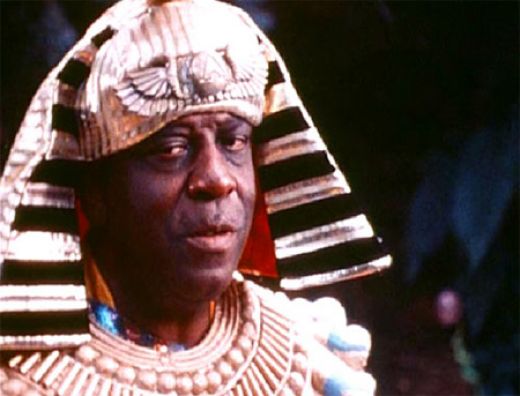
Still reading? Great! This blog is not about Gustav Holst because Gustav Holst never even went to Saturn. You know who did go to Saturn? Sun Ra went to Saturn. Do you know who Sun Ra is? Most people don’t, so don’t feel bad (or if you do, congratulations on belonging to this educated minority).

Herman Blount (later known as Le Sony’r Ra or, more commonly, Sun Ra, named for the Egyptian solar god) was born – or awoke or arrived, depending on who you ask – on May 22, 1914 in Birmingham Alabama. This was, according to him, the least important of all his births, though it still seems to be the one that we Earthlings gravitate toward. This essay from Sun Ra’s official site gives some insight as to how he conceived of his arrival. To give a radically condensed history of Sun Ra’s early life, he was a skilled pianist who gravitated toward jazz (strong traces of Duke Ellington, and later on Charles Mingus and Thelonious Monk can be found in his playing and his composition) and briefly attended college until an unexpected trip to Saturn changed his perspective. As he describes the experience:

“My whole body changed into something else. I could see through myself. And I went up…I wasn’t in human form…I landed on a planet that I identified as Saturn…they teleported me and I was down on a stage with them. They wanted to talk with me. They had one little antenna on each ear. A little antenna over each eye. They talked to me. They told me to stop attending college because there was going to be great trouble in schools…the world was going into complete chaos…I would speak (through music) and the world would listen. That’s what they told me”.

And thus Sun Ra embarked on a decades-long musical career with his Arkestra (named for ‘Ra’ the Egyptian sun god and ‘kist’ coming from a Sansrit word meaning ‘sun gleam’, though Sun Ra also remarked that the name was simply “the way black people say ‘orchestra'”). This and loads of other biographical info on Sun Ra can be found in John F. Szwed’s Space is the Place: The Life and Times of Sun Ra. You can also check out Szwed’s personal site for more writings on African American studies and jazz biographies.

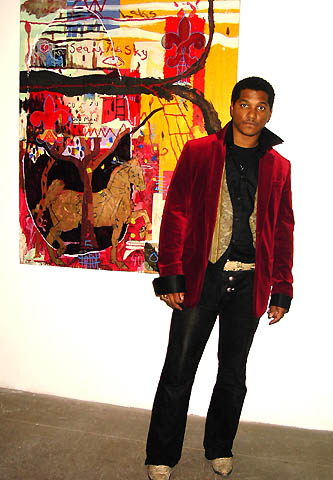
Sun Ra’s work falls into a movement known as Afro-Futurism – an artistic and cultural movement that uses ‘futuristic’ (think science-fiction) and cosmic influences to represent black culture and grapple with the experiences of the African Diaspora, or African-descendant communities throughout the world. This 43-second video can give you a snapshot idea of what this movement stands for, but for an in-depth study would benefit from the writings of Octavia Butler or the art of Angelbert Metoyer (pictured below).

Themes of the great cosmic unknown, furiously advancing technologies, confusion and peace permeate Afro-Futurist art, and Sun Ra is no exception to these themes. His music often deals with space and the cosmos, with performances by his Arkestra often referred to as ‘space jazz’. Long, open-ended groove sections, various combinations of keyboards and synthesizers and confusing dissonances all contribute to this label and combine to create one of the most distinctive sounds in jazz music. Sun Ra also often included other arts or media in his performances, including dance, poetry and electronic visuals. Perhaps most famous of these other media is the Outer-Space Visual Communicator invented by Bill Sebastian in a collaboration with Sun Ra in the late 1970’s. In a nutshell, this device is a giant keyboard controlled by one’s hands and feet that manipulates a light display, to be played in real time (as opposed to being pre-programmed) and projected onto a large screen. This collaboration, including the hopelessly complicated and futuristic OVC device, seems to strike the heart of what Afro-Futurism is for Sun Ra – a seamless musical and visual presentation that cannot possibly be considered from this world, that seems to take the audience on a journey toward some sort of unattainable enlightenment, defying you all along the way to categorize it. This piece is called “Calling Planet Earth” and features the OVC and the Arkestra. It lasts 15 minutes, but its effect is not lost if you jump around in the video – in fact, in light of the piece depicting a surreal, other-worldly experience mostly disconnected from this reality, I’m sure Sun Ra would even welcome this. Enjoy!

https://www.youtube.com/watch?v=CPuK7hfWCfA


The Politics in Barber’s ‘Adagio for Strings’

On June 12th 2016, the deadliest mass shooting seen yet in the United States occurred in Orlando, Florida at ‘Pulse,’ a gay nightclub. This horrific event caused uproar on various political topics, including hate crime, gun violence and laws, terrorism, and immigration, as articulated in this New York Times Article. The perpetrator, Omar Mateen, was a Muslim American, who felt strongly against the American government for the conflicts in Iraq and Syria. Mateen also openly stated his hate for gays, and latinos. Mateen’s motives were very clear in making a statement of hate. This event broke the hearts of people not only in Florida but to the entire country. In so many aspects, the United States seemed to be progressing with gay rights and many other political stances, but also falls so far behind with issues of terrorism and gun violence.

https://www.youtube.com/watch?v=6uRS8O3nT4U&feature=youtu.be

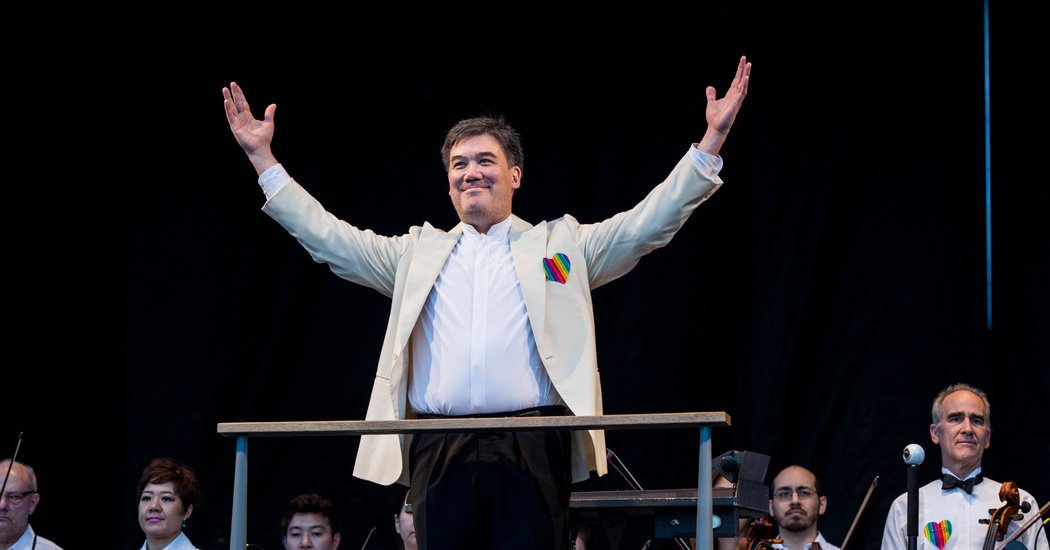
Soon after, on June 15th 2016, the New York Philharmonic had their annual Concert in the Parks Series in Central Park. Originally on the program was a Rossini Overture, but was changed to Barber’s Adagio for Strings as a tribute to the victims of the Orlando shooting. Alan Gilbert said a few words before the performance, showing the effects this event had on the community. While attending this event, I was moved by the sentiment and truly heartwarming performance. A few days after attending this event, a New York Times Article was published, reviewing the concert. This article mentioned that Barber was an openly gay composer, making the performance that much more meaningful.

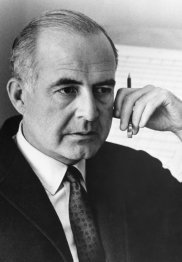
Samuel Barber

Although this piece was not necessarily written as a memorial, it is often used in memorials and as a tribute to events like this. Barber’s Adagio for Strings was broadcasted over radio and television for major events such as the death of Franklin D. Roosevelt, John F. Kennedy, Princess Diana and played at the funeral of Albert Einstein.

Music and politics inevitably coincide, as each affects lives on a daily basis. Whether a piece’s original intent had political meaning behind it or not, music can act as a voice in politics as well. Music brings people together, and as Alan Gilbert said, “we are all part of a shared humanity,” especially after heartbreaking events like this one.

Alan Gilbert at Concerts in the Parks