
Music has always been a powerful emotive force that is able to explain events that words alone cannot. Because of this, it has the ability to shed light on some of the darkest and most feared issues in the world. “Strange Fruit,” sung by Billie Holiday in 1939, brought attention to one of the most horrendous moments of American history: racism and the unfair discrimination towards African Americans.

As an African American artist in the 1930s, Holiday had experienced racism throughout her career. She had performed in mostly “high-society,” white venues but wasn’t allowed to even enter the front of the house. She had to take a freight elevator up to the stage because she was not allowed to share the elevator with white patrons. Although she was one of the best jazz vocalists of all time, she truly understood and experienced the heartbreaking reality of racism in America.

The birth of “Strange Fruit” occurred after a Jewish white school teacher, Abel Meeropol, saw a horrific photograph of a lynching of two black men in Indiana.
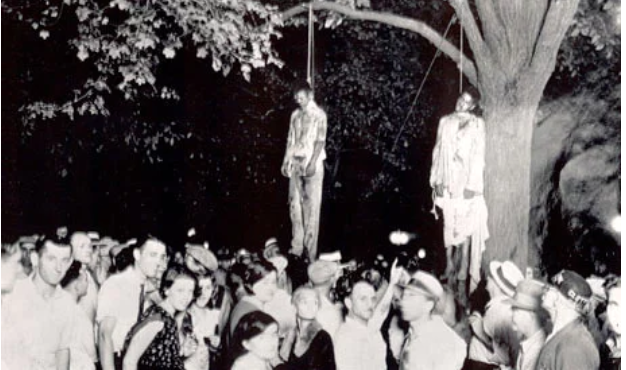
Outraged and upset, he wrote a protest poem that was later used as lyrics for Holiday’s song. The lyrics depict the lynched black men as “strange fruit” hanging from trees as they rot in the sun for birds to eat. The song uses physical imagery and strong metaphors, making the scene come to life in the listener’s mind.
Southern trees bear a strange fruit
Blood on the leaves and blood at the root
Black bodies swinging in the southern breeze
Strange fruit hanging from the poplar trees
[Verse 2]
Pastoral scene of the gallant south
The bulging eyes and the twisted mouth
Scent of magnolias, sweet and fresh
Then the sudden smell of burning flesh
[Verse 3]
Here is fruit for the crows to pluck
For the rain to gather, for the wind to suck
For the sun to rot, for the trees to drop
Here is a strange and bitter crop
The song debuted in New York’s first integrated club. Holiday’s manager knew it was extremely heavy and programmed it at the very end of her performance. Waiters stopped serving before the performance of the song, and no encore was performed. Holiday’s dramatic and heart wrenching interpretation continuously left all of her audiences stunned, and most responses included silence followed by a tremendous applause of approval.
The song was extremely controversial, and Holiday’s regular recording label refused to record it. She was released from her contract and forced to find an alternative record company to complete her recording. It was eventually produced and sold over 1 million copies, making it Holiday’s most sold record.
The recording of “Strange Fruit” was the first time a black artist had ever released something so controversial, and some consider it a contributing factor to the beginning of the Civil Rights Movement. Artists such as Nina Simone and John Martin went on to record it, and Time Magazine named it the Song of the Century in 1999. It has continued to impact people today and has been inspiration for a novel by Lillian Smith, an opera by Chandler Carter, and a song released in 2014 by Kanye West, “Blood on the Leaves (Strange Fruit)”
Every musical creation has a history and story behind it, and it is an integral piece that must not be forgotten. Even if a work has a strong political message, it should not be overlooked or hidden from its audience. If no one had paid attention to the political issues in “Strange Fruit,” the Civil Rights Movement may not have developed as soon as it did. Billie Holiday’s song changed history, and all artists should have the desire to change the world the way she did.
I particularly like how you presented the background of “Strange Fruit”. You did a great job placing it in the context of the Civil Rights Movement, which helped me understand the song and its purpose. Also, I like your hyperlink to the lyrics website, as it is a very useful tool in understanding the literary nuances of the poem. In regards to the hyperlinked article at the end, I think you could have referred to a specific quote in the article that you agreed with. However, your point is very much in line with what the article said. Also, I think it would be interesting to include Billie Holiday’s stance on the Civil Rights movement (nonviolent or not), if you can find information about it; you mentioned that Nina Simone also recorded it, and I am wondering if Holiday’s version was popular in part due to her stance. I enjoyed your use of media. I think the pictures add to the contextualization of the song, and the Kanye video shows the impact “Strange Fruit” had on other artists.