
As musicians, sometimes we get to experience our art, but other times we sacrifice ourselves for it. Victor Jara, a Chilean musician, teacher, and strong political activist “used to play guitar and write folk songs. But a soldier chopped his hands with an axe and machine gunned him to death so he couldn’t play guitar anymore.” When I first read this sentence from Andrew Tyler’s article I was in shock. It’s heartbreaking when politics get violent, and innocent people lose their lives. Victor Jara’s death stands for democratic social change in Chile. Even though he died for what he believed in, his music and spirit both still live on today.
Victor Jara started out singing in the neighborhoods of Chile as a 1960’s protest folk singer for human rights. He was a member of the New Chilean Song Movement, and was a supporter of the socialist Salvador Allende. Salvador Allende was the president elected in 1970 who initiated many social programs. During the election season, Jara wrote a song for Allende’s movement titled Venceremos, which translates to We Shall Triumph.
Prior to the election in 1970 the United States CIA ran propaganda campaigns to discredit Allende, showing the United States dissatisfaction with his new government. According to interviews with Amy Goodman of Democracy Now, Allende planned to nationalize private United States corporations. The Allende government of Chile wanted to negotiate how
 to compensate the United States corporations so they would finally leave Chile. In particular, the main telephone company of Chile, and the owner of Sheraton Hotels , ITT Corporation. Henry Kissinger and Nixon refused these negotiations and planned a violent “coup” in 1973. Bill Clinton declassified the CIA documents showing that the CIA trained DINA (secret police) invaded a helicopter, and murdered the Commander in chief of the Chilean armed forces. Allende eventually committed suicide and the brutal dictator Augusto Pinochet, took control of Chile.
Chile was not in great shape during this time in history. More interviews with Democracy Now tell the story of Victor Jara’s death. He was arrested along with thousands. (30,000 had been referred to as “the disappeared”) He was singing to the people in the Santiago soccer stadium where the executions were taking place. According to Democracy Now, as his wife described what happened, he was well r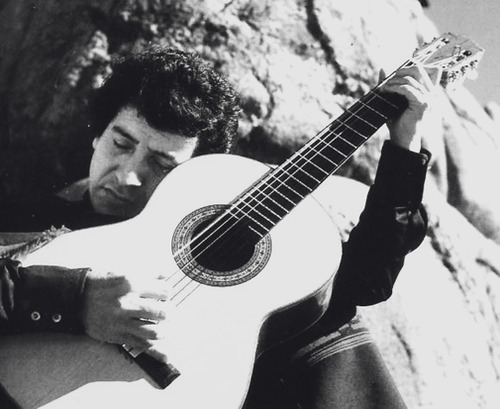 ecognized and one soldiers said “that one is for me. He was tortured, in particular his hands smashed so he couldn’t play guitar. He was shot and his body was recognized after being dragged on the streets and claimed by his wife when a friend informed her a week after the coup that his body was at the morgue. He wrote one last poem that night in the stadium to document what happened. It was somehow smuggled out of the stadium and eventually put to music by Pete Seeger.
Victor Jara, saw what was happening politically in Chile and decided to take action by sharing his art. He incorporated his beliefs through his musical creations to promote peace, but the government silenced him. If I’ve learned anything from Victor Jara’s story, it’s that he has inspired many other artists to stand up for what they believe in. Politics always try to control what we do, but in the end music continued to fight back with creativity and truth.
http://www.vjvive.com/?page_id=14
https://www.theguardian.com/music/2013/sep/18/victor-jara-pinochet-chile- rocks-backpages
https://www.democracynow.org/2016/6/29/former_chilean_army_officer_found_liable
https://www.democracynow.org/1999/10/8/documentary_on_legendary_chilean_protest_singer
http://www.angelfire.com/ca3/jphuck/BOOK3Ch3Part5.html
Hi Danielle!
I really enjoyed reading your post as I had never heard of Victor Jara nor the political struggle Chile was experiencing in the 1960’s. Your opening paragraph does a fantastic job of making me want to read more as you link an article to the life and brutal death of Victor Jara and then following it with how his death impacted Chile’s infrastructure. Another great thing about your post is the abundance of additional information with articles to help tie your points together, creating a comprehensible post without becoming too difficult to digest. One small criticism I have is there is not too much information about Jara’s influence while he was still alive. There’s a fantastic amount of information about Chile’s state of turmoil, but I would have loved to see how Jara was a major and influential figure during such a chaotic and desperate time. Regardless, it was a fantastic read overall and I learned new information I did not know! Thank you!