
Records of distinct nationalist identity in music have existed since the before the middle ages. And, until approximately the 17th century, the majority of music composition was virtually inseparable from the church, which was virtually inseparable from the state. Thus, nationalism has always been a lens through which to look at the unfading marriage of music and politics. The 20th century musical stage in particular was flooded with nationalist compositions in response to territorial conflicts and as a reaction to oppressive regimes. Karel Husa’s Music for Prague 1968, is a politically motivated composition that reveals a paradox in nationalist music.
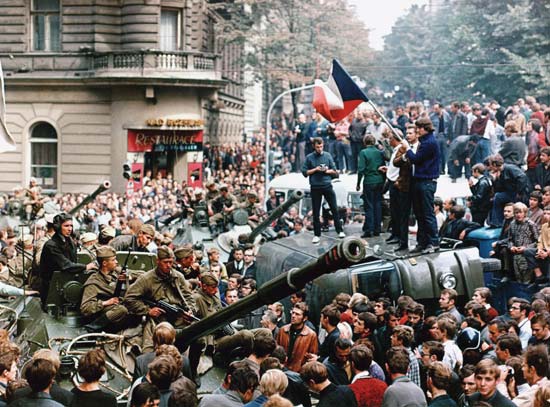
Karel Husa was born in Prague, Czechoslovakia in 1921, and later emigrated to the United States. Music for Prague 1968 was written shortly after the Soviet Union crushed the Prague Spring reform movement in Czechoslovakia in August, 1968. When Husa heard of the events that occurred in Prague over the radio, he was deeply moved. The piece serves as a memoriam to the victims of USSR violence, as well as a call for Czech identity.
The work includes a Hussite hymn, which blatantly creates an element of Czech nationalism. The Czech hymn that Husa uses, originally a war song from the 15th century, is titled “Ye Who Are Warriors of God.” It had previously been known for its use in Dvorak’s nationalist composition “Hussite Overture,” and there is no doubt that Husa’s choice to integrate the hymn is due to the tune’s overtly nationalistic connotation. One of the lines from the hymn reads, “Ye warriors of God, if you believe in the future, things will be better in the future.”
Music for Prague 1968 therefore reveals a paradox of nationalist music. In the piece, the Hussite hymn partially represents “solidarity and resistance”. On one hand, Husa is supporting his country by means of using traditional Czech music. The words of the allude to being willing to sacrificing oneself for one’s country and having hope for the well being of it. On the other hand, he is using the hymn to beckon back to a time before Soviet control- or even before the existence of a modern communist state. Hence, the composer is effectively attacking and bolstering his beloved country simultaneously; Music for Prague 1968 seems to portray that Husa is both proud and ashamed of his homeland. This leads to the conclusion that a nation is not characterized by any one political period, and that composers can praise all the good things about a nation while still speaking out against current events.
One of the essential requirements for nationalist music, is a broad audience; the point of such music is for a composer to share his or her feelings about their country with others. Husa’s conviction to write Music for Prague 1968 was also a conviction to share his thoughts about larger political ideas. One interesting source that provides commentary on the intended audience of music, and specifically politically driven music, is the article “Does ‘Music Trump Politics’?” by Ted Gordon. Gorgon quotes Dennis Prager as controversially saying, “Great music should transcend political differences.” Like many members of the Classical music world, I strongly disagree with Prager’s logic. Not only does this way of thinking nullify the point of nationalist music, it also pushes a limitation onto art as a whole. Though not all music is political, some pieces of art are meant to be derisive; Husa’s Music for Prague 1968 was not thought highly of by the Communist government of Czechoslovakia. Furthermore, there is a distinction between the reason for composition (perhaps to speak out against a certain person) and its objective face value meaning to a listener (maybe a piece written to shame a dictator is enjoyable to listen to even by the dictator himself). For example, Shostakovich’s 5th symphony subtly condemns the violence of the USSR, and yet it was praised by the Stalin regime; while this composition is politically influenced, at face value, everyone can appreciate them, included the party against which it was written.
In relation to Husa’s Music for Prague 1968, I think the intended audience is the people of democratic nations, to whom it serves a warning of oppressive regimes. One generally conclusion that Music for Prague 1968 demonstrates is that there can be a paradoxical balance of critique and patriotism that constitutes nationalism. And on a larger scale, Husa himself later reflected in an L.A. Times interview, “I don’t think of [Music for Prague 1968] as a political message for one country… It is universal.”
Hi Clancy! I really enjoyed reading your post and thought your research on Music for Prague was very thought provoking. I had always only associated nationalism with composes such as Prokofiev and Shostakovich and had not thought of affected composers. The point you brought up about the reason for a composition vs the face value of a piece is something I would like to think more about. I wonder which other compositions/songs have this at work and how they have influenced other groups of people. Are there any recent pop songs that use the same idea?