Schulhoff and Socialist Realism

Erwin Schulhoff was born in 1894 to a Jewish family in Prague. He died in 1942 in a Bavarian concentration camp. He studied with Debussy in his early writing years and was heavily influenced by ideas of the Second Viennese School. He was also one of the first European composers to experiment with elements of jazz and incorporate them into his own works. He was drawn to avant-garde trends and experimented with the less traditional ideas during that time. Schulhoff studied in the cities of Vienna, Leipzig and Cologne before he was drafted to serve in the Austrian Army at the outbreak of WWI. However, he continued to compose throughout the war and had his first pieces published immediately after the war ended. Politically, Schulhoff, an outspoken socialist, was very liberal throughout his life and would turn even more left towards the end of his life. He was described as a “radical artist”. Being of Jewish decent, Schulhoff found himself drawn to communist ideas as his life became more difficult as he was committed to Soviet Communism, a party that promoted democracy. In the 1930s, Schulhoff moved back to Prague, but once he realized he and his family were in danger, applied for Soviet citizenship. Shortly after, Hitler would attack the USSR and Schulhoff was sent off to the Wulzburg concentration camp in Bavaria. He stayed committed to his political ideas to the end of his life in 1942.

One of his works written before his turn towards socialist realism is Five Pieces for string quartet, written in 1923. The quartet I am a part of has been working on this piece this semester, which is what inspired me for this blogpost. While not long or particularly difficult in a technical sense, this piece is filled with musical ideas that take a lot of conversation amongst the members of the group. For example, the first movement has waltz-like qualities with a feeling of 1, 2, 3, 1, 2, 3. However, it is written in 4/4 meter. There is a lot of chromaticisms and harmonic idiosyncrasies that might take a couple of hearings to be able to grasp on to. I would say that this piece, although early for the genre, hints at some “jazz-y” ideas in the Tango, the fourth movement. His music was rejected by the Nazi regime as he was of Jewish and German descent. I think it is safe to say that music is inspired by experience. And even if we are not the ones writing the music, when we perform it, we reach for ideas of experiences that would strengthen our performance of any given pieces.

https://open.spotify.com/user/1256778210/playlist/07aNycgbaxlZFUR53Aof6L

He was a supporter of the ideas of Socialist Realism. He was both jewish and a communist which put him in danger once World War II started. Schulhoff commissioned libretto based off the Communist Manifesto which he would go on to write music to in 1932 for choir, vocal soloists and wind ensemble. His goal was to make his works easily accessible by audiences and the general public as he wished to “convey politically meaningful programs”. The Communist Manifesto by Erwin Schulhoff was written after his writing style took a turn towards socialist realism. In 1931, he participated in a workers’ theatre group, as he continued to stay heavily invested in music. His later music was aimed towards pleasing the audiences. His past works had been well received and his career had been at a peak when Germany invaded. This work, the Communist Manifesto, in comparison to Five Pieces, sounds much more tonal. It has a militaristic element to it rhythmically. Also, with it being written for wind ensemble, and no strings, I think one might be reminded of a military bands, with the drums keeping steady and very taut rhythms. Also, from the beginning of this piece, there is a steadiness which makes me thinking of marching in unison. The choir sings in unison rhythmically, which, when added to the instruments, gives the sense of unity, which may have been a political statement that suggests “us against them”. There is a very clear difference between the music of his earlier influences with the music after he became interested in the idea of socialist realism.

Socialist Realism is an idea that music serves a political purpose and is easily accessible by public and audiences. The article, Colin Kaepernick and the Radical Uses of “ The Star Spangled Banner” talks about the anthem and how it has been changed politically over time. I think there is a fair point to the Kaepernick’s argument. There are lyrics in the anthem, “land of the free, home of the brave”, which seem a little dark and ironic when one takes into account the fact that it was written by a Francis Scott Key, who is believed to have been a slave owner. It may be a stretch, but Schulhoff’s music also changed as his political views became more prominent and important to himself and his music. It is definitely interesting to see how music of such different genres have so much in common (in this case, representing political ideas in music), and how they are still thought over and understood by individuals today.

http://orelfoundation.org/images/composers/schulhoff.jpg
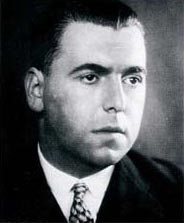
Erwin Schulhoff

Western Revised: Django Unchained

The American wild West on the cinema screen is an iconic and globally influential part of film and popular culture. The rugged cowboy heroism sweats the narrative of manifest destiny and makes every young boy yearn for a Red Ryder BB Gun. But the Western as a cinema genre is inherently intertwined with deeply problematic racial and gendered oppression and violence. Most Western films feature a principal conflict between a white, male hero facing off against a savage group of Native Americans or Mexican bandits. Watch this short clip detailing the consequences of perpetuating the cowboy myth on the Native American population:

This video makes clear that the western genre overtly relies on racial conflict and violence as the central plot device and the genre shamelessly villianizes Native American people for the purpose of glorifying white western conquest.

Since popular opinion on the subject of the genocide of Native American people has generally and slowly shifted to a position of “that was a bad thing” in the past thirty years, the western film enterprise needed to find  a new angle. This article in The Atlantic analyzes the trend of “revisionist” Westerns as American film directors grapple with the contradictions of our nation’s morally dubious history and the optimistic heroism of a cowboy character. Michael Agresta writes in this article:

“For a century plus, we have relied on Westerns to teach us our history and reflect our current politics and our place in the world. We can ill afford to lose that mirror now, especially just because we don’t like what we see staring back at us.”

Enter: Django. A hero that subverts this racialized genre. Quentin Tarantino’s film Django Unchained is about a freed slave who partners with a bounty hunter to kill wanted men, exact revenge, and rescue and free his wife. The artistic splendor of this film relies heavily on the ways Tarantino sets up a traditional Western scene or narrative and subverts it in ways that are political, shocking, comedic, or uncomfortable. The score to this film is one of they key ways the audience can engage with this historical commentary. One clear example of music defining the boundaries of the paradigm and the exception is in the trailer:

https://www.youtube.com/watch?v=eUdM9vrCbow

The first minute of the trailer features the Jonny Cash song “Ain’t No Grave” that fits our expectations about wild west Americana. The mood of the song is enhanced by the added sound effects of a hawk crying overhead, the wind whistling, and a horse whinnying. This use of sound in the score is consistent with Ennio Morricone’s writing for famous spaghetti Westerns. Listen to this clip for a reminder of a tune you’re probably familiar with:

https://www.youtube.com/watch?v=h1PfrmCGFnk

Ennio Morricone, in fact, wrote several original pieces for the score to Django Unchained, which is a detail that creates consistency with the aesthetic paradigms of the Western genre. This sense of consistency breaks about one minute into the trailer for Django, when a funky classic from James Brown, “The Payback” underscores the advertisement for Django’s complicated, free, and heroic character.

In this next clip we can hear the familiar trumpet fanfare of a heroic, Morricone style Western soundtrack. In this scene, the music establishes the connection to the genre traditions while the action subverts the historical narrative as Django whips a white slaver and his bounty hunter friend kills another in an evocative scene in a cotton field.

Content warning: the following clips from Django Unchained gratuitously use the word “n***er”.

https://www.youtube.com/watch?v=45V4fdoeMiE

In contrast with this use of familiar Western style music to ground the action in the context of the genre, the following clip uses distinctly different music by Rick Ross to underline the way Django is walking a complicated line between empowered and constrained. The next scene doesn’t necessarily portray Django as heroic, but rather as grappling with his position in society and the role he is occupying while in the company of white slave owners. The central conflict in this clip is over the social power of the word “n***er”. I think the use of the song “100 Black Coffins”, which Rick Ross wrote for this film, underscores this element of personal racialized conflict and reminds the audience that even though Django is the hero, he must constantly fight for his autonomy among white men.

https://www.youtube.com/watch?v=dFfDPc0JY38

This song by Rick Ross and a few other featured songs by John Legend and the aforementioned James Brown song conspicuously stick out in this film because they are a major anachronism in an otherwise fairly linear and stylistically consistent movie. Therefore, I credit the juxtaposition of familiar Western tropes with racially charged divergences from the genre as a key element that makes this film so successful at reclaiming the American narrative.

As the Atlantic article informed us, Westerns have long been a reflection of American politics and ideals. Django Unchained is an important film because it reflects a mainstream acknowledgement of the deeply flawed racial oppression in American history, culture, and media. And, while including a James Brown song in a movie where black men are eaten by dogs is really not a great victory for the equality of mankind, it is a small victory against the inherently racist whitewashed history and art culture of America.

Vietnam War Protests and Rock n’ Roll

The Vietnam War is one of the most controversial wars in all of history. This seemed to be the first time where the majority of people living in the United States were unhappy with the government’s decisions to go to war, and the first time that the government actively chose to ignore the complaints of the people. Protests broke out across the country- in the streets, in Washington, even on college campuses. These protests were very forward, but one way that many people used as a medium to express their unhappiness with the U.S’s involvement in the Vietnam War was through music, or more specifically, rock and roll.

Elvis, the father of rock and roll

Rock and roll first appeared in the United States in the 1950’s and was a fusion of electric blues, boogie, country and jazz. This music was created for the younger generation and explored risqué themes for the time (obviously these themes grew more vulgar as the years went on), but when these songs came out, they were targeted at the younger generation and almost always made the older ones scoff in disbelief. This transformed rock n’ roll into the rebellious and powerful genre it is now. Its music had such a wide fan base, especially in the younger generation, that it was able to serve as a fantastic medium to get thoughts and values of the bands to others, and also served as a way so that the rock and roll fan base could express their own values.

A photo from a Vietnam protest gone wrong

When the Vietnam War began, people already felt that the U.S did not need to be involved since they had already just spent nearly twenty years at war with their involvement in WWII and the Cold War. The Vietnam war also turned out to be expensive, much longer than predicted, and resulted in more than 58,000 american casualties. To state that people were not happy with these facts after not wanting to join the war would be an understatement. The majority of Americans were angry with their government, especially the younger generation since they were the ones forced to go fight in Vietnam: this began a surge of protests across the country, many of which ended up violent, however rock and roll artists were able to take their music and incorporate the emotions they were feeling at the time which began a whole new way people were able to express their opposition to the war.

Woodstock became one of the largest, most famous concerts in the world.
A Woodstock poster

Since musicians were now writing songs left and right urging for a change during this war, there was a greater chance for the people’s voice to be heard. One song that grew very famous and popular during the time of the Vietnam war war was Buffalo Springfield’s “For What It’s Worth.” This song delves into the horrors of the war, and urges people to look around and ask themselves what is really being fought. Springfield also urges everyone to look around and realize how many people are against the war, because if people, specifically those in the government, were to just look beyond their close-minded opinions, they would see how many are angry, hurt, and trying to show their leaders that they are not happy. With this song, it is very obvious that Springfield was trying to bring the war protests to an even greater level. With his ability to share his music with so many, he had the power to bring this issue to light. Although many other people were able to make a difference with their protests, many of the most notable protests were violent ones, and Springfield was able to share his anger and frustration through a peaceful means. These rock bands even began addressing their concerts as a way to protest peacefully: Woodstock was advertised as being “three days of peace and music.” This is very important to note, considering the riots that were occurring at colleges like University of Buffalo, Kent State, and many others. These musicians were able to change the ways people were protesting which resulted in much fewer injuries and deaths, and also showed the government that these people were willing to work out issues in a peaceful and reasonable manner, something they may not have seen through all of the violence in previous protests.

Seeing what all of these musicians did to speak out against war despite the controversy makes it difficult to get angry at the athletes who have begun to protest the National Anthem. Although many people see it as a sign of disrespect, this is a peaceful way to make it clear that they are in opposition to to obvious racism that lies within the anthem’s lyrics, as well as the racism that still exists in the country. Music has always been a way for people to peacefully protest while also getting their message out to hundreds of thousands of people and will continue to be a means for people to express their dissatisfaction. The music during the Vietnam War is only one small portion of music that was written to share frustration with political issues, but nonetheless, these seemingly simple rock and roll songs became a powerful way for people to express their anger with the government at the time. Of course the war did eventually end and rock and roll moved onto different, up to date topics, but these songs, especially “For What It’s Worth,” will remain in history as songs that allowed people to speak their mind and make a change in the world with out harming one another.

Marley’s Moving Music

From Bob Marley’s musical beginnings, he has always had an important message in his lyrics. The subject matter of many of his most famous songs regard the political unrest within his home of Kingston, Jamaica. However, as Marley’s musical fame grew and grew, he was able to address more worldly issues in his music.

Bob Marley was very passionate about political justice, especially in Jamaica. Thus, as his fame rose, it seems he began to speak out more and more of the issues and political unrest he was experiencing and trying to change. Marley’s political activism seems to be primarily rooted in his album releases between 1973-1979, although this of course does not cover the entirety of his politically charged music. In The Wailer’s 1973 album “Burnin'” there are several tracks that very directly discuss the issues of racial inequality, mistreatment of people from authoritative figures such as police, government figures, etc. This album in particular is noted to have a much more direct tone in discussing these issues, rather than the cryptic lyrics present in The Wailers earlier works. Off of “Burnin'”, Marley notably wrote the songs “Get Up, Stand Up”, “I Shot The Sheriff”,  and “Burnin’ and Lootin'”, among others.  https://en.wikipedia.org/wiki/Burnin%27_(The_Wailers_album)

“Get Up, Stand Up” has proven itself to be one of Marley’s most timeless songs. It very clearly discusses Marley’s displeasure with the treatment of African and Jamaican peoples in his homeland. In this song, the lyrics speak of encouragement and standing up for the worth of one’s life. Marley sings “If you know what life is worth, you would look for yours on earth.” https://www.youtube.com/watch?v=X2W3aG8uizA 

More specifically, this song deals with the socioeconomic and religious inspirations for the mistreatment of these African and Jamaican peoples in Jamaica. He discredits the cultural idea that unfortunately has been around for a very long time: the mistreatment of those who are not in good socioeconomic standing, as well as racial discrimination.  Marley also discredits the religious belief of waiting and settling for mistreatment in hopes of a substantially better afterlife, stemming from a typically Christian belief system. There was undoubtedly a great deal of religious conflict in Marley’s hometown of Kingston. Christian and Rastafarian beliefs often clashed, and were often bundled together with the mistreatment of poor and lesser-educated peoples. https://www.pastemagazine.com/blogs/crawdaddy/2011/08/the-origin-of-song-the-wailers-and-get-up-stand-up.html

Another massively popular Bob Marley song off of The Wailers’ album “Burnin'” is “I Shot The Sheriff”. https://www.youtube.com/watch?v=nrnZSLwfzVs . While there is clearly a conflict depicted here of government/authoritative officials versus the common people, there is a much more specific connotation for this song. Marley details Sheriff John Brown as those who are discriminating against Marley and his peers, presumably for similar reasons that were discussed above: social, economic and religious discrimination. This song is Marley stating that he will not stand for this unfair treatment, and will continue to try to spark an uprising against this long-lasting mistreatment of Marley and his people. information used from: https://everlivingroots.wordpress.com/2016/12/04/10-strongly-political-messages-in-the-music-of-bob-marley/

This song is also meant to be an anthem of sorts, an inspiring message for all people to be able to connect to and, as a result,  take action. Here is a video of Marley discussing his music and various inspirations, among other things: https://www.youtube.com/watch?v=pl0JpC7XO74

In reading Ted Gordon’s article on Dennis Prager, I found some stark differences between Prager’s approach in comparison to Bob Marley’s in both of their pursuits to spread music and it’s message. In Prager’s case, he argued that classical music must be integrated into culture in order to fortify Western supremacism and political “correctness”, in Prager’s case, being very far right.. Bob Marley is nearly the opposite of this, promoting the destruction of one’s ego and the support of one’s spiritual and compassionate beliefs. Marley promoted this positivity, peace and activism (not in any sort of violent way) in his music, whereas Prager promoted classical music’s integration into modern culture in a very destructive and hateful way; Marley’s integration of reggae into modern culture proved to be much more peaceful and universally accepted. http://musicologynow.ams-net.org/2017/09/does-music-trump-politics-dennis-prager.html

Ultimately, Marley proved to be a prominent political figure through his musical ideas and lyricism. He promoted equality, peace, and love in addition to highlighting political injustices such as racial discrimination and discrimination of people who are in lower economic and social standings. His music truly carries a powerful message for all.


*I’m sorry, I’m not really sure how to integrate hyperlinks so I just added the regular links..

Progression of Oppression and Technology

Doom. A Sigh

– Istvan Marta


I’ve always been interested in music that evokes an emotional response. As a performer and listener, having an emotional connection to a piece makes it feel significantly more satisfying. When looking for pieces to match the extreme amount of angst I was feeling at the time (also to put said angst into perspective by having my privilege checked) I began to search for music that was revolving around an intense political movement (something along the lines of Messiaen’s Quartet for the End of Time) and came across the piece “Doom. A Sigh” (https://open.spotify.com/track/1hCNaY6jPujUZjS13qK6bP).

The piece is easily one of the darkest pieces I have ever heard, as it combines the use of electronic sound effects with percussion and string quartet alongside “old sounding” recordings of two women speaking/singing. They appear to be talking/singing about something very that makes them very sad and/or angry. After reading the notes by Marta (https://www.youtube.com/watch?v=e-LQ7nBQcjA&t=0m00s), I understood the context; these women were from the remote village of Trunk, Romania, and were part of the group of around 400 people who lived there called the Csangos. These people had been uninfluenced by the progression of language in the 19th century due to their lack of connection to society and the progression of media. Their language was dying out due to the fact that people rarely left the village, and children would receive education in a language they were unfamiliar with. “…an encroaching government was wearing their sense of identity and family bonds”. Marta recorded these women and actually used one of Bartok’s 3 tiers of composition, in which he created an accompaniment to the exact melody recorded (with the melody being these two women). One of the women is talking about her deceased parents and the other is singing about a battle. Marta then talks about his circumstances with getting the recording and how the people were actually punished for him doing so. He accurately depicts these events happening through his music, and this is through being able to use technology of the recording, and electronics that create this scene of oppression.

Rarely before had a piece moved me so much that I looked up the situations surrounding the piece on my own. I had always been of the mindset that music is only relevant to the listener, but this piece had proven me wrong. I had heard such an intensity of emotion that motivated me to learn more about how this came together as a piece of music, and that was due to the bizarre nature of the musical instrumentation (ie, the recording of the women and the battlefield setting created with electronics)

I think that pieces like this was only really possible through the advances of technology in the 20th century, as the level of recording that had developed now can give rise to a new type of communication in a piece of music. For this, it was conveying the oppression of a society. Although the listener is unable to understand what exactly the speaker is saying, you are immediately able to grasp the emotion and power behind this work.  In the past, when a piece (like a symphony) uses a motive to represent a certain idea, and would incorporate politics into this by inserting the motive at a certain time, there is still a sort of “code” needed to decipher the meaning, whereas with this, you immediately are captivated by the emotion and are curious as to what the meaning is, even though this work is nowhere near anything standard of the previous century. This made me think of the article in which Trump brought up symphonies and somehow used them to convert this idea of elitism to prove whatever ridiculous point he was trying to make. This piece is definitely not a symphony, and in fact some people would maybe describe this more as performance art, as it does not have a standard form that we would be used to in Western music, however, I believe that the confusion itself adds to the meaning if the piece. The piece puts us in this uncomfortable state in which we question many things: what do they mean? how did something like this happen? what happened?. These questions allow for the growth as an individual both politically and musically due to the fact that we do not know, yet are still extremely captivated.(https://www.nytimes.com/2017/07/30/arts/music/trump-classical-music.html?smid=tw-%20nytimes&smtyp=cur&_r=0)

Rock Against Racism: Reaction to Far Right Politics and Eric Clapton in the United Kingdom

Rock Against Racism: Reaction to Far Right Politics and Eric Clapton in the       United Kingdom

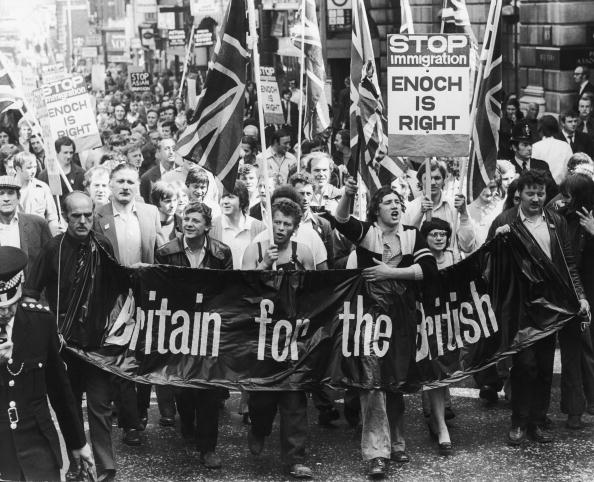
A large crowd gathered at London’s East End Victoria Park on April 30th 19781. They came from all over Britain to join forces and support a cause which had become a embroiled in the central struggle of British politics. This struggle was a race struggle thinly veiled as a immigration debate. Political agents such as Enoch Powell and his National Front had, in the years prior, created an atmosphere of xenophobia, hate and White/English supremacy. But there was a reaction to this rhetoric. Rock Against Racism, founded by Red Saunders, was a movement which fought hatred with music. They turned music from a medium of entertainment to a form of political activism. When one looks in retrospect, one might claim that they were central to reclaiming Britain’s youth from the jaws of neo-fascism.

The far right had always been lurking in the back waters of British politics. As far back as the 1920s, fascists such as Oswald Mosley had wielded varying degrees of power and influence2. But ever since the end of WWII support for the far right had dwindled. This was likely due to the increasing radical anti-semitic policy proposals ended Mosley’s Career, the traumatic war against the Nazis and the existence of a centre right party, the conservative party, which contested all elections as one of the two main political parties.  However, starting in the late 1960’s there was an unsettling resurgence of Ultra-Nationalist rhetoric entering the mainstream political debate. The main reasons for the resurgence of far right parties such as the National Front was the great influx of immigrants coming from former colonies/ commonwealth realms3. The Troubles, the civil rights movement turned insurgency/ fight for liberation in Northern Ireland, was also a cause for their surge in popularity. They believed in Ulster as an integral part of the UK and advocated for extreme Loyalism in NI. The culmination of this racist populism was a speech given by Enoch Powell (National Front Leader) in 1968. The “River of Blood” speech, as it is now known, voiced Powell’s paranoid concerns that within the century the white british people will become an underclass to the commonwealth immigrants3. While this paranoia is totally unjustified, it resonated with the white working class and lead to a atmosphere of racial intolerance and hatred.

Now with the political context set, we can look at the inciting incident which lead to the formation of Rock Against Racism. On august 5th1976, at a concert in at the Birmingham Odeon,Eric Clapton made remarks which will forever overshadow anything he played that night. Just blocks away from where Powell made his “Rivers of Blood” speech, Clapton went on an alcohol fueled diatribe against the immigrant community and people of colour in general. Below is an slightly censored quote from that night.


The black w*gs and c**ns and Arabs and f***ing Jamaicans don’t belong here, we don’t want them here”


Clapton then followed up this remark with.


“This is England, this is a white country, we don’t want any black w**s and c**ns living here… Enoch for Prime Minister! Throw the wogs out! Keep Britain white!”4


Drunkenness does not turn someone into a racist, and even if it did it would not matter. Clapton never apologised for his statement that night. This lead to a reaction by a rock photographer and future organizer of Rock Against Racism, Red Saunders . Saunders’ response included a swift denunciation of Clapton, a accurate accusation of appropriating black music and a call to action to support his new found cause1. But why was it Clapton’s comment that prompted such a large response from popular culture and not Enochs Speech? Similarly why didn’t this response come when David Bowie made similar albeit stranger remark a few months earlier?  I think what Saunders understood about music was that it had a profound ability to mold the thoughts and outlooks of a generation. It was not so much that Claptons music was overtly racist, but that people felt a deep connection to him due to his immense expressive power. We identify with the artists of our time more so than the politicians of our time. So when Clapton demonstrates his racist attitude openly, it encourages others who feel similarly to overtly convey their attitudes. Furthermore when Clapton does not apologize he vindicates the racists attitudes held by some of these younger fans. This, I think, is what separated Bowie from Clapton, who has since apologized many times and was admittedly under the influence of a lot of narcotics (and Nietzsche?) at the time5.

Western music has been creating cults of personality for many centuries. Since Beethoven, the musician as a demigod has been an unfortunate feature of our musical culture6. However what happens when this elitist attitude transforms from a dog-whistle of white supremacy6 ,suggesting western classical music is superior music written by a superior race, to the bull-horn for fascist ideologies? Luckily in the UK the reaction is the organization of sane people standing up for those who are marginalized. By rejecting the propagators of  fascism and reclaiming the idiom of rock the British scene was able to save a generation from shifting two giant steps to the right and played a part in the fall of the National Front.


  1. https://www.theguardian.com/music/2008/apr/20/popandrock.race
  2. https://depts.washington.edu/chid/intersections_Autumn_2010/Bret_Rubin_The_Death_of_British_Fascism.pdf
  3. http://www.telegraph.co.uk/comment/3643826/Enoch-Powells-Rivers-of-Blood-speech.html
  4. http://thequietus.com/articles/20701-eric-clapton-racism-morrissey
  5. http://www.playboy.com/articles/playboy-interview-david-bowie
  6. https://www.nytimes.com/2017/07/30/arts/music/trump-classical-music.html?smid=tw-


How Could Holst Write About Planets He’d Never Even Been To?

This is not a blog post about Gustav Holst. It is not about Holst’s “Planets” suite and will not mention anything remotely related to Holst’s music from this point forward. If you are disappointed because you thought this was going to be about Gustav Holst, feel free to walk away now, no judgment.

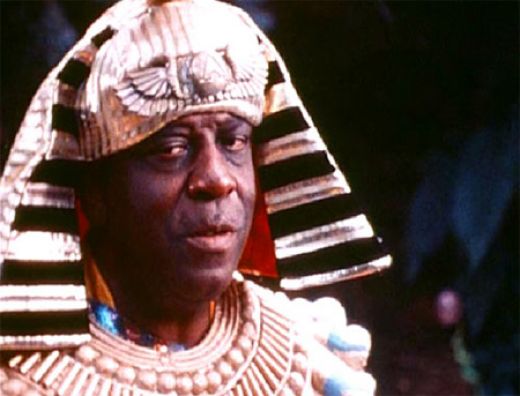
Still reading? Great! This blog is not about Gustav Holst because Gustav Holst never even went to Saturn. You know who did go to Saturn? Sun Ra went to Saturn. Do you know who Sun Ra is? Most people don’t, so don’t feel bad (or if you do, congratulations on belonging to this educated minority).

Herman Blount (later known as Le Sony’r Ra or, more commonly, Sun Ra, named for the Egyptian solar god) was born – or awoke or arrived, depending on who you ask – on May 22, 1914 in Birmingham Alabama. This was, according to him, the least important of all his births, though it still seems to be the one that we Earthlings gravitate toward. This essay from Sun Ra’s official site gives some insight as to how he conceived of his arrival. To give a radically condensed history of Sun Ra’s early life, he was a skilled pianist who gravitated toward jazz (strong traces of Duke Ellington, and later on Charles Mingus and Thelonious Monk can be found in his playing and his composition) and briefly attended college until an unexpected trip to Saturn changed his perspective. As he describes the experience:

“My whole body changed into something else. I could see through myself. And I went up…I wasn’t in human form…I landed on a planet that I identified as Saturn…they teleported me and I was down on a stage with them. They wanted to talk with me. They had one little antenna on each ear. A little antenna over each eye. They talked to me. They told me to stop attending college because there was going to be great trouble in schools…the world was going into complete chaos…I would speak (through music) and the world would listen. That’s what they told me”.

And thus Sun Ra embarked on a decades-long musical career with his Arkestra (named for ‘Ra’ the Egyptian sun god and ‘kist’ coming from a Sansrit word meaning ‘sun gleam’, though Sun Ra also remarked that the name was simply “the way black people say ‘orchestra'”). This and loads of other biographical info on Sun Ra can be found in John F. Szwed’s Space is the Place: The Life and Times of Sun Ra. You can also check out Szwed’s personal site for more writings on African American studies and jazz biographies.

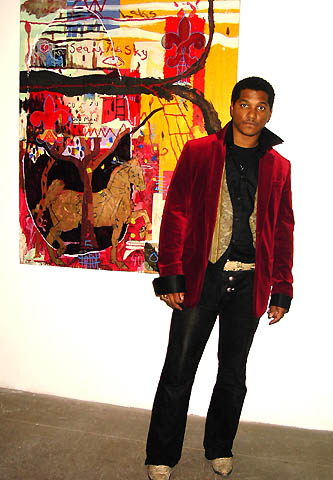
Sun Ra’s work falls into a movement known as Afro-Futurism – an artistic and cultural movement that uses ‘futuristic’ (think science-fiction) and cosmic influences to represent black culture and grapple with the experiences of the African Diaspora, or African-descendant communities throughout the world. This 43-second video can give you a snapshot idea of what this movement stands for, but for an in-depth study would benefit from the writings of Octavia Butler or the art of Angelbert Metoyer (pictured below).

Themes of the great cosmic unknown, furiously advancing technologies, confusion and peace permeate Afro-Futurist art, and Sun Ra is no exception to these themes. His music often deals with space and the cosmos, with performances by his Arkestra often referred to as ‘space jazz’. Long, open-ended groove sections, various combinations of keyboards and synthesizers and confusing dissonances all contribute to this label and combine to create one of the most distinctive sounds in jazz music. Sun Ra also often included other arts or media in his performances, including dance, poetry and electronic visuals. Perhaps most famous of these other media is the Outer-Space Visual Communicator invented by Bill Sebastian in a collaboration with Sun Ra in the late 1970’s. In a nutshell, this device is a giant keyboard controlled by one’s hands and feet that manipulates a light display, to be played in real time (as opposed to being pre-programmed) and projected onto a large screen. This collaboration, including the hopelessly complicated and futuristic OVC device, seems to strike the heart of what Afro-Futurism is for Sun Ra – a seamless musical and visual presentation that cannot possibly be considered from this world, that seems to take the audience on a journey toward some sort of unattainable enlightenment, defying you all along the way to categorize it. This piece is called “Calling Planet Earth” and features the OVC and the Arkestra. It lasts 15 minutes, but its effect is not lost if you jump around in the video – in fact, in light of the piece depicting a surreal, other-worldly experience mostly disconnected from this reality, I’m sure Sun Ra would even welcome this. Enjoy!

https://www.youtube.com/watch?v=CPuK7hfWCfA


The Politics in Barber’s ‘Adagio for Strings’

On June 12th 2016, the deadliest mass shooting seen yet in the United States occurred in Orlando, Florida at ‘Pulse,’ a gay nightclub. This horrific event caused uproar on various political topics, including hate crime, gun violence and laws, terrorism, and immigration, as articulated in this New York Times Article. The perpetrator, Omar Mateen, was a Muslim American, who felt strongly against the American government for the conflicts in Iraq and Syria. Mateen also openly stated his hate for gays, and latinos. Mateen’s motives were very clear in making a statement of hate. This event broke the hearts of people not only in Florida but to the entire country. In so many aspects, the United States seemed to be progressing with gay rights and many other political stances, but also falls so far behind with issues of terrorism and gun violence.

https://www.youtube.com/watch?v=6uRS8O3nT4U&feature=youtu.be

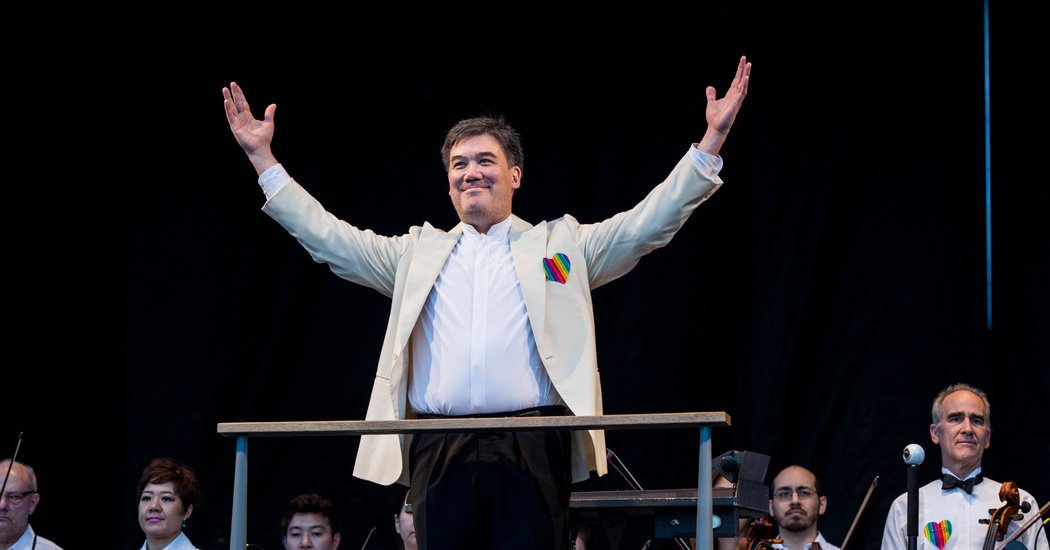
Soon after, on June 15th 2016, the New York Philharmonic had their annual Concert in the Parks Series in Central Park. Originally on the program was a Rossini Overture, but was changed to Barber’s Adagio for Strings as a tribute to the victims of the Orlando shooting. Alan Gilbert said a few words before the performance, showing the effects this event had on the community. While attending this event, I was moved by the sentiment and truly heartwarming performance. A few days after attending this event, a New York Times Article was published, reviewing the concert. This article mentioned that Barber was an openly gay composer, making the performance that much more meaningful.

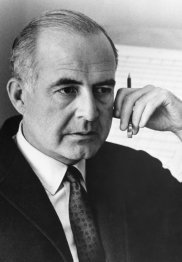
Samuel Barber

Although this piece was not necessarily written as a memorial, it is often used in memorials and as a tribute to events like this. Barber’s Adagio for Strings was broadcasted over radio and television for major events such as the death of Franklin D. Roosevelt, John F. Kennedy, Princess Diana and played at the funeral of Albert Einstein.

Music and politics inevitably coincide, as each affects lives on a daily basis. Whether a piece’s original intent had political meaning behind it or not, music can act as a voice in politics as well. Music brings people together, and as Alan Gilbert said, “we are all part of a shared humanity,” especially after heartbreaking events like this one.

Alan Gilbert at Concerts in the Parks


The Powers That Be

“Let me tell you the story of Right Hand, Left Hand. It’s a tale of good and evil. Hate: it was with this hand that Cain iced his brother. Love: these five fingers, they go straight to the soul of man. The right hand: the hand of love. The story of life is this: static. One hand is always fighting the other hand, and the left hand is kicking much ass. I mean, it looks like the right hand, Love, is finished. But hold on, stop the presses, the right hand is coming back. Yeah, he got the left hand on the ropes, now, that’s right. Ooh, it’s a devastating right and Hate is hurt, he’s down. Left-Hand, Hate, KO-ed by Love.”

(Actual song starts around 2:00, music video by Spike Lee)

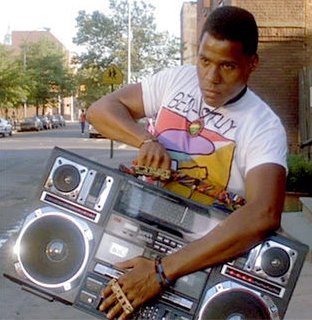
So goes one of the only main monologues attributed to Radio Raheem throughout the film Do the Right Thing. Instead, he spends most of his time cruising the streets of Brooklyn, radio in hand blasting Public Enemy’s “Fight the Power”.

Fight the Power was commissioned by Spike Lee, specifically for the film. The song takes the refrain of a classic Isley Brothers tune and turns up the energy and rhythmic impulse past 10, resulting in an anthem of protest and unity. Fight the Power’s release is a pivotal moment in the development of hip-hop, with Public Enemy injecting political and social values into the nascent genre of hip hop while combining with Spike Lee’s film to create a unified form of social protest for a restless youth population, forever cementing hip-hop as a unique way to combat social institutions.

In the article, “Does music trump politics”, Lamell, an organizer of a community orchestra who hired a controversial political talk show host to conduct a Haydn symphony, states that, “music and politics ‘are two entirely different worlds: Political discourse is one realm, and music is another realm”. While this may be true for some forms of absolute music, the logic behind this statement blatantly ignores the composer and (more importantly), human behind the piece, not to mention the performers who bring that piece to life. Political ideologies perpetually affect every decision humans make, even if this filter occurs unconsciously. Not only that, but this statement also appears to be made under the assumption that only Western classical music is worth acknowledging as “music” because anyone who has been living in America within the past half a century has witnessed politics as a hotbed for music, not just in hip hop but the entire punk movement (notables such as Bad Brains, Dead Kennedys) as well as folk music with Crosby Stills and Nash, Neil young, and Bob Dylan just to name a few. Both Spike Lee and Public Enemy resoundingly reject this idea of fine arts simply being an escape from everyday life, with astute portrayals of urban cultural conflict and unified protest respectively, specifically revolving around power and its’ abuse. In the words of prominent African-American author, Ta-Nehisi Coates, “All the world’s boomboxes were transformed into pulpits for Public Enemy. Before now, the music was escapist and fun– some beats and the dozens, fat chains and gilded belt-buckles. But Chuck D pulled us back into the real….. Here in Baltimore, brothers would put on the Enemy and recoil. We had never heard anything so grating–drums crashed into whistles, sirens blared off-beat. But the cacophony was addictive and everywhere”.

To understand Fight the Power, first one must understand what the hook, “Fight the power, We’ve to fight the powers that be” actually means. It’s easy to take the line at face value and assume that Public Enemy is simply calling for retaliation against any and all authority but instead the line is referencing the systematic abuse of power by those in positions of authority, and how these systems keep the poor and rich (many times along racial lines) disparate. Off of the second verse the lines, “People, people we are the same, No we’re not the same cause we don’t know the game, What we need is awareness, we can’t get careless…” reinforce this concept. Even groups such as NWA (who formed slightly after public enemy but had songs like Fuck the Police that were released before Fight the Power) who had traces of socio-political message hadn’t fully capitalized on how unique of a position hip-hop was in to educate and unite African-Americans, and this mentality coincides with Mike D’s belief mentioned earlier in the second verse, “What counts is that the rhymes, Designed to fill your mind”.

So what exactly is it about Fight the Power that made it so anthemic for millions of people? Firstly, is the song’s (as well as much of early hip hop’s) roots in African American culture, specifically through the use of samples as well as shout outs like, “Sound of the funky drummer” in reference to the James Brown song (a break beat responsible for an unfathomable number of hip hop beats). A cursory glance at the song’s WhoSampled page (a site that breaks down both what samples are used in hip hop songs as well as the ability to look at the various ways in which a single song has been sampled throughout history), brings up names such as James Brown, Isley Brothers, Sly & the Family Stone, the J.B.s, Bob Marley (I know, technically not African American), and Syl Johnson, a who’s who of progressive black artists. Pair these reworked cultural touchstones with scathing lyrics such as,

“Cause I’m Black and I’m proud
I’m ready and hyped plus I’m amped
Most of my heroes don’t appear on no stamps”

and,

“Elvis was a hero to most
But he never meant shit to me you see
Straight up racist that sucker was
Simple and plain
Mother fuck him and John Wayne”

and it becomes easier to understand why this resonated with millions of young black people in the 1980’s, especially after epidemics such as AIDS and the war on drugs that destroyed urban areas had been mishandled by the powers that were. While the Elvis line is a bit of hyperbole considering Elvis himself was respectful to his African-American inspirations (admitted to here by Chuck D), the line is supposed to convey the frustration that for  the majority of America, Elvis was the be all end all of rock music, blocking out any recognition of all of the African-American musicians that preceded and inspired him. John Wayne on the other hand had this to say in a Playboy interview back in 1971, “I believe in white supremacy until the blacks are educated to a point of responsibility. I don’t believe in giving authority and positions of leadership and judgment to irresponsible people”, so the bitterness is understandable.

(Spoiler alert for Do the Right Thing ahead)

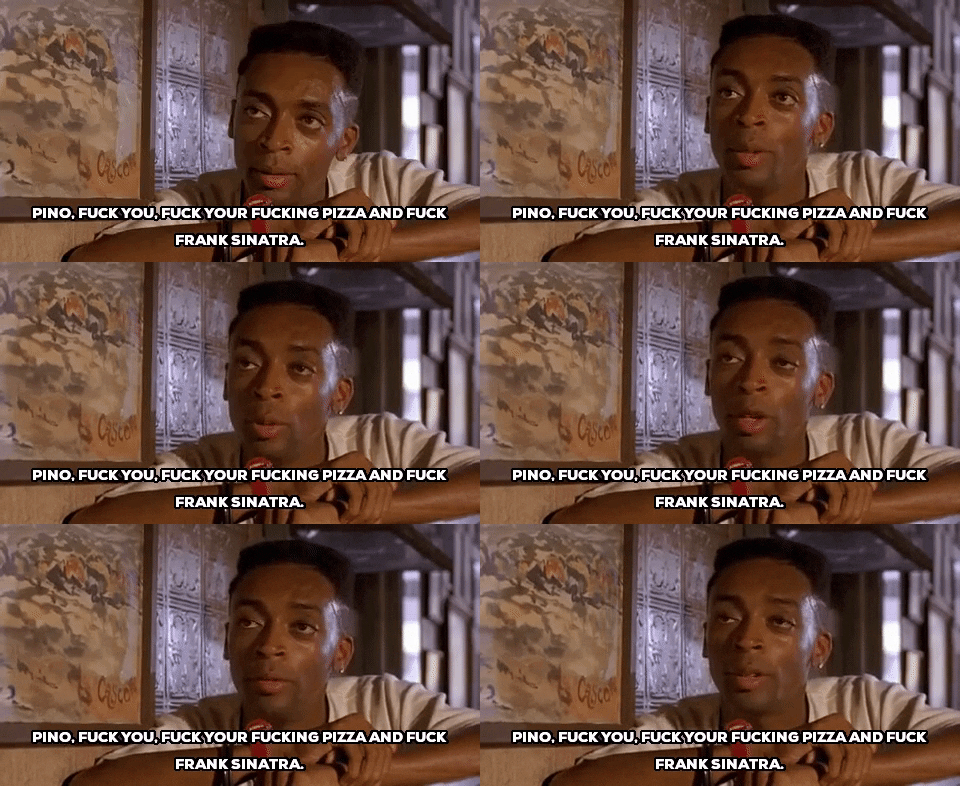
The culmination of all the events in Do the Right Thing leads to a showdown in the only pizza joint in the neighborhood owned by a white Italian family, with a riot catalyzed by the shop owner breaking Radio Raheem’s box with a baseball bat due to his refusal to turn the hip-hop off. This is a mightily simplified version of a very complicated film, yet serves as potent foreshadowing by Spike Lee of both the power of hip-hop as a social statement as well as the apprehension and fear it caused when it first started becoming popular. While the summer of 1989 was maybe not the first moment that politics and hip hop intertwined, it served as a visceral introduction for mainstream America to a very frustrated and very vocal group named Public Enemy.

Further Exploration:
-Do the Right Thing (film)
-http://www.npr.org/event/music/560379652/the-roots-feat-bilal-tiny-desk-concert (very current example of hip-hop and politics)
-Fear of a Black Planet (album by Public Enemy)

Assignment #2 “Strange Fruit”

“Strange Fruit”: An American Protest Song                                                                           by Livio Fasullo

“Strange Fruit”- Abel Meerpol

“Southern trees bear a strange fruit,

Blood on the leaves and blood at the root,

Black body swinging in the Southern breeze,

Strange fruit hanging from the poplar trees.

Pastoral scene of the gallant South,

The bulging eyes and the twisted mouth,

Scent of magnolia sweet and fresh,

And the sudden smell of burning flesh!

Here is a fruit for the crows to pluck,

For the rain to gather, for the wind to suck,

For the sun to rot, for a tree to drop,

Here is a strange and bitter crop.”


    In 1939 Billie Holiday sang “Strange Fruit”, the poem above, set to music for an integrated audience at New York City`s Cafe Society. After she finished the audience was silent until one patron began to nervously applaud. (http://www.nytimes.com/books/first/m/margolick-fruit.html)“Strange Fruit” became one of Billie Holiday’s signature songs, and she would perform it nightly at the “Cafe Society” and wherever else it was safe to perform. (http://www.nytimes.com/books/first/m/margolick-fruit.html) Although Holiday`s label Columbia Records, refused to record it, and many radio stations refused to play it, “Strange Fruit” was quite successful.

    To understand the success of “Strange Fruit” it is important to understand its origins. “Strange Fruit” was written by Alan Meerpol, a white Jewish schoolteacher from the Bronx who was inspired to write “Strange Fruit” in 1934 when he saw the haunting photograph of the lynchings of Thomas Shipp and Abram Smith in Marion, Ind.  http://www.npr.org/templates/story/story.php?storyId=129025516 Meerpol gave the song to Barney Josephson, the founder and owner of Cafe Society, who gave it to Billy Holiday to perform. (http://www.nytimes.com/books/first/m/margolick-fruit.html) It is important to note that when Holiday recorded “Strange Fruit” in 1939, lynchings were still occurring each year and then President Franklin Delano Roosevelt refused to sign anti-lynching legislation over fear of upsetting Southern Democrats (http://www.nytimes.com/books/first/m/margolick-fruit.html). Some say that “Strange Fruit” marked the beginning of the Civil Rights Movement in America 14 years before Rosa Parks refused to give up her seat on the bus. Legendary drummer Max Roach said “When she recorded it, it was more than revolutionary…No one was speaking out (at the time) She became one of the fighters… She became a voice of black people and they loved this woman.” ( http://www.nytimes.com/books/first/m/margolick-fruit.html).


   Over the years, other artists have recorded “Strange Fruit” to Protest Inequality in America. Nina Simone recorded it in 1964 for the album Pastel Blues. (https://en.wikipedia.org/wiki/Pastel_Blues)  Simone would continue to perform “Strange Fruit” live as her involvement in the American Civil Rights movement increased in the 1960s. Here is a recording of Simone performing it live at Morehouse college in Atlanta, 1969. “Strange Fruit” was also in the speeches of Khalil Abdul Muhammed, a speaker of the Black Panthers. http://www.nytimes.com/books/first/m/margolick-fruit.html


   “Strange Fruit” has continued to appear in the news during the last year.The British Singer Rebecca Ferguson, refused to sing at President Donald Trump`s Inauguration unless she was permitted to sing “Strange Fruit” (she did not perform).  (https://www.theguardian.com/us-news/2017/jan/02/rebecca-ferguson-says-she-will-play-trump-inauguration-if-she-can-sing-strange-fruit)President Donald Trump has been criticized for his affiliation with the White-Nationalist linked Steve Bannon and for refusing to condemn the actions of a white-Nationalist groups at the Charlottesville Rally. On August 11-12 2017 various White Supremacist groups held the Charlottesville Rally protesting the removal of the a Confederate era monument, during which a protestor drove a car into a crowd of counter-protesters, killing one and injuring 19. ( https://en.wikipedia.org/wiki/Unite_the_Right_rally) In response, dancer Travis Wall choreographed a dance routine set to Nina Simone`s rendition of “Strange Fruit” comparing a current hate crime to the countless hate crimes of the Jim Crow Era South.

https://www.youtube.com/watch?v=REQLA_05TlI

   These modern performances of “Strange Fruit” are very socially and politically motivated. In these scenarios, the performance (or refusal thereof) of a song protesting lynching is used as to condemn modern hatred, and the President who turns a blind eye. And although “Strange Fruit” is clear example of how music can be used to make a bold political statement, any instance in which a political figure uses music is political. Conservative radio host Dennis Prager conducted the Santa Monica Symphony on August 16th 2017, just four days after the tragedy in Charlottesville. Prager and Orchestra director Guido Lamell responded to criticism by claiming that conducting Haydn is not a political statement. Yet Prager, who claims that Classical Music glorifies the supremacy of White Western Culture made a huge political statement by telling his supporters to buy all the tickets available in the hall. http://musicologynow.ams-net.org/2017/09/does-music-trump-politics-dennis-prager.html


   In conclusion, Music is incredibly powerful as a political tool. Music can inspire suppressed people to speak out against the oppressive, and it can enable the oppressive and hateful to gain influence. Any patriotic tune can be used as propaganda by political party, and any folk song can become an anthem of resistance. “Strange Fruit” was an incredibly powerful piece of music that