Totino’s Pizza Rolls: A Postmodern Adventure Great Job!

Summarized in this article beautifully as a video in which “grown men … dance to shrill synth beats while eating Totino’s pizza rolls out of a tiny pink backpack,” comedy duo Tim Heidecker and Eric Wareheim’s commercial for Totino’s pizza rolls depicts an authentic and successful marriage between image, music, sound, and editing — a true multimedia experience. After all, as the comment below reminds us, this is a real commercial:

Totino’s actually paid Tim and Eric to create an advertisement featuring their product, and they’re not the first ones to do so (check out these pieces for Absolut and Old Spice). But what exactly is the fine line that separates this masterpiece from a Mountain Dew-fueled fever dream of a last minute assignment thrown together the night before a freshman English presentation?

There’s definitely… a lot to unpack here. Much of the ad’s effectiveness lies in incongruity theory, or the idea that part of what makes something funny is presenting the unexpected. In his Critique of Judgement, Immanuel Kant writes, “In everything that is to excite a lively laugh there must be something absurd.” 

Incongruity theory hard at work

This definition of incongruity theory also touches on irony, which derives power from an awareness of what is expected and plays off of that expectation by subverting it. Much of Tim and Eric’s humor relies on this principle, often pushing past a primary boundary into the absurd. The juxtaposition of a tiny pink backpack on a grown man, for example, is ironic enough, but in the segment from 0:28-0:35 the team takes it further by cutting away from the scene and labeling this backpack as a “Feminine Pizza Bag.” In this cut scene, Tim and Eric are made tiny and the tiny pink backpack is made huge, with the duo standing on top of it. This takes the juxtaposition one degree further — using something that already lies outside a norm (shrinking a backpack and putting it on someone who you would not normally see wearing said backpack), pinpointing some aspect that makes it weird (it’s really small!), and then inverting that quality (let’s make it large and put Tim and Eric on the bag instead of putting the bag on Eric), then sequencing those two visuals back to back to back. This happens in a span of less than ten seconds, which is not a lot of time for your brain to consciously grab on to all of these intricacies, further playing into the absurdity of it all.

Tiny Tim Feat. Big Backpack

Repetition is another powerful tool throughout the video. From an auditory standpoint, the chorus “Totino’s, Totino’s, how did you know!” comes and goes throughout the video in various forms. It opens with the original iteration in the exposition, but later revisits Tim and Eric in a greenscreened kitchen just chanting “Totino’s” over and over. In fact, thanks to a transcript provided in the comments by user HannibalOrJustRex, we know that the word “Totino’s” comes up no less than 29 times. The majority of this repetition is concentrated near the end of the video, which devolves into an Einstein-on-the-Beach-esque chorus of “Totino’s,” “Whoo” (from Tim), and “Yeah” (from Eric), before a closing word from Hard Rock Joe and a final “Whoo/Yeah” from Tim and Eric, respectively. This progression from coherent nonsense distilled down to the most basic dialogue consisting solely of product name and cheers of enthusiasm falls under that same umbrella of absurdist incongruity theory, but does so in a way that still abstractly relates to the original topic at hand (Totino’s = Good). From an advertising standpoint, it also sends the subliminal message tying the product (Totino’s) to a positive reaction (Whoo/Yeah), which strengthens the overall effect of the work.

Visual repetition is an equally powerful element at play. The video opens and closes with snippets of Hard Rock Joe talking about his love of punk bass and pizza rolls over a green screen backdrop of a dimly lit brick room. Whenever we see Hard Rock Joe by himself throughout the video, it’s in this setting, and the three principal scenes in this setting are the very beginning, middle (1:35), and very end. Repetition abounds within a lot of these recurring green screen backgrounds — take the layered pizza one at 0:15 (which comes back at 0:25 and 1:15), or the cut and paste city assembled from a combination of pizza rolls, party pizza boxes, and standard run-of-the-mill pizzas at 0:27. The pizza with holes cut out of it here is actually derived from the pizza mask the unnamed woman wears in the exposition at 0:08, and resurfaces in the backdrop at 2:28 (as evidenced below).

Pizza Mask, Upper Right
Pizza Mask, Original
Pizza Mask Returns (also as a bonus, note the face swap of Tim’s head on Eric’s body and vice versa)

A similar repetition out of context can be found with the glasses Eric wears in the pizza chess scene — we saw a cut and paste version of those on Hard Rock Joe near the beginning (0:22). And there are plenty of scenes with duplicates of Tim or Eric — we have three Tims on screen at 1:32, five Tims at 1:59, and three Erics at 2:32, for instance. There’s also two separate scenes where each sings with mouths replacing their eyes — Tim at 1:35, and Eric at 2:29. 
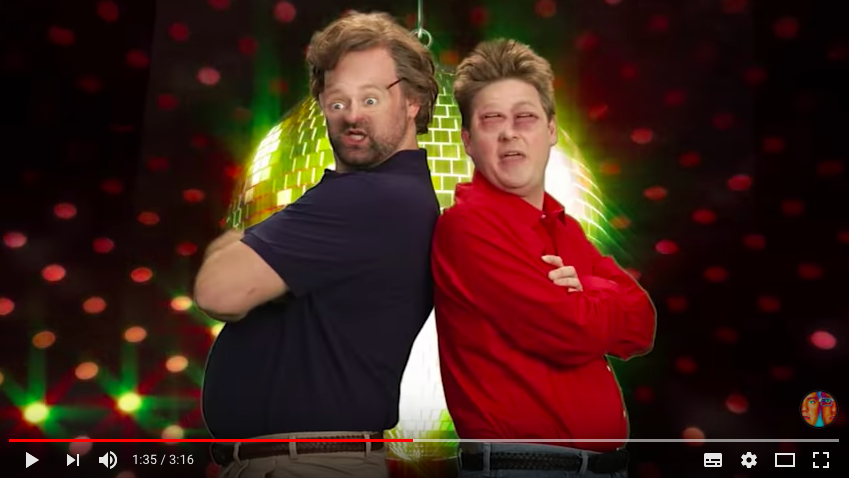
Tim on the right (sans eyes but with triple the mouths)

 This repetition of image and sound provides us with a sense of formal structure throughout, however abstract, whether it’s revisiting Hard Rock Joe in his punk bass dungeon, repeating a backdrop as with the layered pizzas, or repeating a word or phrase. This purposeful reuse of previous material, no matter how fleeting or subtle, provides a thread for our subconscious to follow, which is what allows us to view the whole thing as a (somewhat) coherent single entity as opposed to a string of random unrelated vignettes. Again, this is all presented in a very fast paced manner, not something we consciously pick up on but rather dependent on the fact that the human brain is hard-wired to detect pattern and repetition. 
Art is hard sometimes

A lot of the time we hear responses to contemporary art (and by extension contemporary music) like, “My kid could do that — so unimpressive,” or “I can’t tell the difference between that and garbage,” or “What’s this doing in a gallery? That’s not art!” These reactions imply a few things. First, that the artist is not talented; consequentially, that a determining factor of “talent” lies in how easy it is for the viewer to “get” the meaning at first glance; and finally, an output fueled by anger at the museum or concert hall or whatever space said piece of art finds residence for allowing that piece of art to be put on display. To me, comments like this are a visceral negative response that allow the (often narrow-minded) viewer to maintain a sense of superiority, maintain power in an unfamiliar context, and maintain the same worldview they had before it was challenged by the idea that something different or hard to understand could have something powerful and relevant behind it. In the words of this Guardian article, that’s a big part of what makes Contemporary Art art: “As long as someone thinks modern art is rubbish, it is still provocative. It is still dangerous.”

A lot of the negative reactions to Tim and Eric’s work (the Totino’s advertisement being no exception) contain a similar veiled anger. One comment reads:

And to an extent, he does have a point, with regard to timing. I don’t think this kind of humor would have resonated as strongly 20 years ago, and it also seems to resonate better with younger audiences than older demographics. But the reason this dynamic duo finds success is because the “nonsense” they put out is so carefully not random. It toes the line between expectation and absurdity in a way that plays with your head but still leaves you with the impression that you’ve watched some abstraction of a single idea, as opposed to a disparate smattering of screenshots and soundbites of unrelated material. It provokes a powerful reaction from most people because there is intent in the execution and coherency in the concept, no matter how absurd that concept might be. That, to me, is the mark of something great: the ability to evoke a strong emotional response, and make people think, whether or not that response is positive or negative.


Beyonce & Stage Design

Beyonce is known to be one of the quintessential performers of our time. The Queen Bee has set an incredibly high standard for herself with her recordings, performances, and music videos. I would like to take a brief look at how Beyonce maintains continuity with her audience through live performance and her music videos, and also analyze the use of stage design in performance practices as well.

The song we will be looking at is arguably her most famous, “Crazy in Love,” featuring Jay-Z.

This music video has all the tropes of early 2000s stardom. It received 11 awards including the Grammy for Best RnB song. It incorporates all kinds of sex appeal but two that I would like us to pay special attention to: the strut and the group dance. These two characteristics are staples of Beyonce as an icon and should be expected to be seen by an audience member attending her show.

Now I’d like for us to look at a video of a live performance of this same tune.

https://www.youtube.com/watch?v=Q5TyTPMaf1Q

I’d like to walk through this performance as it relates to stage design and audience’s expectations. For my criteria for judging stage design, I would like to use Es Devlin’s discussion of the topic from Abstract: The Art of Design; Stage Design. In this series she discusses the five basic principles of stage design; light, darkness, space, time, and scale. Beyonce uses these as well as other performance aspects with the music to continually keep her audience enticed and engaged through out the whole performance. It is as if the whole song is one big build up and the energy is carefully cultivated through out to give the viewer an iconic and memorable performance.

Let’s start at the beginning of the video. Beyonce is introduced while the audience waits in anticipation. You can only imagine that since purchasing the ticket they have been fantasizing of what this moment will be like and now it is finally here. Beyonce clearly knows this and builds on this excitement from the very beginning. The stage goes from being completely black to illuminating a white triangle, which often symbolizes power and stability. Right in the center of the triangle, much higher than the actual stage stands the silhouette of Beyonce. The music is ambient and atmospheric. Beyonce is heard singing upon fifths but not seen. The audience is dying to see her, and yet they can only hear her. Her fifths are ornamented with an eastern sounding scale, which gives the silhouetted Beyonce an air of mystery. The drums strike and the lyrics to “Crazy in Love” are heard but it is slower and with a lament bass instead of the original bass line. Her silhouette is now projected on large screens. In terms of scale, she is first scene in front of the giant triangle which is much higher than the audience, giving her this larger than life appearance. As she finishes singing and comes down from being much higher up than the audience the band accelerates the time, thus increasing the excitement to the build up of finally seeing Beyonce in the flesh. Finally, write before the song starts, the band drops out to hear just the voices. As they finish the band comes in even louder, which creates an even more dramatic effect, and while this is going on there is a dramatic shift from darkness to lights, with full fireworks and light show. Beyonce simply has to stand triumphantly at this point. Her persona as an other worldly phenomenon has been established long before this moment by all the elements of stage design used to her advantage, and now in this moment simple standing brings the audience to an immense roar. The darkness at the beginning gave mystery, the scale gave power, and the light gave the big reveal.

Before continuing I’d like to bring to light the fact that the entire band is made up of black women wearing all white. The white being seen before in the enormous triangle that first illuminated the stage and generally represents power and stability. As the song opens Beyonce stands firmly and hypes up the audience, without moving her feet at all. Can you imagine the energy she must be feeling and the self control to not move your feet at all during this opening scene? Shortly before the first verse, she turns and struts away from the audience and this is enough to get another enormous response from the audience. Simply her strut is enough to make them bust out in pandemonium at this point, but that will not sustain them again, she will have to continually up the anti if she is to win over the audience, and she does just that. As she sings the first verse there is a point of rest as she has your full attention and delivers the verse again with out moving her feet at all. As the first verse finishes she simply walks again, this time towards the audience, to another round of applause. Before the second verse she does a little dance, in a group. Which is oddly enough, exactly the same time that dance is seen in the music video. The live performance at this moment is coordinated exactly with the music video to create a seamless experience for the audience.

After the second verse we come to a point in the show that simply can not be like the recording, the rap verse. As we saw in the video earlier, Jay-Z is present in support of Beyonce, but does not come out to rap his verse. Instead there is an instrumental break, in which Beyonce hypes up her horn players to play some lines. These lines are again clearly choreographed, but to the audience, this is all an organic experience, or maybe it isn’t, it actually doesn’t matter, because they are seeing Beyonce and everything she does at this moment is sublime. This is because the audience is experiencing the show emotionally rather than logically. The instrumental break also is something fresh that distinguishes her live performance from her recordings thus creating a unique experience that could only have been experienced live.

At the end of the song she seals the whole performance by showing the breadth of her vocal range and more importantly doing a full group dance. From start to finish we’ve had one momentous build. From utter darkness and mystery, to seeing the star, to seeing her strut, to finally seeing her sing the highest highs and dance her signature group dances. This is a textbook performance and it simply could not be accomplished on this scale without the immense work in stage design, choreography, arranging, and so on. This experience was so carefully crafted by master technicians all working to establish Beyonce is this pop goddess radiating female empowerment and inspiration wherever she goes. The truly cultivate an experience that makes her seem super human and solidifies her as a pop icon for the ages.  

Sources: Beyonce Crazy in Love video. First video

Beyonce Glastonbury performance. Second video.

Beyonce awards search.

https://genius.com/Beyonce-crazy-in-love-lyrics

Netflix Abstract the Art of Design.


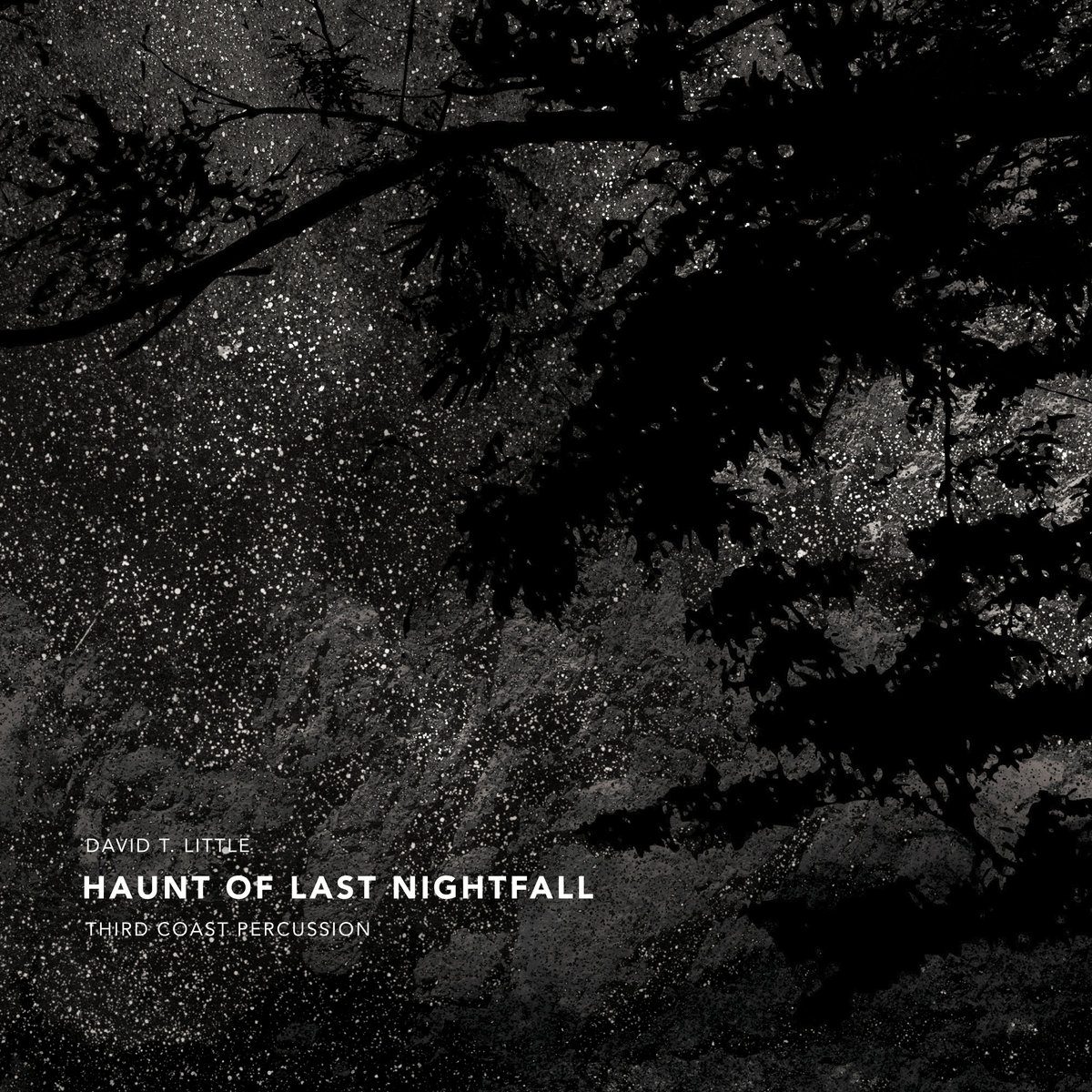
David T. Little’s Haunt of Last Nightfall and the El Mozote Massacre


Famous Auschwitz survivor, writer, and activist Elie Wiesel once said, “Without memory, there is no culture. Without memory, there would be no civilization, no society, no future.” The quote by itself seems to be just about memory in a general sense but considering the context of Wiesel’s experiences and activism, there is a very poignant truth: there is no hope for future generations to create a better future unless they remember and understand the past. Culture and art as a whole are very reflective of this sense of collective memory. Our movies, book, shows, and art all reflect the accomplishments we remember the most triumphantly and the losses that we feel most the most acutely as a society, particularly on a national scale. The question I am addressing is where music fits in our cultural memory and how a piece like David T. Little’s Haunt of Last Nightfall can serve as a sort of cultural artifact, expanding the awareness, breadth, and influence of a certain point in time on todays cultural memory.

Haunt of Last Nightfall was premiered and commissioned by Grammy Award winning percussion group Third Coast Percussion. The piece takes influence from experimental metal music, specifically the bands Sunn O))) and One Day as a Lion, and is inspired by the events that took place on December 11th, 1981 in El Mozote, El Salvador where an elite battalion of the Salvadoran government, funded by the United States, slaughtered over 800 innocent civilians. While it is not my intention to be unnecessarily graphic, I believe that this story is important and needs to be told in order to understand what this piece is really about and what it and this history means for us today.

CONTENT WARNING: The accounts of these events involve frequent mention of extreme violence such as murder, decapitation, and rape.

The source material for the account I am about to give comes entirely from Mark Danner’s amazing piece of journalism “The Truth of El Mozote” published in the New Yorker in 1993 which was the first definitive piece written on El Mozote after both the Salvadoran and U.S. governments attempted to deny that the massacre took place. It is a highly fascinating read and delves much more into the details of the Cold War-era politics of the story than I will here.

In the early eighties, El Salvador found itself at the onset of a messy civil war between leftist guerrilla groups and the national government.  The right-wing U.S. administration felt responsibility to make sure that fascism crept no further into the western hemisphere and thus had aligned priorities with the Salvadoran government. Avoiding trying to create another Vietnam, the U.S. chose to provide funding and training for the highly inept Salvadoran armies rather than actually send in troops. Early on in the war the guerrilla groups remained ever elusive to the government but with military reform, the government began an operation called “Hammer and Anvil” in the northeast portion of El Salvador called Morazán where they knew guerrillas were hiding. The operation was spear-headed by an elite group of government soldiers called the Atlacatl Battalion lead by the ruthless Domingo Monterrosa. The Atlacatl had a fire in them that the rest of the army didn’t when it came to exterminating the guerrillas or as they called them, “delinquent terrorists”. They proceeded throughout Morozán destroying all villages that could be guerrilla outposts, not matter the cost. Locals in villages in the area knew that the army was headed their way and were actually told by richer villagers that they trusted to stay put and that the relatively small town of El Mozote would be safe since they largely did not deal with guerrilla fighters. El Mozote also had a large population of Protestant Evangelical Christians which helped their case considering Catholic liberation theology had been contributing to guerrilla recruitment in other villages, so guerrillas had learned not to recruit there.

This fact is what made El Mozote special. Most of the towns ravaged by the Atlacatl in Morazán did at least have some guerillas there or civilian guerrilla sympathizers, but El Mozote was known to be largely outside the sphere of influence of the guerrilla fighters. Yet because of great intelligence and mobility the guerillas were able to stay one step ahead of the government and the army grew increasingly frustrated. Then on the evening of Thursday, December 10th, 1981, the Atlacatl arrived in El Mozote and went around through the village banging on doors, forcing the residents from their homes into the street. As night fell, the soldiers lined the entire village up and forced them to lie literally mouth down in the street. Much what actually happened in El Mozote is known from a single eye-witness account, Rufina Amaya, who was the sole survivor of the massacre.

She, along with her husband and four children were among those laying in the dirt that night as the soldiers kicked them and asked where the guerrillas were. After some time the soldiers ordered everyone back into their homes threatening that they would be shot if “even so much as their noses” were poking out of the door.

David T. Little’s piece follows this narrative of events pretty faithfully although it is not completely programmatic. The first movement “Curtain, El Mozote” sets the scene for the piece and story with a sultry marimba voice, clapping, and deep synthesized bass. It is also worth noting that in the video recording of Third Coast playing the piece, the stage is almost completely dark except for a few lights lighting the instruments and performers. This adds to the haunting, night-time feeling the piece capitalizes on. The second movement, “Between the Hammer and the Anvil“, is quicker, full of deep, aggressive drumming, piercing brake drum sounds and introduces electric guitar which plays a prominent role representing violence throughout the rest of the piece. The third and fourth movements then begin to focus on the events of the night that the Atlacatl arrive. The third is called “Last Nightfall” and to me it evokes the feeling of silent dread and uncertainty of that night. The fourth movement “Line Up/ Face Down” returns briefly back to the chaotic drumming and guitar of the second movement before melting into the lush, hammond organ sounds of the fifth movement: “Coda: And there was evening…” This concludes the first half of the piece which David T. Little describes as ” a ghost play in two acts”.

On the morning of Friday December 11th, 1981 the soldiers ordered everyone in El Mozote out of their homes and into the plaza again. From there they were divided into groups of men and then women and children and then sent into separate locations: men in the church and women and children into the home of one of the local residents. An officer involved in the operation later said that the plan was to interrogate the village for information about the guerrillas yet it is unclear how strong this intention was because after roughly an hour of questioning, Rufina and the other women and children could hear the men shouting from the church and see the soldiers marching bound and blind-folded men out of the church and into the plaza and streets. From a small window in the house they were held Rufina and her nine year-old son Cristino saw her husband Domingo Claros in one of the groups try to escape with another man and watched as the Atlacatl soldiers gunned them down on the spot and then walk over to the still breathing men and use their machetes to behead them. After a similarly brief questioning period with the women, the soldiers came in and started picking off young women and girls as young as ten and marching them out of the village and into the nearby hills named El Chingo and La Cruz. The rest of the women soon could hear the screaming coming from the hills of the girls being raped and shot. As the afternoon wore on, the soldiers began taking the mothers from the children and out into the town to be killed as well. Rufina was in one of the last groups, leaving behind a house full of screaming children, to be marched into the streets where the soldiers began burning houses full of corpses. Once the women saw the bodies screaming and chaos broke out. Rufina fell to her knees in despair and managed to crawl out of sight of the guards under a bush near a crab-apple tree. Some of the soldiers came to rest near where Rufina was hiding after they started burning more buildings. She could overhear them discussing whether they should kill all of the children or not. She heard one finally say, “We have orders to finish everyone and we have to complete our orders. That’s it.” After that she could hear the children begin screaming as the soldiers finished them off too.

As evening fell, shrieks could still be heard from the girls left on the hills and the soldiers began to burn the rest of the village. Soon silence began to fall and the Atlacatl eventually marched out of El Mozote, killing even the animals, leaving nothing behind. Rufina eventually escaped far enough to reach the guerrillas and share her story of survival through their underground radio.

The second half of Haunt of Last Nightfall opens up with the sixth movement “… and there was morning- the Second Day”. The beginning starts as softly and innocently as the people of El Mozote woke up that fateful morning, conjuring images of a sunrise with small metallic sounds. The movement drastically shifts towards some of the most aggressive music heard yet on the piece, with large, all-encompassing electric guitar chords that become almost unbearable. The next movement “Smoldering Hymn” still uses the ominous and terrifying guitar sounds but pairs it with Hammond Organ at a much slower pace. The eighth movement of the piece is entitled “Prayer (for No. 59)“. This title has an interesting background though that isn’t immediately obvious. In the beginning of Mark Danner’s article he describes the work of Argentinian Forensic Anthropology Unit that is there to examine some of the remains of the people that died in El Mozote. One young woman is examining the remains of a young child labeled No. 59, and finds in the shreds of clothing left, a bright orange plastic horse. In his program notes David T. Little makes the sad connection that although this child’s family was well off enough to provide them with a nice toy, it was not enough to be able to escape a horrible fate.

A woman examines remains after an investigation into the massacre is reopened in 2016

The last movement of the piece also has a bizarre backstory. Entitled “Postlude: The Girl on La Cruz“, it refers to a haunting story told by soldiers in the battalion that was also recorded in an official report of the operation. The story is of a girl who instead of screaming while being raped repeatedly on La Cruz, sang strange evangelical hymns. Even after being shot in the chest it was told that she continued to sing. Mark Danner’s article describes it best:

“She had lain there on La Cruz with the blood flowing from her chest, and had kept on singing — a bit weaker than before, but still singing. And the soldiers, stupefied, had watched and pointed. Then they had grown tired of the game and shot her again, and she sang still, and their wonder began to turn to fear — until finally they had unsheathed their machetes and hacked through her neck, and at last the singing had stopped.”

Danner explains that this story is related to a certain supernatural fear the soldiers came to have for the people of El Mozote. Guides with the soldiers at the time told of hearing the soldiers talk about the evangelicals as if they had a strange power about them.  Some, like the girl on La Cruz, also sang as they died, while others did not resist the soldiers and delivered themselves over to God as they died. I think that David Little’s description of this piece as a ghost play relates to this idea. Theres a strong sense in his piece of the permanence of memory. To me, this piece doesn’t come across necessarily as a purely programmatic piece that accompanies these events like a film score. Rather, it seems like this piece is almost revisiting the memory of these events or perhaps visiting them for the first time as someone who doesn’t know of these stories.

I think that power of this piece comes from that idea of reflecting on something that has come to light, because I, and I assume most other people, have never heard of this tragedy. I find it absolutely astounding that an event that can be called the largest massacre in modern Latin American history can be something that lives outside of the public eye. And while I can’t speak for many other nations, I believe that it has a lot to do with America’s unwillingness to deal with ugly parts of its past. Even in the decade of civil war El Salvador endured following the massacre at El Mozote the U.S. continued to support and fund the Salvadoran government, in light of these atrocities. The worst part about the immediate aftermath of El Mozote is that while in El Salvador, where Rufina’s story was being blatantly denied or ignored, the story was widely reported in America but failed to garner any real action from Congress, who decided that it better let the atrocities in El Salvador slide because who knows what will happen if the communist guerrillas win, all the while downplaying the extent of the massacre in El Mozote to try to save face and rationalize their decisions.

To me it all seems very relevant in today’s discussion about preservation or removal of Confederate monuments. If we as a nation cannot agree that the actions taken to suppress the humanity of others over 150 years ago were wrong and motivated by hatred, then it begins to make sense why America would rather collectively forget the hundreds of families that were slaughtered by our guns in the hands of troops we trained. Mark Danner’s article was published in 1993 and his book on the subject was released in 1994. Danner has been the only real voice on the subject since then yet the Salvadoran government did not formally apologize for the atrocities until December of 2011.

This is why I think that pieces like Haunt of Last Nightfall are so important. I would never have known about these events had I not heard of this piece and been interested enough to look up what it was about. I really love pieces that  suck you in and make you want to learn more about them. Because now I can say that I know something about the United States’ response to the Cold War and how it relates to politics today that I definitely didn’t know about earlier and might not have ever known. Its very similar to what the Santa Monica Symphony was trying to do by inviting Dennis Prager. They wanted to use him as a tool to reach a larger classical music audience. David T. Little essentially does the opposite by using music to reach and connect with a larger audience that may not know about this terrible political tragedy.

This piece and this story are not ones that you are likely to forget and I think thats important especially considering the distance between these events and today’s generation. I think that as a part of this generation we have a responsibility to history that needs to be shared and learned from, and not only to tragedies like this that we are removed from but especially to mistakes and pasts that we may be a little closer to. And I think that art makes encountering those things a little more bearable, or at least a little more humbling. It provides a common ground on which we can meet with others and helps us remember what is most important, individually and as a society. I think that David Little sums it up perfectly in his thoughts about why he wrote the piece:

“What we know shapes us, and whether I like it or not, I now know this.”


Britten’s War Requiem as a Critique of War

Commissioned for the 1962 reopening of Coventry Cathedral, which was destroyed during a World War II bombing raid, Benjamin Britten’s War Requiem offers a critique of war while still maintaining a mournful setting with a traditional Latin text. Britten, a conscientious objector, vehemently adhered to the principles of pacifism and his critique of war shines within this opus through the addition of Wilfred Owen’s poetry. Owen, a soldier, wrote scathing poems about his wartime experiences and his opinions on war. The combination of the traditional Latin text and Owen’s poetry along with Britten’s setting merge within the work to create comforting, mournful environments or these elements contrast drastically forming sharp oppositions, demonstrating the composer’s opposition to war. In addition to textual tension, the personnel and venue of the premiere further the anti-war statement particularly though the hiring of nationally diverse soloists. Britten’s War Requiem acts not only as a lamentation of the dead, but also speaks as a reflection of Britten’s pacifist beliefs shown through the text setting and the premiere.

The texts employed in War Requiem make an anti-war statement through the juxtaposition of the traditional Latin Mass of the Dead and nine poems by Wilfred Owen. Wilfred Owen is revered as one of the greatest war poets; he served in World War I, losing his life one week before armistice day. Throughout the work the texts create tension through opposition and this tension is particularly poignant in the third movement, The Offertorium, scored for boy’s choir, chorus, and tenor and baritone soloists, organ, chamber orchestra, and full orchestra. The movement begins with the boys choir singing Domine Jesu Christe, followed by the juxtaposition of Quam olim Abrahae and Owen’s “Parable of the Young Man and the Old.” The combination of these texts and ensembles demonstrate an anti-war belief through the usage of a boy’s choir, representing the men lost at battle. Wilfred Owen’s Parable of the Old Man and the Young sharply critiques war and the attitudes of national authorities on young people, particularly men. Within the poem, Owen refers to Abraham as Abram, defying Genesis 17:5, the bible verse in which God changes Abram to Abraham because He states “a father of many nations have I made thee.” Besides the name change, the beginning of the poem derives directly from the biblical text of Genesis 22, particularly the King James Version, until the angel telling Abraham to sacrifice the ram instead of Isaac. In Owen’s poem, the angel points out the ram caught in the thicket and refers to it as the “Ram of Pride.” No such reference exists within either version of the bible, and Abraham finds the ram on his accord in the parable, though he knows God provided it. In the poem, Abram rejects the slaying of pride and chooses to murder his own son instead. Instead of sacrificing pride, he opts to kill his offspring, presenting Owen’s views on the world powers’ decision to continue the war rather than end it. Owen offers Abram as a representation the world powers, unfit as the fathers of nations and choosing to kill the youth rather than sacrifice pride, represented by the ram. In contrast to this, the Latin text of the offertory of a Requiem, lauds Abraham as the father of all nations in Quam olim Abrahae and prays for the return of souls to the holy light. Towards the end of the movement, after the slaying of Isaac in the poem and “half the seed of Europe one by one,” the Latin text returns, praying for the sacrifices offered to be accepted for the salvation of the lives recalled during the mass. This creates a vicious cycle of slaughter in which none survive and none are saved, an argument in accordance with Britten’s pacifist views. The juxtaposition of the old Latin text and the newer poetry of Owen creates an irony of an inescapable vicious cycle to which, Britten argues, half of Europe’s young men fell victim during the two world wars.

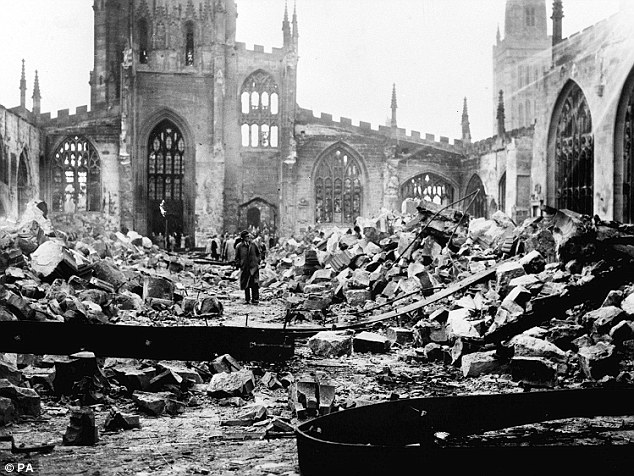
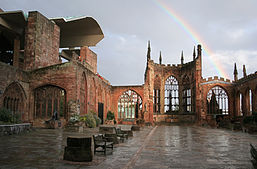
The premiere of the work was intended to further demonstrate Britten’s pacifist beliefs through venue and personnel. The piece was commissioned for the reopening of Coventry Cathedral, originally a fourteenth century structure

Coventry Cathedral after bombing; 1940.


Coventry Cathedral at reopening; 1962. It maintains the bones of the destroyed structure while rebuilding a new church.

in Coventry, England, that was destroyed during a World War II bombing and reopened in 1962. This venue is representative of the destruction caused by war and also faith struggles inflicted by war, as it is a church that was destroyed, making it an ideal venue for a work demonstrating the tragedy of war. In addition to venue, the work was originally written for British tenor, Peter Pears, German baritone, Dietrich Fisher-Dieskau, and Russian soprano, Galina Vishnevskaya. The nationalities of these soloists are representative of the great powers of the war, and having these nations, represented by the singers, unify to perform a work centering on war is inherently pacifist. Because there was such a strong hatred during the war, any art created by these nations together would be pacifist. However, Soviet authorities did not permit Ms. Vishnevskaya to attend the premiere, and English soprano, Heather Harper, stepped in only ten days before the event. The nationalities of the soloists and the venue of the premiere are representative of the composer’s pacifist beliefs as they demonstrate the reunification and rebuilding after war.


Benjamin Britten’s War Requiem offers a strong statement against war in a method that still honors the dead. The piece demonstrates the opposition and irony of war powers between the world powers and the young serving and also shows the reunification after war. This struggle between world powers and institutions demonstrated through the juxtaposition of old and new texts is still poignant today. Colin Kaepernick’s use of the Star Spangled Banner as a platform against institutional racism parallels Britten’s use of traditional Requiem mass text as a platform against war. Drawing upon familiar material to illustrate pain and discomfort, but also hope, furthers a goal or message. This message within Britten’s War Requiem was vehemently anti-war, demonstrated through the juxtaposition of traditional Latin text and Wilfred Owen’s poetry and the premiere of the work.


Additional Sources:

Britten, Benjamin. War Requiem. London: Boosey and Hawkes, n.d.

Acid House and the Iron Lady

The Second Summer of Love is a name attributed to the period between 1988 and 1989 where the rise of MDMA and acid house resulted in an explosion in youth culture, and complete resistance to the rise of oppressive conservative politics .

In the autumn of 1989 a very interesting letter came across the desk of a third term Lady Margaret Thatcher. MP Archibald Gavin Hamilton forwarded a letter on behalf of his great uncle Gerald Coke who had become extremely disturbed by an all-night rave party hosted near the outside of his property.  Not only did Coke share a misinformed fear of confrontation but also described his fear of “bloodshed.”

Coke could not be any farther from the reality of this rave, one of 223 known acid house parties during the Second Summer of Love. These underground, mostly illegal parties were marked by the prevalent use of MDMA, also known by the more descriptive name of ecstasy. The feelings of empathy, euphoria and love caused by ecstasy were marked features of these gatherings, and resulted in incredibly low instances of violence.

The ecstasy and music came together. It was all part of the package… That may sound a little sad, but there’s no way acid house would have taken off the way it did without ecstasy.


-Nicky Holloway, DJ

Government research into these parties led to the shocking discovery of “very little alcohol use” and the prevalence of discarded “ecstasy wrappers;” whatever that means… What the government feared more so than public health, was the gathering of young people, of all races and backgrounds, in a defiance of conservative attitudes and politics of the time.

“Because a few people had the power to assemble thousands of young people with a phone call, the government thought there was a political angle to it when there wasn’t.”
Andrew Weatherall , English DJ, producer, and remixer.

Thatchers brand of conservatism was akin to the U.S.’s Reaganism.  An era marked by the triumph of imperialism, offensive against the working class, increased international military aggression, rise in poverty and the exponential growth of ruling class wealth.  Military invasions of Latin America, the fight against Irish Liberation movements and an overall interest in the elite over British workers are just some of the calling cards which have been attributed to Thatcher.

Prime Minister Thatcher became notorious for her no-frills political style and willingness to oppress individual rights of expression in order to protect the  ruling class. In 1988 she introduced a broadcasting  ban on left-wing political views in six countries. In 1982 Thatcher directly ordered the sinking of an Argentine ship, outside of fighting area, in a conflict to protect imperial interests in the area.

In 1981 Britain saw the rise of a social rebellion. Unequal social conditions and high levels of unemployment created pressure to address segregation and opportunity for the youth. Thatcher however rejected the idea that social conditions had any influence on the unrest.

“What absolute nonsense. … No one should condone violence. No one should condone the events. … They were criminal, criminal.”

Margaret Thatcher, in response to the resistance of the Black Caribbean population in Brixton subject to immense police brutality

Her politics and ruling style were considered so oppressive and lacking any interest in its people that her death in 2013 was celebrated by thousands throughout England.

Thatcherism was at its most powerful when Acid House jumped the pond from the underground music scene of Chicago, it first landed on the Island of Ibiza before five major English DJs brought it over to Britain. In celebration of Paul Oakenfold’s 24th birthday, Johnny Walker, Danny Rampling, Nicky Holloway and Oakenfold himself had massive revelation at the iconic Amnesia nightclub. They returned home with a drive to recreate the incredible experience. The sounds and culture of acid house quickly took over the underground music scene in England, much more so than it ever did in the U.S.

https://www.youtube.com/watch?v=JCUPc9zVfyo

Acid House had been playing in Haçienda nightclub in England since 1986 but it wasn’t until the introduction of MDMA in 1987 that the new style began to take. “It was like a tidal wave across the club from their alcove. Suddenly everyone was on ecstasy. I could stop a record and put my hands in the air, and the place would erupt.”Ecstasy also affected what people wore. “It’s quite endearing looking back now,” says DJ Dave Haslam.

When met with the stern and austere rule of Prime Minister Thatcher, the freedom, unity and escape that the rave provided became a de facto form of resistance and delegitimization of Thatcher’s influence and control over the youth of England.  Symbols like the yellow smiley face, whistles and baggy clothes now became synonymous with rave culture and Acid House, a clear resistance to the conservatism of the time.

Thatcher, much like Trump in recent months, utilized the arts and music to elevate the elitist concert experience above the expression and freedom of various disciplines. She utilized the works of Andrew Lloyd Weber, and placed them upon a pedestal as the clear forerunner in artistic and musical expression. Much like Trump, she was very misinformed when it came to the nature and underlying message of the works she chose to champion, In doing so, Thatcher strengthened the political message, legitimacy and social revolution of the New Romantics, Socca producers of South London and DJs throughout the country. 

The government met the social revolution with limited success. Unable to seize profits because the rave gatherings were mostly free, the government found its only solution in banning the music all together and Thatcher’s immediate successor did just that.

“Rave was more about unity … and, unlike other scenes, there weren’t really any faces from the scene for society to grab on to and scapegoat, which must have been frustrating for the government and media at the time. Because it was kind of this big, inclusive faceless mass, I also feel like the social pressures that got people seeking a release from rave did a lot of good things to make the racial divide less of a divide.”

Gavin Watson

By 1994 legislation had been passed banning music with “repetitive beats” and outdoor gatherings with more than 12 people where amplified music would be played. In a shocking, under the radar political statement, artists like Autechre released electronic music, which was labeled as having “no bars contain identical beats ” a music which could legally be played under this new law.

https://www.youtube.com/watch?v=fk0JxXFJMKw

Acid House became the anthem for a new generation of liberal, socially conscious individuals that continue to shape England to this day. The generation that found and elevated Rave culture into the realm of political resistance to this day finds itself across England, taking the ideas of empathy, love and freedom that defined the Summer of Love. Despite the efforts of an oppressive, conservatism government  House music and rave culture are still powerful drivers of culture throughout England and its realm of influence.


Symphonies and Cyphers: Exploring the Relationship between Power and Presentation

In this New York Times article, music critic Anthony Tommasini discusses the political implications behind Trump’s recent remark that “we write symphonies” as an indicator of cultural superiority. Tommasini further laments this comment, making the point that, “Nothing impedes the appreciation of classical music — and keeps potential listeners away — more than the perception that it is an elitist art form.” The troubling political implication behind this comment, of course, is that Trump is using an art form that he probably in reality knows very little about in order to prove a point of western superiority over other (particularly Islamic) cultures. Trump is, after all, not the first person to exploit Western classical music as a symbol of cultural superiority, and symphonies certainly weren’t written with the intention of being used to showcase this assertion. But it also touches on a concept that’s interesting from a societal standpoint: who (or what) really holds the power within a piece of art? Is it in the art itself, the so-called “experts,” those who hold political power, or with the artist?

Regarding this question, I am reminded of another article I read a while ago on NPR featuring an interview with Sophia Chang — you may have never heard of her, but she’s the total badass management genius behind a lot of early hip-hop stars including A Tribe Called Quest, Q-Tip, RZA, GZA, D’Angelo, and Joey Bada$$, among others. Chang is a powerhouse, a fact made clear from her resume and her no-nonsense tone throughout the article. At the same time, though, she makes it clear that hip-hop is an art form that she loves but is aware does not belong to her or her heritage. She states, “I was welcomed into hip-hop. This was not my house. I didn’t build this house. This wasn’t my culture. I was brought in, and I was welcomed. And that’s an honor.” Hip-hop provides a voice and an outlet for a group of people who are generally marginalized by larger Western culture, which is part of the reason it’s such a powerful art form. Hip-hop and rap are also genres often viewed negatively, for both lyrical content and musicality — Keith Richards says it’s music for “tone deaf people,” and Bob Boilen, host of NPR’s All Songs Considered, can’t relate to it because he feels “the crux of the music is focused on the words and if the words don’t relate to the listener then it’s all is a big disconnect.” Chang, on the other hand, says the following about what drew her to hip-hop in the first place:

It was certainly before social media, so the way that we experienced it was together and in person, right? So I wouldn’t go on and I wouldn’t live stream what’s going on at the club tonight. I actually have to be there. And you wanted to be there because you knew you were gonna see your friends, and you would talk about the music and you would experience it together. It was — it was truly remarkable. It was really a privilege. It was fantastic to be in there and be part of it.Sophia Chang, on the club scene in NYC during the rise of hip-hop and rap in the early ‘80s

So for Chang, this music is powerful to her because, among other things, she holds an emotional tie to it. It’s vibrant, alive, and something she was able to see evolve right from its start. In this interview, as well as in the aforementioned one, even her tone of voice reflects her love of everything involved with what makes hip-hop culture its own. She also treats it with great reverence and respect, and recognizes that her job as a manager is to facilitate the artists, not to be the creator herself. In her own words, “I’m a manager. I am in the service industry. The service industry. I’m Midas f****** Muffler. You come to me. You pay me to fix your muffler. I’ll do it, and you’re gone. I’m not — I’m not the car. I’m not the star. That’s not what it is.” Hip-hop is something that helped shape her identity and something she ties to experience, as opposed to the naysayers cited above, who don’t have any emotional attachment to it or a means of contextualizing the music as something they understand. 

Later in the Times piece, Tommasini (himself an avid classical music fan and critic) clarifies that even though he believes classical music is not elitist, “the art form is certainly ambitious and demanding. It asks for your time and attention. Even a 20-minute Haydn string quartet requires you to focus in order to grasp the structure, content and character.” To me, this provides us with somewhat of a contradiction — though Tommasini has specified that he does not believe classical music to be inherently better or worse than any other genre of music, this comment separates classical music as more complicated music, something difficult to digest and hard to listen to, which is an element not specified explicitly in the context of other music: he briefly mentions Eleanor Rigby, but only speaks about classical music in-depth. Even though he has to go back and clarify he doesn’t actually find it superior, it comes through in his writing all the time that he genuinely loves classical music and likely prefers that genre over most others, which makes sense considering his background. And I think the reason for this likely has more to do with the fact that Tommasini is a classical music aficionado as opposed to a hip-hop mogul, and less to do with the idea that he believes other music to be inferior — after all, he asserts an explicit stance throughout the article refuting that assumption.

The parallel I see between Chang and Tommasini is that both of them are incredibly passionate about a specific genre of music and have significant power in their respective positions regarding those genres, but at the same time their influence is not necessarily directly inherent to the creative process but instead in influencing how an artist’s product is perceived by their audiences. People turn to classical music critics like Tommasini to help guide them in what to listen to. Tommasini’s power as a critic lies not in the creation of classical music but the re-contextualization of it as well as his accessibility through a popular large scale publication. Similarly, Chang’s power lies in a behind-the-scenes service role, recognizing talent and helping that talent become its most successful possible realization in a final artistic product. The difference is Tommasini deals mostly with works of dead people being reimagined by living people and facilitating a conversation about these time honored works, while Chang’s whole career was based on her having a knack for managerial skills an ear for talent, and a drive for success in an entirely new genre of music from its inception in the early 1980s. Though the artist is certainly the reason we have what we have accessible to us to hear, just as important and arguably just as powerful are those working behind the scenes who get the word out and tell us what’s out there and what of that is important to actually sit down and listen to. The power in art often lies just as much in the piece itself as the manner in which it is presented.

Karel Husa and the Paradox of Prague

Records of distinct nationalist identity in music have existed since the before the middle ages. And, until approximately the 17th century, the majority of music composition was virtually inseparable from the church, which was virtually inseparable from the state. Thus, nationalism has always been a lens through which to look at the unfading marriage of music and politics. The 20th century musical stage in particular was flooded with nationalist compositions in response to territorial conflicts and as a reaction to oppressive regimes. Karel Husa’s Music for Prague 1968, is a politically motivated composition that reveals a paradox in nationalist music.

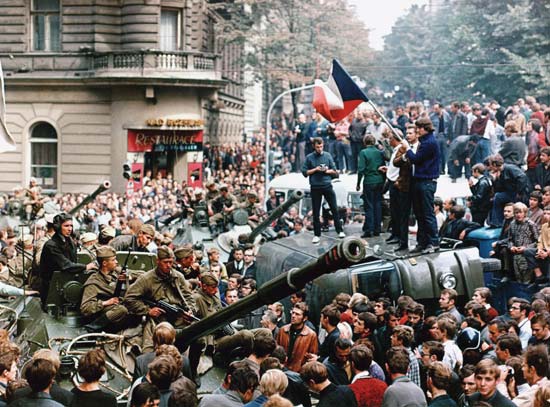
Karel Husa was born in Prague, Czechoslovakia in 1921, and later emigrated to the United States. Music for Prague 1968 was written shortly after the Soviet Union crushed the Prague Spring reform movement in Czechoslovakia in August, 1968. When Husa heard of the events that occurred in Prague over the radio, he was deeply moved. The piece serves as a memoriam to the victims of USSR violence, as well as a call for Czech identity.

The work includes a Hussite hymn, which blatantly creates an element of Czech nationalism. The Czech hymn that Husa uses, originally a war song from the 15th century, is titled “Ye Who Are Warriors of God.” It had previously been known for its use in Dvorak’s nationalist composition “Hussite Overture,” and there is no doubt that Husa’s choice to integrate the hymn is due to the tune’s overtly nationalistic connotation. One of the lines from the hymn reads, “Ye warriors of God, if you believe in the future, things will be better in the future.”

Music for Prague 1968 therefore reveals a paradox of nationalist music. In the piece, the Hussite hymn partially represents “solidarity and resistance”. On one hand, Husa is supporting his country by means of using traditional Czech music. The words of the allude to being willing to sacrificing oneself for one’s country and having hope for the well being of it. On the other hand, he is using the hymn to beckon back to a time before Soviet control- or even before the existence of a modern communist state. Hence, the composer is effectively attacking and bolstering his beloved country simultaneously; Music for Prague 1968 seems to portray that Husa is both proud and ashamed of his homeland. This leads to the conclusion that a nation is not characterized by any one political period, and that composers can praise all the good things about a nation while still speaking out against current events.

One of the essential requirements for nationalist music, is a broad audience; the point of such music is for a composer to share his or her feelings about their country with others. Husa’s conviction to write Music for Prague 1968 was also a conviction to share his thoughts about larger political ideas. One interesting source that provides commentary on the intended audience of music, and specifically politically driven music, is the article “Does ‘Music Trump Politics’?” by Ted Gordon. Gorgon quotes Dennis Prager as controversially saying, “Great music should transcend political differences.” Like many members of the Classical music world, I strongly disagree with Prager’s logic. Not only does this way of thinking nullify the point of nationalist music, it also pushes a limitation onto art as a whole. Though not all music is political, some pieces of art are meant to be derisive; Husa’s Music for Prague 1968 was not thought highly of by the Communist government of Czechoslovakia. Furthermore, there is a distinction between the reason for composition (perhaps to speak out against a certain person) and its objective face value meaning to a listener (maybe a piece written to shame a dictator is enjoyable to listen to even by the dictator himself). For example, Shostakovich’s 5th symphony subtly condemns the violence of the USSR, and yet it was praised by the Stalin regime; while this composition is politically influenced, at face value, everyone can appreciate them, included the party against which it was written.

In relation to Husa’s Music for Prague 1968, I think the intended audience is the people of democratic nations, to whom it serves a warning of oppressive regimes. One generally conclusion that Music for Prague 1968 demonstrates is that there can be a paradoxical balance of critique and patriotism that constitutes nationalism. And on a larger scale, Husa himself later reflected in an L.A. Times interview, “I don’t think of [Music for Prague 1968] as a political message for one country… It is universal.”

Echoes of Floyd: Animals

Sixty years after the Russian Revolution and thirty-two years after the publication of George Orwell’s Animal Farm, Pink Floyd released the politically charged album Animals. Whereas Orwell’s novel critiqued Stalinist corruption and the exploitation of the Soviet proletariat class through allegory, Animals, primarily written and sung by Roger Waters, criticized the economic and social conditions of Britain in the 1970s. The cohesive five track album’s primary message is to expose the negative effects of capitalism and social repression on inter-human connection and empathy. Although Pink Floyd’s music and George Orwell’s novel were written about different societies in very different historical contexts, both make similar overall points about social and political revolution. The only revolutions that can effect real change must be led by an aware populous. As long as the “sheep” of a society are at least partially ignorant to their exploitation, they are doomed to continue suffering at the hands of the ruling “pigs”. Animals remains just as relevant today as it was in 1977 as Roger Waters just completed a four month North American tour in which he performed the song “Pigs” to demeaning images of Donald Trump. Concerned now, as always, for the fate of humanity, Waters continues to use his music to alert the masses to their exploitation in search of true social and political change.

(Lyrics and some analysis can be found here.)

Inspired by Orwell’s allegory, Pink Floyd’s album classifies people into three animal-designated categories by their socioeconomic class. The sheep are the blind proletariat class, unaware of their conditions and thus unlikely to challenge their rulers. The dogs are the greedy and ambitious that seek to climb the economic food change to materialistic prosperity. The dogs are uncaring in their pursuit and unknowingly support the tilted system they hope to conquer. This keeps the pigs, the wealthy capitalist class and owners of the “means of production”, in power.

The album is split into four main sections: an opening acoustic poem-like song that also returns with more percipient lyrics to close the album and a song for each of the three previously mentioned animals. Each song dedicated to an animal extends beyond the ten minute mark, allowing for the development of distinct grooves and for complex evolution of character and story line.

The first song, “Pigs on the Wing (Part One)”, introduces Waters’ main issue with the state of society. It opens, “If you didn’t care what happened to me/And I didn’t care for you/We would zig zag our way through the boredom and pain”. Without human compassion life is largely painful and meaningless. Phillip Rose, in his thesis on the music of Pink Floyd, points out that the use of acoustic guitar in this song, as on the final song of the album, conveys a feeling of “honesty” and humanity which is in sharp contrast to the electronic sounds of the other tracks.

The next track, “Dogs” immediately transitions into a darker character which signals the approach of the dog. There are two distinct voices in this song, indicated by the two different singers. David Gilmour sings the first three verses in which he describes the tough and ruthless life of a dog. The song begins, “You got to be crazy, you gotta have a real need,” stating how ambitious one must be to fight for material wealth. It continues, “You got to be able to pick out the easy meat with your eyes closed,” which exposes the “dog-eat-dog” mentality one must have to survive. Rogers then explicitly frames the dogs in a corporate businessperson light with the lyrics, “And after a while, you can work on points for style/Like the club tie, and the firm handshake”. Clearly the more skilled dogs can climb the corporate ladder to achieve greater wealth and prosperity.

After a long atmospheric instrumental section, the dog’s attitude changes as Roger Water’s vocals enter. This verse shows the dog is becoming disillusioned by the system with the lyrics, “Gotta admit that I’m a little bit confused/Sometimes it seems to me as if I’m just being used”. The dog is shown to have a lack of personal connection as it continues to pretend “That everyone’s expendable, and no one has a real friend”. The final verse exposes everything the dog missed in its greed for wealth: “…trained not to spit in the fan” – it was trained to conform and not pursue social change, “…broken by trained personnel” – it was used by the system for the gain of those at the top, “Who was only a stranger at home” – it had no intimate familial relationships. By the end of its life the dog finally realizes that it was duped. The superficial material success that it achieved in place of human connection and compassion did not provide the meaning or purpose for which it originally hoped.

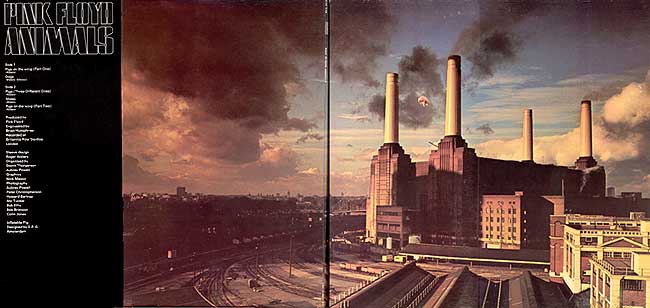
Album cover for Animals (1977). The cover shows a pig floating over the Battersea Power Station in West London. The power station embodies capitalism which the “pigs” control.

The following song, “Pigs (Three Different Ones)”, derides the ruling capitalist class and takes aim at some specific characters of the British social and political scene. The first verse concerns a generic pig who is so caught up in its own greed that’s its almost funny. “Pig stain on your fat chin/…You’re nearly a laugh/You’re nearly a laugh/But you’re really a cry”. The obvious indulgence of the pig is so sloppy that it would be comical if it wasn’t so depressing. The third verse is the only place on the album that explicitly names a real person, starting, “Hey you, Whitehouse”. This refers to Mary Whitehouse, a British social conservative that used religion to justify and promote censorship of blasphemous texts and the banning of sex toys and pornography. Rogers yells, “You’re trying to keep our feelings off the street” at her before mockingly saying, “You gotta stem the evil tide/And keep it all on the inside”.

The final animal-based song on the album, “Sheep”, is where all the action happens. It begins with a depiction of the mindless masses: “Harmlessly passing your time in the grassland away/Only dimly aware of a certain unease in the air/…Things are not what they seem”. The sheep are shown to be blind to their oppression and unknowingly prop up the system for the benefit of the pigs. The sheep then “obedient[ly]… follow the leader” down to “the valley of steel” which, following the allegory, likely means their death. The following section of the song features an altered version of Psalm 23:1 which is recited robotically through a vocoder (Here is the real Biblical version). The new version of the passage depicts the shepherd killing the sheep and “convert[ing]” them to “lamb cutlets”. Philip Rose interprets the shepherd as the pigs who have “great power” and “great hunger”. By the end of the verse, however, the sheep have begun to formulate an uprising as is evidenced by “Lo, we shall rise up”.

In the final verse, the sheep attack the dogs. The use of the word “babbling” in the line “Bleating and babbling we fell on his neck with a scream” implies that the sheep aren’t really sure why they’re rising up so violently. In the next line the sheep are referred to as “demented avengers,” furthering the idea that they are without clear-minded purpose. In the final lines of the song the cycle is shown to be complete. The sheep have risen up to overthrow the dogs and those with newfound power tell the others, “You better stay home/And do as you’re told”. The point here is that the rebellious sheep have now taken over the role of the previously powerful (but also exploited) dogs, ready now to achieve great wealth as they “March cheerfully out of obscurity into the dream”. Of course the real reason for the other animals pain, the pigs, have remained solidly in power.

Whereas the end of “Sheep” presents a fairly pessimistic message, the final track is hopeful. Featuring only guitar and voice, like the opening song, “Pigs on the Wing (Part 2)” tells the story of a dog who has forged some meaningful human connections. It no longer “feel[s] alone” and now has a “shelter” from the pigs. This song says that even in the inherently cutthroat world of capitalism, people can find safety in human empathy.

Despite this final moment of optimism, Roger Waters has more often seen the ending depicted in “Sheep”  in the years since the album was released. Over the last forty years he has performed selections from the album frequently but most recently, on his 2016 tour, the songs have a new target: Donald Trump. Below is a live video from October 1st, 2016 in Mexico City. Waters performs “Pigs (Three Different Ones)” and it is clear that he has repurposed the line “Hey you, Whitehouse” in the third verse to point to the residency of the president of the United States (8:10).

In a recent interview about the tour Waters takes issue with Trump “living in an ivory tower” and “treating everyone as the enemy”. Undoubtedly rhetoric that implies the “superiority of Western culture” like Trump’s “We write symphonies”  comment in Poland is ignorant and dangerous. And “The wall just got 10 feet higher” comments clearly go against Waters promotion of human connection and empathy. In a world that often seems as if it hasn’t changed at all since the release of Animals, the final idea of the album that shelter and safety can be found in human connection is more important than ever.

In 1917 George Orwell witnessed a revolution in Russia which he felt effected not “radical improvement” but only a “change in masters”. In 1977 Pink Floyd warned of this problem in socially repressive capitalist Britain through an Animal Farm-like allegorical album. Today Roger Waters is carrying that message on in light of the “us versus them” rhetoric of Donald Trump. Will the “sheep” ever rise up to enact fundamental social and political change? Or are they (we?) doomed to be content with mere changes of pig-like masters forever?

We Didn’t Start the Fire

Although Billy Joel’s hit song, “We Didn’t Start the Fire” wasn’t intended to become a deeply political song, people found it to be extremely telling and honest.  In an interview, Billy Joel states that he tries to stay out of politics.  In another interview he talks about how he thought the song wasn’t very good because the melody was terrible.  He said that he just started writing down major events in chronological order.  In general I think it’s a good idea for musicians to avoid being involved with politics as much as they can.  If a musician wants to get involved, more power to them, but it’s certainly easier to avoid becoming involved.  Even at Eastman, I find that there are a lot of political events happening behind the scenes that have potential to affect students negatively.  There are politics with part assignments, paychecks, international students, relations with other schools, funding, scholarships, etc.  Heck, there could be a (biased because I wrote it) song just about the living situations in the dorms:


Leaking roof, moldy showers,

rats, expired orange juice,

res life, piss bottles,

throw up in the halls.


Smelly washers, used condoms,  

mental illness, fire alarms

Burned a candle, on probation,

The Elevator’s broken

We don’t want to live here

We have to buy it and we can not fight it

We don’t want to live here

We have to buy it and we can not fight it


The list could go on forever.  Once students become involved with politics they usually end up having to sacrifice time and energy they could be using for becoming better people and musicians.  So, most of the time when musicians are sucked into politics they don’t have as much energy to focus on a musical career.  A lot composers and artists use politics as inspiration though.  For example Shostakovich wrote a lot of music as a satire on Russian leaders.  Eminem does the same thing in his song, “Role Model”.  Eminem and Shostakovich  refer to events in their music, but the difference is that Billy Joel’s song is unbiased.   What makes that so cool is that people can interpret the song however they want.  Billy Joel isn’t very public about controversial topics and he doesn’t apply negative or positive connotations in the lyrics.  So, people could take the lyrics, “Birth control, Ho Chi Minh, Richard Nixon back again/Moonshot, Woodstock, Watergate, punk rockand say that he is against birth control and Nixon.  Or they could say he thinks birth control and the moon landing is great but Nixon and Punk Rock is now.  There are many ways to interpret this song depending on the listener’s personal view.  In my unprofessional opinion I think that he is liberal simply because is seems like rock stars tend to be more open minded towards topics like gay marriage, abortion/birth control, immigration, etc.

In the song, Billy Joel mentions not only negative events but positive events.  He sings about vaccines, Prokofiev, James Dean, Einstein, Marilyn Monroe, and many other famous people.  What’s interesting is that all of these people were icons and held a lot of power in politics due to the fact that they had a large audience.  Some people, like Prokofiev were directly involved with politics.  Even though it’s probably easier for musicians to stay out of politics, it seems impossible for famous artists to stay out of the spotlight when they have such large influence.  By writing this song, it seems like Billy joel is signalling his interest in politics.  Why would someone write this kind of song if they didn’t have something to say about the topics?  It seems like people in general tend to signify what their views are and their thoughts either through talking or by reacting to something.  I think this is especially true with musicians.  Whenever we play something we find a way to relate to it so that we can express something we think or feel.  This is just what Billy Joel is doing.  He’s writing something he can relate to and knows about which resulted in something a lot of people related to.  


Role Model:

This song is timeless because it makes people think.  While it’s mostly un relatable to people who didn’t live through the era, it’s a simple form that can be applied to any era.  I even found a couple “We didn’t Start the Fire 2017” editions online:

Version One:

George Bush, Noriega, Batman, Genesis by Sega

MC Hammer, Kuwait, Long Dong Silver Hi Ho

Wayne’s World, Right Said Fred, Cross Colours, Gennifer Flowers giving head

Hurricane Andrew, Somalia, Joey Buttafuoco

Tonya Harding, Kurt Cobain, Forrest Gump, “Insane in the Membrane”

Newt Gingrich, Pulp Fiction, OJ got away

Chupacabra, AOL, Bob Dole, “Macarena” goes to hell

Beanie Babies, Spice Girls, Jon Benet Ramsey

[chorus]

Seinfeld, Monica Lewinsky, Backstreet Boys, Elian set free

Y2K, hipster chic, Cheney’s first name is Dick

Ralph Nader, “Who Let the Dogs Out,” Florida recount

Anthrax letters, 9/11, world’s gone sick

Sopranos, Al Queda, Bin Laden playa hater

Lord of the Rings, Napster, Afghanistan

Condaleezza, Kobe/Shaq, Bush lies about Iraq

Napoleon Dynamite, John Kerry, and Lindsay Lohan

[chorus]

TomKat, Kanye West, New Orleans gets wet

MySpace, Prius, President Barack Obama

iPhones, housing bubble, bank bailout, Kardashian trouble

Sarah Palin, global warming, GMOs, Octomama

Guantamano, Arab Spring, Paul Ryan, LeBron wins a ring

Obamacare, Killer Drones, Lady Gaga, Game of Thrones

Fukushima, Hunger Games, books of binders women names

Selfies, twerking, Jersey Shore, I can’t take it anymore!


Another 2017 version:

Stephen Bannon, KKK, homophobics, woke baes

Trans-Pacific, Gallup polling, Putin’s puppet show

Trump is worse than Richard Nixon, addicted to his television

North Korea, South Korea, “Little Marco”


Lyin’ Ted, atom bombs, refreshing browsers all day long

FAKE NEWS, spreading lies, a crowd that falsely multiplies

So-called judges, fake tears, Muslim BAN, stoking fears

Paul Ryan, KFC, Scotch tape on a neck tie!


We didn’t start the fire

Now the planet’s burning

And we’re anti-learning

We didn’t start the fire

No we didn’t light it

But we tried to fight it


Refugees, Russian hacks, FBI, alt-facts

Richard Spencer, Kellyanne, L.L. Bean stock

Ivanka’s tanking fashion line, Melania who plagiarized

Rick Rolls, taco bowls, Obamacare block

John McCain, Lindsey Graham, Congress doesn’t have a plan

Bathrobes, emoluments, time to GET SMART!

Women’s March, pussy hats, tiny hands, Democrats

Orange face, hair disgrace, “glam room” in the White House


We didn’t start the fire

Now the planet’s burning

And we’re anti-learning

We didn’t start the fire

No we didn’t light it

But we tried to fight it


Bowling Green, Iraq, Wikileaks, Big Macs,

Tax returns, First Amendment, Julian Assange

Private server email, Black Lives Matter, third rail

Neo-Nazis, Liar Spice, SNL’s not very nice

NBC, CNN, voter fraud, Marine LePen, Hamilton, viral memes, is this all a bad dream?

Mike Pence, hashtags, late-night #MAGA Twitter brags

Rogue accounts, Sally Yates, church is melding into state.


We didn’t start the fire

Now the planet’s burning

And we’re anti-learning

We didn’t start the fire

No we didn’t light it

But we tried to fight it


Hannity, Infowars, urinating Russian whores

Filibuster, VERY SAD, Yemen raid DISASTER!

Mar-a-lago golf carts, Brexit, lawsuits, Breitbart

Patriots, protests, bathroom bills, policing sex

Pope Francis, Facebook feed, corporate lobbies, rampant greed

Common sense, equal pay, what else do I have to say?


We didn’t start the fire

Now the planet’s burning

And we’re anti-learning

We didn’t start the fire

No we didn’t light it

But we tried to fight it


Birth control, thin skin, Scott Baio’s a has-been

Scientists, gun rights, DeVos was some pick

Netanyahu, Palestine, Dakota Access Pipeline

Made a “bad deal” with Iran, crumbling Afghanistan


Feuding friends, Jared K., golden toilets, Doomsday

Foreign debts, homeless vets, super-bugs, Trump regrets

Plastic garbage washed ashore, U.S. flirts with martial law

Schwarzenegger ratings wars, I can’t take it anymore!


We didn’t start the fire

Now the planet’s burning

And we’re anti-learning

We didn’t start the fire

No we didn’t light it

But we tried to fight it

So, I think what makes this piece have so much impact is the honesty and it’s power to make people think about what is happening around them.  In the “Music Trumps Politics” article we read about, it says that “Lamell’s invitation was explicitly intended to create a new group of people for desiring, and taking pleasure in, classical music–a pleasure, according to Lamell, that is apolitical”.  Like the author of the article, I disagree.  I think it is virtually impossible for music to be apolitical.  The artist can write or perform a song intended to be removed from politics, but they can’t stop their audiences from making their own interpretations on their music just like “We Didn’t Start the Fire”.  It wasn’t intended to be super political, but there are copious amounts of articles and websites dedicated to decoding the events and politics in the song.


Betsy Devos Brochure (?)

Handlebars by Flobots:

Handlebars is another example of popular music addressing politics!

“American Tune” is an American?

As a foreigner and if I don’t know what is the “American Tune”, I will probably think about it as the American National Anthem because of the title—the tune for the all american citizens. The title of the song is very direct and also sounds very powerful. After you listen the song, however, you will realize that it actually is a pop-folk song, and it does not sound loud at all. No any wind instrument and no orchestra, just a male singer with his guitar. On the Wikipedia, it even says the genre of  the “American Tune” is soft rock, and I am pretty sure that the American National Anthem is not a rock song. But, why a pop music song can be called “American Tune”? And what is the story behind it?

The video of “American Tune” in 1975 by Paul Simon: https://www.youtube.com/watch?v=AE3kKUEY5WU

Before we take a deep adventure about the “American Tune”, let us get some basic information. “American Tune” is one of the songs in the third solo studio album—There Goes Rhymin’ Simon—by Paul Simon. Paul Simon is an American singer-songwriter, guitarist and musician, and he born on October 13, 1941 in a Hungarian Jewish family. The album released on May 5, 1973, and it recorded from September 1972 to January 1973. Paul Simon wrote the lyrics of the “American Tune”, and if you listen the song carefully, you can distinguish the melody is taken from St Matthew Passion by Johann Sebastian Bach. Or actually we should say the melody is based on the Christian Passion hymn “O Sacred Head, Now Wounded” by Paul Gerhardt, and its a reworking melody of the earlier secular love song “Mein G’müt its mir verwirret” composed by Hans Leo Hassler. The lyrics is mainly used the first-person pronoun, such as I and we. So, it seems that Paul Simon tells a story about himself and many other american people through the song—“American Tune”.

The lyrics contains four verses, and it is very obvious that the song is about a dark and kind of depressed reflection, rather than a happy song. For example, Paul Simon wrote “Many’s the time I’ve been mistaken” at the beginning of the song, “I don’t have a friend who feels at ease” and “I wonder what went wrong, I can’t help it” in the second verse, “And I dream I was dying” in the third verse and “You can’t be forever blessed” in the verse 4. However, it is also very interesting that in the lyrics, Paul Simon also presented his optimistic side and kept saying “It’s all right, it’s all right.” Was he really alright? Could he be able to recover the bad memory? The answer is maybe, but also could be maybe not…

After we know the background information and the lyrics of the song, can we tell what is the subject that Paul Simon talks in “American Tune”? The answer is absolutely yes. In the third verse of the lyrics, Paul mentions that, “the Statue of Liberty (see below) sailing away to sea”, and everyone knows the Statue of Liberty is the symbol of the United State. Therefore, this song is a meditation about the political things happened in the early 1970s for all american people and the America.

Statue of liberty

From the 1960s, the US government deiced to bring more armies and weapons into the Vietnam War and terribly, widely attacked the Vietnamese people over the decade. The war not only caused millions of the Vietnamese people passed away and destroyed their homes and lands, but it also made a great numbers of the US soldiers lose their lives and led a lot of american people to have a very hard, confusion and struggle time. The US government gained condemnation from other countries, organizations and many US citizens, even though the original goal is to assist French government to make Vietnam become a free country. Eventually, America lost the war, and the aftereffects became extremely painful for both the US government and the Vietnam. For instance, the economy in US grew very weakly and even had the Great inflation in 1970s after excessively supporting the military for the decades.

Iconic photos of the Vietnam War: http://www.cnn.com/2014/06/19/world/gallery/iconic-vietnam-war-photos/index.html

Under this circumstance and atmosphere, Paul Simon wrote “American Tune” to express his and many american people’s emotions and attitudes. It is a very quiet song, and it performs in a very peaceful way. In my opinion, this incredible quietness shows the heavily struggle and weariness between the feelings of hopeless/depression and hopefulness. Also, the melody of St Matthew Passion states the painfulness and darkness since the initial tune depicts the crucifixion and the suffering of Jesus Christ. However, why Paul Simon decided to use a religious-related (Christian) tune to sing this song, even though he raised in a Jewish family? Why he cannot composer a new, good melody or use a well-known American folksong melody to cooperate the title “American Tune”?

Besides St Matthew Passion’s melody is very famous and almost every person knows it and the story about the tune, it also presents Paul’s political points. Firstly, the biblical meaning of the crucifixion is similar to the suffering of the american people’s lives in the 1970s. Also, his optimistic thought is identical to the resurrection of Jesus’ death as well. Secondly, since Paul born in a Hungarian Jewish family, I assume he is also a jewish. As many people know, lots of scholars consider St Matthew Passion is an Anti-Semitism piece. However, the way Paul Simon used the tune in this situation (about the war and even the races) is somehow to prove the ideal and  original American politics’ views—everyone is freedom and equal, and it testifies that everything should blend and mix very well in music and also in the political world.

It is very difficult to avoid any bias in the politics, and it becomes even hard when the music associated with the politics. For example, in William Robin’s article—Colin Kaepernick and the radical uses of “The Start-Spangled Banner” and Anthony Tommasini’s article—Trump Is Wrong if He Thinks Symphonies Are Superior, we can see the controversies always come suddenly through very detailed lyrics, words or even just one phrase. I totally agree with Anthony’s opinion that the symphonies are not superior because every type of the music forms is equally important and significant. However, I think it is a little implausible to make the connection between the music and politics in this case, because Trump is not a professional musician. He might regarded the symphonies as a great type of the music since the orchestra music is normally loud, huge and superior for the audiences. Especially for the amateur audiences, they do think music in this way. Thus, Trump may not put bias into the statement “we write symphonies”, even though he says many bad stuffs sometimes.

Overall, politics influences the music broadly, and Paul Simon’s expresses his attitudes and moods about it clearly in “American Tune”. Also, based on the lyrics and the melody, he builds a good connection between the music and the politics and avoids bias in his music. Therefore, “American Tune” becomes a very popular song over the decades. If you ask me is the “American Tune” an American, even though the melody is not from the American? I will say yes, because this is the song talking about the story in the American and American people in the 1970s.